Fill out insurance exchange forms
with AI.
Insurance exchange forms are essential documents for individuals managing their retirement assets and insurance policies. They facilitate the movement of funds between different investment companies or insurance providers, most notably through Section 1035 exchanges. These exchanges are critical because they allow policyholders to transfer accumulated value from one contract to another—such as from an annuity or life insurance policy—without triggering a taxable event. By using these forms, individuals can optimize their portfolios, seek better returns, or adjust their coverage to better suit their current financial goals while maintaining the tax-deferred status of their investments.
By continuing, you acknowledge Instafill's Privacy Policy and agree to get occasional product update and promotional emails.
About insurance exchange forms
These forms are typically used by annuity holders and long-term investors during major financial transitions. For instance, someone might need a 1035 Exchange Authorization to move funds from a traditional account to an alternate investment company through a structured payout. Whether you are consolidating accounts for easier management or switching providers to access different investment vehicles, completing these documents accurately is vital to ensure the IRS recognizes the transfer as tax-free. Precision in these forms prevents costly delays and potential tax liabilities that could arise from errors in account details or authorization signatures.
Managing complex financial paperwork can be time-consuming, but modern tools simplify the process. Services like Instafill.ai use AI to complete insurance exchange forms in under 30 seconds, ensuring that data is handled accurately and securely. This approach saves significant time for policyholders who need to focus on their financial strategy rather than the manual entry of repetitive data on static PDF documents.
Every form on this page can be completed without typing. Instafill is form filling software that reads a PDF and fills it for you — including flat and scanned documents that carry no fillable fields at all.
Forms in This Category
| Form Name | Pages | FCI | |
|---|---|---|---|
| 1. | TIAA 1035 Exchange Authorization to Alternate Investment Company Transfer Payout Annuity for ATRA | 1 | – |
- Enterprise-grade security & data encryption
- 99%+ accuracy powered by AI
- 1,000+ forms from all industries
- Complete forms in under 60 seconds
How to Choose the Right Form
Choosing the correct documentation for an insurance exchange is critical to maintaining the tax-deferred status of your retirement savings. While the process of moving funds between providers can be complex, identifying the specific account type and transfer method will help you determine if the form on this page meets your needs.
Is the TIAA Form F10926 Right for You?
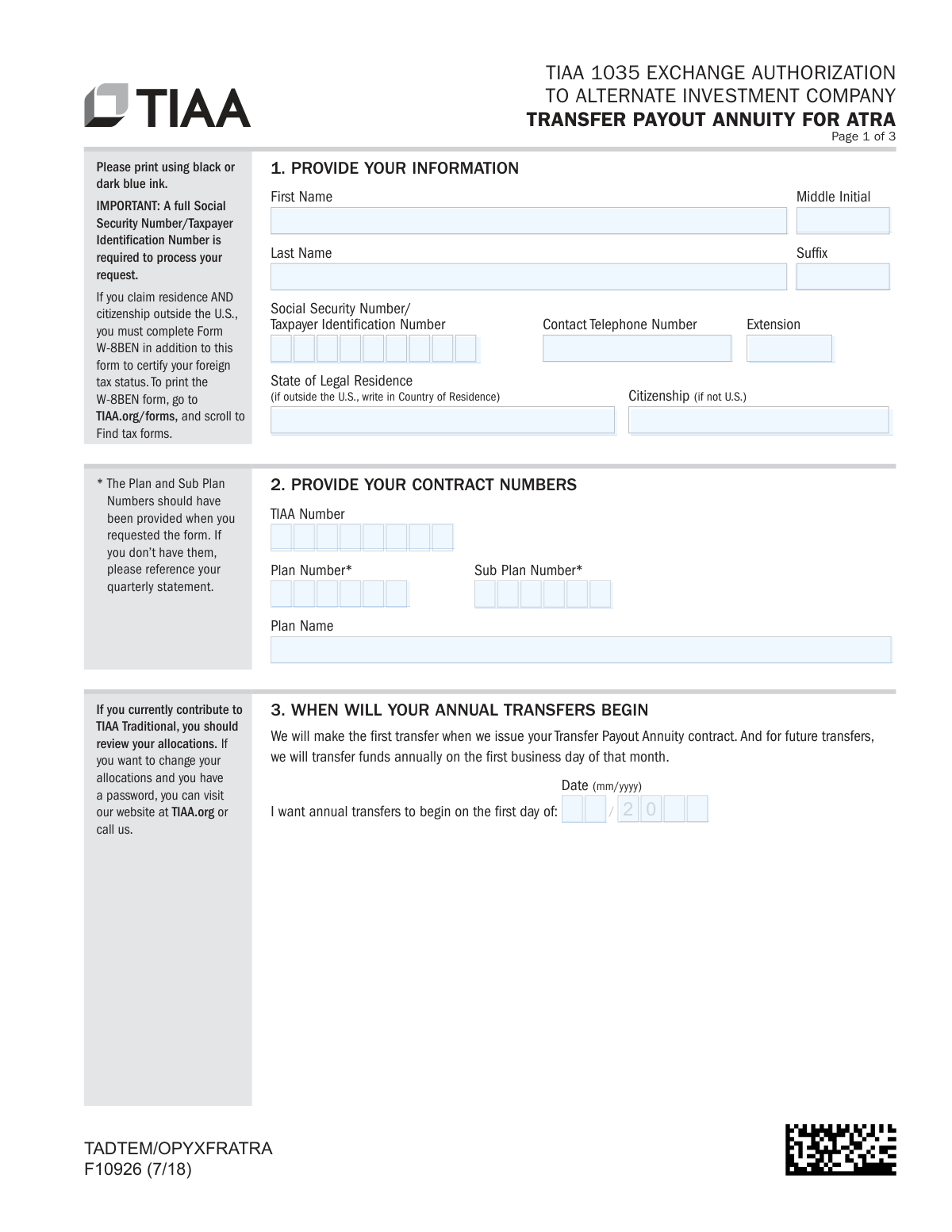
Currently, this category features the TIAA 1035 Exchange Authorization to Alternate Investment Company Transfer Payout Annuity for ATRA (Form F10926). You should select this form if your financial situation meets the following criteria:
- You hold a TIAA Traditional Account: This form is specifically designed for individuals who wish to move balances out of a TIAA Traditional account.
- You are transferring ATRA Funds: The form is intended for the transfer of After-Tax Retirement Annuity (ATRA) funds to an external investment company.
- You require a 1035 Exchange: Use this document if you want to execute a tax-free exchange under Section 1035 of the Internal Revenue Code, which allows you to switch insurance or annuity providers without immediate tax liability.
Understanding the Transfer Structure
Before completing Form F10926, it is important to note the specific payout structure associated with this transfer. This is not a lump-sum movement of capital. Instead, this authorization initiates a Transfer Payout Annuity (TPA), where the balance is moved to the alternate company in 10 installments over a 9-year period. If your goal is a one-time total transfer, you may need to consult with your financial advisor to see if your specific contract allows for other options.
Why Accuracy Matters
Because 1035 exchanges involve strict IRS regulations, any errors in the TIAA 1035 Exchange Authorization could lead to unintended tax consequences or delays in your payout schedule. Using Instafill.ai allows you to accurately complete this form online, ensuring all fields are legible and correctly formatted before submission.
Form Comparison
| Form | Purpose | Who Files It | Transfer Structure |
|---|---|---|---|
| TIAA 1035 Exchange Authorization to Alternate Investment Company Transfer Payout Annuity for ATRA | Facilitates tax-free transfer of TIAA Traditional account balances to another company. | Annuity holders wishing to move After-Tax Retirement Annuity (ATRA) funds. | Executed as a 1035 Exchange over ten payments across nine years. |
Tips for insurance exchange forms
Ensure the receiving investment company's name, account number, and mailing address are 100% accurate. Even a small typo in the destination details can lead to significant delays or rejected transfers during the 1035 exchange process.
Many insurance exchange forms involve multi-year payout schedules rather than a lump-sum transfer. Review the specific payout terms carefully to ensure the transfer timeline aligns with your long-term financial strategy and liquidity needs.
Large financial transfers often require a medallion signature guarantee or a notary public's seal. Check the form instructions early to see if you need to visit a financial institution to have your signature witnessed before submission.
While a 1035 exchange is designed to be tax-free, you must maintain copies of the completed authorization for your tax records. These documents provide the necessary proof to the IRS that the transfer was a direct exchange and not a taxable distribution.
AI-powered tools like Instafill.ai can complete these complex insurance forms in under 30 seconds with high accuracy. Your sensitive financial data stays secure during the process, making it a practical and time-saving solution for managing multiple exchange documents.
The owner and annuitant names on the existing insurance account must exactly match the information on the new account. Discrepancies in naming conventions or middle initials can cause the insurance company to flag the form for manual review or rejection.
Frequently Asked Questions
Insurance exchange forms are used to authorize the transfer of funds from one insurance policy or annuity to another provider. These documents ensure that the movement of assets is recorded officially, allowing the policyholder to maintain their investment status while changing financial institutions.
Individuals who own an annuity or life insurance policy and wish to move their funds to a different company often need these forms. It is a common requirement for those looking to consolidate retirement accounts or seek better investment terms without incurring immediate tax penalties.
A 1035 exchange allows for a tax-free transfer of funds between similar insurance products under the Internal Revenue Code. This means you can upgrade your policy or change providers without being taxed on the growth or gains of the original investment at the time of the move.
In many cases, such as with certain TIAA accounts, the transfer is not a single lump sum but is structured as a series of payments over a set number of years. The exchange form authorizes the current holder to send these scheduled payments directly to the new investment company.
Typically, you must submit the completed and signed form to either the company currently holding your funds or the new receiving institution, depending on their specific requirements. Many providers now accept digital copies, though some may still require original documents by mail.
Yes, you can use AI-powered tools to fill out these forms efficiently. Services like Instafill.ai can accurately extract data from your source documents and populate the necessary fields on the insurance exchange form in under 30 seconds.
Using modern online tools, filling out an insurance exchange form takes significantly less time than manual entry. AI technology can complete the process in less than a minute by automatically placing your information into the correct sections of the PDF.
If you have a flat or scanned PDF that does not have interactive fields, AI services can convert it into a fillable format. This allows you to type directly into the document and ensures that all information is legible and professional for the insurance company.
You will generally need to provide your policy or account number, the name of the receiving financial institution, and your personal contact details. Some forms also require specific instructions on whether the transfer is for the full balance or just a partial amount.
While there is no fixed federal deadline, individual insurance companies often have their own internal processing windows. It is advisable to submit your paperwork as soon as you decide to transfer funds to avoid delays in the multi-year payout or transfer schedule.
Glossary
- 1035 Exchange
- A provision in the Internal Revenue Code that allows for the tax-free transfer of an existing annuity or life insurance policy for a new one of similar nature.
- After-Tax Retirement Annuity (ATRA)
- A type of annuity funded with money that has already been taxed, allowing the earnings to grow tax-deferred until they are eventually withdrawn.
- Transfer Payout Annuity (TPA)
- A specific distribution method where funds are moved from a fixed account to another company in scheduled installments over a set number of years rather than a lump sum.
- Cost Basis
- The total amount of after-tax money originally invested in an annuity, which serves as the tax-free portion of the contract during an exchange or withdrawal.
- Non-Qualified Contract
- An annuity or insurance policy purchased with after-tax dollars that is not part of a formal employer-sponsored retirement plan like a 401(k) or 403(b).
- Surrender Charge
- A fee or penalty charged by an insurance company if you withdraw funds or transfer your policy to another provider before a specified period has elapsed.
- Assignee
- The new insurance company or investment firm that receives the ownership rights of the policy and the transferred funds during the exchange process.