Fill out insurance reimbursement forms
with AI.
Insurance reimbursement forms are the essential link between receiving specialized care and obtaining the financial coverage promised by your policy. These documents are used to request repayment for out-of-pocket expenses, particularly when services are provided by independent caregivers or facilities that do not bill insurance companies directly. Because these forms serve as the official record of care, they require meticulous detail regarding service dates, provider credentials, and itemized costs. Ensuring every field is accurate is vital for avoiding claim denials and ensuring a timely payout.
By continuing, you acknowledge Instafill's Privacy Policy and agree to get occasional product update and promotional emails.
About insurance reimbursement forms
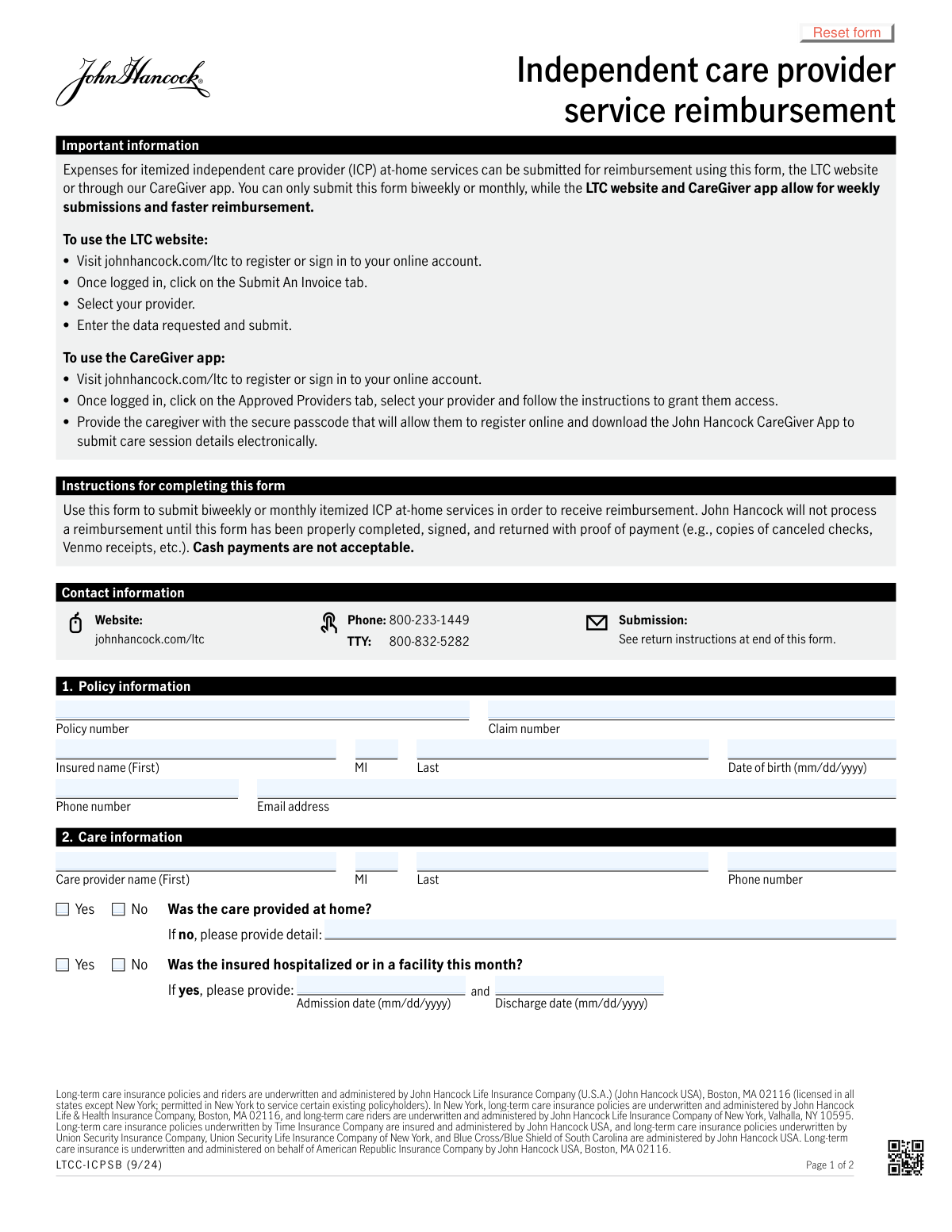
This category of forms is most frequently used by individuals managing long-term care, such as those filing a John Hancock Independent Care Provider Service Reimbursement form. Family members or professional advocates often find themselves responsible for submitting these documents weekly or monthly to maintain a steady flow of benefits. The process involves coordinating information between care logs and insurance requirements, which can become a significant administrative burden during an already challenging time. Tools like Instafill.ai use AI to fill these forms in under 30 seconds, handling your data accurately and securely to streamline the entire reimbursement process. By automating the data entry, you can reduce the risk of clerical errors and focus your energy on the health and well-being of your loved ones rather than paperwork.
Every form on this page can be completed without typing. Instafill is form filling software that reads a PDF and fills it for you — including flat and scanned documents that carry no fillable fields at all.
Forms in This Category
The forms in this category have a median Form Complexity Index of 66/100 (Complex), measured across 1 forms by field count, input difficulty, length, conditional logic and structure. See how it is calculated.
| Form Name | Pages | FCI | |
|---|---|---|---|
| 1. | John Hancock Independent Care Provider Service Reimbursement | 2 | Complex 66 |
- Enterprise-grade security & data encryption
- 99%+ accuracy powered by AI
- 1,000+ forms from all industries
- Complete forms in under 60 seconds
How to Choose the Right Form
Selecting Your John Hancock Reimbursement Form
Navigating insurance claims for long-term care can be complex. The key to a successful reimbursement is matching your documentation to the specific type of care you receive. Currently, this category focuses on policyholders under the John Hancock umbrella.
When to Use the Independent Care Provider Form
The John Hancock Independent Care Provider Service Reimbursement form is specifically designed for policyholders who hire private individuals rather than using a licensed home health agency. Use this form if your caregiver is an independent contractor or a private hire. If your care is managed through a formal facility or a corporate agency, they typically provide their own billing statements or require a different set of forms.
Key Requirements for Your Submission
To ensure your claim is processed quickly and to avoid common pitfalls, you should have the following information ready before you begin filling out the John Hancock Independent Care Provider Service Reimbursement form:
- Policyholder Details: Accurate policy numbers and contact information.
- Provider Information: The caregiver’s full legal name, address, and Tax ID or Social Security number.
- Itemized Service Logs: A clear breakdown of the dates of service, the specific hours worked, and the nature of the care provided.
- Cost Documentation: The agreed-upon rates and total costs incurred during the billing period.
Why Use Instafill.ai for Insurance Forms?
Insurance documents are often distributed as flat PDF files that are difficult to edit. By using the John Hancock Independent Care Provider Service Reimbursement form through Instafill.ai, you can leverage AI to convert these documents into interactive, fillable forms. This ensures that every field is legible and complete, significantly reducing the chances of the insurance company returning the form due to missing information or illegible handwriting.
Form Comparison
| Form | Purpose | Who Files It | Key Requirements |
|---|---|---|---|
| John Hancock Independent Care Provider Service Reimbursement | Request reimbursement for long-term care services from independent providers. | John Hancock policyholders receiving care from non-agency providers. | Itemized service list, provider information, and specific care dates. |
Tips for insurance reimbursement forms
Ensure every date listed on your reimbursement form aligns perfectly with your provider's itemized invoices. Discrepancies between the form and supporting documents are a leading cause of claim delays or denials.
Double-check that your care provider’s tax identification or Social Security number is accurate before submission. Insurance companies require this specific information to process payments and verify the provider's eligibility under your specific policy.
AI-powered tools like Instafill.ai can complete these complex forms in under 30 seconds with high accuracy. Your sensitive medical and personal data stays secure during the process, making it a reliable way to manage recurring reimbursement requests efficiently.
Avoid grouping different types of services into a single line item on the form. Listing each service, time, and cost separately makes it easier for the claims adjuster to approve the full amount without requesting further clarification.
Always save a copy of the completed form and all uploaded attachments for your own records before sending them off. Having a digital trail allows you to quickly resubmit or reference specific dates if the insurance company has follow-up questions.
Ensure the policyholder's name and ID number are written exactly as they appear on the insurance card. Even minor spelling errors can trigger automated system rejections, delaying your reimbursement by several weeks.
Frequently Asked Questions
Insurance reimbursement forms are used by policyholders to request repayment for out-of-pocket expenses covered under their specific insurance plan. These forms provide the insurance company with the necessary details to verify that the services were rendered and to determine the appropriate payment amount according to the policy terms.
Generally, the policyholder or their authorized representative is responsible for filing these forms, especially when services are provided by independent contractors who do not bill the insurance company directly. It is the claimant's responsibility to ensure all information is accurate and that all required supporting documentation is attached.
Most insurers require itemized invoices or receipts that clearly list the dates of service, the specific types of care or services provided, and the total cost. For independent care providers, you may also need to include a provider's social security number or tax identification number for tax reporting purposes.
Yes, AI tools like Instafill.ai can fill these forms in under 30 seconds by accurately extracting data from your invoices or receipts and placing it into the correct fields. This technology helps eliminate manual entry errors and ensures that the data on the form perfectly matches your source documentation.
Using traditional manual entry, these forms can take 15 to 20 minutes to complete, but with AI-powered services, the process is significantly faster. AI can populate an entire reimbursement form in less than 30 seconds, allowing you to review and submit your claim almost immediately.
Most insurance policies have a 'timely filing' limit, which is the window of time you have to submit a claim after the service is provided. This period varies by provider but often ranges from 90 days to one year; failing to submit within this window may result in a denial of the claim.
Agencies usually have an established billing department that handles insurance claims directly, whereas independent providers are typically paid out-of-pocket by the client. When using an independent provider, the burden of proof and the administrative task of filing for reimbursement falls on the policyholder.
Many insurance companies allow you to list multiple dates of service on a single form if they fall within the same month or a specific billing cycle. However, you must ensure that each date is clearly itemized with its corresponding service and cost to avoid delays in processing.
Completed forms should be sent to the claims address or fax number specified by your insurance provider. Many modern insurers also offer secure member portals where you can upload digital copies of the form and supporting receipts for faster processing.
If a form is incomplete, the insurance company will likely 'pend' the claim and send a request for additional information. This can delay your payment by several weeks, which is why using AI tools to ensure all fields are accurately populated from your records is beneficial.
Glossary
- Form Complexity Index
- Instafill’s 0–100 measure of how much effort a form takes to complete, calculated deterministically from the form’s own structure rather than estimated. It combines the number of fillable fields (the largest factor), how difficult those fields are to complete based on their type, the number of pages that contain fields, the amount of conditional “fill-only-if” logic, and how many sections the form is divided into, then adds modifiers for tables and repeating lists, bundled instruction pages, and dense page layouts. A higher score means the form is harder to fill out by hand. The forms in this category have a median Form Complexity Index of 66/100 (Complex). See exactly how it is calculated.
- Policyholder
- The individual who owns the insurance contract and is entitled to the benefits or reimbursements specified in the policy.
- Independent Care Provider
- A caregiver who is not employed by a home health agency and provides services directly to the insured person.
- Itemized Statement
- A detailed breakdown of services rendered that includes the date of service, the specific type of care provided, and the exact cost for each entry.
- Activities of Daily Living (ADLs)
- Standardized tasks such as bathing, dressing, and eating used by insurers to determine a policyholder's eligibility for long-term care benefits.
- Elimination Period
- A waiting period defined in the policy during which the insured must pay for their own care before the insurance company starts making payments.
- Assignment of Benefits
- An arrangement where the policyholder directs the insurance company to pay the reimbursement amount directly to the service provider instead of themselves.
- Plan of Care
- A formal document developed by a medical professional that describes the specific assistance a patient needs to manage their health or personal care.
- Taxpayer Identification Number (TIN)
- A unique nine-digit number, such as a Social Security Number or Employer Identification Number, required by the IRS to report payments made to care providers.