Fill out Italian visa forms
with AI.
Navigating the administrative requirements for entering Italy involves a variety of official documents designed to regulate immigration and temporary stays. This category covers the essential forms required by Italian embassies and consulates worldwide to process entry permits. These documents are crucial because they serve as the primary record for your application, detailing your background, travel intentions, and legal eligibility to enter the country. Ensuring these forms are completed accurately is the first step toward a successful visa approval.
By continuing, you acknowledge Instafill's Privacy Policy and agree to get occasional product update and promotional emails.
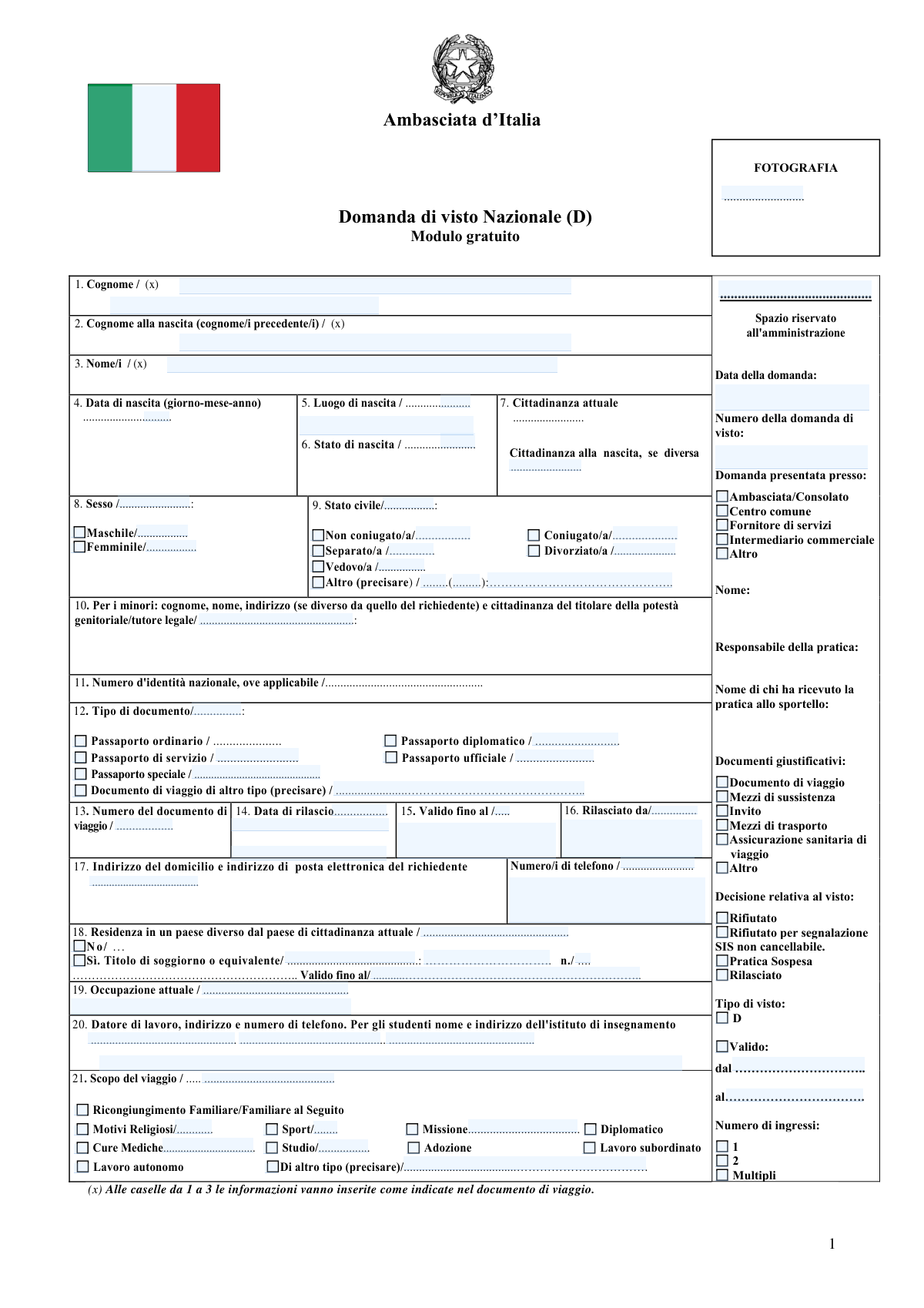
About Italian visa forms
These forms are typically needed by non-EU, non-EEA, or non-Swiss citizens who plan to visit, work, or study in Italy. Whether you are applying for a National Visa (Type D) for a stay exceeding 90 days or preparing other travel documents, the paperwork remains a central part of the process. This applies to students enrolling in Italian universities, professionals relocating for employment, and individuals seeking family reunification. Because the Italian visa process is rigorous, providing clear and precise information is vital for avoiding processing delays or application rejections.
Managing this paperwork does not have to be a manual burden or a source of stress. Tools like Instafill.ai use AI to fill these forms in under 30 seconds, handling your data accurately and securely to streamline your application process and save you valuable time.
Every form on this page can be completed without typing. Instafill is form filling software that reads a PDF and fills it for you — including flat and scanned documents that carry no fillable fields at all.
Forms in This Category
The forms in this category have a median Form Complexity Index of 72/100 (Complex), measured across 1 forms by field count, input difficulty, length, conditional logic and structure. See how it is calculated.
| Form Name | Pages | FCI | |
|---|---|---|---|
| 1. | Domanda di visto Nazionale (D), National Visa Application (D) | 4 | Complex 72 |
- Enterprise-grade security & data encryption
- 99%+ accuracy powered by AI
- 1,000+ forms from all industries
- Complete forms in under 60 seconds
How to Choose the Right Form
Navigating Italian immigration requirements depends entirely on how long you plan to stay and what you intend to do while in the country. While there are various travel documents, the primary distinction lies between short-term visits and long-term residency.
For Long-Term Stays (Over 90 Days)
If you are a non-EU, non-EEA, or non-Swiss citizen planning to relocate to Italy for more than three months, you must use the Domanda di visto Nazionale (D), National Visa Application (D). This is the standard "Type D" visa form required by Italian embassies and consulates for a variety of official purposes. You should select this form if your stay involves:
- Employment: Working for an Italian company or seeking self-employment.
- Education: Enrolling in a university or long-term academic program.
- Family Reunification: Joining a family member who is already a legal resident of Italy.
- Elective Residency: Moving to Italy for retirement or with independent financial means.
Is This the Right Form for You?
Before you begin filling out the Domanda di visto Nazionale (D), ensure your travel plans meet these specific criteria:
- Duration: Your stay must exceed 90 days. For shorter trips (tourism, business meetings, or short courses), you would typically require a Uniform Schengen Visa (Type C) rather than this National Visa form.
- Documentation: Ensure you have your supporting documents ready, such as your letter of enrollment, work contract, or proof of financial means, as the information on the form must match these documents exactly.
Using Instafill.ai, you can process the National Visa Application (D) efficiently. Our AI tools help ensure that personal, travel, and purpose-of-stay fields are completed accurately, reducing the risk of administrative delays during your appointment at the Italian embassy or consulate.
Form Comparison
| Form | Purpose | Stay Duration | Common Use Cases | Target Audience |
|---|---|---|---|---|
| Domanda di visto Nazionale (D), National Visa Application (D) | Application for long-term residency or long-stay visas in Italy. | Valid for stays exceeding 90 days (Type D visa). | Work, study, elective residency, or family reunification purposes. | Non-EU/EEA/Swiss citizens planning an extended stay in Italy. |
Tips for Italian visa forms
Italian visa forms require dates to be entered in the Day/Month/Year (DD/MM/YYYY) format. Double-check your entry for birth dates and travel periods to ensure they align with European standards and match your supporting documents.
Ensure your name, place of birth, and passport number are transcribed exactly as they appear in the machine-readable zone of your passport. Any discrepancy, such as missing middle names or typos, can lead to immediate processing delays or rejection.
Never leave a section blank unless specifically instructed. If a field does not apply to your specific situation, enter 'N/A' or 'Not Applicable' to demonstrate that you have reviewed the entire form and provided a complete response.
AI-powered tools like Instafill.ai can complete these complex Italian visa forms in under 30 seconds with high accuracy. This is a significant time-saver for applicants, and your personal data stays secure throughout the automated filling process.
When providing your intended address in Italy, include the full street name, house number, and the five-digit postal code (CAP). If you are staying at multiple locations, list the primary residence where you can be reached during your first few weeks.
After filling out your National Visa (D) form, save a digital copy before printing and signing. Having a digital record allows you to quickly reference your answers during your consulate interview and helps you maintain consistency across all immigration paperwork.
Frequently Asked Questions
The Type D form is for individuals planning to stay in Italy for more than 90 days. It is the primary document used to apply for long-term residency categories such as work, study, or family reunification.
If your intended stay in Italy is 90 days or less, you typically need a Type C Schengen Visa. For stays exceeding 90 days, the National Visa (Type D) is mandatory for non-EU/EEA citizens.
Most citizens from outside the European Union, European Economic Area, or Switzerland need to complete these forms to enter Italy for long-term purposes. Requirements can vary based on your country of origin and specific bilateral agreements.
Generally, you must submit your application to the Italian consulate or embassy that has jurisdiction over your place of permanent residence. In many countries, Italy uses third-party service providers like VFS Global to handle the initial document collection.
Yes, platforms like Instafill.ai allow you to fill out Italian visa forms using AI to automate the data entry. These tools can accurately extract information from your ID or supporting documents and place it into the form in under 30 seconds.
The most frequent reasons include pursuing higher education at an Italian university, accepting a job offer from an Italian employer, or joining family members who are already legal residents. Each category may require specific supplemental documentation alongside the main form.
Manually filling out long-stay visa forms can take 20 to 30 minutes due to the high level of detail required. Using AI-powered services like Instafill.ai can reduce this time significantly, completing the entire form in less than 30 seconds by mapping data from your source files.
While requirements vary, you will generally need a valid passport, recent photographs, proof of health insurance, and evidence of sufficient financial means. You must also provide documentation supporting the specific reason for your stay, such as an enrollment letter or work contract.
Most Italian visa forms are bilingual, featuring both Italian and English text. You can generally complete the form in either language, though it is advisable to check the specific preferences of the consulate where you are applying.
It is advisable to apply at least three weeks to three months before your planned departure date. Processing times can vary significantly depending on the consulate's current workload and the specific visa category.
While the forms themselves are often available for free, the consulate charges a non-refundable processing fee for the visa application. These fees vary depending on the type of visa and the applicant's nationality.
Most consulates require a printed and signed hard copy of the form for the actual interview. However, you can use digital tools to fill the form out clearly and accurately before printing it to ensure all information is legible for the processing officers.
Glossary
- Form Complexity Index
- Instafill’s 0–100 measure of how much effort a form takes to complete, calculated deterministically from the form’s own structure rather than estimated. It combines the number of fillable fields (the largest factor), how difficult those fields are to complete based on their type, the number of pages that contain fields, the amount of conditional “fill-only-if” logic, and how many sections the form is divided into, then adds modifiers for tables and repeating lists, bundled instruction pages, and dense page layouts. A higher score means the form is harder to fill out by hand. The forms in this category have a median Form Complexity Index of 72/100 (Complex). See exactly how it is calculated.
- Type D Visa (National Visa)
- A long-stay visa required for non-EU citizens planning to stay in Italy for more than 90 days for reasons such as work, study, or family reunification.
- Nulla Osta
- An official entry clearance or 'no impediment' certificate issued by Italian provincial authorities that is often a prerequisite for obtaining work or family visas.
- Permesso di Soggiorno
- The residence permit that foreigners must apply for within eight working days of entering Italy to legally stay in the country long-term.
- SUI (Sportello Unico per l’Immigrazione)
- The Unified Immigration Desk in Italy responsible for processing the preliminary authorizations, like the Nulla Osta, needed for many visa categories.
- Codice Fiscale
- An Italian tax identification code, similar to a Social Security number, used for administrative tasks, opening bank accounts, and signing contracts in Italy.
- Dichiarazione di Valore
- A 'Declaration of Value' issued by an Italian consulate that verifies the validity and level of an applicant's foreign educational qualifications for study visas.
- Consular Jurisdiction
- The specific geographic region assigned to an Italian embassy or consulate; applicants must usually submit their forms to the office serving their place of legal residence.
- Schengen Area
- A group of European countries with no internal border controls; while a Type D visa is specific to Italy, it generally allows the holder to travel to other Schengen states for up to 90 days.