Fill out judicial review forms
with AI.
Judicial review is a critical legal process in the UK that allows individuals and organizations to challenge the lawfulness of decisions made by public bodies. These forms are the primary mechanism for holding government departments, local councils, and other authorities accountable when their actions are deemed illegal, irrational, or procedurally unfair. By initiating a claim, you are asking the Administrative Court to examine the decision-making process rather than just the outcome, ensuring that public power is exercised within the bounds of the law.
By continuing, you acknowledge Instafill's Privacy Policy and agree to get occasional product update and promotional emails.
About judicial review forms
Typically, these forms are used by legal professionals, activists, or individuals who believe a public authority has breached their rights or failed to follow proper legal procedures. Common scenarios include challenging planning permissions, immigration decisions, or changes to local healthcare services. Whether you are filing a standard claim using Form N461 or requesting an expedited process via Form N463 for time-sensitive matters, these documents require precise legal details and a clear statement of facts to be considered by the court.
Navigating the complexities of civil litigation can be daunting, but digital tools have made the administrative side of the process significantly more manageable. Tools like Instafill.ai use AI to fill these forms in under 30 seconds, ensuring that data is handled accurately and securely while saving valuable time for claimants and their legal representatives.
Every form on this page can be completed without typing. Instafill is form filling software that reads a PDF and fills it for you — including flat and scanned documents that carry no fillable fields at all.
Forms in This Category
The forms in this category have a median Form Complexity Index of 50/100 (Moderate), measured across 3 forms by field count, input difficulty, length, conditional logic and structure. See how it is calculated.
| Form Name | Pages | FCI | |
|---|---|---|---|
| 1. | Form N461: Claim for judicial review | 17 | Moderate 62 |
| 2. | Form N463, Judicial Review Application for urgent consideration | 8 | Moderate 50 |
| 3. | Motion - Requesting Judicial Review of Certain Marijuana and Hashish Cases Pursuant to The Marijuana Decriminalization Law, L. 2021, c. 19 | 1 | Basic 38 |
- Enterprise-grade security & data encryption
- 99%+ accuracy powered by AI
- 1,000+ forms from all industries
- Complete forms in under 60 seconds
How to Choose the Right Form
Starting Your Judicial Review
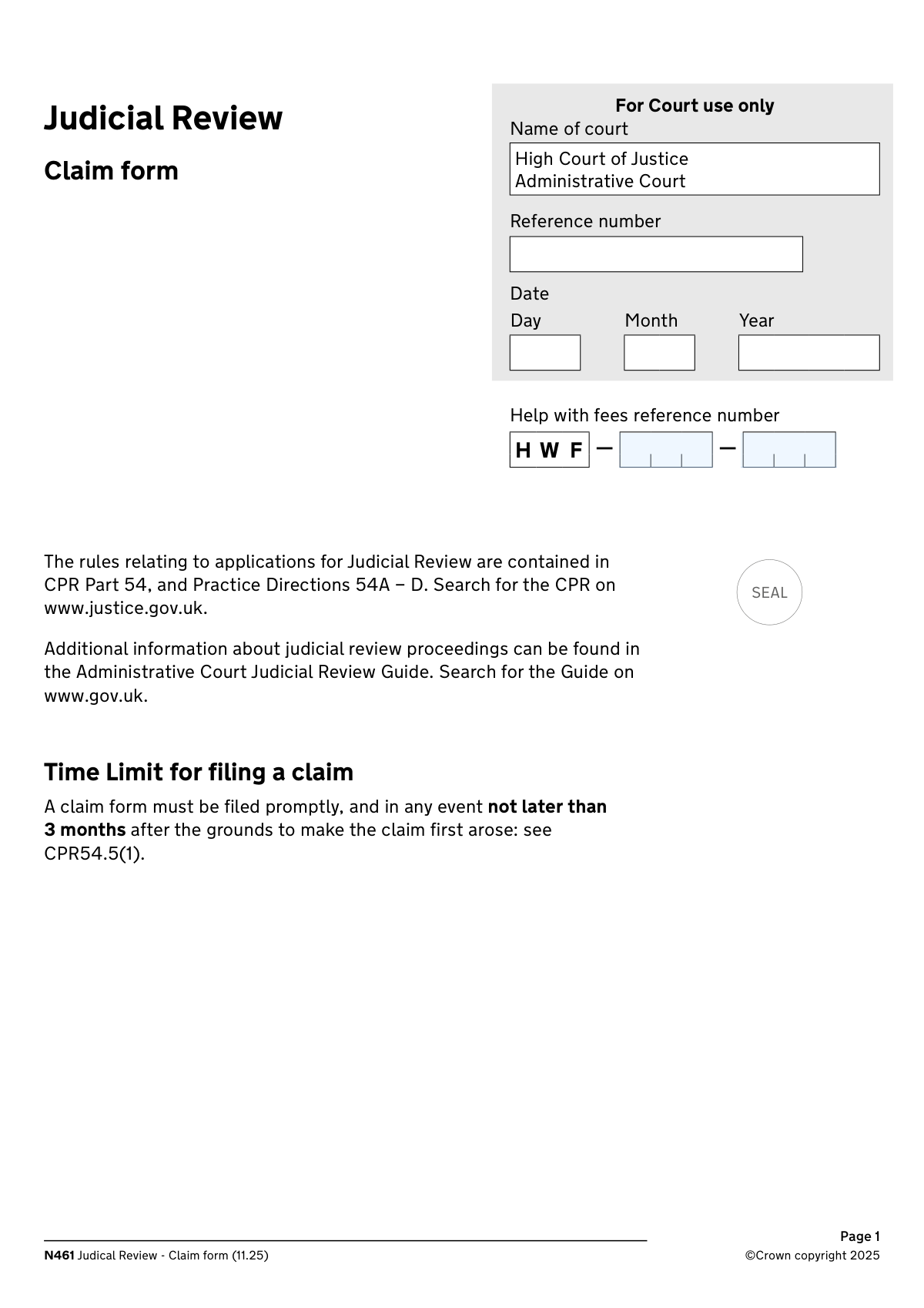
The primary document for any civil litigation involving the challenge of a public authority's decision in the UK is Form N461: Claim for judicial review. You should select this form if you are seeking to have the Administrative Court review an action or decision based on:
- Illegality: The authority acted outside its legal powers or misapplied the law.
- Irrationality: The decision was so unreasonable that no sensible authority could have made it.
- Procedural Impropriety: The authority failed to follow fair procedures or statutory requirements.
Handling Time-Sensitive Claims
In many legal disputes, the standard court timetable is too slow to prevent immediate harm. If your situation requires immediate intervention, you must use Form N463: Judicial Review Application for urgent consideration.
This form is not a replacement for the N461; rather, it is a supplemental application used when:
- You require a decision or interim relief within 7 days.
- There is an imminent threat, such as an immediate deportation or the imminent implementation of a contested policy.
- You can provide a detailed justification for why the case cannot wait for the standard review process and have a proposed timetable ready.
Which Forms Do I Need?
- For Standard Reviews: Use Form N461 only. This is the correct choice for most civil litigation cases where the timeline follows standard court procedures.
- For Emergency Reviews: Use Form N461 AND Form N463. You must file the N463 simultaneously with your claim form to alert the High Court of Justice to the urgency.
Using Instafill.ai ensures that these complex UK court forms are completed accurately. Our AI tools help you navigate the specific fields required for both the N461 and N463, helping you convert these legal documents into fillable formats and ensuring your grounds for review are presented clearly.
Form Comparison
| Form | Primary Purpose | Filing Deadline/Timing | Key Requirements |
|---|---|---|---|
| Form N461: Claim for judicial review | Initiates a legal challenge against a public authority's decision or action. | Must be filed promptly, typically within three months of the decision. | Statement of facts, grounds for review, and supporting documentation. |
| Form N463, Judicial Review Application for urgent consideration | Requests the court to expedite the judicial review process urgently. | Used when immediate court intervention is required, often within 7 days. | Detailed explanation of urgency and a proposed timetable for the court. |
Tips for judicial review forms
Judicial review is generally considered a remedy of last resort in the UK legal system. Before submitting Form N461, ensure you have explored all other available appeal processes or internal grievance procedures provided by the public authority.
Claims must be filed promptly and typically no later than three months after the grounds for the claim first arose. Be aware that some specific types of cases may have even shorter statutory time limits, so acting quickly is essential.
Except in cases of extreme urgency, you should send a Letter Before Claim to the defendant before filing your forms. Failure to follow this protocol without a valid justification can result in cost penalties or procedural delays.
When using Form N463 for urgent consideration, you must explicitly state why the matter is time-sensitive and provide a proposed timetable. Clearly explain the specific consequences that will occur if the court does not intervene within your requested timeframe.
AI-powered tools like Instafill.ai can complete these complex judicial review forms in under 30 seconds with high accuracy. This is a significant time-saver for legal professionals or individuals handling multiple documents, and your data stays secure during the entire process.
Ensure all supporting documents, such as the decision letter being challenged, are clearly indexed and paginated. A well-organized bundle helps the court navigate your claim efficiently and reduces the risk of administrative rejection.
Double-check that you have named the correct legal entity as the defendant and included any interested parties affected by the claim. Errors in identifying the decision-making authority can lead to your claim being struck out or requiring expensive amendments.
Frequently Asked Questions
Judicial review forms are used to challenge the lawfulness of decisions, actions, or failures to act by public bodies, such as government departments or local authorities. These forms allow individuals or organizations to ask the Administrative Court to examine whether a decision was made legally, rationally, and with procedural fairness.
Form N461 is the standard claim form required to initiate any judicial review process in the UK. You should only use Form N463 in addition to N461 if your case is exceptionally time-sensitive and requires the court's attention within a very short timeframe, typically within seven days.
Most claims are based on grounds of illegality, irrationality, or procedural impropriety. This means the authority may have acted outside its legal powers, made a decision so unreasonable that no sensible person would have made it, or followed a process that was biased or unfair.
A claim for judicial review must generally be filed promptly and no later than three months after the grounds for the claim first arose. However, some specific types of cases, such as those involving planning decisions, may have significantly shorter deadlines, so it is important to act quickly.
Once completed, these forms are typically submitted to the Administrative Court, which is part of the High Court of Justice. Depending on the nature of the claim, they are filed at the Royal Courts of Justice in London or at one of the regional Administrative Court centers.
Yes, you can use AI tools like Instafill.ai to complete judicial review forms. The AI accurately extracts data from your source documents and places it directly into the correct fields on the PDF, helping to ensure that the information is consistent and correctly formatted.
Using AI-powered services like Instafill.ai, these complex legal forms can often be filled out in under 30 seconds. This significantly reduces the manual effort involved in drafting the claim while maintaining high levels of accuracy in data placement.
When filing Form N461, you typically need to include a statement of facts, a statement of the grounds for review, and copies of the specific decision letter you are challenging. If you are using Form N463 for urgent consideration, you must also provide a draft order and a clear explanation of the urgency.
To file these forms, a claimant must usually demonstrate that they have 'sufficient interest' in the matter. This generally means the individual or organization is directly affected by the decision or action of the public body being challenged.
After submission, a judge will review the forms and supporting documents to decide whether to grant 'permission' for the judicial review to proceed. This is a preliminary stage to determine if there is an arguable case before a full hearing is scheduled.
Glossary
- Form Complexity Index
- Instafill’s 0–100 measure of how much effort a form takes to complete, calculated deterministically from the form’s own structure rather than estimated. It combines the number of fillable fields (the largest factor), how difficult those fields are to complete based on their type, the number of pages that contain fields, the amount of conditional “fill-only-if” logic, and how many sections the form is divided into, then adds modifiers for tables and repeating lists, bundled instruction pages, and dense page layouts. A higher score means the form is harder to fill out by hand. The forms in this category have a median Form Complexity Index of 50/100 (Moderate). See exactly how it is calculated.
- Administrative Court
- A specialized division of the High Court in the UK that hears judicial review cases and legal challenges against the decisions of public bodies.
- Public Authority
- Any organization performing public functions, such as local councils, government departments, or the police, whose decisions are subject to legal scrutiny.
- Permission (Leave) to Proceed
- The initial stage of a judicial review where a judge reviews the claim to ensure it has a realistic prospect of success before allowing it to move to a full hearing.
- Pre-Action Protocol
- The set of mandatory steps and communications, such as sending a formal letter before claim, that parties must follow before filing an N461 form.
- Interested Party
- An individual or organization, other than the claimant or defendant, who is directly affected by the outcome of the judicial review and has a right to be heard.
- Grounds for Review
- The legal justifications for the challenge, traditionally categorized as illegality, irrationality (Wednesbury unreasonableness), or procedural impropriety.
- Quashing Order
- A court order that nullifies an unlawful decision made by a public authority, effectively making it void and requiring the decision to be made again.
- Interim Relief
- Temporary measures, such as an injunction, granted by the court to preserve the claimant's position or prevent harm until the final judgment is reached.