Fill out laboratory requisition forms
with AI.
Laboratory requisition forms are essential documents in the healthcare system, serving as the formal link between a clinical consultation and the diagnostic data provided by medical labs. These medical requisition forms ensure that specific tests—ranging from routine hematology and general chemistry to complex endocrine panels—are ordered accurately, tracked through the system, and billed to the correct insurance or provincial health plan. By standardizing the request process, these forms help minimize diagnostic errors and ensure that laboratories have the necessary patient demographics and clinical context to provide reliable results.
By continuing, you acknowledge Instafill's Privacy Policy and agree to get occasional product update and promotional emails.
About laboratory requisition forms
Typically used by physicians, nurse practitioners, and other authorized healthcare providers, these forms are a staple of both routine check-ups and urgent diagnostic investigations. In regions like Alberta, clinicians frequently rely on specific Alberta health forms to coordinate care with centralized laboratory services. Because these documents often require repetitive data entry, such as patient history and provider information, completing them manually can be a significant administrative burden for busy medical offices and clinics.
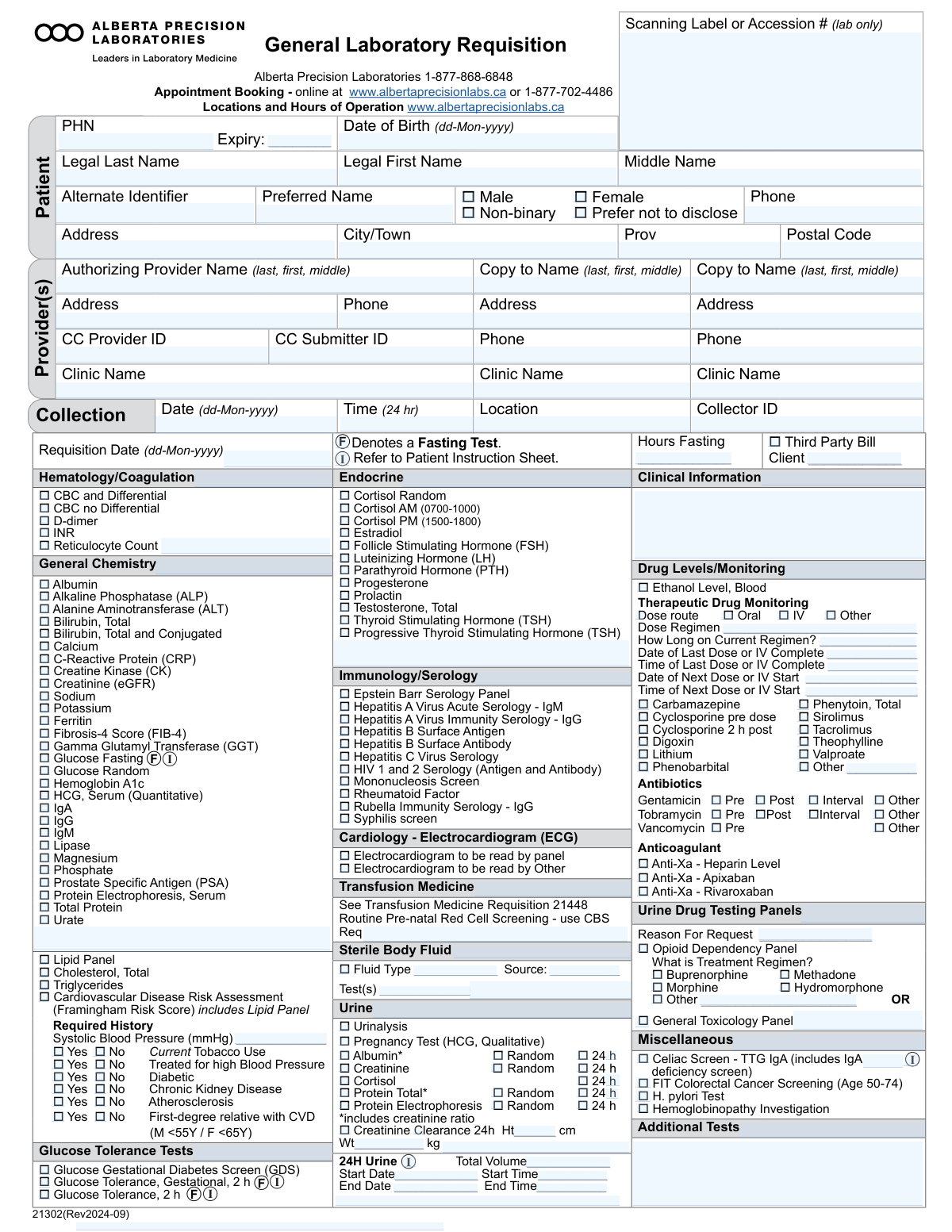
To streamline this process, tools like Instafill.ai use AI to fill these laboratory requisition forms in under 30 seconds, ensuring that data is handled accurately and securely. By automating the completion of documents like the Alberta Precision Laboratories General Laboratory Requisition, healthcare professionals can reduce the time spent on paperwork and focus more on direct patient care.
Every form on this page can be completed without typing. Instafill is form filling software that reads a PDF and fills it for you — including flat and scanned documents that carry no fillable fields at all.
Forms in This Category
The forms in this category have a median Form Complexity Index of 69/100 (Complex), measured across 1 forms by field count, input difficulty, length, conditional logic and structure. See how it is calculated.
| Form Name | Pages | FCI | |
|---|---|---|---|
| 1. | Alberta Precision Laboratories General Laboratory Requisition (Form 21302) | 1 | Complex 69 |
- Enterprise-grade security & data encryption
- 99%+ accuracy powered by AI
- 1,000+ forms from all industries
- Complete forms in under 60 seconds
How to Choose the Right Form
Navigating medical requisition forms in Alberta is simplified by the fact that most routine testing is consolidated into a single, comprehensive document. If you are a healthcare provider or a patient directed to provide a standardized request to Alberta Precision Laboratories (APL), you are likely looking for the standard general requisition.
The Primary Choice: Alberta Precision Laboratories General Laboratory Requisition (Form 21302)
This is the standard document used across the province for the vast majority of outpatient and community laboratory requests. You should choose this form if you need to order or provide documentation for:
- Routine Blood Work: Including Hematology (CBC, Differential) and Coagulation tests.
- General Chemistry: Such as Electrolytes, Glucose, Creatinine, and Liver Function tests.
- Endocrine Panels: Including Thyroid (TSH) and Diabetes monitoring (HbA1c).
- Immunology and Specialized Testing: Specific diagnostic markers and screening.
When to Use This Form
The Alberta Precision Laboratories General Laboratory Requisition (Form 21302) is appropriate for physicians, nurse practitioners, and other authorized health professionals operating within the Alberta health system. It serves as the official communication between the clinic and the laboratory, ensuring that patient demographics, billing information (including Alberta Health Care Insurance Plan details), and specific diagnostic instructions are clearly conveyed.
Essential Information for Completion
To ensure the laboratory can process the request without delay, verify that the following sections are addressed when utilizing these laboratory requisition forms:
- Patient Demographics: Full name, date of birth, and personal health number (PHN) are required for identification.
- Provider Details: The ordering practitioner’s name, clinic address, and PRACID are mandatory for reporting results.
- Clinical Indication: Providing the "Reason for Test" or ICD code helps lab staff interpret results accurately.
Using Instafill.ai to manage these alberta health forms allows you to transform the standard PDF into a smart, fillable document, reducing manual entry errors and speeding up the diagnostic process for both providers and patients.
Form Comparison
| Form | Primary Purpose | Key Test Categories | Required Information |
|---|---|---|---|
| Alberta Precision Laboratories General Laboratory Requisition (Form 21302) | Standard request for diagnostic laboratory testing within the Alberta healthcare system. | Covers hematology, general chemistry, endocrine panels, and immunology tests. | Patient demographics, healthcare provider details, billing information, and specific tests requested. |
Tips for laboratory requisition forms
Ensure the patient's name, date of birth, and Provincial Health Number match their official identification exactly. Mismatched data can lead to processing delays or errors in linking results to the correct medical record.
When filling out the checklist, ensure only the necessary tests are selected to avoid unnecessary blood draws or billing issues. For tests not listed in the standard sections, use the 'Other' or 'Clinical History' area to write specific instructions clearly.
The laboratory needs accurate contact information for the physician or authorized provider to deliver results promptly. Double-check that the provider's name, clinic address, and phone or fax numbers are legible and current before submission.
Providing brief clinical indications or noting if the patient was fasting helps the lab interpret the results accurately. This context is particularly crucial for tests like glucose or lipid panels where timing and diet significantly impact the data.
AI-powered tools like Instafill.ai can complete these laboratory requisition forms in under 30 seconds with high accuracy. Your data stays secure during the process, providing a practical and fast way to manage multiple medical forms without manual data entry.
Always save a digital copy of the completed requisition before sending it to the lab. This ensures you have a backup if the physical form is lost and allows for easy re-printing if the patient requires a duplicate for their appointment.
Frequently Asked Questions
A laboratory requisition form serves as an official request from a healthcare provider to a diagnostic lab, specifying which tests need to be performed for a patient. It ensures that the lab has the correct patient information, billing details, and clinical instructions to process samples accurately.
These forms are typically completed by licensed healthcare providers, such as physicians, nurse practitioners, or midwives, who are authorized to order diagnostic tests in Alberta. The form requires the provider's unique identification number and contact information to ensure results are sent to the correct medical professional.
Yes, AI tools like Instafill.ai can fill out these forms in under 30 seconds by accurately extracting data from source documents and placing it into the correct fields. This technology can also convert static PDF versions of medical forms into interactive, fillable documents to streamline the administrative process.
Essential information includes the patient’s full name, date of birth, and personal health number, alongside the requesting provider's details. Additionally, the form must clearly indicate the specific tests required, any relevant clinical history, and the date the request was issued.
Patients should take their completed requisition form to an Alberta Precision Laboratories (APL) collection site or a participating community lab location. In many cases, the ordering physician may fax the form directly to the lab, but patients are often encouraged to bring a physical or digital copy to their appointment.
Filling out a laboratory requisition online with AI takes significantly less time than manual entry, often completing the task in under 30 seconds. By automating the extraction of patient demographics and provider information, these tools minimize errors and ensure all required fields are addressed before submission.
Most laboratory requisitions have an expiration date, which varies depending on the type of test and the jurisdiction's health regulations. For Alberta Precision Laboratories, it is generally recommended to complete the tests within a few months of the order date, as clinical needs may change over time.
If a form is incomplete, the laboratory may be unable to process the request or bill the provincial health plan correctly. It is important to ensure that both patient and provider sections are fully filled out to avoid delays in testing or the need for a follow-up appointment with your doctor.
While the General Laboratory Requisition (Form 21302) covers a wide range of common tests like hematology and chemistry, some specialized tests may require specific forms. However, for the majority of routine diagnostic screenings in Alberta, the general requisition is the standard document used by providers.
While the clinical testing section must be completed by a healthcare provider, patients may sometimes assist by providing or verifying their personal demographic details and health card numbers. Using digital tools can help ensure this data is entered legibly, reducing the risk of administrative errors at the lab.
Glossary
- Form Complexity Index
- Instafill’s 0–100 measure of how much effort a form takes to complete, calculated deterministically from the form’s own structure rather than estimated. It combines the number of fillable fields (the largest factor), how difficult those fields are to complete based on their type, the number of pages that contain fields, the amount of conditional “fill-only-if” logic, and how many sections the form is divided into, then adds modifiers for tables and repeating lists, bundled instruction pages, and dense page layouts. A higher score means the form is harder to fill out by hand. The forms in this category have a median Form Complexity Index of 69/100 (Complex). See exactly how it is calculated.
- PHN (Personal Health Number)
- A unique nine-digit identification number assigned to individuals eligible for subsidized health services in Alberta, which must be provided on all medical requisitions.
- Ordering Provider
- The licensed healthcare professional, such as a physician or nurse practitioner, who authorizes the laboratory tests and is responsible for receiving the results.
- STAT
- A designation derived from the Latin word 'statim,' indicating that the test is an emergency and must be processed and reported immediately.
- Hematology
- A section of the requisition for tests related to blood and blood-forming tissues, commonly including Complete Blood Counts (CBC) and coagulation studies.
- Fasting
- A requirement for the patient to abstain from all food and drink (except water) for a specific period, typically 8 to 12 hours, before the sample is collected.
- Endocrine Panel
- A group of laboratory tests specifically designed to measure hormone levels and evaluate the function of glands like the thyroid, adrenals, or pancreas.
- Clinical History
- Brief medical notes provided by the practitioner regarding the patient's symptoms or diagnosis to help the laboratory pathologist interpret the test results.
- Alberta Precision Laboratories (APL)
- The provincial laboratory service provider in Alberta that processes the samples and manages the standardized forms used across the province.