Fill out managed account forms
with AI.
Managed account forms are essential documents used by investors and financial institutions to facilitate the professional oversight of investment portfolios. These forms cover a wide range of administrative actions, from initial account setup to the complex process of consolidating assets from various external brokerages. By formalizing the relationship between the client and the investment manager, these documents ensure that asset transfers—such as moving stocks, mutual funds, or retirement plan assets—are handled with the necessary legal and financial precision to protect the investor's interests.
By continuing, you acknowledge Instafill's Privacy Policy and agree to get occasional product update and promotional emails.
About managed account forms
These forms are typically needed by individuals looking to streamline their financial management, such as retirees consolidating multiple accounts or high-net-worth clients switching to a managed brokerage service. For instance, an Incoming Managed Account Transfer Form is a common requirement when moving assets from an external firm to a new provider to ensure a smooth transition of the portfolio. Because these documents often require detailed institutional data and specific asset information, completing them manually can be a tedious and error-prone process. Tools like Instafill.ai use AI to fill these forms in under 30 seconds, handling the data accurately and securely to save you time and reduce administrative friction.
Every form on this page can be completed without typing. Instafill is form filling software that reads a PDF and fills it for you — including flat and scanned documents that carry no fillable fields at all.
Forms in This Category
| Form Name | Pages | FCI | |
|---|---|---|---|
| 1. | TIAA Brokerage Incoming Managed Account Transfer Form (F11319) | 1 | – |
- Enterprise-grade security & data encryption
- 99%+ accuracy powered by AI
- 1,000+ forms from all industries
- Complete forms in under 60 seconds
How to Choose the Right Form
Selecting the right managed account form depends primarily on whether you are opening a new account, changing your investment strategy, or consolidating assets from another financial institution. While managed accounts offer professional oversight of your portfolio, the paperwork required to fund them is specific to the direction of the capital flow.
Consolidating Your Investments
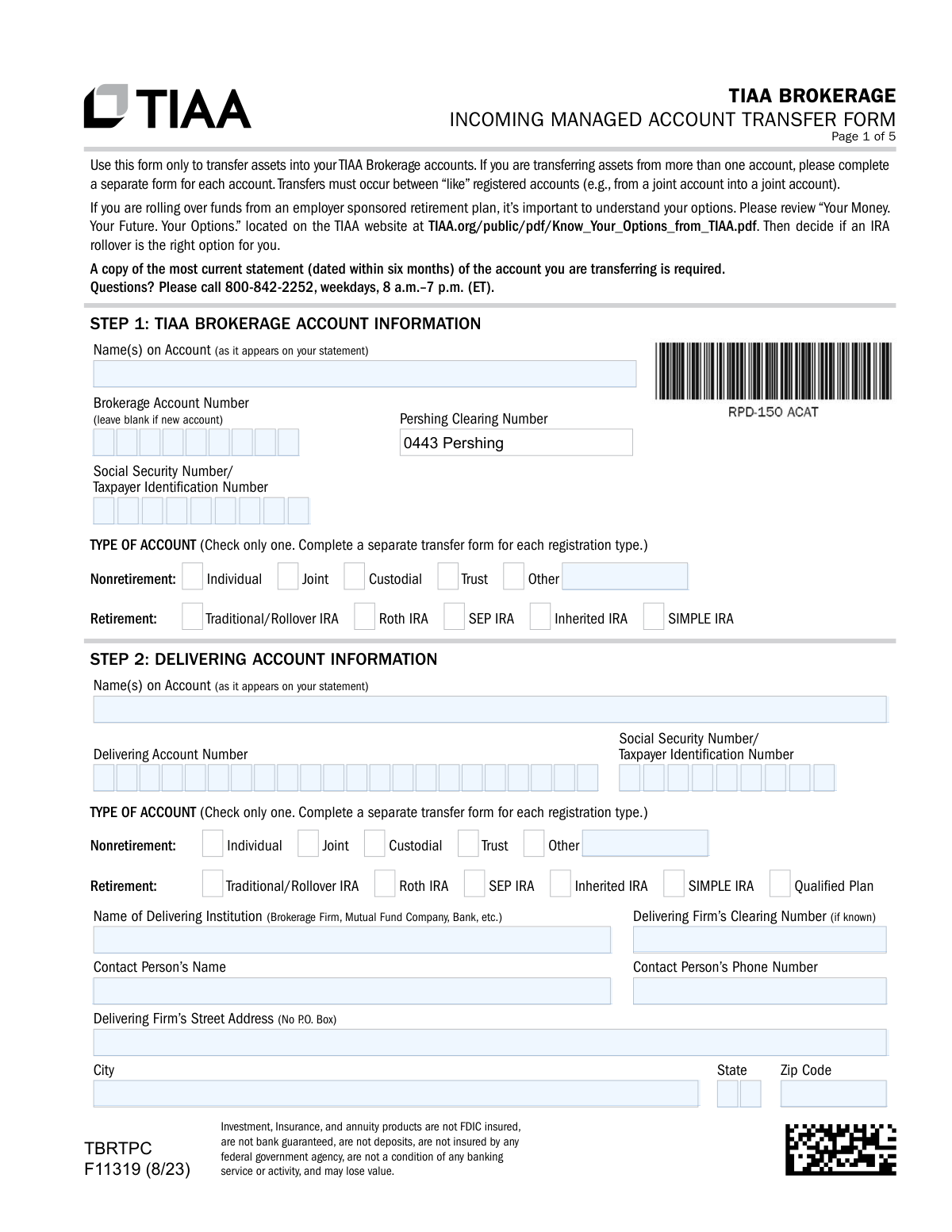
If your goal is to move existing assets from an external brokerage or retirement plan into a professionally managed environment, you need a specific transfer authorization. Currently, the primary document available in this category is the TIAA Brokerage Incoming Managed Account Transfer Form (F11319).
You should choose this form if:
- Consolidating Portfolios: You have stocks, mutual funds, or cash at a different firm (the "delivering institution") and want to move them under TIAA’s management.
- Retirement Plan Transfers: You are moving retirement plan assets into a single managed brokerage account for easier oversight.
- In-Kind Transfers: You wish to move specific securities without selling them first, preserving your current market positions during the transition.
What Information is Required?
To ensure your transfer is processed without delays, the TIAA Brokerage Incoming Managed Account Transfer Form (F11319) requires specific details from your most recent external account statement:
- Delivering Firm Information: The name of the company currently holding your assets and your specific account number at that firm.
- Asset Details: You must specify whether you are transferring the "entire account" or only specific assets and quantities.
- Account Type Matching: It is vital to ensure the registration on your external account (e.g., Individual, IRA) matches your TIAA managed account to avoid potential tax complications or rejection by the delivering firm.
Streamlining the Process
Manually filling out complex financial forms can lead to errors that stall your asset transfer. By using Instafill.ai, you can utilize AI to accurately complete the TIAA Brokerage Incoming Managed Account Transfer Form (F11319). Our platform handles non-fillable PDFs, allowing you to quickly input your data and prepare the document for submission, ensuring your investments are moved into your managed account as efficiently as possible.
Form Comparison
| Form | Purpose | Assets Covered | When to Use |
|---|---|---|---|
| TIAA Brokerage Incoming Managed Account Transfer Form (F11319) | Authorizes the transfer of external assets into a TIAA Brokerage managed account. | Includes stocks, mutual funds, cash, and various retirement plan assets. | Use when consolidating external investment portfolios into a TIAA managed account. |
Tips for managed account forms
Double-check the account numbers and the full name of the delivering firm to prevent delays in the transfer process. Even a single digit error can cause the request to be rejected by the sending institution, requiring you to start the paperwork over.
The names on your current account must match the names on your new managed account exactly. If you are moving a joint account to an individual account, additional documentation or a signature guarantee might be necessary to authorize the change in ownership.
Not all investments, such as specific proprietary mutual funds or certain alternative assets, are eligible for transfer into a managed brokerage account. Review your current holdings to see if they can be moved 'in-kind' or if they need to be liquidated before the transfer begins.
Using AI-powered tools like Instafill.ai allows you to complete managed account forms in under 30 seconds with high accuracy. Your sensitive financial data stays secure throughout the process, providing a fast and reliable way to handle complex investment paperwork.
Have your most recent account statement from the delivering firm nearby when filling out these forms. This ensures you have the correct account type, clearing number, and asset list ready to input without having to search through multiple documents.
When transferring assets between brokerage accounts, fractional shares are often sold and moved as cash. Be sure to specify how you want residual balances handled to avoid small amounts of money being left behind in the old account after the primary assets move.
Frequently Asked Questions
These forms are used to authorize the movement of financial assets from one institution to another specifically for placement into a managed investment account. They provide the receiving firm with the legal permission and account details necessary to pull assets like stocks, bonds, or cash from your existing brokerage or retirement provider.
Investors who want to consolidate their portfolios or move their wealth under the professional management of a specific brokerage or financial advisor will need these forms. This includes individuals moving retirement assets, taxable brokerage accounts, or mutual fund holdings to a new managed service provider.
You generally need a recent statement from your current delivering financial institution to ensure account numbers and asset descriptions are accurate. Additionally, you will need your new managed account number and personal identification details to verify your identity and authorization.
Yes, most managed account transfer forms allow for the movement of various asset types, including Traditional IRAs, Roth IRAs, and taxable brokerage accounts. However, it is important to ensure the receiving account type matches the delivering account type to avoid unintended tax consequences.
Yes, AI tools like Instafill.ai can process managed account forms by accurately extracting data from your existing financial statements and placing it directly into the required fields. This minimizes manual entry errors and ensures that complex account numbers and asset details are recorded correctly.
Using AI-powered services, you can complete these forms in under 30 seconds. The technology analyzes the source documents, identifies the relevant information, and populates the form automatically, which is significantly faster than manual typing.
Once the forms are filled and signed, they are typically submitted to the receiving institution, which is the firm that will be managing your account. Many firms allow for digital submission through secure portals, though some may still require physical mailing depending on the asset value.
While not always strictly required, it is often helpful to notify your current firm to ensure there are no stops or pending transactions on the account that could delay the transfer. The receiving firm usually handles the communication with the delivering firm once they have your signed authorization.
Most transfer forms provide the option for either a full or partial transfer. If you choose a partial transfer, you must specify exactly which assets or what dollar amount you wish to move, while leaving the remainder in your current account.
The electronic transfer process usually takes between 5 to 10 business days after the paperwork is processed by both institutions. However, transfers involving certain mutual funds or proprietary assets may take longer if they require manual liquidation or special handling.
For joint accounts, both account holders are typically required to sign the transfer forms to authorize the movement of assets. The names and Social Security numbers on the delivering account must generally match the names on the new managed account for the transfer to be approved.
Glossary
- Managed Account
- An investment account owned by an individual investor but overseen by a professional money manager or financial firm to achieve specific objectives.
- Delivering Institution
- The bank, brokerage, or financial firm that currently holds your assets and will be sending them to the new receiving firm.
- In-Kind Transfer
- The process of moving investments like stocks or mutual funds between accounts without selling them, allowing you to maintain your current positions.
- ACATS (Automated Customer Account Transfer Service)
- A standardized system used by the financial industry to electronically transfer securities and assets from one brokerage firm to another.
- Medallion Signature Guarantee
- A special certification stamp provided by a financial institution that confirms a signature is genuine and that the signer has the legal authority to transfer the assets.
- Cost Basis
- The original purchase price of an investment, including commissions and fees, used to calculate capital gains or losses for tax reporting.
- Qualified Account
- An investment account that receives special tax treatment under the tax code, such as an IRA or 403(b) retirement plan.