Fill out Maryland government forms
with AI.
Maryland government forms serve as the official bridge between citizens and state agencies, facilitating everything from administrative updates to significant legal requests. These documents are essential for maintaining accurate records and ensuring that individuals can exercise their rights or request specific actions from state authorities. In the context of the justice system, forms related to clemency and criminal records represent a critical step for those seeking to move forward with their lives after past legal involvements.
By continuing, you acknowledge Instafill's Privacy Policy and agree to get occasional product update and promotional emails.
About Maryland government forms
Individuals typically require these forms when navigating complex bureaucratic processes like applying for a pardon or managing criminal history records. For instance, the Maryland Application for Pardon is a vital document for those seeking executive clemency from the Governor. This process is often pursued by individuals who have demonstrated rehabilitation and are looking to remove certain legal barriers related to employment, licensing, or civic participation. Because these applications require exhaustive details regarding personal history, financial status, and legal backgrounds, accuracy is paramount to ensure the request is properly reviewed by the Parole Commission.
Completing these extensive documents manually can be a daunting and time-consuming task. Tools like Instafill.ai use AI to fill these Maryland government forms in under 30 seconds, handling complex data accurately and securely to streamline the application process. By automating the data entry, users can focus on the substance of their requests rather than the technicalities of the paperwork.
Every form on this page can be completed without typing. Instafill is form filling software that reads a PDF and fills it for you — including flat and scanned documents that carry no fillable fields at all.
Forms in This Category
The forms in this category have a median Form Complexity Index of 70/100 (Complex), measured across 1 forms by field count, input difficulty, length, conditional logic and structure. See how it is calculated.
| Form Name | Pages | FCI | |
|---|---|---|---|
| 1. | Maryland Department of Public Safety and Correctional Services Application for Pardon | 27 | Complex 70 |
- Enterprise-grade security & data encryption
- 99%+ accuracy powered by AI
- 1,000+ forms from all industries
- Complete forms in under 60 seconds
How to Choose the Right Form
Navigating Maryland government forms requires precision, especially when dealing with legal and criminal justice documentation. If you are looking to address past convictions through official state channels, it is essential to select the document that matches your specific legal goal.
Seeking Executive Clemency
If your objective is to receive formal forgiveness for a past crime from the Governor of Maryland, you should use the Maryland Department of Public Safety and Correctional Services Application for Pardon. This is the primary document used for clemency requests in the state.
You should choose this form if:
- You have completed your sentence: This includes finishing all terms of incarceration, parole, and probation.
- You are seeking a restoration of rights: A pardon can help restore certain civil rights and remove the legal disabilities associated with a conviction.
- You want to demonstrate rehabilitation: This form requires a deep dive into your personal background, employment history, and financial status to prove you have become a law-abiding citizen.
Pardon vs. Other Criminal Record Forms
It is important to distinguish pardon application forms from other criminal record forms, such as expungement petitions. While an expungement seeks to remove a record from public view, the Maryland Department of Public Safety and Correctional Services Application for Pardon is a request for executive grace. Even if a pardon is granted, it does not automatically expunge the record; however, it is a significant step in the clemency process.
Streamlining the Process
The pardon application is notoriously detailed and time-consuming. Because it requires exhaustive disclosure of your criminal history and life since the offense, using Instafill.ai can simplify the process. Our AI-powered tools help you manage the complex fields of the Application for Pardon, ensuring that your request to the Parole Commission is professional, legible, and complete.
Form Comparison
| Form | Purpose | Who Files It | Key Requirements |
|---|---|---|---|
| Maryland Department of Public Safety and Correctional Services Application for Pardon | Formal request for the Governor to grant legal forgiveness for past criminal offenses. | Individuals with Maryland criminal records seeking clemency after completing their sentences. | Detailed criminal history, financial disclosures, personal background, and extensive supporting documentation. |
Tips for Maryland government forms
When filling out Maryland pardon applications, it is crucial to list every conviction, even minor ones. Omitting information can lead to an automatic denial, as the Parole Commission performs a comprehensive background check through the Department of Public Safety and Correctional Services.
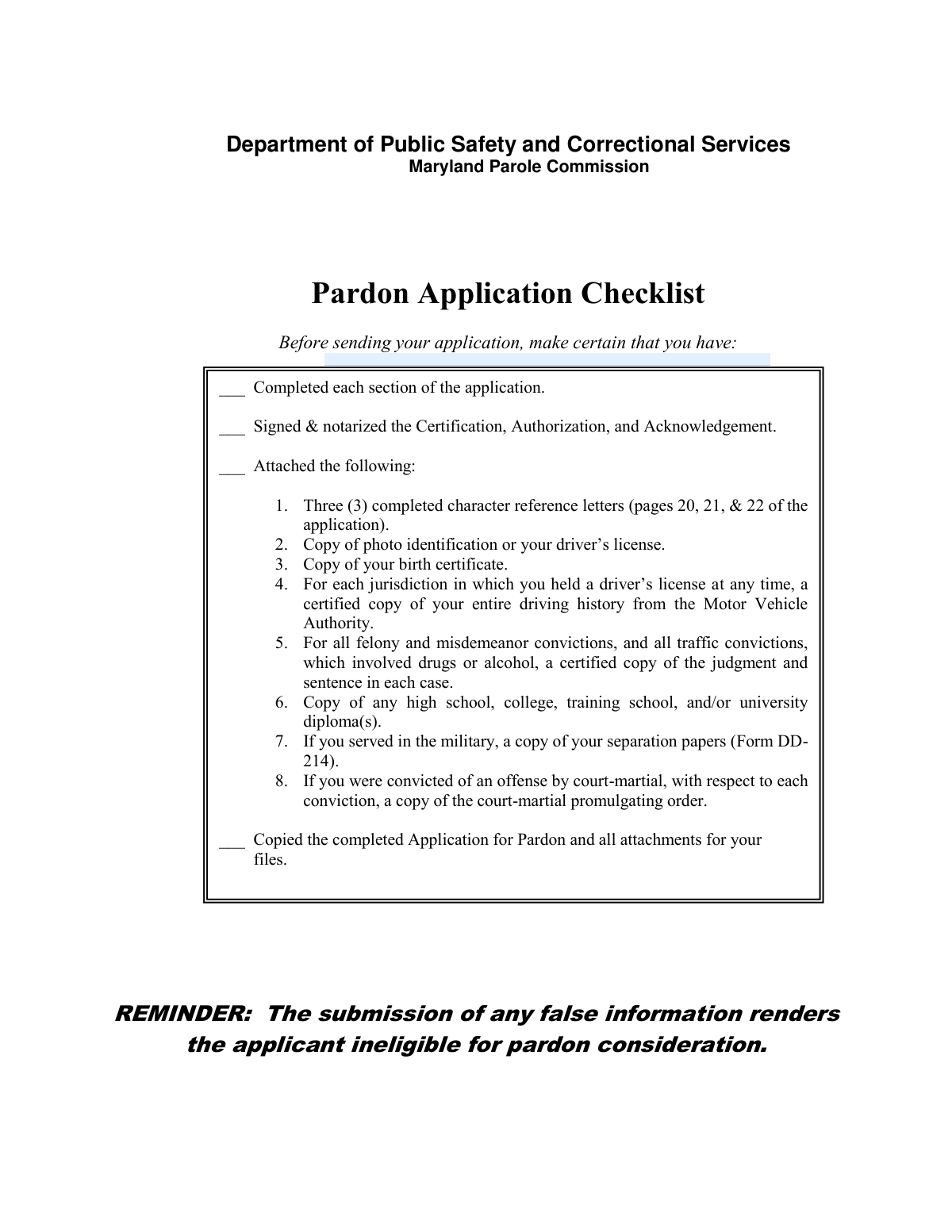
Maryland clemency requests often require character references, proof of employment, and educational certificates. Collecting these documents before you start the form ensures you won't have to pause the process to track down old records or signatures.
Completing complex Maryland government forms can be overwhelming, but AI-powered tools like Instafill.ai can complete these forms in under 30 seconds with high accuracy. Your data stays secure throughout the process, making it a reliable way to handle the extensive data entry required for pardon applications.
Maryland generally requires a specific number of years to pass after you have completed your sentence, including parole or probation, before you can apply for a pardon. Verify that you have met these timeframes to avoid having your application returned without review.
The section regarding your reasons for seeking a pardon is your chance to explain how you have changed. Use clear, concise language to describe your contributions to your community and how a pardon would specifically improve your life or career prospects.
Maryland pardon forms often inquire about outstanding fines, restitution, or state taxes. Before submitting, ensure all financial obligations related to your case are fully paid, as outstanding debts to the state can negatively impact the decision-making process.
Frequently Asked Questions
Maryland provides several forms for individuals seeking relief from past convictions, including applications for pardons and executive clemency. These forms allow residents to petition the Governor and the Parole Commission to officially recognize their rehabilitation and forgive specific offenses.
Eligibility generally depends on the nature of the offense and the time elapsed since the completion of the sentence, including any parole or probation. Applicants are typically required to demonstrate a period of law-abiding behavior and provide a compelling reason for the request, such as employment or licensing requirements.
Yes, AI tools like Instafill.ai can be used to fill out Maryland government forms quickly and accurately. These tools can extract data from your source documents and place it into the correct fields in under 30 seconds, helping to ensure that complex applications are completed without errors.
Most pardon and clemency applications are submitted to the Maryland Parole Commission for initial review. The Commission investigates the request and provides a recommendation to the Governor, who holds the final authority to grant or deny the petition.
Applicants often need to provide certified copies of court records, police reports, and character references. Additionally, you may be asked to include proof of employment, tax returns, and documentation of any community service or educational achievements since the conviction.
While manual entry for detailed Maryland government forms can take several hours, using AI-powered services can complete the process in under 30 seconds. These services accurately extract information from your existing files and populate the form fields automatically.
No, they are distinct legal processes. A pardon is an act of executive clemency that forgives a crime, whereas an expungement removes the record from public view; in some cases, obtaining a pardon is a necessary step before a conviction can be eligible for expungement.
You are not required to have an attorney to file these forms, though some people choose to seek legal advice due to the complexity of the process. Digital tools can help individuals manage the paperwork accurately by ensuring all required fields are addressed based on their personal records.
Maryland pardon forms often require a disclosure of your current financial situation, including assets, debts, and income. This information helps the state assess your current stability and confirm that any court-ordered restitution or fines have been fully paid.
A Governor's pardon is one of the primary ways to seek the restoration of rights lost due to a criminal conviction, including the right to possess a firearm. However, the specific language of the pardon must explicitly state that these rights are being restored.
Once submitted, the Maryland Parole Commission conducts a thorough background investigation, which may include an interview with the applicant. After the investigation, the Commission votes on a recommendation and forwards the file to the Governor's Office for a final decision.
Glossary
- Form Complexity Index
- Instafill’s 0–100 measure of how much effort a form takes to complete, calculated deterministically from the form’s own structure rather than estimated. It combines the number of fillable fields (the largest factor), how difficult those fields are to complete based on their type, the number of pages that contain fields, the amount of conditional “fill-only-if” logic, and how many sections the form is divided into, then adds modifiers for tables and repeating lists, bundled instruction pages, and dense page layouts. A higher score means the form is harder to fill out by hand. The forms in this category have a median Form Complexity Index of 70/100 (Complex). See exactly how it is calculated.
- Pardon
- An official act by the Governor that forgives a past criminal offense and restores certain legal rights to an individual.
- Clemency
- An umbrella term for the Governor's power to show mercy, which includes granting pardons, commuting sentences, or reducing fines.
- Maryland Parole Commission (MPC)
- The state body that reviews pardon applications and provides recommendations to the Governor regarding whether or not to grant the request.
- Disposition
- The final status or outcome of a court case, such as a conviction, acquittal, or dismissal, which is a required detail in criminal history forms.
- Commutation
- A reduction of a legal penalty or sentence length without fully forgiving the underlying crime, distinct from a full pardon.
- Expungement
- The legal process of sealing or destroying a criminal record; in Maryland, receiving a pardon does not automatically expunge a record.
- Nolle Prosequi
- A formal notice by a prosecutor that they are dropping the charges or will no longer pursue the case against the defendant.
- Restoration of Rights
- The process of regaining civil privileges lost due to a conviction, such as the right to vote, hold public office, or possess a firearm.