Fill out medical directive forms
with AI.
Medical directive forms, often referred to as advance directive or end-of-life forms, are essential legal documents that outline an individual's preferences for medical treatment in scenarios where they can no longer communicate for themselves. These documents ensure that healthcare providers and family members understand a patient's wishes regarding life-sustaining treatments, such as artificial ventilation or resuscitation. By proactively completing these forms, individuals can maintain control over their medical care and provide clear guidance to their loved ones during difficult emotional times.
By continuing, you acknowledge Instafill's Privacy Policy and agree to get occasional product update and promotional emails.
About medical directive forms
These forms are typically used by individuals managing chronic illnesses, those entering hospice care, or seniors planning for future health contingencies. For example, a Do-Not-Resuscitate (DNR) form specifies that medical professionals should not perform CPR or other emergency interventions if the patient’s heart stops or they stop breathing. Having these documents prepared and accessible is crucial for emergency responders and hospital staff to ensure that care aligns strictly with the patient’s personal values and medical goals.
Completing these sensitive documents accurately is vital to ensure they are legally recognized and clear to medical staff. Tools like Instafill.ai use AI to fill these forms in under 30 seconds, ensuring data is handled securely and accurately while saving time during critical planning phases.
Every form on this page can be completed without typing. Instafill is form filling software that reads a PDF and fills it for you — including flat and scanned documents that carry no fillable fields at all.
Forms in This Category
The forms in this category have a median Form Complexity Index of 67/100 (Complex), measured across 1 forms by field count, input difficulty, length, conditional logic and structure. See how it is calculated.
| Form Name | Pages | FCI | |
|---|---|---|---|
| 1. | Texas Out-of-Hospital Do-Not-Resuscitate (OOH-DNR) Order | 1 | Complex 67 |
- Enterprise-grade security & data encryption
- 99%+ accuracy powered by AI
- 1,000+ forms from all industries
- Complete forms in under 60 seconds
How to Choose the Right Form
Medical directive forms are essential documents that ensure your healthcare preferences are honored if you become unable to communicate them yourself. While this category can include a wide range of documents like living wills and powers of attorney, it is important to select the specific form that matches your current medical environment and state residency.
When to Choose the Texas OOH-DNR Order
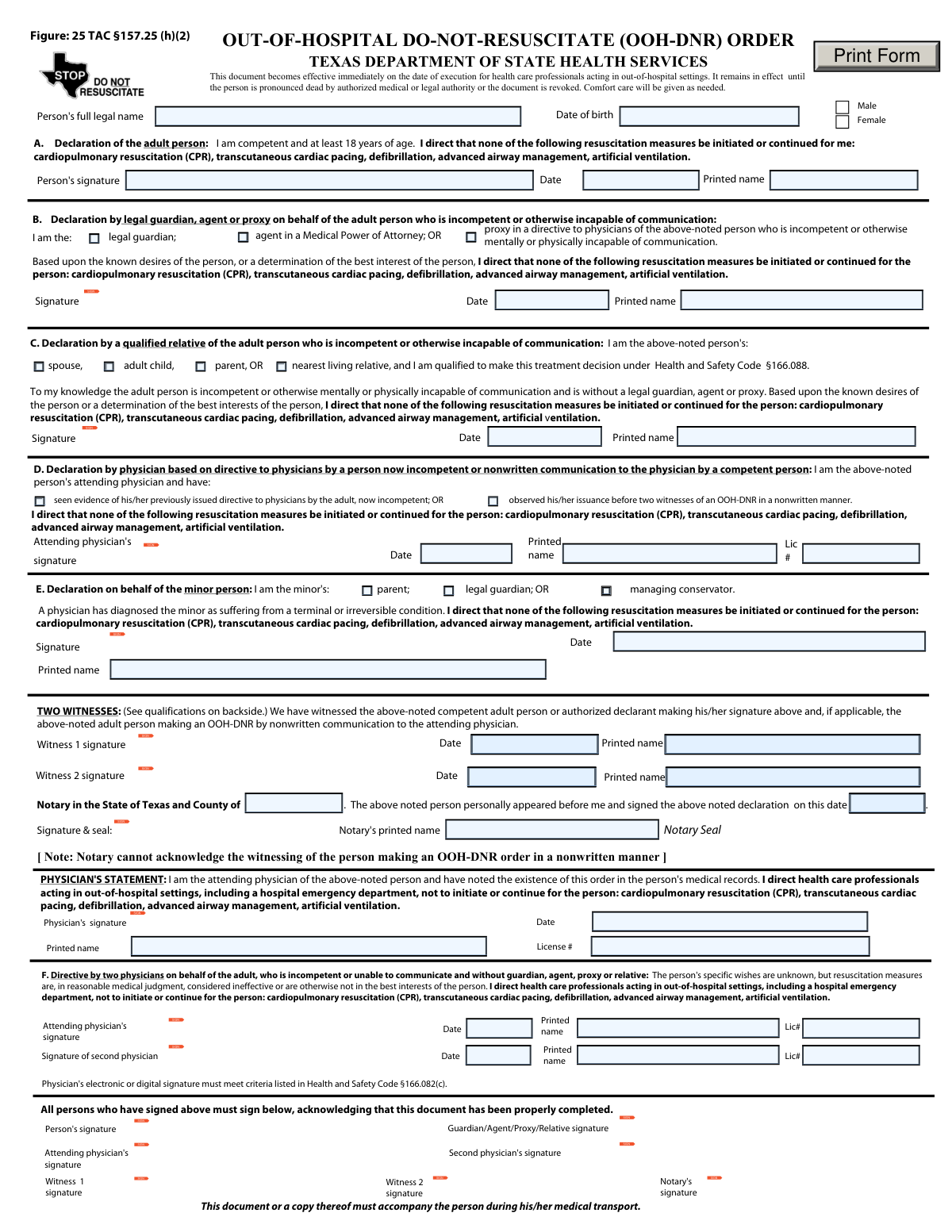
The Texas Out-of-Hospital Do-Not-Resuscitate (OOH-DNR) Order is a specialized document designed for use outside of a traditional hospital setting. This includes locations such as your private home, assisted living facilities, or during transport in an ambulance.
You should choose this form if:
- You are in Texas: This specific form is legally recognized within the state of Texas.
- You want to limit emergency intervention: It specifically instructs first responders and EMS personnel to forgo treatments like CPR, transcutaneous cardiac pacing, and artificial ventilation.
- You want a natural death: It is intended for individuals with terminal or irreversible conditions who wish to avoid invasive life-sustaining measures in an emergency.
Distinguishing Between Directives
It is important to note that the Texas Out-of-Hospital Do-Not-Resuscitate (OOH-DNR) Order is different from a standard "Living Will." While a living will provides general instructions for hospital care, the OOH-DNR is a physician-signed order that applies specifically to emergency medical services (EMS) in the field. If you are looking to prevent unwanted resuscitation during a 911 call or at home, this is the correct document to prioritize.
Completing Your Form with AI
Filling out end-of-life forms can be emotionally difficult and technically precise. Using Instafill.ai, you can convert the Texas Out-of-Hospital Do-Not-Resuscitate (OOH-DNR) Order into a fillable format. This ensures that all critical fields—including patient identification and witness signatures—are clear and legible, reducing the risk of the document being contested or ignored during a medical crisis.
Form Comparison
| Form | Primary Purpose | Scope of Care | Where It Applies | Required Signatures |
|---|---|---|---|---|
| Texas Out-of-Hospital Do-Not-Resuscitate (OOH-DNR) Order | Refuse life-sustaining resuscitation efforts like CPR in non-hospital environments. | Forgoes specific treatments including CPR, defibrillation, and artificial ventilation. | Applicable in homes, nursing facilities, and during transport via ambulance. | Must be signed by the individual or representative and their physician. |
Tips for medical directive forms
Ensure you are using the correct form for your specific environment, such as an Out-of-Hospital DNR for non-clinical settings. These documents are legally specific regarding where they can be enforced by first responders and emergency personnel.
Place a copy of your completed form in a highly visible location, such as on the refrigerator or near your bed. Emergency personnel are trained to look for these documents quickly, and they cannot honor your wishes if the form is locked away.
Most medical directives require signatures from disinterested witnesses or a notary public to be legally valid. Review the specific instructions on each form to ensure all legal formalities are completed before the document is needed.
AI-powered tools like Instafill.ai can complete these forms in under 30 seconds with high accuracy, which is essential for complex medical paperwork. Your data stays secure during the process, providing a practical and efficient way to organize multiple directives.
Medical preferences and life circumstances can change over time. It is a best practice to review your medical directive forms annually to ensure they still accurately reflect your current end-of-life wishes and personal values.
Once your form is finalized, provide copies to your primary care physician and your designated healthcare proxy. Having these documents already recorded in your medical file at the hospital can prevent confusion during a medical crisis.
Frequently Asked Questions
Medical directive forms, often called advance directives, are legal documents that allow you to outline your preferences for medical treatment in the event you become unable to communicate. These forms guide healthcare providers and family members on decisions regarding life-sustaining treatments, such as resuscitation, ventilation, or artificial nutrition.
Any adult over the age of 18 should consider having these forms in place, regardless of their current health status. While they are crucial for those with chronic illnesses or the elderly, they also provide peace of mind for healthy individuals by ensuring their wishes are known during unexpected medical emergencies.
A Living Will is a broad document that details your preferences for various types of end-of-life care and life-prolonging treatments. A Do-Not-Resuscitate (DNR) order is a specific medical instruction that tells healthcare providers not to perform CPR or other emergency measures if your heart stops or you stop breathing.
Yes, you can use AI-powered tools like Instafill.ai to complete medical directive forms efficiently. These tools can accurately extract information from your source documents and place it into the correct fields, ensuring that your personal details and medical preferences are recorded correctly.
Using traditional manual entry can be time-consuming, but AI services like Instafill.ai can fill out these forms in under 30 seconds. This significantly speeds up the process while maintaining high accuracy in data placement.
In most jurisdictions, you do not need a lawyer to fill out standard medical directive or DNR forms. Most states provide official templates that are designed for individuals to complete on their own, provided they meet the specific witnessing or notarization requirements of their state.
You should keep the original document in an easily accessible place and provide copies to your primary physician, your designated healthcare agent, and your family. In the case of an Out-of-Hospital DNR, it is often recommended to keep a copy in a prominent location, such as on your refrigerator or in your wallet, so emergency responders can find it quickly.
While many states recognize directives from other states, laws vary regarding specific language and witnessing requirements. If you spend significant time in more than one state, it is often best to complete the specific medical directive forms required by each state to ensure your wishes are honored without delay.
Yes, you can change or revoke your medical directive at any time as long as you are of sound mind. It is important to periodically review your documents to ensure they still reflect your wishes, especially after a major life event or a change in your health status.
Generally, a DNR order must be signed by both the individual (or their legal representative) and a licensed physician. Depending on state law, the form may also require the signatures of two witnesses or a notary public to be considered legally enforceable.
Glossary
- Form Complexity Index
- Instafill’s 0–100 measure of how much effort a form takes to complete, calculated deterministically from the form’s own structure rather than estimated. It combines the number of fillable fields (the largest factor), how difficult those fields are to complete based on their type, the number of pages that contain fields, the amount of conditional “fill-only-if” logic, and how many sections the form is divided into, then adds modifiers for tables and repeating lists, bundled instruction pages, and dense page layouts. A higher score means the form is harder to fill out by hand. The forms in this category have a median Form Complexity Index of 67/100 (Complex). See exactly how it is calculated.
- Advance Directive
- A general term for legal documents that outline your preferences for medical care and treatment if you become unable to communicate your own decisions.
- DNR (Do-Not-Resuscitate)
- A medical order instructing healthcare providers not to perform emergency life-saving measures, such as chest compressions or electric shocks, if your heart or breathing stops.
- Out-of-Hospital (OOH)
- Settings located outside of a traditional hospital environment, including private residences, assisted living facilities, or during transport by emergency medical services.
- CPR (Cardiopulmonary Resuscitation)
- An emergency procedure involving rhythmic chest compressions and rescue breaths intended to manually circulate blood and oxygen when the heart has stopped.
- Artificial Ventilation
- The use of a machine or manual device to assist or take over the act of breathing for a patient who is unable to breathe sufficiently on their own.
- Defibrillation
- The administration of a controlled electric shock to the heart to stop a life-threatening irregular rhythm and allow a normal heartbeat to resume.
- Medical Power of Attorney
- A legal document that designates a specific person to act as your agent and make healthcare decisions for you if you are incapacitated.
- Palliative Care
- Medical care focused on providing relief from the symptoms and stress of a serious illness, prioritizing comfort and quality of life over curative treatments.