Fill out Michigan tax forms
with AI.
Michigan tax forms related to real estate and property transfers are essential for maintaining accurate public records and ensuring that property taxes are assessed correctly. These documents, which include various affidavit forms, serve as the formal notification to local assessors when a change in ownership occurs. By documenting the specific details of a real estate transaction, these forms help the state determine the taxable value of a property, preventing unexpected tax adjustments and ensuring compliance with Michigan's General Property Tax Act.
By continuing, you acknowledge Instafill's Privacy Policy and agree to get occasional product update and promotional emails.
About Michigan tax forms
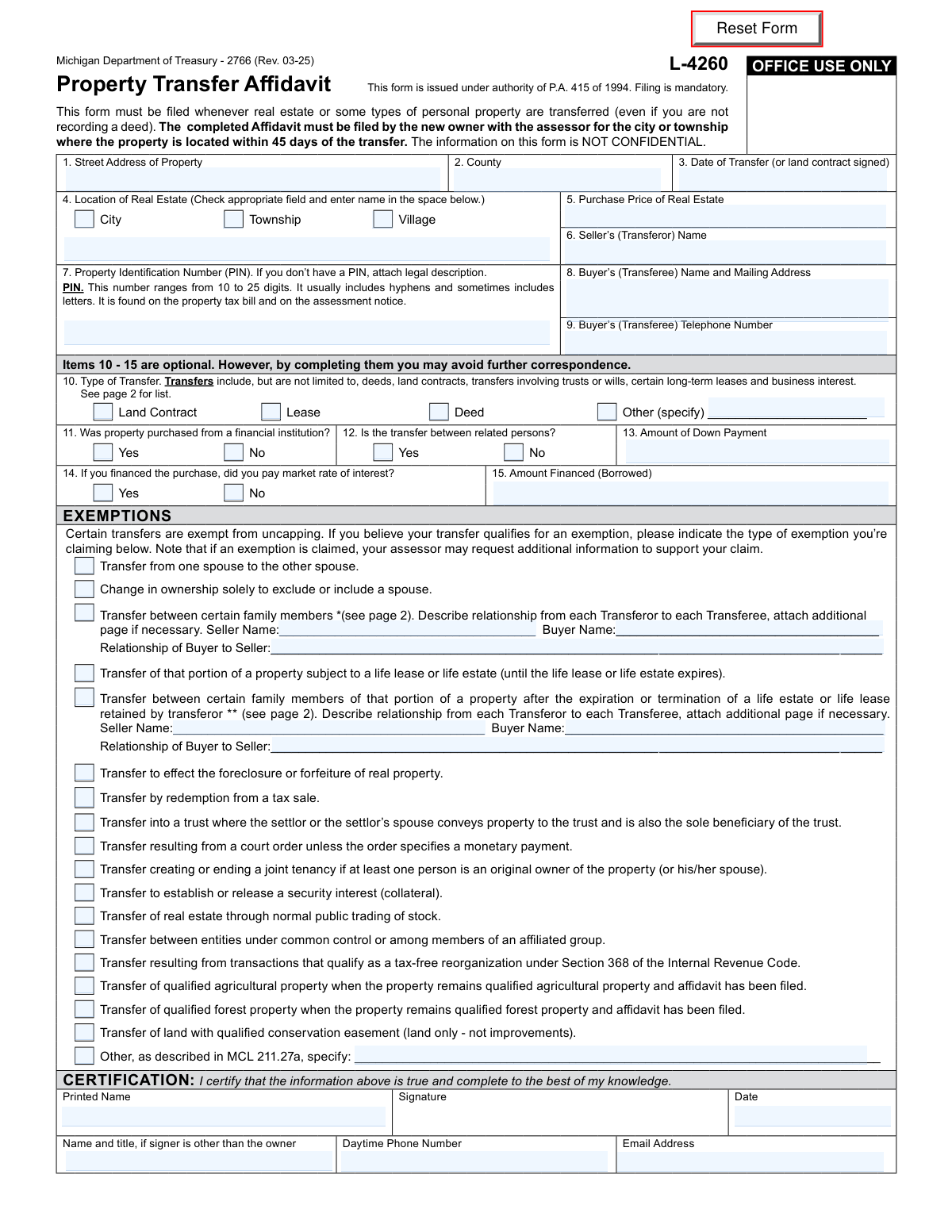
Typically, these forms are required by individuals, families, or businesses who have recently purchased, inherited, or otherwise acquired land, residential homes, or commercial buildings. For example, the Property Transfer Affidavit (Form L-4260) is a mandatory requirement that must be filed with the local assessor within 45 days of any transfer to avoid potential penalties. Navigating these requirements is a critical step for new owners to ensure their legal and financial interests are protected during the transition of property rights.
Managing these administrative tasks can be time-consuming, but tools like Instafill.ai use AI to fill these forms in under 30 seconds while handling your data accurately and securely. This automated approach allows you to focus on the logistics of your move or investment rather than the complexities of manual paperwork.
Every form on this page can be completed without typing. Instafill is form filling software that reads a PDF and fills it for you — including flat and scanned documents that carry no fillable fields at all.
Forms in This Category
The forms in this category have a median Form Complexity Index of 45/100 (Basic), measured across 3 forms by field count, input difficulty, length, conditional logic and structure. See how it is calculated.
| Form Name | Pages | FCI | |
|---|---|---|---|
| 1. | Form L-4260, Property Transfer Affidavit | 1 | Moderate 60 |
| 2. | Form MC 24, Taxation of Costs | 1 | Basic 44 |
| 3. | State of Michigan, Form MC 52, Request and Writ for Garnishment (Income Tax Refund/Credit) | 1 | Basic 45 |
- Enterprise-grade security & data encryption
- 99%+ accuracy powered by AI
- 1,000+ forms from all industries
- Complete forms in under 60 seconds
How to Choose the Right Form
Navigating Michigan's property tax requirements is essential for any new property owner. While the state has various tax documents, the forms in this category specifically address the legal notification of real estate ownership changes to local municipalities.
Reporting Real Estate Ownership Changes
The primary document required for most property transactions in the state is Form L-4260, Property Transfer Affidavit. You should choose this form if any of the following apply:
- Recent Purchase or Gift: You have just bought a home, commercial building, or vacant land, or received property as a gift.
- Inheritance: You have acquired property through a will or trust following a death.
- Legal Transfers: There has been a transfer of ownership as defined by Michigan law, even if no money changed hands.
Filing Deadlines and Compliance
Unlike some tax forms that are filed annually, Form L-4260 is event-driven. It is mandatory for new owners to file this affidavit with their local city or township assessor within 45 days of the transfer.
Choosing to file this form promptly is vital because it notifies the assessor to update property tax records. Failing to file within the 45-day window can result in financial penalties and may lead to an unexpected "uncapping" of the property's taxable value, which often results in a significantly higher tax bill.
Why Use Form L-4260?
This is the specific affidavit required to ensure your property taxes are calculated correctly based on the most recent transfer. By using Instafill.ai to complete Form L-4260, Property Transfer Affidavit, you can ensure all required fields are filled accurately and meet your legal obligations well before the 45-day deadline expires.
Form Comparison
| Form | Primary Purpose | Who Files It | Filing Deadline | Key Sections |
|---|---|---|---|---|
| Form L-4260, Property Transfer Affidavit | Notifies local assessors of property ownership changes for tax record updates. | New property owners, purchasers, or grantees of real estate in Michigan. | Must be filed within 45 days of the property transfer date. | Property identification, transfer details, and contact information for buyer and seller. |
Tips for Michigan tax forms
Michigan law requires the Property Transfer Affidavit to be filed within 45 days of any real estate transfer to avoid financial penalties. Missing this window can result in fines and the immediate 'uncapping' of the property's taxable value without prior notice.
The Parcel ID is the primary way assessors track property records, so ensure this number matches your deed or most recent tax bill exactly. A single digit error can lead to your affidavit being rejected or applied to the wrong property.
Certain transfers, such as those between spouses or into specific types of trusts, may qualify for exemptions that prevent property taxes from increasing. Review the instructions to see if your transfer qualifies, as failing to claim an exemption during filing can be difficult to correct later.
AI-powered tools like Instafill.ai can complete these Michigan forms in under 30 seconds with high accuracy, ensuring no fields are missed. Your sensitive data stays secure during the process, making it an efficient way to manage property documentation.
Property affidavits must be filed with the specific city or township assessor's office where the land is located, rather than the county treasurer. Sending these documents to the wrong municipal department is a common mistake that can lead to missed deadlines.
Ensure the names of the buyer and seller are written exactly as they appear on the recorded deed. Using nicknames or omitting middle initials that are present on the legal title can cause discrepancies in the local tax roll.
Always save a digital or physical copy of the signed affidavit before submitting it to the local assessor. This serves as vital proof of compliance should any questions arise regarding the transfer date or the information reported to the state.
Frequently Asked Questions
These forms are used to notify local assessing officers when ownership of real property changes. They ensure that property tax records are updated and that the taxable value is correctly adjusted based on the transfer of the property.
Any individual or entity that acquires a property through a transfer of ownership must file this affidavit. This includes buyers, grantees, or anyone receiving property through inheritance or other legal transfers of title.
For property transfers, the relevant affidavit must typically be filed with the local assessor within 45 days of the transfer. Failing to file within this timeframe may result in financial penalties or retroactive adjustments to the property's taxable status.
Unlike state income tax forms which go to the Department of Treasury, property transfer affidavits like Form L-4260 are filed directly with the city or township assessor where the property is located. It is important to verify the specific local office address before mailing or hand-delivering the document.
While most transfers require notification, certain transactions between spouses or specific types of legal reorganizations may be exempt from 'uncapping' the property's taxable value. However, the form is often still required to document the change in title for local records.
You will generally need the property's legal description, the parcel identification number, the date of transfer, and the purchase price. Both the buyer and seller information must be accurately recorded to ensure the local assessor can update the records correctly.
Yes, AI tools like Instafill.ai can process these forms in under 30 seconds by extracting relevant data from your source documents and accurately placing it into the correct fields. This reduces the risk of manual entry errors and ensures all required sections are addressed.
While many local assessors still require a physical signature, you can use digital platforms to prepare and fill the forms online. Services like Instafill.ai allow you to convert static PDF forms into interactive ones, making it easier to complete the documentation before printing and filing.
If you are transferring multiple parcels, you usually need to file a separate affidavit for each parcel identification number. If the transfer involves both real estate and personal property, additional state or local forms might be necessary depending on the transaction type.
Failing to file can lead to significant penalties and the 'uncapping' of the property's taxable value, which could result in a higher tax bill. It is critical to submit the forms within the legal timeframe to avoid these financial consequences.
Completing these forms manually can be time-consuming, but using AI-powered automation can reduce the process to less than 30 seconds. Instafill.ai specifically streamlines the data extraction process, allowing for rapid completion while maintaining high accuracy from your original documents.
Glossary
- Form Complexity Index
- Instafill’s 0–100 measure of how much effort a form takes to complete, calculated deterministically from the form’s own structure rather than estimated. It combines the number of fillable fields (the largest factor), how difficult those fields are to complete based on their type, the number of pages that contain fields, the amount of conditional “fill-only-if” logic, and how many sections the form is divided into, then adds modifiers for tables and repeating lists, bundled instruction pages, and dense page layouts. A higher score means the form is harder to fill out by hand. The forms in this category have a median Form Complexity Index of 45/100 (Basic). See exactly how it is calculated.
- Uncapping
- The process where a property's taxable value is reset to match its State Equalized Value (SEV) following a transfer of ownership, often resulting in higher taxes.
- Taxable Value
- The specific value used to calculate property taxes, which is usually the lesser of the property's Capped Value or its State Equalized Value.
- State Equalized Value (SEV)
- A value representing approximately 50% of a property's true cash value or market value, as determined by the local assessor.
- Transfer of Ownership
- The conveyance of title or interest in a property through sale, gift, inheritance, or other legal means that triggers the filing of a Property Transfer Affidavit.
- Assessor
- The local official responsible for maintaining property records, determining property values, and receiving tax affidavits within a city or township.
- Capped Value
- A limit on how much a property's taxable value can increase from year to year, restricted by the rate of inflation or 5%, whichever is less.
- Principal Residence Exemption (PRE)
- A tax exemption that reduces the property tax burden for individuals who own and occupy a property as their primary home.
- L-4260
- The official form number for the Michigan Property Transfer Affidavit, required by law to be filed within 45 days of any real estate transfer.