Fill out mileage reimbursement forms
with AI.
Mileage reimbursement forms are essential documents used by employees, contractors, and care providers to track and claim compensation for business-related travel. These forms ensure that individuals are fairly paid for the wear and tear on their personal vehicles and the cost of fuel used during work duties. In specialized sectors like Financial Management Services (FMS), accurate mileage tracking is critical for staying within approved spending plans and meeting regulatory requirements for person-centered care.
By continuing, you acknowledge Instafill's Privacy Policy and agree to get occasional product update and promotional emails.
About mileage reimbursement forms
These forms are typically used by healthcare workers, social service providers, and corporate employees who frequently travel between job sites or transport clients. Whether you are documenting a single trip or maintaining a monthly log, precision is key; you often need to record specific odometer readings, exact destinations, and the purpose of each journey. Missing details can lead to payment delays or audits, making it vital to maintain clear and organized records of every mile driven to ensure compliance with reimbursement policies.
Manually calculating totals and transcribing log entries into PDF fields can be a tedious and error-prone process. Tools like Instafill.ai use AI to fill these mileage reimbursement forms in under 30 seconds, ensuring data is handled accurately and securely while saving significant administrative time. This allows you to focus on your primary responsibilities rather than the repetitive task of manual data entry.
Every form on this page can be completed without typing. Instafill is form filling software that reads a PDF and fills it for you — including flat and scanned documents that carry no fillable fields at all.
Forms in This Category
The forms in this category have a median Form Complexity Index of 73/100 (Complex), measured across 1 forms by field count, input difficulty, length, conditional logic and structure. See how it is calculated.
| Form Name | Pages | FCI | |
|---|---|---|---|
| 1. | Mileage Reimbursement Request for FMS | 1 | Complex 73 |
- Enterprise-grade security & data encryption
- 99%+ accuracy powered by AI
- 1,000+ forms from all industries
- Complete forms in under 60 seconds
How to Choose the Right Form
Navigating mileage reimbursement forms often depends on the specific program or funding source you are working under. While many travel expense forms share similar fields, the requirements for specialized services are more rigorous and require specific documentation to ensure payment.
When to Use the FMS Mileage Form
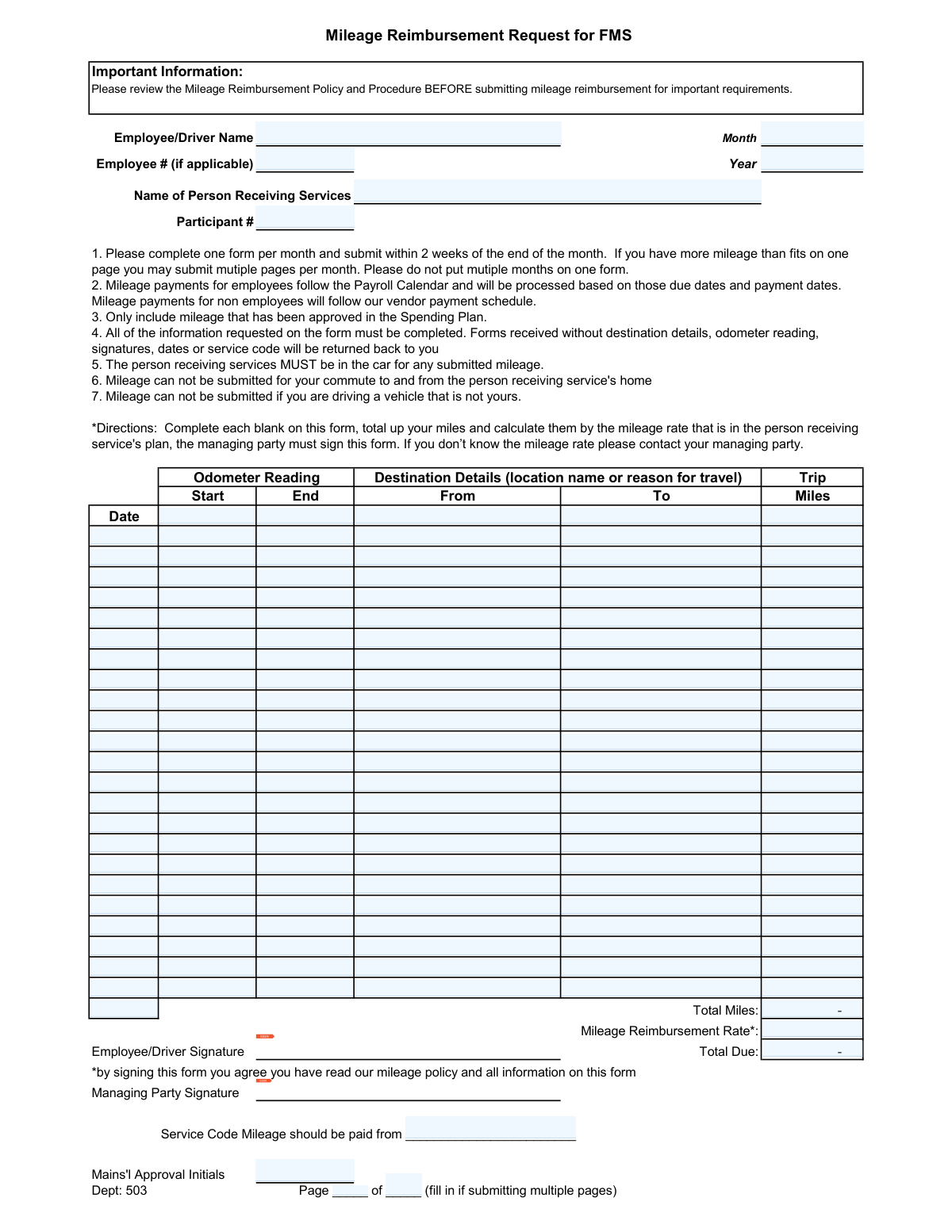
If you are a caregiver, driver, or employee providing transportation for an individual receiving services through Financial Management Services, you must use the Mileage Reimbursement Request for FMS. This form is specifically designed to align with approved spending plans and ensure that every mile driven for service delivery is accounted for according to state or agency guidelines.
Key Features of the FMS Request
Unlike generic expense reimbursement forms, the Mileage Reimbursement Request for FMS requires a high level of detail to satisfy audit requirements. You should choose this form if your reporting needs to include:
- Odometer Readings: You must provide specific start and end readings for every individual trip.
- Detailed Destinations: Each entry requires a clear destination and purpose to justify the travel.
- Spending Plan Alignment: The form is used to track mileage usage against a pre-approved budget for the person receiving services.
Tips for Accurate Submission
To ensure your reimbursement is processed without delays, consistency is key. We recommend logging your travel daily rather than waiting until the end of the month. Because the Mileage Reimbursement Request for FMS often requires meticulous math, using a digital tool can prevent calculation errors that might lead to a rejected claim.
If your travel is for general business purposes—such as attending a corporate meeting or a training seminar—you may typically look for standard corporate travel expense forms. However, for those operating within the FMS framework, this specific form is the required standard for compliance and reimbursement.
Form Comparison
| Form | Primary Purpose | Required Information | Submission Frequency |
|---|---|---|---|
| Mileage Reimbursement Request for FMS | Requesting payment for mileage incurred while transporting individuals receiving services. | Requires trip dates, odometer readings, specific destinations, and total calculated miles. | Typically submitted monthly or as specified by the approved spending plan. |
Tips for mileage reimbursement forms
Always record the exact start and end odometer readings for every trip rather than estimating distances. This ensures that your reimbursement totals match the physical records of the vehicle and prevents payment delays due to discrepancies found during audits.
Before submitting your FMS forms, verify that the requested mileage falls within the limits of the participant's approved spending plan. Exceeding the allotted budget for travel or transportation can result in partial payments or the need for a formal plan amendment.
Avoid using vague terms like 'Doctor's Office' or 'Store' in the destination column. To meet FMS compliance standards, include the full street address or specific facility name to provide a clear and verifiable audit trail for every mile claimed.
For drivers managing multiple trips, AI-powered tools like Instafill.ai can complete these forms in under 30 seconds with high accuracy. Your data stays secure during the process, making it a reliable and efficient way to handle high volumes of reimbursement paperwork.
Ensure that the dates and times listed on your mileage log correspond exactly with the service logs or timesheets submitted for the same period. Any mismatch between when a client received care and when the mileage occurred can trigger a manual review and delay your payment.
Instead of filling out a new form for every single trip, keep a running log and submit a consolidated form at the end of each week or pay period. This reduces administrative overhead for you and simplifies the processing task for the fiscal intermediary.
Frequently Asked Questions
These forms allow employees, contractors, or caregivers to track and submit the miles they have driven for work-related purposes. By documenting specific trips, individuals can receive payment for fuel and vehicle wear and tear incurred while performing their duties.
This form is specifically designed for drivers and employees providing services within Financial Management Services (FMS) programs. It is used to document travel when transporting individuals receiving services to ensure the driver is compensated according to an approved spending plan.
Most forms require the date of travel, the starting and ending odometer readings, the destination, and the total miles driven for each trip. You may also need to include the name of the person being transported and the specific purpose of the trip to ensure the claim is valid.
Yes, AI tools like Instafill.ai can fill these forms in under 30 seconds by accurately extracting and placing data from your source documents. This technology eliminates the need for manual data entry and helps ensure that odometer readings and destinations are transcribed correctly.
When using an AI-powered service, the process is nearly instantaneous, often taking less than 30 seconds to populate a full log of trips. This is significantly faster than manual entry, especially for forms that require detailed trip-by-trip documentation.
Submission deadlines vary by organization, but it is common practice to submit these forms on a weekly or monthly basis. You should check with your specific FMS provider or employer to determine the exact cutoff dates for each pay period.
If you have a static PDF that cannot be typed into, services like Instafill.ai can convert it into an interactive, fillable document. This allows you to complete the form digitally, which is often preferred for electronic submission and faster processing.
Yes, most FMS and travel expense forms require 'point-to-point' odometer readings to verify the distance traveled. It is important to record the reading at the exact start and end of the service-related trip to maintain an accurate and audit-ready log.
Completed forms are usually submitted to a human resources department, a dedicated payroll office, or an FMS administrator. Depending on your organization's policy, you may be able to submit them via email, an online portal, or as a physical copy.
Maintaining a detailed log is crucial for transparency and compliance with approved spending plans. Accurate records prevent reimbursement delays and ensure that all travel is properly accounted for in the event of an internal review or tax audit.
Glossary
- Form Complexity Index
- Instafill’s 0–100 measure of how much effort a form takes to complete, calculated deterministically from the form’s own structure rather than estimated. It combines the number of fillable fields (the largest factor), how difficult those fields are to complete based on their type, the number of pages that contain fields, the amount of conditional “fill-only-if” logic, and how many sections the form is divided into, then adds modifiers for tables and repeating lists, bundled instruction pages, and dense page layouts. A higher score means the form is harder to fill out by hand. The forms in this category have a median Form Complexity Index of 73/100 (Complex). See exactly how it is calculated.
- FMS (Financial Management Services)
- A service that helps individuals managing their own care budgets handle financial tasks, such as paying employees and processing mileage reimbursements.
- Spending Plan
- A pre-approved budget that dictates how much funding is allocated for specific services, including the maximum amount allowed for travel and mileage.
- IRS Standard Mileage Rate
- The per-mile rate set annually by the government used to calculate the deductible costs of operating an automobile for business or medical purposes.
- Odometer Reading
- The specific numbers shown on a vehicle's dashboard at the start and end of a trip, used to calculate the exact distance traveled for a claim.
- Fiscal Intermediary
- An entity that acts as a middleman to process paperwork, verify that expenses match the spending plan, and issue payments to the driver.
- Commuting Miles
- The distance driven from a home to a primary work location, which is generally considered a personal expense and not eligible for reimbursement.
- Point of Origin
- The exact starting address or location where a service-related trip begins, required for auditing and distance verification.
- Incidental Expenses
- Small additional costs incurred during travel, such as parking fees or tolls, that may be requested alongside mileage on reimbursement forms.