Fill out military education forms
with AI.
Military education forms are essential documents for service members and veterans looking to access funding for their academic or vocational pursuits. These forms facilitate the transition from active duty to civilian life by ensuring individuals receive the financial support they earned through their service. Proper completion of these documents is critical for managing benefits like the Post-9/11 GI Bill or specialized vocational rehabilitation programs, as they dictate how tuition, housing allowances, and supply costs are reimbursed by the Department of Veterans Affairs.
By continuing, you acknowledge Instafill's Privacy Policy and agree to get occasional product update and promotional emails.
About military education forms
Typically, these forms are required by veterans who need to adjust their benefit status or request specific reimbursements for past educational expenses. For instance, a veteran might use these documents to request a retroactive induction, switching from Chapter 33 to Chapter 31 benefits for a period they have already completed. Whether you are a student veteran navigating university life or a professional seeking additional certifications, these forms ensure your service records align with your current educational goals and financial needs.
Navigating government paperwork can be time-consuming, but tools like Instafill.ai use AI to fill these forms accurately and securely in under 30 seconds. By automating the data entry process, service members can spend less time on administrative hurdles and more time focusing on their education and career development.
Every form on this page can be completed without typing. Instafill is form filling software that reads a PDF and fills it for you — including flat and scanned documents that carry no fillable fields at all.
Forms in This Category
| Form Name | Pages | FCI | |
|---|---|---|---|
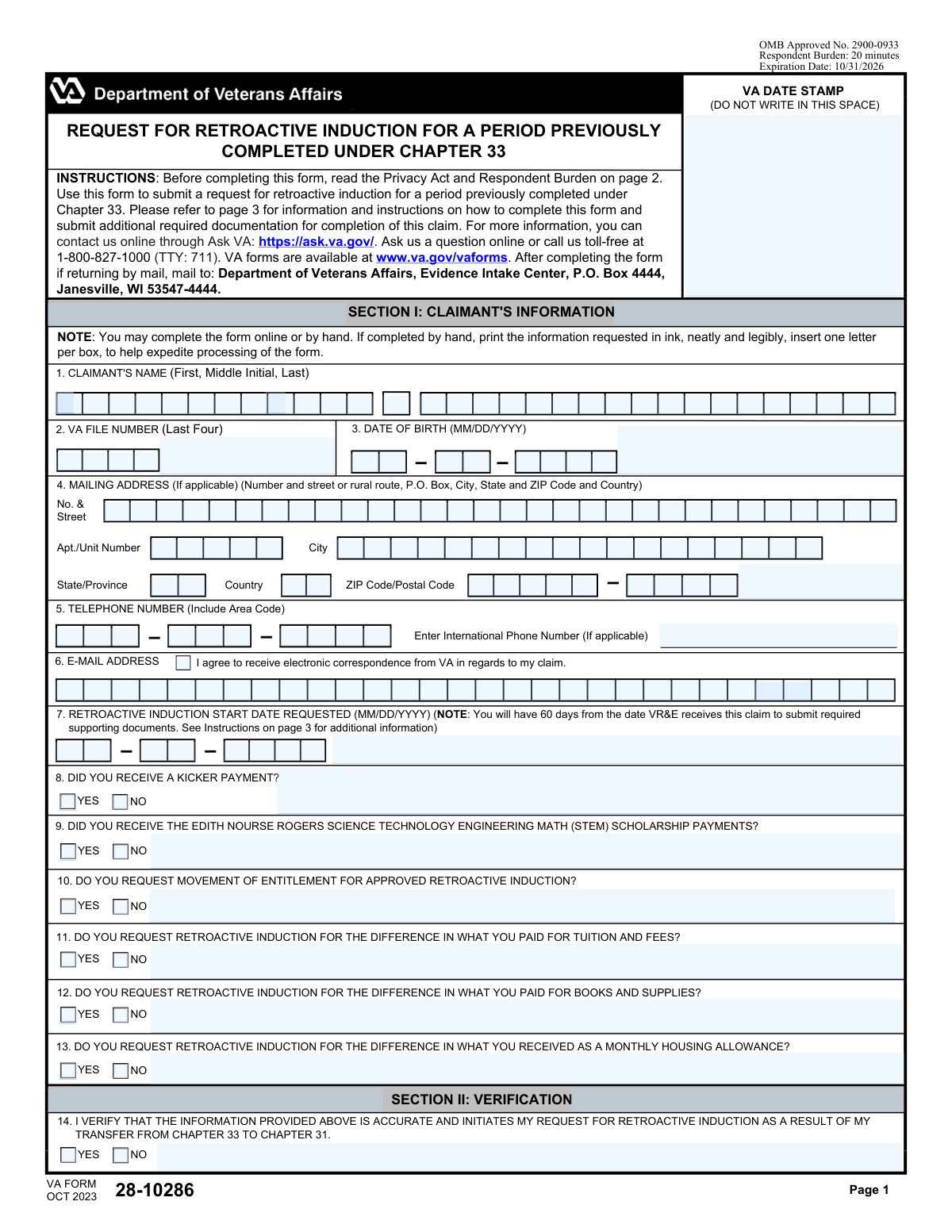
| 1. | VA Form 28-10286, Request for Retroactive Induction for a Period Previously Completed Under Chapter 33 | 1 | – |
- Enterprise-grade security & data encryption
- 99%+ accuracy powered by AI
- 1,000+ forms from all industries
- Complete forms in under 60 seconds
How to Choose the Right Form
Navigating Department of Veterans Affairs (VA) education benefits can be complex, especially when you are transitioning between different programs. Currently, this category focuses on a specific administrative process known as "Retroactive Induction," which allows veterans to optimize how their previous education periods were funded.
When to Use VA Form 28-10286
You should select VA Form 28-10286, Request for Retroactive Induction for a Period Previously Completed Under Chapter 33, if your situation meets these specific criteria:
- Entitlement Status: You are currently entitled to and pursuing benefits under Chapter 31 (Veteran Readiness and Employment/VR&E).
- Past Education: You have already completed a period of training or schooling that was originally paid for using Chapter 33 (Post-9/11 GI Bill) benefits.
- Benefit Optimization: You wish to reclassify that past period as Chapter 31 benefits instead of Chapter 33.
The Goal of Retroactive Induction
The primary reason to choose VA Form 28-10286 is to maximize your remaining benefits. By retroactively applying Chapter 31 to a past period, you can often "buy back" months of your Post-9/11 GI Bill entitlement. This allows you to save those GI Bill months for future use while potentially receiving reimbursement for differences in tuition, fees, and subsistence allowances that Chapter 31 might have covered more extensively.
Is This the Right Form for You?
If you are looking to apply for education benefits for the first time, or if you are simply trying to transfer your GI Bill to a dependent, this is not the correct document. This form is strictly for veterans who are already in the VR&E program and want to look backward at a completed term.
Before you begin, ensure you have the specific dates of the education period you are contesting. Using Instafill.ai can help you accurately complete this detailed request and ensure that your justification for the retroactive change is clearly presented to the VA.
Form Comparison
| Form | Primary Purpose | Eligible Applicants | Benefit Reclassification | Key Outcome |
|---|---|---|---|---|
| VA Form 28-10286, Request for Retroactive Induction for a Period Previously Completed Under Chapter 33 | Requests retroactive reclassification of completed educational periods from Chapter 33 to Chapter 31. | Veterans entitled to Chapter 31 benefits who previously utilized Chapter 33 funding. | Switches past educational benefit coverage from Chapter 33 (Post-9/11) to Chapter 31 (VR&E). | May result in reimbursement for differences in tuition, fees, and monthly allowances. |
Tips for military education forms
Using AI-powered tools like Instafill.ai can help you complete complex military education forms in under 30 seconds with high accuracy. Your sensitive data remains secure throughout the process, providing a massive time-saver for veterans managing multiple benefit claims and documentation requirements.
When requesting retroactive induction, ensure the start and end dates of your previous educational periods match your official transcripts and Chapter 33 records exactly. Inconsistent dates are a primary cause for processing delays or denials during the benefit reclassification process.
Before submitting forms for retroactive induction, confirm with your Vocational Rehabilitation and Employment counselor that you meet the specific eligibility criteria. Coordinating with your counselor beforehand ensures you are applying for a period that qualifies under current Chapter 31 guidelines.
Keep a detailed record of tuition, fees, and subsistence allowances already paid out under Chapter 33 for the periods you wish to reclassify. Having these figures accessible makes it easier to verify the accuracy of your request and anticipate potential reimbursement differences.
Many military education forms are rejected because a signature field was missed or a digital signature was not properly validated. Always review the final document to ensure every required signature and date field is fully populated before sending it to the VA.
Create a dedicated digital folder for all your military education paperwork, including the final submitted versions and any confirmations of receipt. This organization is vital if you need to reference specific claim details during a follow-up interview or an appeal.
Frequently Asked Questions
These forms facilitate the application and management of educational benefits provided by the Department of Veterans Affairs and other military branches. They help veterans and service members secure funding for tuition, housing, and books under programs like the Post-9/11 GI Bill or Veteran Readiness and Employment.
Eligibility generally extends to active-duty service members, veterans, and in some cases, their dependents or survivors. The specific form you need will depend on your service history and which benefit 'chapter' you are qualified to receive.
The correct form depends on your specific goal, such as applying for initial benefits, changing your school, or requesting a retroactive adjustment of benefits. You should review the requirements for different chapters, such as Chapter 31 or Chapter 33, to see which aligns with your current educational status.
A retroactive induction allows a veteran to reclassify a past period of education from one benefit program to another, such as moving a period originally paid under Chapter 33 to Chapter 31. This process is often used to recover tuition costs or allowances that would have been higher under the alternative benefit program.
Most forms are submitted directly to the Department of Veterans Affairs (VA) through their official online portal or by mailing them to a regional processing office. Some forms may also need to be coordinated with your school's certifying official or a Vocational Rehabilitation Counselor.
Yes, AI tools like Instafill.ai can be used to fill out military education forms by accurately extracting data from your source documents and placing it into the required fields. These tools can typically complete a form in under 30 seconds, ensuring that information like service dates and benefit chapters are entered correctly.
Commonly required documents include your DD Form 214, proof of enrollment from your educational institution, and sometimes financial records of past tuition payments. For retroactive requests, you may also need to provide evidence of your eligibility for the specific benefit chapter you are switching to.
Manually filling out these forms can take significant time due to the detailed service history required, but using AI-powered services can complete the process in less than a minute. This technology automates the data entry, allowing you to review and sign the document quickly.
While many education benefits have long eligibility periods, retroactive requests often have specific windows during which they must be filed. It is best to submit these forms as soon as you identify a discrepancy or change in your benefit eligibility to ensure you receive any entitled reimbursements.
Chapter 33 refers to the Post-9/11 GI Bill, which provides tuition and housing for veterans, while Chapter 31 is the Veteran Readiness and Employment (VR&E) program for veterans with service-connected disabilities. Some veterans may find it more advantageous to use Chapter 31 for certain periods of study, which is why retroactive forms exist.
Glossary
- Retroactive Induction
- The process of reclassifying a past period of education or training from one benefit chapter to another, typically to Chapter 31, to recover costs or preserve future eligibility.
- Chapter 31 (VR&E)
- The Veteran Readiness and Employment program, which provides assistance to veterans with service-connected disabilities to help them prepare for, find, and maintain suitable employment.
- Chapter 33 (Post-9/11 GI Bill)
- An education benefit program for individuals who served on active duty after September 10, 2001, covering tuition, housing, and books.
- Subsistence Allowance
- A monthly payment provided to veterans participating in a vocational rehabilitation program to help cover living expenses while they are in training or school.
- VRC (Vocational Rehabilitation Counselor)
- A VA professional who works directly with veterans to evaluate their needs, develop a rehabilitation plan, and approve requests like retroactive induction.
- Entitlement
- The specific duration of time, usually measured in months and days, that a veteran is legally eligible to receive benefits under a VA education or training program.
- Period of Pursuit
- The specific dates during which a veteran was actively enrolled in and attending an approved course of study or training program.
- Delimiting Date
- The expiration date by which a veteran must use their education benefits; this date varies based on when the service member left active duty and the specific benefit type.