Fill out minor account forms
with AI.
Minor account forms are essential legal and financial documents used to manage assets held for the benefit of individuals under the age of majority. These typically fall under the Uniform Gifts to Minors Act (UGMA) or the Uniform Transfers to Minors Act (UTMA), providing a structured framework for adults to oversee investments, savings, or trust funds until the minor reaches adulthood. Proper documentation ensures that these assets are protected and that transitions of responsibility—such as designating a successor custodian—are handled according to legal requirements and financial regulations.
By continuing, you acknowledge Instafill's Privacy Policy and agree to get occasional product update and promotional emails.
About minor account forms
Parents, legal guardians, and financial advisors often encounter these forms when setting up or managing college funds, inheritance accounts, or general investment portfolios for children. For instance, a Successor Custodian Designation Form is critical for ensuring that if the primary custodian can no longer manage the account due to resignation or incapacitation, a trusted individual is already authorized to step in. Having these documents prepared in advance prevents administrative hurdles and ensures the minor's financial interests remain uninterrupted during unexpected life events.
Managing financial paperwork for a minor can be time-consuming, but tools like Instafill.ai use AI to complete these forms in under 30 seconds while maintaining high standards for data accuracy and security. This allows you to handle complex custodial documentation quickly and move forward with your financial planning without the burden of manual data entry.
Every form on this page can be completed without typing. Instafill is form filling software that reads a PDF and fills it for you — including flat and scanned documents that carry no fillable fields at all.
Forms in This Category
The forms in this category have a median Form Complexity Index of 31/100 (Basic), measured across 1 forms by field count, input difficulty, length, conditional logic and structure. See how it is calculated.
| Form Name | Pages | FCI | |
|---|---|---|---|
| 1. | Manning & Napier Fund, Inc. UGMA/UTMA Successor Custodian Designation Form | 1 | Basic 31 |
- Enterprise-grade security & data encryption
- 99%+ accuracy powered by AI
- 1,000+ forms from all industries
- Complete forms in under 60 seconds
How to Choose the Right Form
Understanding UGMA/UTMA Minor Accounts
Minor accounts, specifically those governed by the Uniform Gifts to Minors Act (UGMA) or the Uniform Transfers to Minors Act (UTMA), are designed to hold and protect assets for a child until they reach the age of majority. These accounts require a custodian to manage the investments on the minor's behalf. Because these assets belong to the minor, ensuring a clear line of management is essential for long-term financial security.
When to Use the Manning & Napier Successor Form
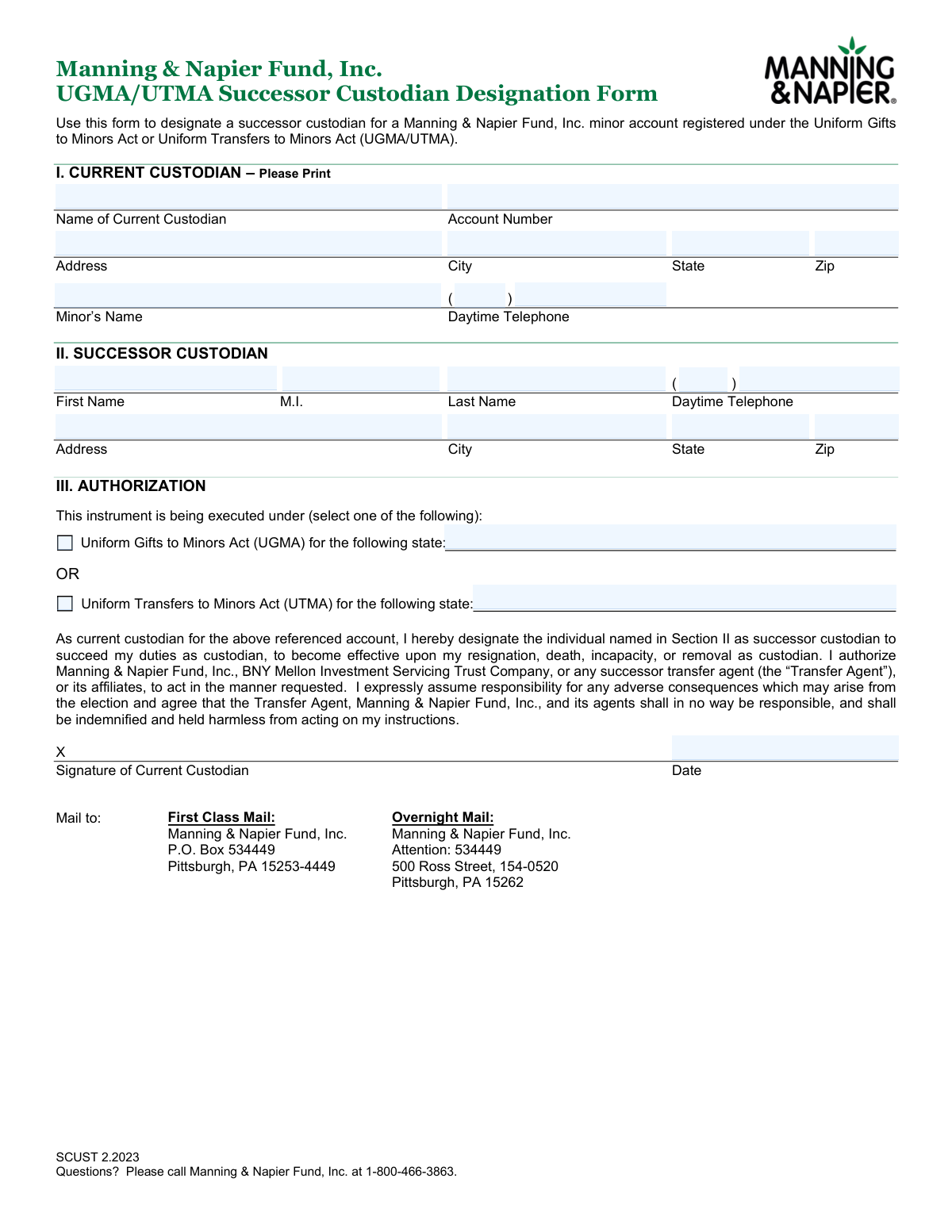
The primary document in this category is the Manning & Napier Fund, Inc. UGMA/UTMA Successor Custodian Designation Form. This form is highly specific and should be used in the following scenarios:
- Proactive Planning: If you are the current custodian and want to name a backup person to take over management of the account in the event of your death or incapacitation.
- Resignation: If you intend to step down from your role as custodian and need to formally designate the person who will succeed you.
- Asset Continuity: When you want to ensure that the minor’s Manning & Napier mutual fund holdings remain accessible and managed without legal delays during a transition.
Why Designating a Successor is Critical
Choosing the right successor is just as important as filling out the form itself. Without a designated successor on file, the process of transferring management of the minor's funds can become legally complex, potentially requiring court intervention. By completing the Manning & Napier Fund, Inc. UGMA/UTMA Successor Custodian Designation Form, you provide immediate legal clarity and safeguard the minor's assets from administrative limbo.
Completing Your Form Efficiently
Financial forms for minor accounts require high levels of accuracy to be accepted by fund managers. Using Instafill.ai, you can transform the Manning & Napier Successor Custodian Designation Form into an interactive document, ensuring every field is completed correctly so that the minor’s financial future is protected without unnecessary paperwork hurdles.
Form Comparison
| Form | Purpose | Who Files It | Trigger Event |
|---|---|---|---|
| Manning & Napier Fund, Inc. UGMA/UTMA Successor Custodian Designation Form | Designates a successor custodian for UGMA/UTMA accounts to ensure continuous asset management. | The current custodian of a minor's account registered with Manning & Napier Fund. | Used upon the resignation, death, or incapacitation of the primary custodian. |
Tips for minor account forms
UGMA and UTMA accounts have different age thresholds for when a minor gains full control of the assets, which can vary significantly by state. Check your local regulations to ensure the successor custodian understands exactly when their fiduciary duties will officially conclude.
When naming a successor, ensure the individual meets the eligibility requirements, such as being a legal adult or a qualified trust company. It is often wise to discuss the responsibility with the individual beforehand to confirm they are willing to manage the minor's financial interests.
AI-powered tools like Instafill.ai can complete these forms in under 30 seconds with high accuracy, ensuring all fields are correctly mapped. Your sensitive financial and personal data stays secure during the process, making it a reliable way to handle complex custodial paperwork.
Many minor account forms require the signature of the current custodian and may require a witness or notary depending on the fund's rules. Double-check the specific requirements for the Manning & Napier forms to avoid administrative delays in processing your successor designation.
Once the form is submitted, keep both a digital and physical copy for your personal records and provide one to the designated successor. This ensures that the transition of authority is documented and accessible to all relevant parties in the event of an emergency.
Ensure the name of the minor and the account number exactly match the records held by the fund. Even small discrepancies in the spelling of names or digits in an account number can cause the financial institution to reject the designation form.
Frequently Asked Questions
Minor account forms, such as those for UGMA or UTMA accounts, are used to manage financial assets held for the benefit of a person under the age of majority. These documents ensure that a designated adult can handle investments and transfers until the minor reaches the legal age to take full control of the account.
A successor custodian is a person designated to take over the management of a minor's account if the current custodian can no longer perform their duties. This role is critical for ensuring there is no lapse in oversight for the minor's assets due to the current custodian's resignation, incapacitation, or death.
It is recommended to file this form as soon as a minor's account is established or whenever the current custodian wants to update their contingency plans. Proactively naming a successor prevents legal complications and delays in account access should an unexpected event occur.
Yes, AI tools like Instafill.ai can be used to fill out minor account forms efficiently by accurately extracting data from your source documents and placing it into the correct fields. This technology helps ensure that complex financial forms are completed without manual entry errors.
Using AI-powered services, you can typically complete minor account forms in under 30 seconds. These platforms automate the data entry process, making it much faster than traditional manual typing or handwriting.
While both are custodial accounts for minors, UGMA accounts are usually limited to cash and securities, whereas UTMA accounts can include other types of property like real estate. Successor custodian forms often cover both account types as they fall under similar state-governed Uniform Acts.
Generally, any competent adult or a trust company can be named as a successor custodian. It is important to choose an individual or entity capable of managing financial assets and understanding the legal responsibilities associated with fiduciary duties.
If no successor is named, the process for appointing a new custodian may require court intervention or follow specific state laws, which can be time-consuming and costly. Filing a designation form ahead of time ensures a smooth and immediate transition of authority for the minor's benefit.
Once the form is filled out and signed, it must be submitted directly to the financial institution or fund manager holding the assets, such as Manning & Napier. They will update their records to reflect the new designation and may require additional identification for the successor.
Yes, once properly executed and filed with the relevant financial institution, these forms serve as a legal instruction regarding who has the authority to manage the minor's assets. They are governed by the specific Uniform Act adopted by the state where the account was established.
In most cases, the current custodian has the primary authority to designate a successor. However, depending on state law, if the minor has reached a certain age (often 14), they may be able to petition the court or participate in the selection process if the current custodian fails to name one.
Many financial institutions require custodial forms to be notarized or to have a Medallion Signature Guarantee to prevent fraud. You should check the specific instructions on the form or contact the account provider to confirm the authentication requirements for your submission.
Glossary
- Form Complexity Index
- Instafill’s 0–100 measure of how much effort a form takes to complete, calculated deterministically from the form’s own structure rather than estimated. It combines the number of fillable fields (the largest factor), how difficult those fields are to complete based on their type, the number of pages that contain fields, the amount of conditional “fill-only-if” logic, and how many sections the form is divided into, then adds modifiers for tables and repeating lists, bundled instruction pages, and dense page layouts. A higher score means the form is harder to fill out by hand. The forms in this category have a median Form Complexity Index of 31/100 (Basic). See exactly how it is calculated.
- UTMA (Uniform Transfers to Minors Act)
- A law that allows a minor to receive and own various types of property, such as real estate or fine art, under the supervision of a custodian.
- UGMA (Uniform Gifts to Minors Act)
- A set of state laws that allows adults to transfer financial assets, like cash and stocks, to a minor without setting up a complex trust.
- Custodian
- An adult or entity appointed to manage and protect the assets in a minor's account until the child reaches the legal age of majority.
- Successor Custodian
- An individual named to take over the management of a minor's account if the current custodian resigns, passes away, or becomes unable to serve.
- Age of Majority
- The legally defined age, usually 18 or 21 depending on the state, at which a minor is entitled to take full control of the assets in their account.
- Incapacitation
- A condition where a custodian is legally determined to be physically or mentally unable to fulfill their responsibilities for the account.
- Fiduciary Duty
- The legal requirement for a custodian to act in the best financial interest of the minor rather than for their own personal gain.
- Beneficiary
- The minor for whom the account was established and who legally owns the assets held within the UGMA or UTMA account.