Fill out minor asset forms
with AI.
Minor asset forms are essential legal documents designed to manage financial resources held in trust or under custodial arrangements for individuals under the age of majority. These forms typically govern accounts established under the Uniform Transfers to Minors Act (UTMA) or the Uniform Gifts to Minors Act (UGMA). They play a critical role in ensuring that assets—ranging from stocks and bonds to cash savings—are properly transitioned or managed as a minor matures, protecting the financial interests of the beneficiary while providing clear instructions for financial institutions.
By continuing, you acknowledge Instafill's Privacy Policy and agree to get occasional product update and promotional emails.
About minor asset forms
These documents are most frequently used by custodians, parents, or legal guardians who need to update account statuses or transfer control of assets. For instance, a custodian might use a relinquishment of control form to transfer a custodial account directly to a minor before they reach the standard termination age. Whether you are liquidating assets to provide for a minor's education or transitioning a portfolio into their sole name, these forms provide the necessary legal framework to ensure the transfer is documented correctly and complies with institutional requirements.
Handling these sensitive financial documents often requires precision to avoid processing delays with banks or brokerage firms. Tools like Instafill.ai use AI to fill these forms in under 30 seconds, ensuring that data is handled accurately and securely. This automated approach simplifies the administrative burden of managing custodial accounts, allowing you to finalize asset transfers without the manual effort of traditional paperwork.
Every form on this page can be completed without typing. Instafill is form filling software that reads a PDF and fills it for you — including flat and scanned documents that carry no fillable fields at all.
Forms in This Category
The forms in this category have a median Form Complexity Index of 25/100 (Simple), measured across 1 forms by field count, input difficulty, length, conditional logic and structure. See how it is calculated.
| Form Name | Pages | FCI | |
|---|---|---|---|
| 1. | Relinquishment of control over assets to minor form | 1 | Simple 25 |
- Enterprise-grade security & data encryption
- 99%+ accuracy powered by AI
- 1,000+ forms from all industries
- Complete forms in under 60 seconds
How to Choose the Right Form
Managing financial assets for a minor involves specific legal responsibilities, particularly when it comes time to transition those assets to the beneficiary. On this page, you will find the essential documentation required to move assets from a custodial environment into the minor's direct control.
Transitioning Custodial Accounts
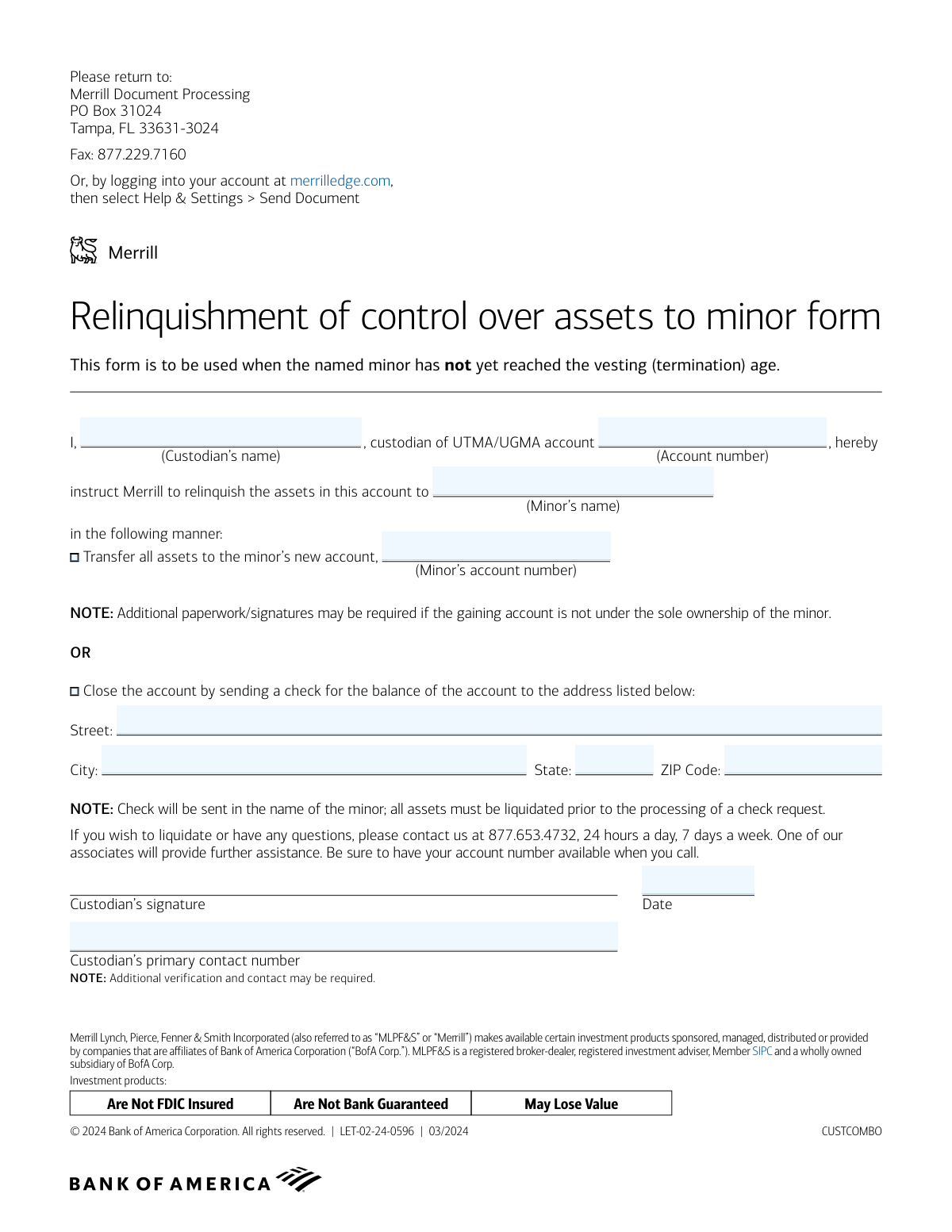
The primary document in this category is the Relinquishment of control over assets to minor form. This form is specifically designed for Merrill Lynch accounts held under the Uniform Transfers to Minors Act (UTMA) or the Uniform Gifts to Minors Act (UGMA). You should choose this form if you are the current custodian and need to formally end your oversight of the account and transfer the legal rights to the minor.
Deciding on the Distribution Method
When filling out the Relinquishment of control over assets to minor form, you must decide how the assets should be handled once your control is relinquished. The form typically offers two distinct paths:
- Internal Transfer: Choose this option if the goal is to move the assets into a new, individual account in the minor's name. This keeps the investments intact while updating the legal ownership so the minor can manage them independently.
- Liquidation and Payout: Select this option if the minor (or the custodian on their behalf) prefers to sell the assets and receive the proceeds as a check. This is often chosen when the funds are intended for immediate use, such as for upcoming educational expenses.
Key Considerations for Custodians
Before completing your documentation, ensure you have the following details ready to make the process as smooth as possible:
- Account Details: Have the specific UTMA/UGMA account number and current balance information available.
- State Regulations: Be aware of the legal age of termination in your state, as this determines when the minor is legally entitled to take full control of the assets.
- Beneficiary Info: You will need the minor's Social Security Number and current contact information to establish their new individual account.
Using Instafill.ai to complete this form ensures that all sensitive financial data is accurately placed, reducing the risk of processing delays with the financial institution.
Form Comparison
| Form | Purpose | Who Files It | Account Type | Asset Options |
|---|---|---|---|---|
| Relinquishment of control over assets to minor form | Transferring control of assets from a custodian to a minor beneficiary. | The current custodian of a UTMA or UGMA investment account. | Uniform Transfers to Minors Act (UTMA) or Uniform Gifts to Minors (UGMA). | Transfer assets to the minor's account or liquidate for cash payout. |
Tips for minor asset forms
Before relinquishing control, confirm the age of majority or termination age for the specific state where the UTMA or UGMA account was established. Transferring assets before the legally required age or missing the termination date can lead to administrative complications with the financial institution.
Minor asset forms typically offer the choice between transferring securities to a new brokerage account in the minor's name or liquidating them into a check. Carefully select the option that aligns with the recipient's financial goals, as liquidation may have different tax implications than a direct transfer.
Financial institutions will reject forms if the minor's Social Security Number or legal name does not exactly match their existing records. Ensure all identifying information is transcribed accurately from official documents to avoid the need to restart the filing process.
Managing financial documents for minors can be time-consuming, but AI-powered tools like Instafill.ai can complete these forms in under 30 seconds with high accuracy. This is a practical time-saver for those handling multiple accounts, and your data stays secure during the entire process.
Many forms involving the transfer of significant assets require a Medallion Signature Guarantee or a standard notary seal. Review the form instructions early so you can arrange a meeting with a qualified official at your local bank before submitting your paperwork.
Once the assets are transferred, keep a digital copy of the signed and processed relinquishment form for your records. This documentation is essential for future tax filings and provides a clear paper trail of the transition from custodian to the minor.
A common reason for form rejection is a missing date or an unsigned field in the custodian or witness section. Scan the entire document one last time before submission to ensure every required field is populated, preventing the need for tedious resubmissions.
Frequently Asked Questions
These forms are legal documents used to manage, transfer, or relinquish control of financial assets held in a minor's name. They are typically used by custodians of UTMA or UGMA accounts to ensure that funds are properly transitioned to the beneficiary once they reach a certain age or under specific conditions.
The designated custodian of the account is responsible for completing and filing these forms. As the person legally managing the assets on behalf of the minor, the custodian must initiate the process to transfer control or liquidate the assets for the beneficiary's benefit.
This form is used when a custodian wants to transfer account ownership to the minor before the standard termination age or when the minor reaches the legal age of majority. It is also applicable when the custodian decides to liquidate the assets and distribute the proceeds directly to the minor.
Both are custodial accounts used to hold assets for a minor, but they differ in what types of assets they can hold. UGMA (Uniform Gifts to Minors Act) accounts are generally limited to cash and securities, while UTMA (Uniform Transfers to Minors Act) accounts can include other property like real estate or fine art.
Yes, you can use AI tools like Instafill.ai to complete these documents efficiently. These tools can extract data from your source documents and place it accurately into the required fields in under 30 seconds, reducing the risk of manual entry errors.
Using modern AI-powered platforms, filling out these forms takes less than a minute. AI services can automatically identify the necessary fields and populate them with your information, transforming a tedious paperwork process into a quick digital task.
You will generally need the account number, the names and contact information for both the custodian and the minor, and Social Security numbers. Depending on the specific request, you may also need to provide instructions for where the funds should be transferred or how the liquidation check should be delivered.
Completed forms should be submitted to the financial institution where the assets are held, such as Merrill Lynch or another brokerage. Most institutions allow for submission via secure online portals, mail, or in person at a local branch.
In some cases, specific forms allow a custodian to relinquish control before the standard age of majority, depending on state laws and the terms of the custodial agreement. It is important to review the specific form instructions to see if early transfer or liquidation is an available option for your account.
Once the financial institution processes the form, the custodian's authority over the account is removed. The assets are either moved into a new account solely in the minor's name or liquidated and sent to the minor as a check, giving them full legal control over the funds.
Transferring control of a UTMA or UGMA account may have tax consequences for the minor, as the assets are legally theirs. While the form facilitates the transfer of control, it is often recommended to consult a tax professional to understand how the transfer or liquidation might affect the minor's tax obligations.
Glossary
- Form Complexity Index
- Instafill’s 0–100 measure of how much effort a form takes to complete, calculated deterministically from the form’s own structure rather than estimated. It combines the number of fillable fields (the largest factor), how difficult those fields are to complete based on their type, the number of pages that contain fields, the amount of conditional “fill-only-if” logic, and how many sections the form is divided into, then adds modifiers for tables and repeating lists, bundled instruction pages, and dense page layouts. A higher score means the form is harder to fill out by hand. The forms in this category have a median Form Complexity Index of 25/100 (Simple). See exactly how it is calculated.
- UTMA (Uniform Transfers to Minors Act)
- A law that allows a minor to receive various types of assets, such as real estate or fine art, without the need for a formal trust until they reach the legal age of majority.
- UGMA (Uniform Gifts to Minors Act)
- A law that allows an adult to manage certain financial assets, like cash and securities, on behalf of a minor until they reach a specific age.
- Custodian
- The adult designated to manage and oversee the assets in a minor's account until the minor is legally old enough to take control.
- Termination Age
- The specific age, typically between 18 and 25 depending on state law, at which a custodian must legally hand over control of the assets to the minor.
- Relinquishment of Control
- The formal legal process where a custodian voluntarily gives up their management authority over an account to transfer full ownership to the minor.
- Age of Majority
- The age at which an individual is legally recognized as an adult and gains the right to manage their own financial affairs and legal documents.
- Asset Liquidation
- The process of selling non-cash assets, such as stocks or mutual funds, to convert them into cash before transferring the value to the minor.
- Fiduciary Duty
- The legal obligation of the custodian to act solely in the best interest of the minor when managing the account's assets.