Fill out NAIC forms
with AI.
National Association of Insurance Commissioners (NAIC) forms serve as the standardized backbone of the insurance industry, ensuring that regulatory reporting and data collection remain consistent across different states and jurisdictions. These documents are vital for maintaining transparency and solvency within the insurance market, covering everything from financial disclosures to complex risk management assessments. By providing a uniform framework, these forms help regulators monitor the health of insurance providers and protect the interests of policyholders.
By continuing, you acknowledge Instafill's Privacy Policy and agree to get occasional product update and promotional emails.
About NAIC forms
Business owners, corporate officers, and insurance professionals typically need these forms during pivotal moments in a company's lifecycle. For example, risk management forms like the ERM-14 are required when a business undergoes a change in ownership, a merger, or a significant structural reorganization. Accurate completion of these forms is essential for calculating workers' compensation premiums and ensuring that a company’s experience rating reflects its current operational reality. Failing to submit this information correctly can lead to administrative delays or incorrect insurance costs.
Navigating these detailed requirements can be a tedious process, but tools like Instafill.ai use AI to fill these forms in under 30 seconds, handling the data accurately and securely. This technology transforms the way businesses handle regulatory paperwork, allowing you to complete necessary filings without the manual effort usually associated with complex PDF documents.
Every form on this page can be completed without typing. Instafill is form filling software that reads a PDF and fills it for you — including flat and scanned documents that carry no fillable fields at all.
Forms in This Category
| Form Name | Pages | FCI | |
|---|---|---|---|
| 1. | REQUEST FOR OWNERSHIP INFORMATION—ERM-14 FORM | 1 | – |
- Enterprise-grade security & data encryption
- 99%+ accuracy powered by AI
- 1,000+ forms from all industries
- Complete forms in under 60 seconds
How to Choose the Right Form
Navigating National Association of Insurance Commissioners (NAIC) requirements and risk management documentation is essential for maintaining accurate workers' compensation records. While this category covers various risk management and ERM forms, the primary document used for reporting organizational changes is the ERM-14.
When to Use the ERM-14 Form
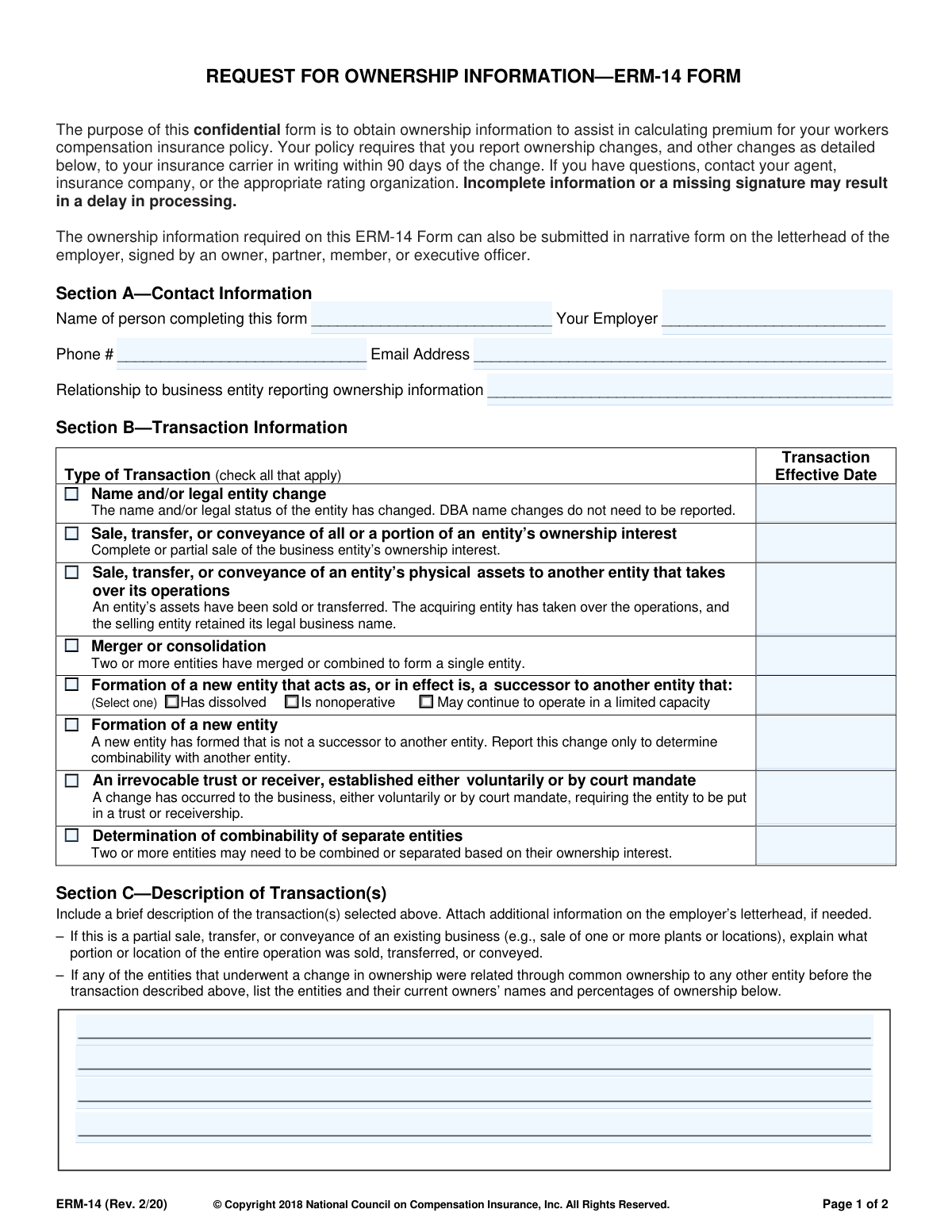
The REQUEST FOR OWNERSHIP INFORMATION—ERM-14 FORM is the industry standard for notifying insurance carriers and rating bureaus about changes in your business structure. You should select this form if your company has experienced any of the following events:
- Ownership Transfers: A sale of some or all of the business assets or stock.
- Mergers and Consolidations: When two or more entities combine into a single organization or a new entity is formed from existing ones.
- Entity Changes: Transitioning from a sole proprietorship to a corporation, LLC, or partnership.
- Name Changes: Even if ownership remains the same, a legal name change often requires an ERM-14 filing to maintain proper records.
Why This Form is Essential for Risk Management
Submitting the ERM-14 Form is crucial for accurate Experience Rating Modification (ERM) calculations. It ensures that your workers' compensation experience rating—which directly impacts your insurance premiums—is calculated based on the correct historical data of the entities involved. Failing to report these changes promptly can lead to significant billing errors or gaps in coverage.
Filing with Confidence
Because the ERM-14 is a confidential and detailed document, precision is paramount. Using Instafill.ai allows you to streamline the process by converting static PDFs into interactive, fillable documents. Our AI-powered tools help you accurately populate complex ownership data, ensuring that all required fields are completed before you submit the form to your carrier or the NCCI.
Form Comparison
| Form | Primary Purpose | Triggering Events | Impact on Policy |
|---|---|---|---|
| REQUEST FOR OWNERSHIP INFORMATION—ERM-14 FORM | Reports business ownership changes to ensure accurate workers' compensation premium calculations. | Sales, mergers, acquisitions, or the formation of new legal entities. | Determines how the business's experience rating history transfers to the new owner. |
Tips for NAIC forms
Provide exact figures for each owner or entity involved in a transfer or merger. Discrepancies in ownership percentages can lead to incorrect experience rating calculations and potential premium adjustments during your next audit.
Most jurisdictions recommend reporting ownership changes within 90 days of the transaction to ensure your experience mod is updated correctly. Filing these forms immediately after a merger or acquisition prevents administrative delays in your workers' compensation coverage.
AI-powered tools like Instafill.ai can complete these complex forms in under 30 seconds with high accuracy. Your data stays secure during the process, providing a reliable way to manage multiple risk management filings without manual data entry.
Use the exact legal names and Federal Employer Identification Numbers (FEIN) as they appear on official tax documents. Inconsistencies between your ERM forms and your insurance policy can trigger unnecessary scrutiny or policy processing errors.
Keep copies of bills of sale, merger agreements, or articles of incorporation handy while filling out NAIC-related forms. You will often need to reference specific effective dates and legal clauses to accurately describe the nature of the ownership change.
Always specify whether the business operations, location, and employees remained the same after the change in ownership. This detail is critical for insurance carriers to determine if the prior claims history should carry over to the new entity.
Frequently Asked Questions
These forms are designed to provide insurance regulators and carriers with accurate data regarding business operations and ownership. Specifically, forms like the ERM-14 help track changes in ownership that could impact workers' compensation experience ratings and premium calculations.
You typically need to file this form whenever there is a significant change in your business structure, such as a merger, acquisition, or sale of assets. It is also required when a new legal entity is formed or when there is a change in the majority ownership of a company.
Generally, the employer or business owner is responsible for providing the information, though insurance agents often assist in the process. Once completed, the form is usually submitted to the relevant rating bureau or the insurance carrier handling the workers' compensation policy.
Ownership changes can trigger a recalculation of a business's experience modification factor, which directly influences workers' compensation costs. Accurate reporting ensures that the premium reflects the current risk profile of the business entity.
Yes, modern AI tools like Instafill.ai can process NAIC forms by automatically extracting data from your business documents and placing it into the correct fields. This technology ensures high accuracy and reduces the manual effort required for complex regulatory paperwork.
Using AI-powered services, most NAIC and risk management forms can be completed in under 30 seconds. The AI quickly maps information from your source files to the form fields, making the process significantly faster than manual data entry.
The form usually asks for details about the predecessor and successor entities, including legal names, Federal Employer Identification Numbers (FEINs), and the percentage of ownership transferred. It also requires a description of the transaction and the effective date of the change.
Yes, most risk management forms containing sensitive ownership and financial data are treated as confidential documents. They are used primarily by insurance carriers and rating bureaus for the purpose of risk assessment and premium auditing.
Failure to report changes can lead to incorrect premium billing, potential audits, or even the loss of coverage in some jurisdictions. It is important to submit these forms promptly to ensure that your workers' compensation policy remains compliant and accurately priced.
Yes, if a business change affects operations in multiple states, the ERM-14 or similar NAIC forms must be filed to notify the rating bureaus in each applicable jurisdiction. This ensures that the experience rating is correctly applied across all locations.
Glossary
- NAIC
- The National Association of Insurance Commissioners is the U.S. standard-setting and regulatory support organization created and governed by the chief insurance regulators from all 50 states.
- ERM-14 Form
- A confidential document used to report changes in ownership, mergers, or business name changes to ensure workers' compensation premiums are calculated correctly.
- Experience Rating
- A method of adjusting workers' compensation insurance premiums based on a company's historical loss experience compared to other businesses in the same industry.
- Experience Modification Factor
- Commonly known as an 'Ex-Mod,' this is a numerical multiplier applied to an employer's premium based on their past safety record and insurance claims.
- NCCI
- The National Council on Compensation Insurance is an organization that collects workers' compensation data and manages the experience rating system used in many states.
- Combinability
- The regulatory determination of whether two or more legal entities should be treated as a single employer for insurance rating purposes due to shared ownership.
- Ownership Interest
- The legal percentage of a business held by an individual or entity, which must be disclosed to determine the impact on insurance experience ratings.
- Successor
- A business entity that takes over the operations or assets of another company and may be required to inherit the previous entity's experience rating history.