Fill out Ontario court forms
with AI.
Ontario court forms are the essential building blocks for initiating and managing legal proceedings within the province’s judicial system. These documents serve as the formal method for communicating claims, evidence, and requests for court orders to both the judiciary and the opposing parties. Whether you are navigating family law matters, civil litigation, or small claims, using the correct standardized ontario government forms is crucial for ensuring that your case is processed correctly and that all legal requirements are met.
By continuing, you acknowledge Instafill's Privacy Policy and agree to get occasional product update and promotional emails.
About Ontario court forms
These legal application forms are typically required by individuals, legal professionals, and businesses navigating the Ontario Superior Court of Justice or the Ontario Court of Justice. They are used in a wide range of situations, such as filing for a divorce, seeking child support, or resolving property disputes through a general application. Because legal processes are often time-sensitive and require precise information, accuracy in these civil court forms is paramount to avoid administrative delays or the dismissal of a case.
Managing the paperwork required for legal applications can be a daunting task, especially during stressful life transitions. Tools like Instafill.ai use AI to fill these forms in under 30 seconds, ensuring that data is handled accurately and securely while saving significant time. This allows you to focus on the substance of your legal matter rather than the technical complexities of manual data entry.
Every form on this page can be completed without typing. Instafill is form filling software that reads a PDF and fills it for you — including flat and scanned documents that carry no fillable fields at all.
Forms in This Category
The forms in this category have a median Form Complexity Index of 57/100 (Moderate), measured across 1 forms by field count, input difficulty, length, conditional logic and structure. See how it is calculated.
| Form Name | Pages | FCI | |
|---|---|---|---|
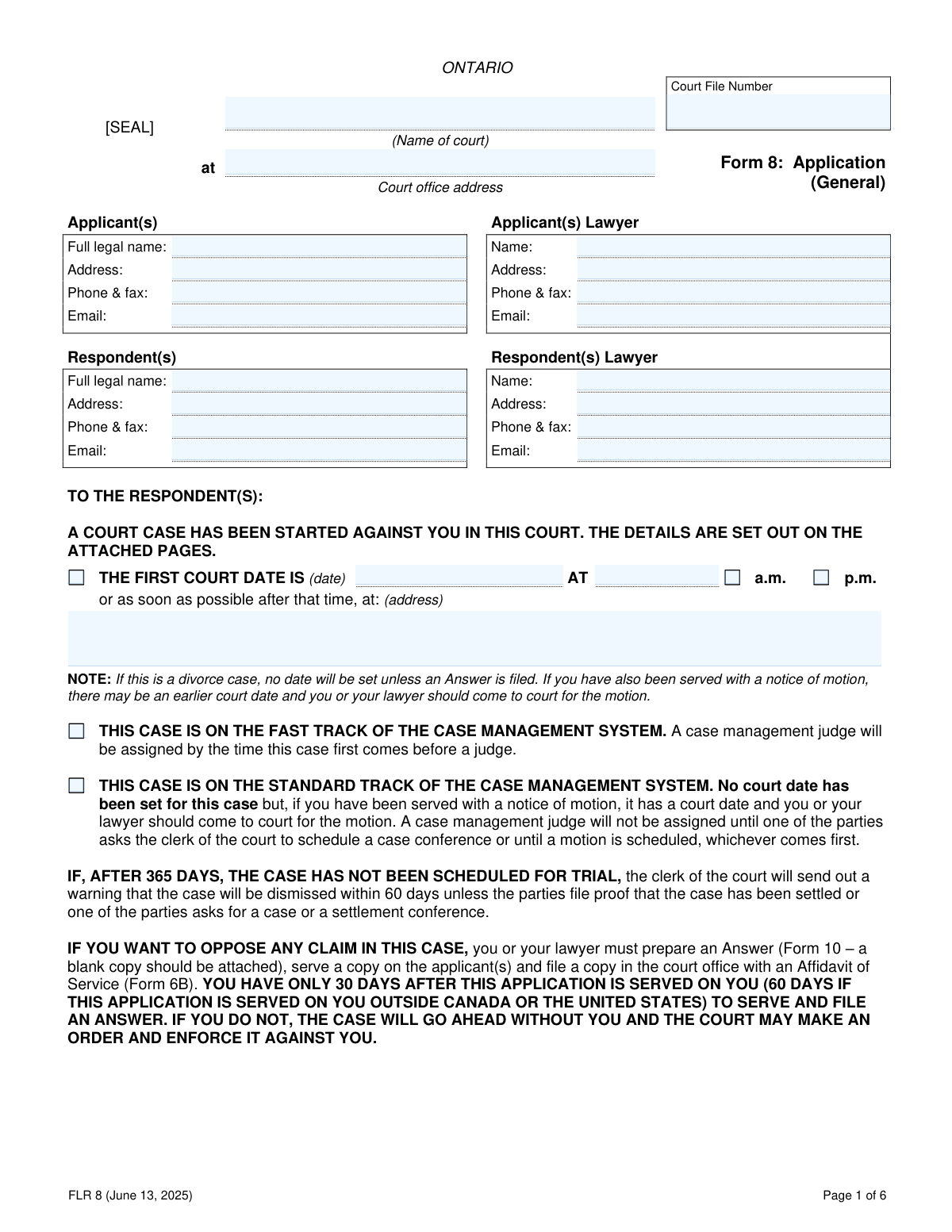
| 1. | ONTARIO Form 8: Application (General) | 6 | Moderate 57 |
- Enterprise-grade security & data encryption
- 99%+ accuracy powered by AI
- 1,000+ forms from all industries
- Complete forms in under 60 seconds
How to Choose the Right Form
Navigating the Ontario court system requires precision, especially when starting a legal proceeding. While there are numerous Ontario government forms available, identifying the correct starting point is essential for your case to move forward without administrative delays.
Starting a Family Law Case
If you are initiating a family law proceeding in Ontario, the ONTARIO Form 8: Application (General) is typically your primary document. This is the foundational legal application form used to open a file with the court when you are seeking specific court orders against a respondent.
You should choose Form 8: Application (General) if your case involves:
- Divorce: Formally requesting the legal dissolution of a marriage.
- Support Claims: Seeking either child support or spousal support payments.
- Parenting Arrangements: Establishing decision-making responsibility (formerly known as custody) or parenting time (formerly known as access) for children.
- Property Division: Addressing the equalization of net family property or other financial claims between spouses.
Determining if Form 8 is Right for You
It is important to distinguish between different types of civil and family court forms. Form 8 is a "General" application, meaning it is used when you are starting a case and outlining your claims. If you are responding to a case that has already been started by someone else, you would likely need a "Response" form instead of this application.
Furthermore, while Form 8 covers a broad range of family law issues, ensure your specific jurisdiction (such as the Superior Court of Justice or the Ontario Court of Justice) accepts this general application for your specific situation.
Simplify Your Legal Filing
Ontario court forms can be complex and time-consuming to complete manually. By using Instafill.ai, you can process ONTARIO Form 8: Application (General) more efficiently. Our AI-powered tools help you navigate the various sections regarding property, support, and children, ensuring that your legal application is clear, professional, and ready for filing.
Form Comparison
| Form | Purpose | Key Claims | Who Files It |
|---|---|---|---|
| ONTARIO Form 8: Application (General) | Initiates family law proceedings and outlines legal claims against a respondent. | Divorce, support, child decision-making responsibility, and division of property. | The applicant seeking specific court orders in a family law case. |
Tips for Ontario court forms
Use the full legal names of both the applicant and respondent as they appear on government-issued identification. Inconsistent naming across different court documents can lead to administrative delays or the need for formal amendments later in the legal process.
Clearly outline exactly what you are seeking, such as child support, property division, or a divorce. Vague requests can result in the court requiring further clarification, which slows down your proceeding and may necessitate additional filings.
Many Ontario family court applications require accompanying financial statements or affidavits. Having these records organized and ready to reference while filling out your forms ensures that the data you input is consistent with your formal evidence.
Completing complex legal documents like Form 8 can be overwhelming, but AI-powered tools like Instafill.ai can complete these forms in under 30 seconds with high accuracy. Your data stays secure during the process, making it a reliable way to manage multiple forms efficiently.
If a section of the application does not apply to your specific situation, it is better to write 'N/A' or 'Not Applicable' rather than leaving it empty. Blank fields can cause the court registry to reject the form, assuming information was accidentally omitted.
While forms are standardized across Ontario, individual courthouses may have specific preferences for how documents are filed or served. Always check the local practice directions to ensure you are following the correct procedure for your specific jurisdiction.
Ensure that the facts and figures provided in your Application match any other forms you are filing simultaneously. Discrepancies between documents can lead to challenges from the respondent or require you to file corrective paperwork.
Frequently Asked Questions
Ontario court forms are standardized legal documents required to initiate or respond to legal proceedings in the Ontario Superior Court of Justice or the Ontario Court of Justice. They cover various legal areas, including family law, civil litigation, and small claims. Using the correct form ensures that the court receives all necessary information in a format that complies with the Rules of Civil Procedure.
The appropriate form depends on the nature of your legal issue, such as family law, civil disputes, or estate matters. Most forms are categorized by the specific court branch and the stage of the proceeding, such as starting a claim or responding to one. You should verify the form number and title against the latest versions provided by the Ontario Ministry of the Attorney General.
Once completed, Ontario court forms are typically filed at the court office where the case is being heard or through authorized online filing portals. Some documents may require physical submission, while many civil and family forms can now be submitted through the Justice Services Online portal. It is important to check the specific filing instructions for your jurisdiction and case type.
Yes, you can use AI tools like Instafill.ai to fill out Ontario court forms quickly and accurately. These tools can extract relevant data from your source documents and place it directly into the correct fields on the form. This process often takes under 30 seconds, significantly reducing the manual effort required for complex legal paperwork.
An Application is generally used to start a new legal proceeding where you are asking the court for specific final orders. In contrast, a Motion is typically used within an existing case to ask the court for a temporary order or a specific direction before the final trial. Understanding which document to use is essential for the proper progression of your legal matter.
While you are permitted to represent yourself and fill out these forms as a self-represented litigant, legal matters can be complex. Many people choose to consult with a lawyer to ensure their claims are properly stated and their rights are protected. If you choose to do it yourself, using automated tools can help ensure the forms are filled out clearly and consistently.
Filling out these forms manually can take hours, but using AI-powered services like Instafill.ai can complete the process in under 30 seconds. The AI accurately identifies where information belongs, minimizing the risk of errors and omissions. This allows you to focus on the content of your legal case rather than the mechanics of data entry.
Ontario court forms must follow specific rules regarding font size, margins, and paper quality if filed in person. When using digital versions, it is important to ensure the PDF remains in a standard format that the court's systems can read. Using a dedicated platform ensures that the resulting document adheres to the standard layouts expected by court clerks.
In most Ontario court proceedings, the 'Applicant' is the person who starts the case by filing the initial documents. The 'Respondent' is the person against whom the claim is made or who is required to respond to the application. These roles remain consistent throughout the initial stages of the legal process.
Many Ontario court forms can be filed electronically through the provincial government's online filing systems for civil, family, and small claims matters. Electronic filing requires the documents to be in PDF format and may involve a digital payment for any applicable filing fees. You should confirm if your specific form is eligible for online submission before proceeding.
If you discover an error before filing, you should correct the information and print a fresh copy. If the form has already been filed, you may need to file an 'Amended' version or seek the court's permission to make changes, depending on the stage of the case. Using AI tools can help prevent these errors by cross-referencing data before the form is finalized.
Most Ontario court forms require a filing fee when they are submitted to the court office, though the amount varies depending on the type of claim. In some cases, individuals with low income may apply for a fee waiver to have these costs excused. It is best to check the current fee schedule provided by the Ministry of the Attorney General for the most up-to-date costs.
Glossary
- Form Complexity Index
- Instafill’s 0–100 measure of how much effort a form takes to complete, calculated deterministically from the form’s own structure rather than estimated. It combines the number of fillable fields (the largest factor), how difficult those fields are to complete based on their type, the number of pages that contain fields, the amount of conditional “fill-only-if” logic, and how many sections the form is divided into, then adds modifiers for tables and repeating lists, bundled instruction pages, and dense page layouts. A higher score means the form is harder to fill out by hand. The forms in this category have a median Form Complexity Index of 57/100 (Moderate). See exactly how it is calculated.
- Applicant
- The individual who initiates a legal proceeding in the Ontario court system by filing the initial application forms.
- Respondent
- The person against whom a legal claim is made and who is required to file a response to the applicant's claims.
- Decision-making Responsibility
- The legal authority to make significant decisions about a child's upbringing, including their education, health, and religion; this term replaced 'custody' in Ontario law.
- Parenting Time
- The actual time a child spends in the care of a parent, whether or not that parent has decision-making responsibility; this term replaced 'access'.
- Equalization
- The process of dividing the value of property and assets acquired during a marriage so that both spouses leave the relationship with a fair share of the wealth gained.
- Service
- The formal procedure of delivering court documents to the other party to ensure they are legally notified of the proceedings against them.
- Continuing Record
- The official court file that contains all documents filed by both parties in a family law case, maintained in a specific chronological order for the judge to review.
- Affidavit
- A written statement of facts that the author swears or affirms to be true in front of a commissioner of oaths, such as a lawyer or notary public.