Fill out Ontario government forms
with AI.
Ontario government forms are essential tools for navigating the province's legal and administrative systems. These documents, ranging from civil court forms to specific legal application forms, serve as the official record for significant life events and legal proceedings. Whether you are initiating a claim in the Ontario court system or responding to a provincial mandate, accuracy is paramount. These forms ensure that all necessary information is captured according to provincial regulations, allowing judicial and administrative bodies to process requests fairly and efficiently.
By continuing, you acknowledge Instafill's Privacy Policy and agree to get occasional product update and promotional emails.
About Ontario government forms
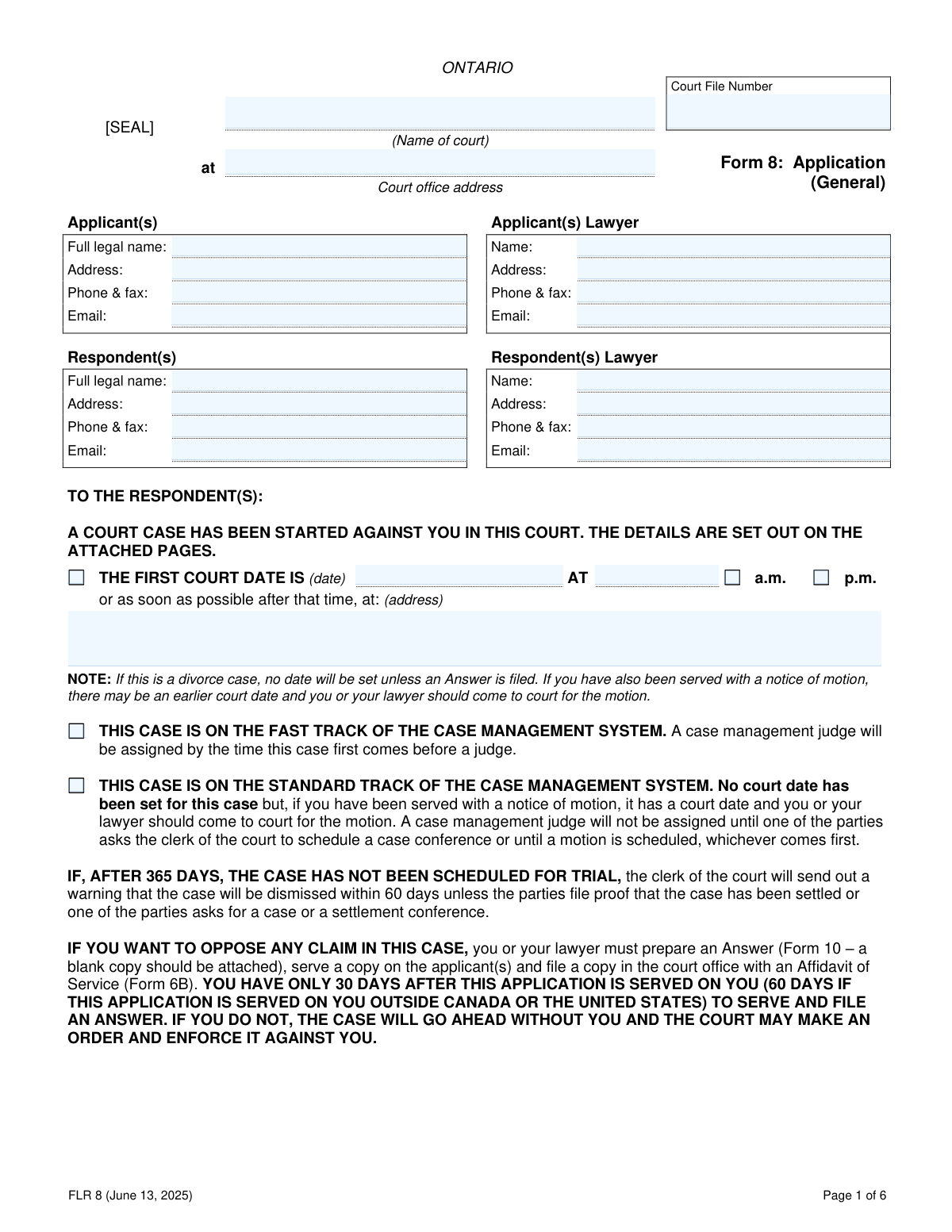
Typically, these forms are used by individuals, legal professionals, and business owners who need to formalize legal actions or comply with provincial mandates. For instance, those involved in family law matters often utilize documents like the Form 8 Application (General) to outline claims regarding support, property division, or child-related decisions. Navigating these requirements can be daunting, especially when facing strict deadlines or complex legal language. Having access to the correct provincial documentation is the first step in ensuring that your legal rights are protected and that your case proceeds without administrative delays.
Completing these extensive documents manually is often time-consuming and prone to clerical errors. Tools like Instafill.ai use AI to fill these Ontario government forms in under 30 seconds, handling sensitive data accurately and securely to ensure your submissions meet the required standards. This technology simplifies the process of managing complex legal paperwork, allowing you to focus on the substance of your application rather than the mechanics of the PDF.
Every form on this page can be completed without typing. Instafill is form filling software that reads a PDF and fills it for you — including flat and scanned documents that carry no fillable fields at all.
Forms in This Category
The forms in this category have a median Form Complexity Index of 57/100 (Moderate), measured across 1 forms by field count, input difficulty, length, conditional logic and structure. See how it is calculated.
| Form Name | Pages | FCI | |
|---|---|---|---|
| 1. | ONTARIO Form 8: Application (General) | 6 | Moderate 57 |
- Enterprise-grade security & data encryption
- 99%+ accuracy powered by AI
- 1,000+ forms from all industries
- Complete forms in under 60 seconds
How to Choose the Right Form
Navigating the landscape of Ontario government forms can be complex, especially when dealing with legal proceedings. While there are many types of civil court forms, the primary focus for starting a family law case in the province is the ONTARIO Form 8: Application (General).
Starting Your Legal Proceeding
If you are initiating a legal action in the Ontario court system regarding family matters, you will likely need to file an application. The ONTARIO Form 8: Application (General) is the standard starting point for most family law disputes. It acts as the foundational document that sets the stage for your entire case.
When to Choose Form 8
You should select this form if your legal application forms involve any of the following claims:
- Divorce: Formally ending a marriage and addressing related issues.
- Support Claims: Seeking financial assistance through child support or spousal support from a respondent.
- Child-Related Matters: Establishing or changing decision-making responsibility (formerly known as custody) or parenting time arrangements.
- Property Division: Requesting an equalization of net family property or other property-related claims following the breakdown of a relationship.
Understanding the Audience and Purpose
This form is specifically designed for the Applicant—the individual starting the court process. It serves as the official notice to both the court and the Respondent (the other party) regarding the specific legal orders you are seeking. It ensures all parties are aware of the claims being made from the outset of the litigation.
Simplifying Ontario Court Forms
Ontario court forms are often provided in static PDF formats that can be difficult to navigate manually. Using Instafill.ai, you can process the ONTARIO Form 8: Application (General) using AI-powered tools. This allows you to fill out the form accurately and convert non-interactive versions into fillable documents, ensuring your legal paperwork is professional and ready for the court registry without the hassle of manual formatting.
Form Comparison
| Form | Purpose | Who Files It | Key Claims Covered |
|---|---|---|---|
| ONTARIO Form 8: Application (General) | Initiates a family law proceeding in the Ontario court system. | The applicant seeking legal orders against a respondent party. | Divorce, support, property division, and decision-making responsibility for children. |
Tips for Ontario government forms
When filling out Ontario court forms, ensure that all names and addresses match your government-issued identification exactly. Discrepancies in personal details can lead to administrative rejections or significant delays in your legal proceedings.
AI-powered tools like Instafill.ai can complete complex Ontario legal forms in under 30 seconds with high accuracy. Your data stays secure throughout the process, providing a fast and reliable alternative to manual data entry for multiple court documents.
Many general application forms serve as a primary document that requires additional schedules or affidavits. Review the instructions carefully to ensure you have attached all necessary supporting documents before attempting to file with the court clerk.
When outlining claims for support or property division, be as specific as possible about the outcomes you are seeking. Vague language can lead to confusion during the legal process, so clearly define each request to help the court understand your position.
Ontario has specific rules regarding which courthouse can hear your case based on your location or the nature of the claim. Always verify that you are submitting your forms to the correct municipal branch to avoid having your application stayed or returned.
Always save a finalized copy of your completed form before submission. Keeping both a digital file and a printed version is essential for serving the other party correctly and tracking your case's progress through the Ontario court system.
Frequently Asked Questions
Ontario government forms cover a wide range of legal areas, including civil litigation, family law, and small claims. For family law specifically, forms are used to initiate proceedings for divorce, support, or child decision-making responsibility.
The correct form depends on the nature of your legal claim and the specific court jurisdiction involved. For many family law matters, the Application (General) is the standard starting point for notifying the court and the respondent of the legal orders you are seeking.
This form is completed by an applicant who wishes to start a family law case against a respondent. It serves as the formal notification to the court and the other party regarding claims such as property division or spousal support.
Forms are generally submitted to the court office in the municipality where either party resides or where the legal matter originated. Many Ontario court forms can now be filed electronically through the provincial government's authorized online portals.
Yes, AI tools like Instafill.ai can fill out complex Ontario government forms in under 30 seconds. These tools accurately extract data from your source documents and place it into the correct fields, reducing the risk of manual entry errors.
While manual completion of legal documents can take several hours, using AI-powered automation can complete the process in less than a minute. This technology maps your information directly into the official PDF structure for immediate use.
Yes, the Ontario Rules of Civil Procedure and Family Law Rules dictate specific standards for document presentation. Using standardized PDF versions ensures that your submission meets the technical requirements of the court clerk regarding font, margins, and layout.
You are permitted to represent yourself as a self-represented litigant and complete these forms on your own. However, because legal forms carry significant consequences, many users use automated tools to prepare the documents and then consult with legal counsel for a final review.
The Ontario government updates court forms periodically to reflect changes in provincial legislation. It is important to use a platform that provides the most current versions of these documents to prevent them from being rejected by the court registry.
Once the court office issues the document, you must 'serve' a copy to the respondent according to specific legal rules. The respondent then has a designated period to file a response or defense before the case proceeds to the next stage.
Most court applications in Ontario require a filing fee payable to the Minister of Finance at the time of submission. If you are unable to afford the fees, you may be able to apply for a fee waiver based on your financial situation.
Glossary
- Form Complexity Index
- Instafill’s 0–100 measure of how much effort a form takes to complete, calculated deterministically from the form’s own structure rather than estimated. It combines the number of fillable fields (the largest factor), how difficult those fields are to complete based on their type, the number of pages that contain fields, the amount of conditional “fill-only-if” logic, and how many sections the form is divided into, then adds modifiers for tables and repeating lists, bundled instruction pages, and dense page layouts. A higher score means the form is harder to fill out by hand. The forms in this category have a median Form Complexity Index of 57/100 (Moderate). See exactly how it is calculated.
- Applicant
- The individual who initiates a legal case by filing the initial application with the Ontario court system.
- Respondent
- The person against whom a legal proceeding is started and who is required to respond to the claims made by the applicant.
- Decision-making Responsibility
- A legal term formerly known as 'custody' that refers to a parent's right to make major decisions about a child's life, including education, religion, and health care.
- Parenting Time
- A legal term formerly known as 'access' that describes the time a child spends in the care of a parent or another person, regardless of whether the child is physically with them.
- Continuing Record
- The official court file that compiles all documents, orders, and evidence filed by both parties in a specific family law case.
- Service
- The formal process of delivering legal documents to the other party to ensure they are legally notified of the court proceedings.
- Equalization
- The calculation and division of the value of assets and debts acquired during a marriage to ensure a fair distribution of property between spouses.
- Affidavit
- A written statement of facts that the person signing it swears or affirms to be true before a commissioner of oaths or a lawyer.