Fill out patent application forms
with AI.
Patent application forms are the foundational documents required by the United States Patent and Trademark Office (USPTO) to secure intellectual property rights and establish legal protection for new inventions. These forms, often referred to as PTO or AIA forms, serve as the formal communication channel between an inventor and the federal government. They are used to establish priority dates, list inventors, and provide the technical and bibliographic data necessary for the USPTO to examine an invention's novelty. Accuracy in these documents is paramount, as errors in identifying information or priority claims can lead to costly legal delays or even the loss of patent rights.
By continuing, you acknowledge Instafill's Privacy Policy and agree to get occasional product update and promotional emails.
About patent application forms
These forms are typically handled by individual inventors, startup founders, and intellectual property attorneys who need to navigate the complex patent prosecution process. Whether you are filing an initial utility patent or managing a design patent application, specific documentation like the Application Data Sheet (ADS) is required to organize applicant information and correspondence details. Because these forms often require repetitive data entry and precise formatting, manually completing them can be a tedious and error-prone task during an already high-stakes legal process.
To streamline this administrative burden, tools like Instafill.ai use AI to fill these complex patent forms in under 30 seconds while maintaining high standards for data accuracy and security. This allows applicants to focus on the technical aspects of their invention while ensuring that essential paperwork is handled efficiently and correctly.
Every form on this page can be completed without typing. Instafill is form filling software that reads a PDF and fills it for you — including flat and scanned documents that carry no fillable fields at all.
Forms in This Category
The forms in this category have a median Form Complexity Index of 65/100 (Complex), measured across 1 forms by field count, input difficulty, length, conditional logic and structure. See how it is calculated.
| Form Name | Pages | FCI | |
|---|---|---|---|
| 1. | Form PTO/AIA/14, Application Data Sheet (ADS) | 7 | Complex 65 |
- Enterprise-grade security & data encryption
- 99%+ accuracy powered by AI
- 1,000+ forms from all industries
- Complete forms in under 60 seconds
How to Choose the Right Form
Navigating the U.S. Patent and Trademark Office (USPTO) requirements can be a complex process. While a complete patent filing involves many technical documents, the forms in this category are designed to handle the critical administrative and bibliographic data required for your application to be processed correctly.
The Essential Bibliographic Document
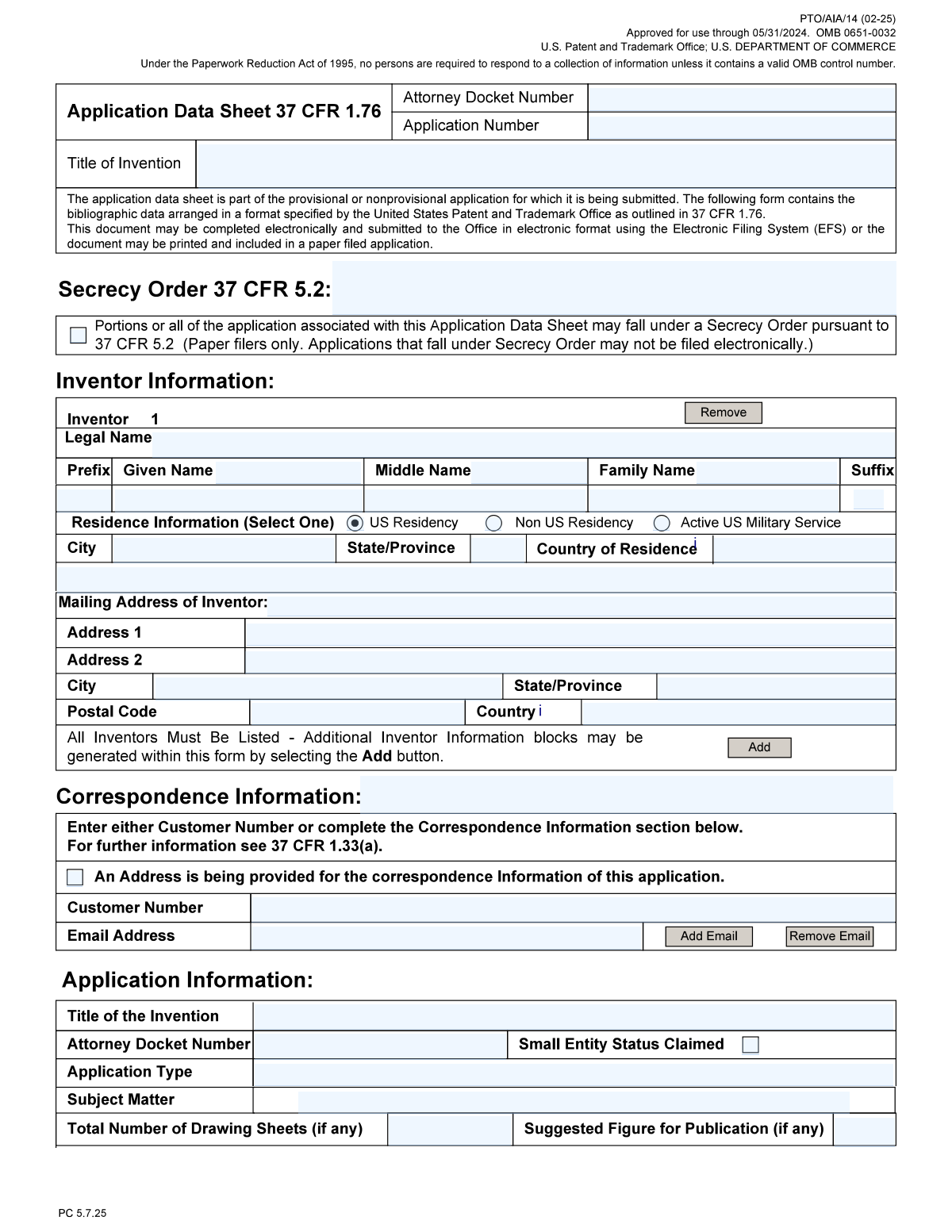
If you are initiating a new patent application, your primary requirement is Form PTO/AIA/14, Application Data Sheet (ADS). This is not merely a supplemental summary; it is the definitive source of bibliographic information for the USPTO. You should select this form if you need to:
- Identify Inventors and Applicants: Formally list the legal names and residences of the individuals or entities who own the intellectual property.
- Establish a Correspondence Address: Provide the official contact information where the USPTO will send all legal notices, office actions, and the eventual patent grant.
- Claim Domestic or Foreign Priority: Formally link your current application to earlier filings to protect your original filing date.
Why Accuracy is Critical
The Application Data Sheet (ADS) is unique because the information provided on this form supersedes any conflicting data found in other parts of your application (such as the oath or declaration). Because the USPTO uses this form to automate their internal records and generate official filing receipts, even small clerical errors can lead to significant delays.
Who Needs This Form?
- Individual Inventors: Filing "pro se" (on their own) who need to ensure their data is formatted correctly for USPTO automated systems.
- Patent Agents and Attorneys: Seeking an efficient way to compile client data into a standardized, professional format.
- Startups and Small Businesses: Managing their own intellectual property portfolios and looking to avoid the administrative burden of manual PDF editing.
By using Instafill.ai to complete Form PTO/AIA/14, you can ensure that your bibliographic data is clear, structured, and ready for submission, reducing the risk of receiving a "Notice to File Missing Parts" due to administrative oversight.
Form Comparison
| Form | Purpose | Key Information | USPTO Requirement |
|---|---|---|---|
| Form PTO/AIA/14, Application Data Sheet (ADS) | Provides a structured summary of bibliographic data for patent application processing. | Includes inventor details, correspondence address, and domestic or foreign priority claims. | Mandatory for most filings to ensure accurate data for official publication and records. |
Tips for patent application forms
The USPTO uses the ADS as the primary authority for bibliographic data, superseding information in other documents. Ensure that inventor names, mailing addresses, and titles are 100% accurate on this form to avoid costly administrative corrections later.
AI-powered tools like Instafill.ai can complete these complex patent forms in under 30 seconds with high accuracy. Your sensitive intellectual property data stays secure during the process, providing a reliable way to manage multiple filings without manual data entry errors.
Clearly list any previous applications to which you are claiming priority directly on the ADS. Failing to include specific filing dates and application numbers for prior related cases can result in the loss of your earliest possible filing date benefit.
Discrepancies between the names listed on the ADS and the signed Inventor’s Oath or Declaration can trigger a Notice to File Missing Parts. Ensure middle initials and legal names are formatted identically throughout your entire application package to ensure smooth processing.
Correctly identifying as a Small Entity or Micro Entity can significantly reduce your filing fees. Verify that you meet the specific USPTO criteria before checking these boxes on the ADS to avoid underpayment issues or the need for future refunds.
The USPTO sends critical deadlines and office actions to the correspondence address listed on your ADS. If you are working with a legal representative or have changed offices, ensure this section is updated to avoid missing time-sensitive response windows.
When filing for a team, list inventors in the preferred order and ensure their residence information is current. Providing a structured, accurate list at the outset prevents the need for filing supplemental ADS forms during the examination process.
Frequently Asked Questions
Patent application forms are the official documents required by the U.S. Patent and Trademark Office (USPTO) to request legal protection for an invention. They collect essential bibliographic data, inventor information, and legal declarations necessary for the government to process and eventually grant a patent.
The ADS, or Form PTO/AIA/14, acts as the primary summary of all bibliographic data for a patent filing. It ensures that the USPTO has a structured record of inventors, applicants, and priority claims, and it generally takes precedence over conflicting information found in other application documents.
Most patent forms are submitted electronically through the USPTO's online filing systems, such as Patent Center. It is important to ensure that the forms are saved in a compatible PDF format and meet the specific technical requirements for electronic submission.
These forms are typically completed by the inventors themselves or by registered patent attorneys and agents acting on their behalf. Accurate completion is vital because the information provided becomes part of the permanent public record once the application is published.
Yes, AI tools like Instafill.ai can be used to fill out complex patent forms like the ADS in under 30 seconds. The AI accurately extracts data from your source documents and places it directly into the correct fields, minimizing the risk of manual transcription errors.
While manual entry can take a significant amount of time due to the high level of detail required, using an AI-powered service allows you to complete these forms almost instantly. These tools can even convert non-fillable PDF versions into interactive forms for easier data entry.
In most cases, the information provided in the Application Data Sheet (ADS) supersedes information found in other parts of the application, such as the oath or declaration. This makes it the most critical document for establishing the official record of the application's bibliographic data.
These forms are used at the very beginning of the filing process to establish the application's identity and filing date. They may also be used later if you need to update correspondence information or make supplemental filings during the examination period.
Priority claims must be explicitly listed on the patent application forms to ensure the invention is granted the earliest possible filing date. This section of the form links the current application to previously filed documents in the U.S. or other countries.
Yes, applicants can often file a corrected or supplemental Application Data Sheet if errors are discovered or if information changes. Keeping this data current is essential for receiving timely correspondence and legal notices from the USPTO.
Glossary
- Form Complexity Index
- Instafill’s 0–100 measure of how much effort a form takes to complete, calculated deterministically from the form’s own structure rather than estimated. It combines the number of fillable fields (the largest factor), how difficult those fields are to complete based on their type, the number of pages that contain fields, the amount of conditional “fill-only-if” logic, and how many sections the form is divided into, then adds modifiers for tables and repeating lists, bundled instruction pages, and dense page layouts. A higher score means the form is harder to fill out by hand. The forms in this category have a median Form Complexity Index of 65/100 (Complex). See exactly how it is calculated.
- USPTO
- The United States Patent and Trademark Office, the federal agency responsible for granting U.S. patents and registering trademarks.
- ADS (Application Data Sheet)
- A standardized form used to provide the USPTO with essential bibliographic information about an application, such as inventor names and filing dates.
- AIA (America Invents Act)
- A federal law that shifted the U.S. patent system to a first-inventor-to-file system and updated many of the forms and procedures used today.
- Priority Claim
- A request by an applicant to use the filing date of an earlier-filed patent application as the effective filing date for the current application.
- Bibliographic Data
- The core identifying information of a patent application, including the title of the invention, inventor details, and the applicant's contact information.
- Assignee
- The individual or legal entity, such as a corporation, to whom an inventor has legally transferred their ownership rights in a patent.
- Correspondence Address
- The specific address designated by the applicant where the USPTO sends all official notices, legal documents, and communications regarding the application.
- Provisional Application
- A preliminary, lower-cost filing that allows an inventor to establish an early filing date for one year while they finalize their invention's details.