Fill out patent forms
with AI.
Patent forms are the foundational documents required to secure intellectual property rights through the United States Patent and Trademark Office (USPTO). These documents serve as the formal communication channel between inventors and the government, detailing technical specifications, inventor identities, and legal declarations. Because the patent process is highly technical and legally binding, accuracy in these forms is paramount. A single error in bibliographic data or priority claims can lead to costly delays or even the loss of patent rights, making these documents a critical component of any innovation strategy.
By continuing, you acknowledge Instafill's Privacy Policy and agree to get occasional product update and promotional emails.
About patent forms
This category is essential for inventors, patent attorneys, and legal assistants who are navigating the complex lifecycle of a patent application. Whether you are filing an initial utility application, submitting a design patent, or managing post-grant proceedings, these forms are necessary at every stage. For instance, documents like the Application Data Sheet (ADS) are used to establish the primary bibliographic information that the USPTO uses for publication and correspondence. These forms are typically needed during the initial filing phase, when responding to office actions, or when updating applicant information throughout the examination process.
Managing the administrative burden of patent filings can be time-consuming, especially when dealing with complex data fields and strict formatting requirements. Tools like Instafill.ai use AI to fill these forms in under 30 seconds, ensuring that data is handled accurately and securely while saving significant manual effort. By automating the data entry process, applicants can focus more on the technical merits of their inventions rather than the repetitive nature of paperwork.
Every form on this page can be completed without typing. Instafill is form filling software that reads a PDF and fills it for you — including flat and scanned documents that carry no fillable fields at all.
Forms in This Category
The forms in this category have a median Form Complexity Index of 65/100 (Complex), measured across 1 forms by field count, input difficulty, length, conditional logic and structure. See how it is calculated.
| Form Name | Pages | FCI | |
|---|---|---|---|
| 1. | Form PTO/AIA/14, Application Data Sheet (ADS) | 7 | Complex 65 |
- Enterprise-grade security & data encryption
- 99%+ accuracy powered by AI
- 1,000+ forms from all industries
- Complete forms in under 60 seconds
How to Choose the Right Form
Navigating the U.S. Patent and Trademark Office (USPTO) filing process requires extreme precision, especially regarding the administrative data associated with your invention. Currently, the most essential document in this category is the Form PTO/AIA/14, Application Data Sheet (ADS).
The Role of the Application Data Sheet
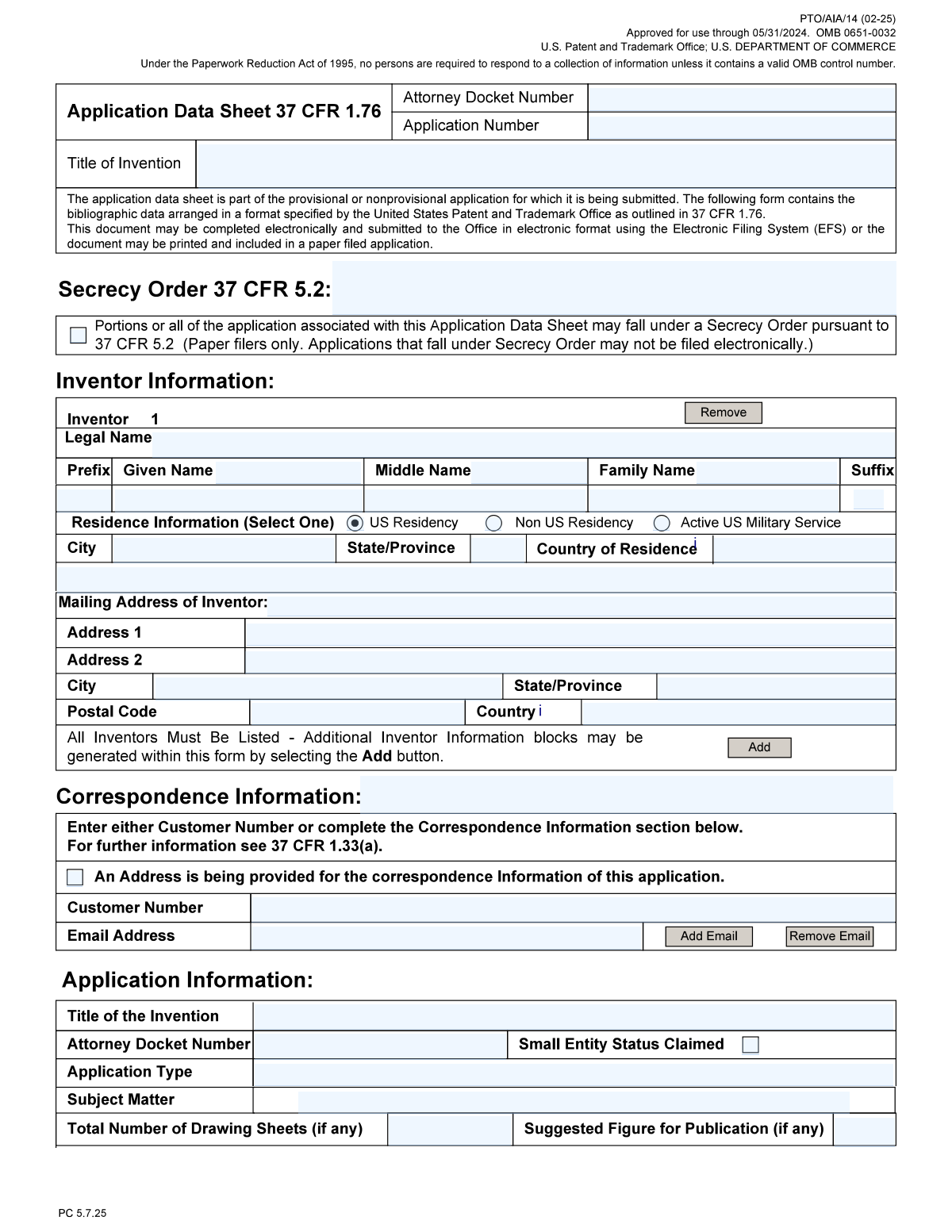
Form PTO/AIA/14 serves as the primary source of bibliographic information for the USPTO. It is not just a summary; it is a legally significant document that ensures the Patent Office has the correct data for processing, indexing, and eventual publication of your patent. Because the USPTO uses automated systems to capture this data, using a properly formatted ADS is vital for avoiding administrative errors.
When to Use Form PTO/AIA/14
You should select this form if you are in any of the following stages of the patent process:
- New Utility or Design Filings: This form is typically submitted at the time of filing a new application under 35 U.S.C. 111 to provide inventor and applicant details.
- Claiming Priority: If your application relies on a previously filed domestic or foreign application, you must use the ADS to list these priority claims clearly to ensure you receive the correct filing date.
- Updating Information: If there are changes to the inventor's address, the correspondence address, or the applicant’s entity status during the prosecution of the patent, a corrected or updated ADS is often required.
Why This Form is Critical
The USPTO treats the Application Data Sheet (ADS) as the "source of truth." If there is a discrepancy between the information on the ADS and other documents (such as the oath or declaration), the information provided on the ADS generally takes precedence.
Streamlining Your USPTO Filing
Filling out the Form PTO/AIA/14 manually can be tedious due to the strict formatting required for names, addresses, and priority data. Using Instafill.ai allows you to quickly populate these fields using AI or convert static PDF versions into interactive, fillable formats, reducing the risk of administrative delays or receiving a "Notice to File Missing Parts" due to clerical errors.
Form Comparison
| Form | Primary Purpose | Key Information Included | Filing Requirement |
|---|---|---|---|
| Form PTO/AIA/14, Application Data Sheet (ADS) | Summarizes bibliographic data for USPTO to ensure accurate application processing and publication. | Contains inventor details, applicant info, correspondence address, and domestic or foreign priority claims. | Typically submitted at the time of filing a new patent application. |
Tips for patent forms
Ensure all inventor names and addresses are spelled correctly, as the USPTO uses the Application Data Sheet as the primary source of truth. Any errors here can lead to significant delays in the examination process or incorrect information on the issued patent.
Cross-reference your ADS with other submitted documents, such as the declaration or power of attorney, to ensure all data points match perfectly. Discrepancies between forms can trigger administrative notices and may require additional filing fees to correct.
AI-powered tools like Instafill.ai can complete complex patent forms in under 30 seconds with high accuracy. This technology ensures your data stays secure during the process, making it an essential time-saver for those managing multiple intellectual property filings.
When filing for domestic or foreign priority, ensure the application numbers and dates are entered exactly as they appear on original filings. Failing to include these details in the initial ADS can complicate your claim to an earlier filing date and requires formal petitions to fix later.
Use a single, stable correspondence address for all USPTO communications to avoid missing critical deadlines or office actions. If you are working with a patent agent or attorney, verify that their registration numbers are accurately listed to ensure they receive all legal notices.
Check that the form is signed by an authorized party, such as the inventor, an assignee, or a registered legal representative. Unauthorized signatures can invalidate the entire submission, potentially resulting in the loss of your original filing date.
Frequently Asked Questions
Patent forms are official documents used to apply for legal protection of an invention through the U.S. Patent and Trademark Office (USPTO). They allow the government to track inventor details, technical descriptions, and legal claims to ensure the intellectual property is properly recorded and examined.
Inventors, legal representatives, and businesses seeking to protect their intellectual property rights in the United States must file these forms. They are essential for anyone wanting to establish an official filing date and begin the formal examination process for a patent.
The Application Data Sheet (ADS), specifically Form PTO/AIA/14, is the primary document used for bibliographic data. It captures essential details like inventor names, mailing addresses, and priority claims in a structured format that the USPTO uses for its official records.
Yes, you can fill out various patent forms using AI tools. Services like Instafill.ai use artificial intelligence to accurately extract data from your source documents and place it directly into the required fields, ensuring the data matches your records exactly.
Most patent forms are submitted electronically through the USPTO’s official online filing systems, such as Patent Center. Electronic filing is the standard method as it allows for faster processing, lower filing fees in many cases, and immediate confirmation of receipt.
While manual entry can be time-consuming due to the precision required, AI-powered tools can complete these forms in under 30 seconds. This technology automates the data entry process, which significantly reduces the risk of manual errors and speeds up the filing preparation.
According to USPTO guidelines, the information provided in a correctly filed Application Data Sheet (ADS) generally supersedes conflicting information found in other parts of the application. This makes it the most critical document for establishing the official record of inventors and priority.
While requirements vary, an ADS is often used for non-provisional applications to clearly define the bibliographic data. It can also be submitted with provisional applications to ensure the USPTO has the correct inventor and correspondence information on file from the outset.
While individuals are permitted to file their own patent forms as 'pro se' applicants, the process is legally complex. Many applicants choose to work with a registered patent attorney or agent to ensure that the technical and legal descriptions meet all USPTO standards and protect their rights effectively.
Common requirements include the full legal names and residences of all inventors, a descriptive title for the invention, and a reliable correspondence address. You may also need to provide details regarding prior related applications if you are claiming domestic or foreign priority.
These specific forms are designed for the U.S. Patent and Trademark Office and provide protection only within the United States. To seek protection in other countries, you would typically need to file additional forms under the Patent Cooperation Treaty (PCT) or directly with the patent offices of those specific nations.
Glossary
- Form Complexity Index
- Instafill’s 0–100 measure of how much effort a form takes to complete, calculated deterministically from the form’s own structure rather than estimated. It combines the number of fillable fields (the largest factor), how difficult those fields are to complete based on their type, the number of pages that contain fields, the amount of conditional “fill-only-if” logic, and how many sections the form is divided into, then adds modifiers for tables and repeating lists, bundled instruction pages, and dense page layouts. A higher score means the form is harder to fill out by hand. The forms in this category have a median Form Complexity Index of 65/100 (Complex). See exactly how it is calculated.
- USPTO
- The United States Patent and Trademark Office, the federal agency responsible for granting U.S. patents and registering trademarks.
- AIA (America Invents Act)
- A 2011 law that shifted the U.S. patent system to a first-inventor-to-file system and introduced specific standardized forms for applications.
- Application Data Sheet (ADS)
- A standardized document (Form PTO/AIA/14) used to submit essential bibliographic information about inventors and the patent application to the USPTO.
- Bibliographic Data
- The administrative details of a patent application, such as the title of the invention, inventor names, contact information, and filing dates.
- Priority Claim
- A formal request to use the filing date of an earlier-filed application as the effective filing date for a new application, protecting against newer competing inventions.
- Assignee
- The person or entity, such as a corporation or university, to whom the inventor has legally transferred their ownership rights in a patent.
- Provisional Application
- A temporary, lower-cost application that establishes an early filing date for one year but does not result in a patent unless a formal application follows.
- Prior Art
- Any existing evidence that an invention is already known, including previous patents, publications, or public demonstrations that might prevent a new patent from being granted.