Fill out portfolio management forms
with AI.
Portfolio management forms are the essential administrative backbone of professional investing, providing the formal structure needed to manage capital flow and maintain regulatory compliance. These documents are used to authorize new capital allocations, update investor profiles, and ensure that all financial activities align with legal standards such as the Financial Intelligence Centre Act (FICA). By documenting every change in a portfolio, these forms provide a clear audit trail that protects both the investor and the fund manager, ensuring that asset movements are processed accurately within the fund's operational framework.
By continuing, you acknowledge Instafill's Privacy Policy and agree to get occasional product update and promotional emails.
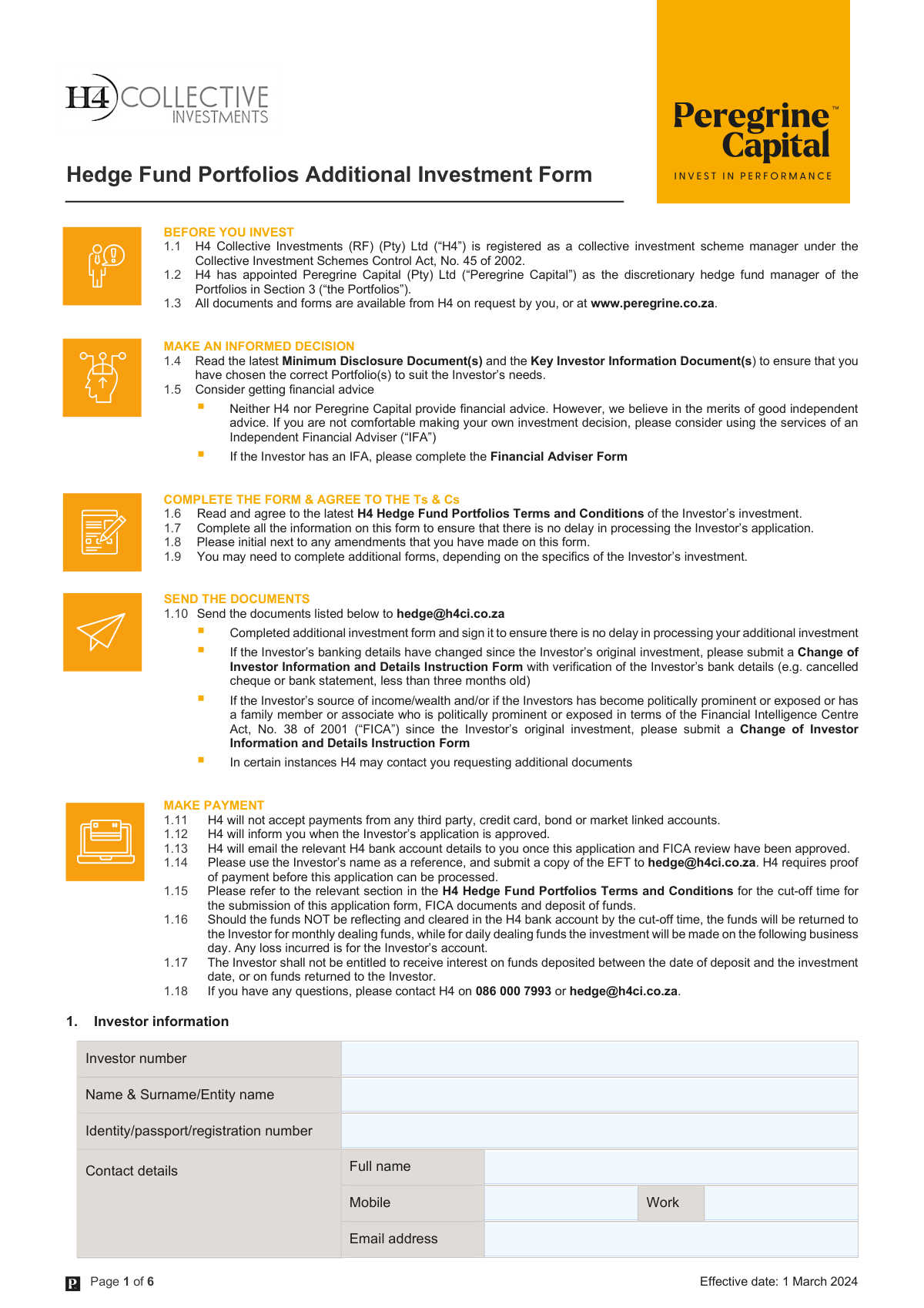
About portfolio management forms
Typically, these forms are required by individual investors, institutional entities, and financial advisors who are looking to expand their existing market positions. For example, when an investor decides to commit additional capital to a hedge fund or establish a recurring debit order, they must complete specific paperwork like an additional investment form to formalize the transaction. These situations often require the precise input of financial data and personal identification details to satisfy "Know Your Customer" (KYC) requirements, making accuracy paramount to avoid processing delays or compliance issues.
Navigating these requirements can often feel like a repetitive administrative burden, especially when dealing with complex or non-interactive PDF documents. Tools like Instafill.ai use AI to fill these forms in under 30 seconds, handling sensitive data accurately and securely to streamline the investment process. This allows investors and advisors to focus on strategic asset allocation rather than the manual friction of data entry.
Every form on this page can be completed without typing. Instafill is form filling software that reads a PDF and fills it for you — including flat and scanned documents that carry no fillable fields at all.
Forms in This Category
The forms in this category have a median Form Complexity Index of 51/100 (Moderate), measured across 1 forms by field count, input difficulty, length, conditional logic and structure. See how it is calculated.
| Form Name | Pages | FCI | |
|---|---|---|---|
| 1. | Hedge Fund Portfolios Additional Investment Form | 1 | Moderate 51 |
- Enterprise-grade security & data encryption
- 99%+ accuracy powered by AI
- 1,000+ forms from all industries
- Complete forms in under 60 seconds
How to Choose the Right Form
Navigating portfolio management requires precision, especially when increasing your exposure to specific funds. While this category currently focuses on a specialized area of hedge fund management, choosing the right document depends on your status as an investor and your specific financial goals.
For Existing Investors
The primary document available is the Hedge Fund Portfolios Additional Investment Form. This is specifically designed for individuals or entities who already hold an account with H4 Hedge Fund Portfolios. You should choose this form if you fall into one of the following categories:
- Retail Investors: Those looking to add capital to standard retail hedge fund structures.
- Qualified Investors: High-net-worth individuals or institutional investors managing more complex qualified investor hedge funds.
Identifying Your Investment Method
When using the Hedge Fund Portfolios Additional Investment Form, you need to decide how you want to deploy your capital. The form supports two main pathways:
- Lump Sum Investments: Select this if you have a one-time capital injection you wish to add to your existing portfolio.
- Recurring Debit Orders: Choose this option if you prefer a "set and forget" strategy, allowing for automated, periodic investments to grow your position over time.
Compliance and Documentation
A critical part of choosing to use this form is ensuring your regulatory standing is up to date. This form includes sections for updating FICA (Financial Intelligence Centre Act) information. If your personal or business details have changed since your initial investment, this form acts as a dual-purpose tool to both invest and maintain compliance.
By using Instafill.ai, you can transform the Hedge Fund Portfolios Additional Investment Form from a static PDF into a dynamic, AI-assisted experience, ensuring that complex financial data and FICA details are captured accurately before submission.
Form Comparison
| Form | Primary Purpose | Target User | Key Requirements |
|---|---|---|---|
| Hedge Fund Portfolios Additional Investment Form | Facilitate additional lump sum or recurring investments into existing hedge fund accounts. | Existing retail and qualified investors holding H4 Hedge Fund Portfolio accounts. | Investment amount details, debit order setup, and updated FICA documentation. |
Tips for portfolio management forms
When submitting additional investment forms, ensure your current account number and portfolio name match your latest statement exactly. Small discrepancies in account naming can lead to significant delays in fund allocation or cause the application to be rejected by the fund manager.
Portfolio management forms often require updated FICA or KYC documentation to process new transactions. Before filling out your form, check if your proof of residence or identification has expired to ensure your investment is processed without administrative holds.
AI-powered tools like Instafill.ai can complete these complex financial forms in under 30 seconds with high accuracy. Your sensitive financial data stays secure during the process, providing a massive time-saving advantage for investors managing multiple hedge fund portfolios.
Clearly mark whether you are making a one-time investment or establishing a recurring debit order. If you are setting up a debit order, double-check the commencement date and frequency to ensure the schedule aligns with your liquidity needs.
Hedge fund portfolios often have different classes for retail versus qualified investors. Before submitting, verify that your investment amount meets the minimum threshold for your chosen fund class to avoid having the transaction reversed.
Always save a copy of the completed and signed PDF for your personal records. Having an organized digital folder of all additional investment forms makes it significantly easier to track your cost basis and prepare for tax season.
Frequently Asked Questions
Portfolio management forms are used to manage, update, or increase holdings within existing investment accounts. They facilitate administrative tasks like adding funds, changing distribution methods, or updating regulatory compliance information to ensure the fund manager has accurate records.
These forms are generally required by existing investors, fund managers, or financial advisors looking to adjust a client's portfolio. They ensure that all transactions are documented for both the investor's records and the fund's compliance requirements.
An additional investment form is used when you already have an established account with a fund and want to increase your stake. It is a streamlined version of the initial application, focusing on the investment amount and fund selection rather than re-collecting all basic personal details.
Most portfolio management forms require updated FICA (Financial Intelligence Centre Act) or KYC (Know Your Customer) documents. This usually includes a copy of your identity document and proof of residence to ensure the transaction meets anti-money laundering regulations.
Yes, many portfolio management forms allow you to choose between a one-time lump sum investment or a recurring debit order. This flexibility helps investors automate their savings and build their portfolio consistently over time.
Completed forms are typically submitted directly to the fund manager or the administrative office of the investment firm. Many firms now accept digital submissions via email or secure portals to expedite the processing of the investment.
Yes, AI tools like Instafill.ai can fill these forms in under 30 seconds by accurately extracting and placing data from your source documents. This technology ensures that complex financial forms are completed without manual entry errors.
While manual completion can take significant time, using AI-powered services can reduce the process to less than a minute. These platforms can even convert non-fillable PDF versions into interactive forms to further simplify the submission process.
Retail funds are generally open to the broader public with lower entry requirements, while qualified investor funds are reserved for those with higher net worth or professional investment experience. The forms will often ask you to designate which category you fall under to ensure the firm adheres to regulatory standards.
While you may not need to provide full documentation for every transaction, you must confirm that your existing information is current. If there have been changes to your address or legal status, the additional investment form provides a necessary opportunity to update these records.
Glossary
- Form Complexity Index
- Instafill’s 0–100 measure of how much effort a form takes to complete, calculated deterministically from the form’s own structure rather than estimated. It combines the number of fillable fields (the largest factor), how difficult those fields are to complete based on their type, the number of pages that contain fields, the amount of conditional “fill-only-if” logic, and how many sections the form is divided into, then adds modifiers for tables and repeating lists, bundled instruction pages, and dense page layouts. A higher score means the form is harder to fill out by hand. The forms in this category have a median Form Complexity Index of 51/100 (Moderate). See exactly how it is calculated.
- FICA (Financial Intelligence Centre Act)
- A South African law designed to combat money laundering and financial crimes by requiring financial institutions to verify the identity and address of their clients.
- Qualified Investor
- An investor who meets specific high-net-worth or professional experience criteria, allowing them access to more complex and higher-risk investment products like certain hedge funds.
- Retail Investor
- An individual, non-professional investor who buys and sells securities through brokerage firms or savings accounts, usually in smaller amounts than institutional or qualified investors.
- Debit Order
- An authorization given by an investor to a fund manager to automatically withdraw a specified amount of money from their bank account at regular intervals for recurring investments.
- Lump Sum Investment
- A single, one-time contribution of a large amount of capital into an investment portfolio, as opposed to making smaller, regular payments over time.
- Hedge Fund
- A pooled investment fund that uses a variety of complex strategies, including leverage and derivatives, to aim for high returns regardless of whether the broader market is rising or falling.
- NAV (Net Asset Value)
- The total value of a fund's assets minus its liabilities, typically calculated daily to determine the price per unit or share for investors.
- KYC (Know Your Customer)
- A mandatory process used by financial institutions to verify the identity, suitability, and risks involved with maintaining a business relationship with a client.