Fill out prescription drug forms
with AI.
Prescription drug forms are essential documents used to bridge the gap between healthcare providers, insurance companies, and pharmacies. They primarily ensure that patients receive the specific medications they need while navigating the complex requirements of health insurance plans. These forms are critical for managing costs and verifying medical necessity, particularly when a prescribed drug is not on a standard formulary or requires additional clinical justification for coverage.
By continuing, you acknowledge Instafill's Privacy Policy and agree to get occasional product update and promotional emails.
About prescription drug forms
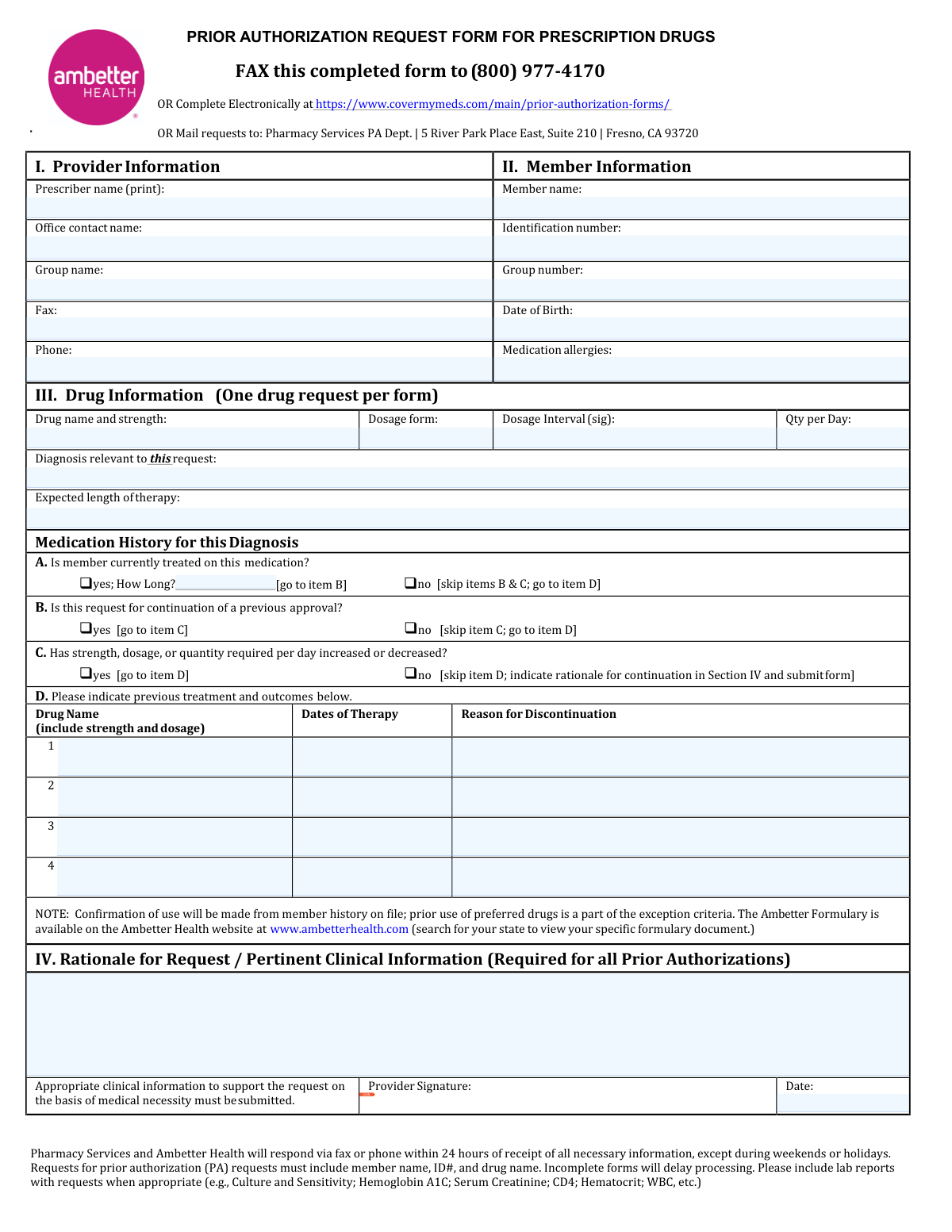
Healthcare professionals, such as doctors and pharmacists, are the primary users of these documents, though patients often need to initiate the process with their insurance providers to secure benefits. Common scenarios include submitting a Prior Authorization Request Form to justify a specific treatment or filing a Texas Standard Prior Authorization Request to meet state-specific regulatory requirements. These situations often arise when a patient requires a specialized medication, a specific medical device, or an exception to a step-therapy protocol mandated by their insurer.
Navigating these administrative requirements can be time-consuming, but tools like Instafill.ai use AI to fill these forms accurately and securely in under 30 seconds. By automating the data entry process, healthcare teams can focus more on patient care rather than paperwork. This technology ensures that even non-fillable PDF versions are handled efficiently, helping to expedite the coverage determination process and reducing the risk of administrative errors.
Every form on this page can be completed without typing. Instafill is form filling software that reads a PDF and fills it for you — including flat and scanned documents that carry no fillable fields at all.
Forms in This Category
The forms in this category have a median Form Complexity Index of 65/100 (Complex), measured across 2 forms by field count, input difficulty, length, conditional logic and structure. See how it is calculated.
| Form Name | Pages | FCI | |
|---|---|---|---|
| 1. | Prior Authorization Request Form for Prescription Drugs | 1 | Moderate 48 |
| 2. | Texas Standard Prior Authorization Request Form for Prescription Drug Benefits | 3 | Complex 65 |
- Enterprise-grade security & data encryption
- 99%+ accuracy powered by AI
- 1,000+ forms from all industries
- Complete forms in under 60 seconds
How to Choose the Right Form
Choosing the right prescription drug form is essential for ensuring patients receive their medications without delay. In most cases, these forms are used by healthcare providers to request "prior authorization" from an insurance company when a medication is not on the insurer's preferred drug list (formulary).
Location and Jurisdiction
The most important factor in your choice is where the medical practice or the patient is located, as state laws often dictate which document is required:
- For Texas-based requests: Use the Texas Standard Prior Authorization Request Form for Prescription Drug Benefits. This is a state-mandated, standardized document designed for all health benefit plan issuers operating in Texas. It is the correct choice for requesting drugs, medical devices, or exceptions to step-therapy requirements within the state.
- For other states or specific carriers: Use the Prior Authorization Request Form for Prescription Drugs. This form is commonly used for providers such as Ambetter Health and other national insurers to justify the medical necessity of a specific treatment for a patient.
Nature of the Request
While both forms serve to secure coverage, their scope varies slightly depending on what you are prescribing:
- Standard Formulary Exceptions: If you are requesting a medication that isn't on a preferred list for a national carrier, the general Prior Authorization Request Form for Prescription Drugs is typically the most direct route for approval.
- Clinical Detail and Devices: If your request involves complex clinical data, specific medical devices, or a "step-therapy" exception (where a patient must try and fail other drugs first), the Texas Standard Prior Authorization Request Form for Prescription Drug Benefits provides the specialized fields required to document these specific clinical scenarios.
By using Instafill.ai, you can quickly convert these complex PDF forms into interactive documents, allowing you to use AI to help fill out clinical justifications and ensure all required fields are completed before submission.
Tips for prescription drug forms
One of the most common reasons for immediate rejection is a typo in the patient's insurance identification or group number. Always cross-reference these details with the member's current insurance card to ensure the request is processed under the correct policy.
Insurers often require proof that a patient has tried less expensive or formulary-preferred drugs before approving a specialized medication. Clearly document which alternative treatments were attempted and specifically why they were ineffective or caused adverse reactions.
Support your request by attaching relevant lab results, clinical notes, or diagnostic reports that demonstrate medical necessity. Providing this objective data upfront reduces the need for back-and-forth communication and can significantly shorten the approval timeline.
Manually entering clinical data into complex healthcare forms is prone to error and takes valuable time. AI-powered tools like Instafill.ai can complete these forms in under 30 seconds with high accuracy, ensuring your data stays secure while you focus on patient care.
The insurance company must be able to contact the prescribing office quickly if they require additional clarification. Double-check that the National Provider Identifier (NPI) and the direct phone or fax numbers for the clinical coordinator are accurate and easy to read.
Always save a copy of the completed form and the confirmation of receipt from the insurance carrier. This documentation is essential for tracking the status of the request and serves as a reference point if you need to file an appeal later.
Frequently Asked Questions
These forms are used to request approval from a health insurance provider before a specific medication is covered under a patient's plan. They are typically required for drugs that are not on the insurer's preferred list or for high-cost treatments where medical necessity must be proven.
While the patient is the beneficiary, the healthcare provider or their office staff usually completes these forms because they require detailed clinical information. The physician must provide the medical justification, diagnosis codes, and treatment history to support the request for the medication.
State-specific forms are required when a state has mandated a standardized document that all health benefit plan issuers within that jurisdiction must accept. In Texas, for example, prescribers use the standard form to ensure consistency and compliance with state insurance regulations regardless of the specific insurance carrier.
Yes, AI tools like Instafill.ai can be used to fill out these complex medical documents efficiently. These tools can accurately extract data from source documents and medical records, placing the information into the correct fields in under 30 seconds.
Manually completing medical authorization forms can be a time-consuming process for healthcare offices. By using automated platforms like Instafill.ai, the same forms can be completed in less than 30 seconds, significantly reducing the administrative burden on medical staff.
If a required prior authorization is not submitted or is rejected by the insurer, the pharmacy will likely charge the patient the full retail price for the medication. If denied, the healthcare provider often has the right to appeal the decision by providing additional clinical evidence.
Most forms require the patient's insurance ID, the prescriber's National Provider Identifier (NPI), and the specific diagnosis codes (ICD-10). Additionally, the form usually asks for a list of other medications the patient has tried and why those alternatives were unsuccessful or inappropriate.
Completed forms are generally sent directly to the insurance company's prior authorization department or their Pharmacy Benefit Manager (PBM). Submission is typically handled via fax or a secure online provider portal, with contact details usually listed on the form itself.
Many insurance companies, such as Ambetter or Blue Cross Blue Shield, have their own proprietary forms for drug requests. You should check the insurer's website or the patient's plan documents to see if they require their own specific form or if they accept a general or state-standardized version.
A formulary exception is a request for an insurance plan to cover a drug that is otherwise excluded from its list of covered medications. The prior authorization form is the standard document used to request this exception by demonstrating that the requested drug is medically necessary for the patient's condition.
Glossary
- Form Complexity Index
- Instafill’s 0–100 measure of how much effort a form takes to complete, calculated deterministically from the form’s own structure rather than estimated. It combines the number of fillable fields (the largest factor), how difficult those fields are to complete based on their type, the number of pages that contain fields, the amount of conditional “fill-only-if” logic, and how many sections the form is divided into, then adds modifiers for tables and repeating lists, bundled instruction pages, and dense page layouts. A higher score means the form is harder to fill out by hand. The forms in this category have a median Form Complexity Index of 65/100 (Complex). See exactly how it is calculated.
- Prior Authorization (PA)
- A requirement by a health insurance plan for a provider to obtain approval before a specific medication is covered or dispensed to a patient.
- Formulary
- An official list of prescription drugs covered by a health insurance plan, often categorized into tiers that determine the patient's out-of-pocket costs.
- Step Therapy
- A protocol where an insurer requires a patient to try lower-cost or more established medications before they will cover a more expensive or newer drug.
- Medical Necessity
- The clinical justification provided by a physician to prove that a specific drug or treatment is essential for a patient’s health condition according to established standards of care.
- NPI Number
- The National Provider Identifier is a unique 10-digit identification number used by healthcare providers in the United States to process claims and administrative forms.
- ICD-10 Code
- A standardized system of diagnostic codes used by healthcare providers to classify diseases and health conditions on medical and pharmacy forms.
- NDC (National Drug Code)
- A unique 10 or 11-digit number that serves as a universal identifier for human drugs, identifying the manufacturer, the specific product, and the package size.
- Quantity Limit
- A restriction set by an insurance plan on the maximum amount of a specific medication that can be filled per prescription or over a set period of time.