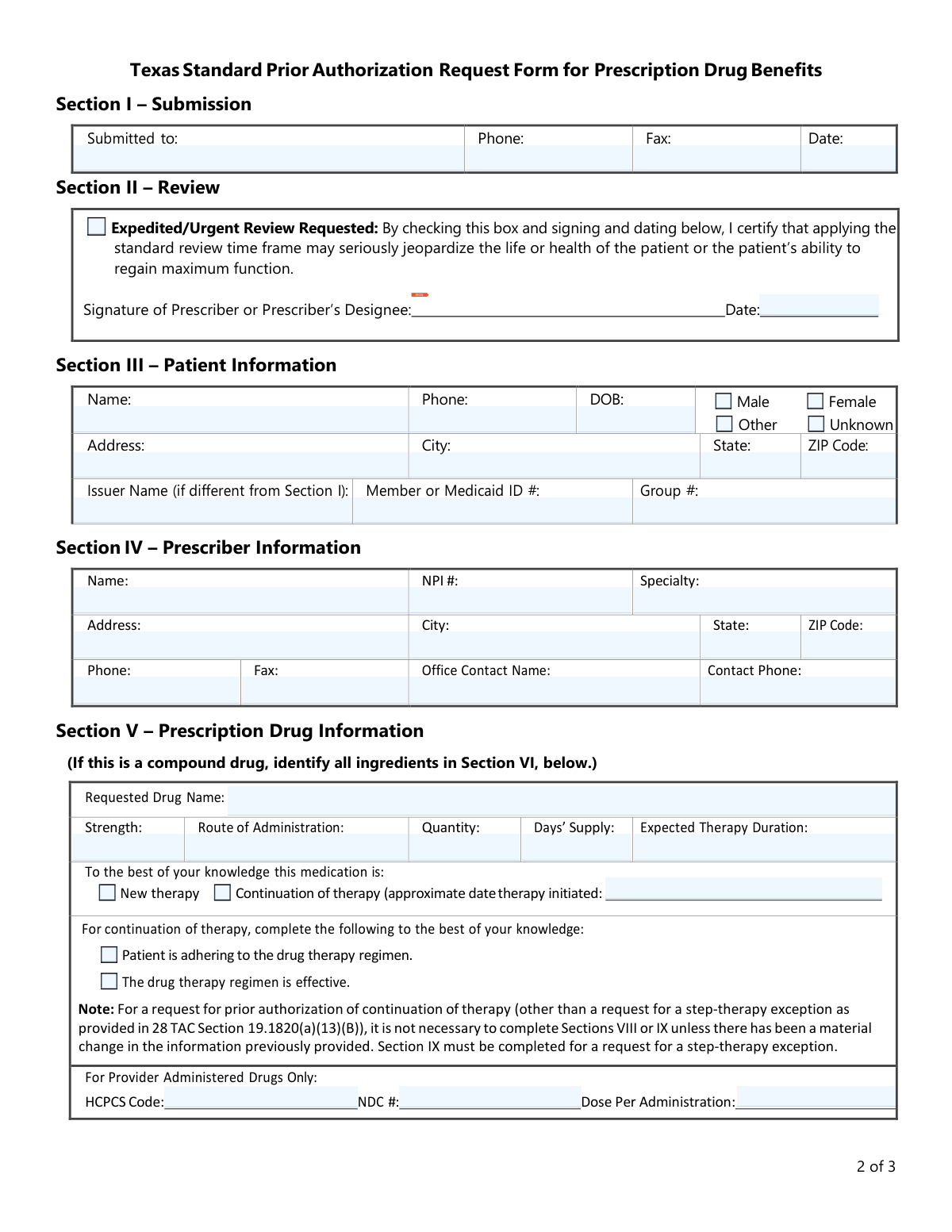
Yes! You can use AI to fill out Texas Standard Prior Authorization Request Form for Prescription Drug Benefits

This form is a standardized document in Texas for prescribers to request prior authorization from health benefit plan issuers for prescription drugs, devices, formulary exceptions, or step-therapy requirement exceptions. It ensures that all necessary clinical and patient information is provided to the issuer for a coverage determination. Today, this form can be filled out quickly and accurately using AI-powered services like Instafill.ai, which can also convert non-fillable PDF versions into interactive fillable forms.
Our AI automatically handles information lookup, data retrieval, formatting, and form filling.
It takes less than a minute to fill out NOFR002 using our AI form filling.
Securely upload your data. Information is encrypted in transit and deleted immediately after the form is filled out.

Form specifications

Form name: Texas Standard Prior Authorization Request Form for Prescription Drug Benefits
Number of pages: 3
Language: English
Categories: prior authorization forms, benefit forms, authorization forms
main-image

Instafill Demo: How to fill out PDF forms in seconds with AI

How to Fill Out NOFR002 Online for Free in 2026

Are you looking to fill out a NOFR002 form online quickly and accurately? Instafill.ai offers the #1 AI-powered PDF filling software of 2026, allowing you to complete your NOFR002 form in just 37 seconds or less.
Follow these steps to fill out your NOFR002 form online using Instafill.ai:
  1. 1 Navigate to Instafill.ai and upload or select the Texas Standard Prior Authorization Request Form.
  2. 2 Use the AI assistant to accurately fill in patient details, including name, date of birth, and insurance information from Section III.
  3. 3 Provide the prescriber's information in Section IV, such as name, NPI number, and contact details.
  4. 4 Enter the specific prescription drug or device information in Sections V, VI, or VII, including the drug name, strength, and quantity.
  5. 5 Complete the patient's clinical information in Section VIII, including the diagnosis (ICD code) and a history of medications taken for the condition.
  6. 6 Provide a detailed clinical justification for the request in Section IX, attaching any necessary supporting documents like lab reports or progress notes.
  7. 7 Review all auto-filled information for accuracy, have the prescriber or their designee sign the form, and submit it to the appropriate health plan issuer.

Our AI-powered system ensures each field is filled out correctly, reducing errors and saving you time.

Why Choose Instafill.ai for Your Fillable NOFR002 Form?

Speed

Complete your NOFR002 in as little as 37 seconds.

Up-to-Date

Always use the latest 2026 NOFR002 form version.

Cost-effective

No need to hire expensive lawyers.

Accuracy

Our AI performs 10 compliance checks to ensure your form is error-free.

Security

Your personal information is protected with bank-level encryption.

Frequently Asked Questions About Form NOFR002

This form is used by prescribers to request prior authorization from a health plan for a prescription drug, device, formulary exception, quantity limit override, or step-therapy exception.

A prescriber or their authorized designee must complete this form when a patient's health benefit plan requires prior authorization for a prescription drug or device.

Send the form directly to the patient's health benefit plan issuer or their agent that manages prescription drug benefits. Do not send it to the Texas Department of Insurance or the patient's employer.

Do not use this form to request an appeal, confirm patient eligibility, verify coverage, or ask if a drug requires prior authorization in the first place.

You should only request an expedited review if applying the standard time frame may seriously jeopardize the patient's life, health, or ability to regain maximum function. By checking the box, you are certifying this urgency.

No, for a continuation of therapy, you generally do not need to complete Sections VIII (Patient Clinical Information) or IX (Justification) unless there has been a significant change. However, Section IX is always required for a step-therapy exception request.

In this section, provide clinical information to justify the request, explain any comorbid conditions, and detail why formulary drugs are not appropriate. You should attach supporting documents like medical records or lab reports.

Yes, this form must be accepted by public issuers including Medicaid, the Medicaid managed care program, and the Children’s Health Insurance Program (CHIP).

For a compound drug, you must use Section VI to list all individual ingredients, their NDC numbers, and their specific quantities.

Yes, services like Instafill.ai use AI to accurately auto-fill form fields from your records, which can save significant time and reduce errors.

You can use a service like Instafill.ai by uploading the form to their platform. Their AI will help you fill in the patient, prescriber, and prescription details quickly and accurately online.

If you have a non-fillable or 'flat' PDF, you can upload it to a platform like Instafill.ai. Their service can convert it into an interactive, fillable form for you to complete online.

You need to enter the name and contact information for the insurance issuer or their agent. Some issuers may provide a version of this form on their website with this information already filled in.

Compliance NOFR002
Validation Checks by Instafill.ai

1
Validates NPI Number Format and Structure
This check ensures the Prescriber's National Provider Identifier (NPI) in Section IV is exactly 10 digits long. The NPI is a critical, unique identifier for health care providers. If the NPI is missing, incomplete, or invalid, the prescriber cannot be verified, which will lead to an automatic rejection or significant delay of the authorization request.
2
Ensures Patient Date of Birth is a Valid Past Date
This validation confirms that the Patient's Date of Birth (DOB) in Section III is a complete, logical date (e.g., not '02/30/2000') and that it occurs before the form's submission date. The DOB is essential for correct patient identification and eligibility verification. An invalid or future date will cause a processing failure, as the patient cannot be accurately identified in the issuer's system.
3
Requires Signature for Expedited Review Request
This check verifies that if the 'Expedited/Urgent Review Requested' box is checked in Section II, then the 'Signature of Prescriber' and the corresponding 'Date' fields are also filled. This signature serves as a legal certification of medical urgency. Without the signature and date, the request for an expedited review is invalid and will be processed under the standard, non-urgent timeframe.
4
Validates 'Date Therapy Initiated' for Continuation Requests
If 'Continuation of therapy' is selected in Section V, this validation ensures the 'Date Therapy Initiated' field is populated with a valid date that is prior to the form's submission date. This information is critical for the issuer to assess the patient's history with the medication. A missing, future, or illogical date will result in an incomplete request, requiring follow-up and delaying approval for ongoing treatment.
5
Ensures Request is for Either a Drug or a Device, Not Both
This validation checks that information is provided in either Section V (Prescription Drug Information) or Section VII (Prescription Device Information), but not both simultaneously. A single prior authorization form is designed to process a request for one item. Submitting a request for both a drug and a device on the same form creates ambiguity and will likely result in the form being rejected for clarification.
6
Validates ICD Code against its Specified Version
This check verifies that the provided ICD Code in Section VIII is a valid code format that corresponds to the specified ICD Version (e.g., ICD-9 or ICD-10). Medical necessity is determined based on the diagnosis, so a valid and matching code/version pair is essential for system-based checks. A mismatch or invalid code will prevent the system from verifying the diagnosis and will require manual correction and resubmission.
7
Validates National Drug Code (NDC) Format
This validation ensures that any National Drug Code (NDC) number entered in Sections V or VI adheres to the standard 10 or 11-digit format. The NDC is the universal product identifier for drugs and is essential for accurately identifying the requested medication and its dosage form. An incorrectly formatted NDC will lead to incorrect drug identification and certain rejection of the prior authorization request.
8
Requires Ingredient Details for Compound Drugs
If information is entered in Section VI (Prescription Compound Drug Information), this check ensures that at least one ingredient with its corresponding NDC and quantity is also listed. A request for a compound drug is incomplete and cannot be evaluated without the details of its constituent ingredients. Failure to provide this information will result in an incomplete submission and immediate rejection.
9
Ensures Core Patient Identifiers are Complete
This check ensures that the Patient's Name, Date of Birth, and Member or Medicaid ID # are all present in Section III. These fields are the primary identifiers used by the insurance issuer to locate the patient's specific policy and benefits information. If any of this core information is missing or unreadable, the issuer cannot process the request, leading to an immediate rejection.
10
Validates Phone and Fax Number Format
This check verifies that all phone and fax number fields on the form contain a valid format, typically 10 digits, with or without common separators. Correctly formatted contact numbers are crucial for communication between the issuer and the prescriber's office. Invalid numbers can prevent necessary follow-up for clarifications, leading to delays or denials due to inability to contact the provider.
11
Validates ZIP Code Format
This validation ensures that the ZIP Code fields for both the patient and prescriber addresses contain either a 5-digit or 9-digit (ZIP+4) numeric value. A valid ZIP code is essential for verifying addresses, determining network status, and for mailing correspondence. An invalid format can cause processing errors or misdirected mail, delaying the entire authorization process.
12
Requires Justification for Step-Therapy Exceptions
Based on the form's instructions, this check validates that if the request is for a step-therapy exception, the Justification field in Section IX is completed. Texas law requires specific details for this type of exception. Failure to provide a justification for a step-therapy exception will result in a denial, as the request does not meet the required criteria for overriding the standard drug protocol.
13
Validates HCPCS Code Format
This check ensures that any Healthcare Common Procedure Coding System (HCPCS) code entered in Section V or VII is a 5-character alphanumeric string. HCPCS codes are used for billing and identifying specific provider-administered drugs and medical devices. An invalidly formatted code will fail system lookups and cause the authorization to be rejected.
14
Ensures at Least One Gender is Selected
This validation confirms that one of the gender options (Male, Female, Other, Unknown) in Section III has been selected for the patient. While it may seem minor, this demographic data is often required for complete patient records and can be used in clinical or actuarial analysis. An incomplete record may be flagged for correction, causing a minor processing delay.

Common Mistakes in Completing NOFR002

Incorrect Form Submission Destination

Many users mistakenly send this form to the Texas Department of Insurance (TDI) or the patient's employer instead of the correct health plan issuer. This happens due to confusion about who handles prior authorizations. Submitting to the wrong entity causes significant processing delays as the form must be rerouted, potentially delaying patient care. Always verify the specific issuer's contact information, often found on their website or the patient's insurance card, before faxing or mailing the form.

Incomplete Expedited Review Request

A frequent error is checking the 'Expedited/Urgent Review Requested' box in Section II without providing the required signature and date on the designated lines below it. The signature legally certifies that a standard review timeframe would jeopardize the patient's health. Without the signature and date, the request is automatically downgraded to a standard review, which can delay access to critical medication.

Vague or Insufficient Clinical Justification

In Section IX, providers often write a brief, generic justification that fails to provide the necessary clinical details. A strong justification must explain comorbid conditions, contraindications for formulary drugs, or details for a step-therapy exception as instructed. A weak or incomplete justification is one of the most common reasons for denial, as it fails to prove medical necessity to the reviewer.

Missing ICD Version with Diagnosis Code

In Section VIII, users frequently enter the patient's diagnosis code (e.g., 'F33.2') but omit the required ICD version (e.g., 'ICD-10'). Since multiple coding systems exist, this ambiguity forces the issuer to seek clarification, halting the review process. To prevent delays, always specify the ICD version next to the diagnosis code.

Incomplete Prior Medication History

The table in Section VIII detailing drugs the patient has previously taken is often filled out incompletely. Users may list a drug but forget to include the duration of therapy or, most critically, a clear 'Reason for Failure' or description of the patient's response. This information is essential for justifying a step-therapy exception, and its absence often leads to an automatic denial for failing to demonstrate that preferred alternatives were ineffective.

Misunderstanding 'Continuation of Therapy' Rules

The form notes that for 'Continuation of therapy,' Sections VIII and IX may be skipped unless there's a material change or it's a step-therapy exception. This nuance is often missed; users either fail to complete these critical sections when required for a step-therapy exception, leading to denial, or they fill them out unnecessarily. It is vital to read this instruction carefully to determine if the clinical justification sections are required for your specific request.

Invalid NPI or NDC Number Formatting

Data entry errors are common when inputting the prescriber's National Provider Identifier (NPI) in Section IV or the National Drug Code (NDC) in Sections V or VI. These numbers have specific lengths and formats, and a single incorrect digit can cause an automated system to reject the entire submission. Carefully double-checking these numbers is crucial for a successful submission. AI-powered form filling tools like Instafill.ai can help prevent these errors by automatically validating number formats.

Failure to Attach Supporting Documentation

The instructions recommend attaching supporting clinical documents like lab reports, progress notes, or medical records, but this step is frequently forgotten. The justification in Section IX may be insufficient on its own, and without the attached evidence, the reviewer cannot verify the clinical claims. This often results in a denial for insufficient information, requiring a new submission. Always compile and attach all relevant documents to support your request.

Missing Patient Insurance Identifiers

In Section III, users sometimes omit the patient's 'Member or Medicaid ID #' or 'Group #'. This often happens when the information is not readily available, but it makes it impossible for the issuer to locate the patient's benefits plan. An incomplete ID will lead to an immediate rejection or a lengthy delay while the office contacts the patient for the correct information. Ensure all insurance identifiers are copied accurately from the patient's card.

Incomplete Compound Drug Ingredient List

When requesting a compound drug, it is a common mistake to not list every single ingredient, its precise quantity, and its NDC number in Section VI. Reviewers need this complete breakdown to assess the medical necessity and coverage for each component of the compound. An incomplete list will halt the review and trigger a request for more information, delaying the authorization. If the form is a non-fillable PDF, a tool like Instafill.ai can convert it into a fillable version to make entering this detailed information easier.
Saved over 80 hours a year

“I was never sure if my IRS forms like W-9 were filled correctly. Now, I can complete the forms accurately without any external help.”

Kevin Martin Green

Your data stays secure with advanced protection from Instafill and our subprocessors

Robust compliance program

Transparent business model

You’re not the product. You always know where your data is and what it is processed for.

ISO 27001, HIPAA, and GDPR

Our subprocesses adhere to multiple compliance standards, including but not limited to ISO 27001, HIPAA, and GDPR.

Security & privacy by design

We consider security and privacy from the initial design phase of any new service or functionality. It’s not an afterthought, it’s built-in, including support for two-factor authentication (2FA) to further protect your account.

Fill out NOFR002 with Instafill.ai

Worried about filling PDFs wrong? Instafill securely fills texas-standard-prior-authorization-request-form-for-prescription-drug-benefits forms, ensuring each field is accurate.