Fill out price quote forms
with AI.
Price quote forms are essential documents used by contractors, vendors, and businesses to outline the costs associated with specific projects or services. In the context of government and infrastructure, such as various DOT forms, these documents serve as the formal basis for competitive bidding. They ensure that all parties have a clear, itemized understanding of the expenses involved—ranging from labor and materials to specialized equipment—before a contract is finalized or work begins.
By continuing, you acknowledge Instafill's Privacy Policy and agree to get occasional product update and promotional emails.
About price quote forms
These forms are typically required by construction firms, independent contractors, and logistics providers when submitting bid proposal forms for state or local projects. For instance, detailed proposals for unit items are critical for those bidding on transportation contracts, where precision in unit pricing is mandatory. Accurate completion of these forms is vital, as a single error in calculation or a missed field can lead to a proposal being disqualified, potentially costing a business a significant contract opportunity.
Managing the paperwork for multiple bids can be time-consuming and prone to manual error. Tools like Instafill.ai use AI to fill these price quote forms in under 30 seconds, handling complex data accurately and securely to streamline the submission process. This allows professionals to focus on the strategic aspects of their proposals while ensuring their documentation is completed efficiently.
Every form on this page can be completed without typing. Instafill is form filling software that reads a PDF and fills it for you — including flat and scanned documents that carry no fillable fields at all.
Forms in This Category
The forms in this category have a median Form Complexity Index of 37/100 (Basic), measured across 1 forms by field count, input difficulty, length, conditional logic and structure. See how it is calculated.
| Form Name | Pages | FCI | |
|---|---|---|---|
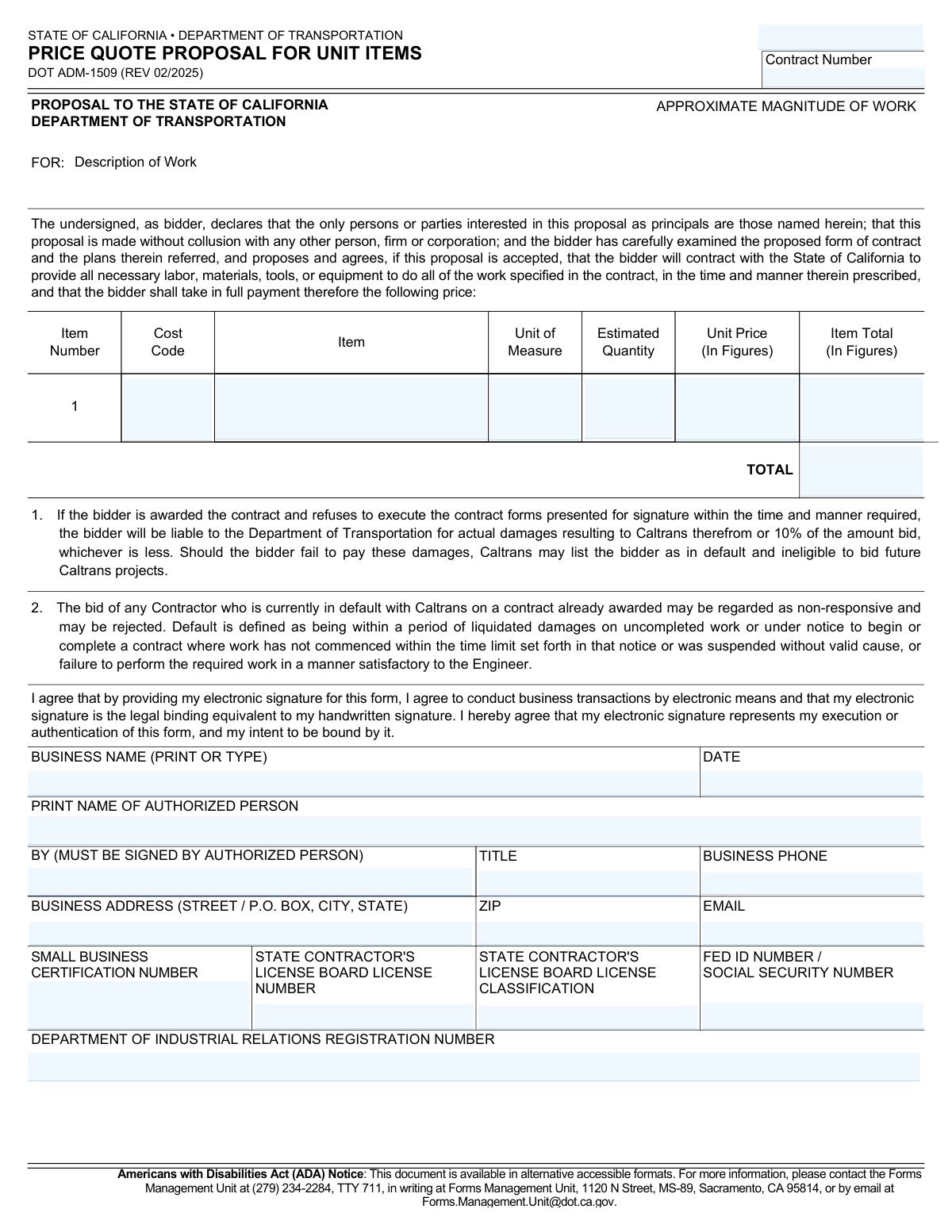
| 1. | Form DOT ADM-1509, Price Quote Proposal for Unit Items | 2 | Basic 37 |
- Enterprise-grade security & data encryption
- 99%+ accuracy powered by AI
- 1,000+ forms from all industries
- Complete forms in under 60 seconds
How to Choose the Right Form
Navigating state-level procurement can be complex, especially when dealing with the Department of Transportation (DOT). This category focuses on specialized bid proposal forms required for public works and transportation projects, specifically within the state of California. Choosing the right document is essential for ensuring your bid is compliant and professionally presented.
For California DOT Bidding
If you are a contractor, vendor, or business owner bidding on a project for the State of California Department of Transportation (Caltrans), you will likely need Form DOT ADM-1509, Price Quote Proposal for Unit Items. Unlike a generic business invoice or a simple price list, this form is a formal document used to submit competitive bids for specific state contracts.
When to Select Form DOT ADM-1509
Choose this form if your project requirements involve the following criteria:
- Unit Price Submissions: You are required to provide a cost breakdown for specific units of work or materials rather than a single lump-sum estimate.
- Caltrans Compliance: Your contract is specifically managed by the California Department of Transportation or follows their strict administrative guidelines for unit item proposals.
- Detailed Resource Allocation: The proposal requires a clear distinction between labor, materials, and equipment costs for each line item identified in the project specifications.
Key Considerations for Bid Proposals
When filling out price quote forms for government agencies, accuracy is critical. Using Form DOT ADM-1509 ensures that your bid is formatted correctly for state reviewers. Because these forms often require precise mathematical calculations across multiple unit items, using an AI-powered tool like Instafill.ai helps prevent common manual entry errors that could lead to a bid being rejected or disqualified.
If you are looking for a general commercial price quote for private sector work, this specific DOT form may be too specialized. However, for public infrastructure and Caltrans-related unit item proposals, it is the standard requirement for a professional and successful submission.
Form Comparison
| Form | Purpose | Primary Users | Key Information Required | Issuing Agency |
|---|---|---|---|---|
| Form DOT ADM-1509, Price Quote Proposal for Unit Items | Submit formal contract proposals for specific unit-priced labor, materials, and equipment. | Contractors and bidders seeking work on state transportation projects. | Detailed cost breakdowns for labor and materials for specific project units. | California Department of Transportation (Caltrans). |
Tips for price quote forms
Ensure that every unit price and total extension is calculated correctly, as even small mathematical errors can lead to a rejected proposal. Always verify that the sum of all individual items matches the total bid amount provided on the summary page.
Leaving fields blank or marked as 'N/A' without clarification can cause your bid to be flagged as non-responsive. If an item is included in another price, clearly state where that cost is accounted for to ensure the reviewer understands your pricing structure.
Completing complex bid proposals can be time-consuming, but AI-powered tools like Instafill.ai can finish these forms in under 30 seconds with high accuracy. Your data remains secure throughout the process, allowing you to focus on competitive pricing rather than manual data entry.
Before filling out the price quote, verify that the materials and labor units you are quoting exactly match the project’s technical specifications. Discrepancies between the form and the project requirements can lead to disputes during the contract award phase.
Always save a final, dated copy of every submitted price quote proposal for your internal records. This practice helps you track historical pricing trends and provides a quick reference point if a government agency or client requests clarification on your bid.
Ensure that the person signing the proposal has the legal authority to bind your company to the contract. Missing or unauthorized signatures are one of the most common reasons for bid disqualification in Department of Transportation projects.
Frequently Asked Questions
Price quote proposal forms are used by contractors and vendors to provide a detailed breakdown of costs for specific project components. These documents allow agencies, such as the Department of Transportation, to compare bids fairly based on standardized unit pricing for labor, materials, and equipment.
Licensed contractors and subcontractors bidding on state-funded infrastructure or maintenance projects are the primary users of these forms. The individual completing the form should be authorized to commit the business to the prices listed and have a thorough understanding of the project's technical requirements.
Unit items refer to specific, measurable parts of a project, such as tons of asphalt, linear feet of piping, or hours of specialized labor. Instead of providing a single lump sum, the contractor provides a price per unit, which allows the agency to adjust final payments based on the actual quantity of work completed.
Yes, you can use AI-powered services like Instafill.ai to complete these forms by extracting data directly from your internal estimates or spreadsheets. The AI accurately identifies where each piece of data belongs, ensuring that unit prices and item descriptions are placed correctly without manual data entry.
While manual entry for a long list of unit items can take significant time, AI tools can fill these forms in under 30 seconds. By automating the extraction and placement of data from your source documents, these tools significantly increase efficiency and reduce the risk of transcription errors.
You will generally need to provide the item number, a description of the work or material, the estimated quantity, the unit price, and the total extension for each item. Additionally, the form will require company contact information, contractor license numbers, and a signature from an authorized representative.
Submission instructions are typically found in the project's 'Notice to Bidders' or 'Invitation to Bid.' Most Department of Transportation forms are submitted to the specific district office overseeing the project or uploaded through a designated electronic bidding portal.
Once submitted, a price quote proposal is generally considered a firm offer to perform the described work at the stated prices for a specific period. If the agency accepts the proposal, the terms and prices provided in the form usually become the basis for the formal construction or service contract.
Most agencies have specific rules for handling mathematical errors, often prioritizing the unit price over the calculated total. However, significant errors can lead to a bid being rejected as non-responsive, which is why using automated tools to ensure accuracy is highly recommended.
The specific form required is almost always identified in the project's contract documents or bid package. For example, California DOT projects may specifically require Form DOT ADM-1509 for unit item proposals, while other states or agencies may have their own proprietary versions.
Glossary
- Form Complexity Index
- Instafill’s 0–100 measure of how much effort a form takes to complete, calculated deterministically from the form’s own structure rather than estimated. It combines the number of fillable fields (the largest factor), how difficult those fields are to complete based on their type, the number of pages that contain fields, the amount of conditional “fill-only-if” logic, and how many sections the form is divided into, then adds modifiers for tables and repeating lists, bundled instruction pages, and dense page layouts. A higher score means the form is harder to fill out by hand. The forms in this category have a median Form Complexity Index of 37/100 (Basic). See exactly how it is calculated.
- Unit Item
- A specific, individual component of work or material defined in a contract for which a bidder provides a separate price.
- Caltrans
- The California Department of Transportation, the state agency responsible for managing the state's highway system and public transportation.
- Mobilization
- The initial costs associated with starting a project, such as transporting equipment, personnel, and supplies to the job site.
- Addendum
- A written amendment or clarification issued by the agency during the bidding period that modifies the original proposal documents.
- Responsible Bidder
- A contractor who demonstrates the financial capability, technical experience, and reliability necessary to fulfill the terms of the contract.
- Force Account
- A payment method for extra work where the contractor is reimbursed for actual costs of labor, materials, and equipment plus a set markup.
- Prevailing Wage
- The hourly wage, including benefits, required by law to be paid to workers on public works projects within a specific region.
- Liquidated Damages
- A specified daily amount that a contractor must pay to the agency if they fail to complete the project within the agreed-upon timeframe.