Fill out procurement forms
with AI.
Procurement forms are the backbone of organized business transactions, serving as the official record for the acquisition of goods and services. These documents ensure that every step of the purchasing process—from initial bidding to final vendor selection—is handled with transparency and legal compliance. By utilizing standardized business forms, organizations can maintain clear audit trails for accounts payable and ensure that all vendor agreements are properly documented and authorized.
By continuing, you acknowledge Instafill's Privacy Policy and agree to get occasional product update and promotional emails.
About procurement forms
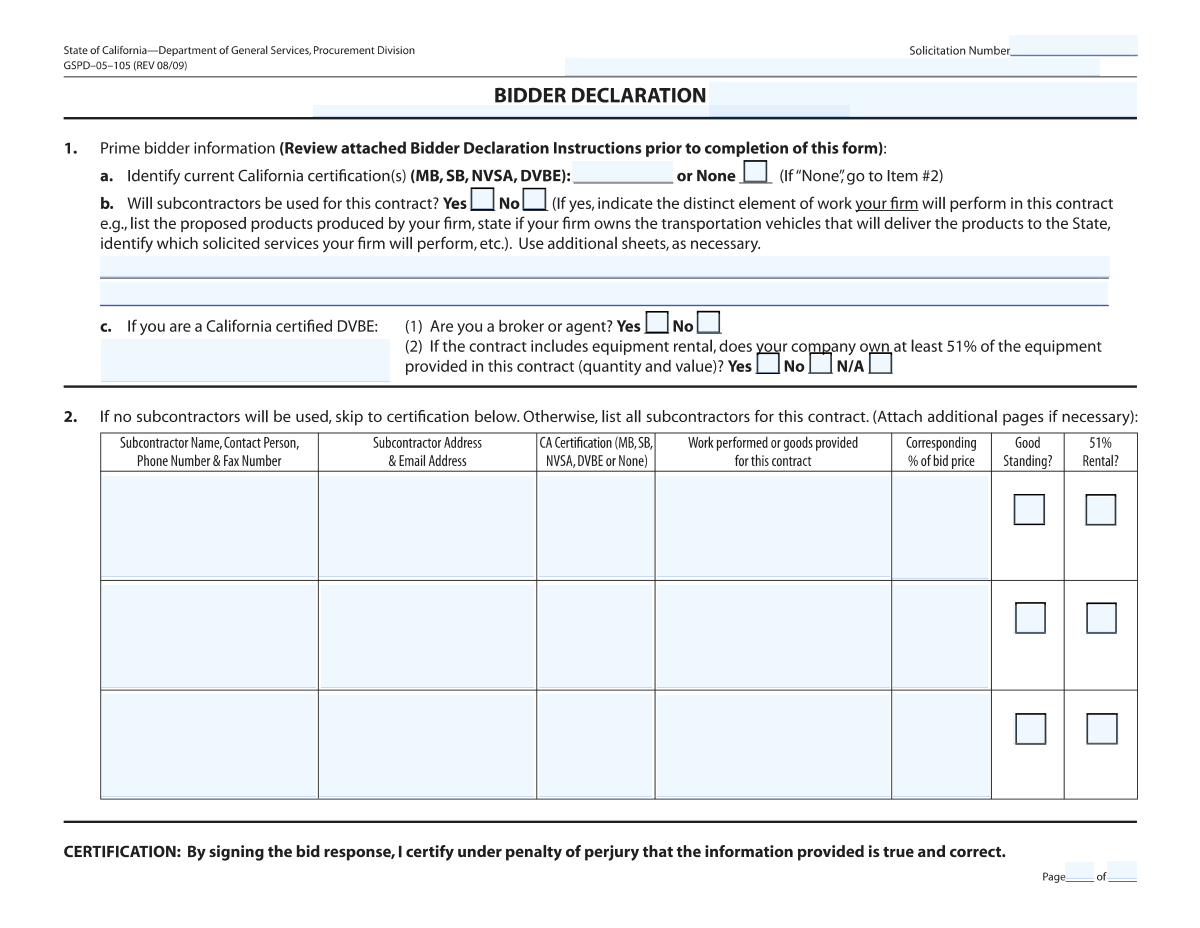
These forms are primarily used by procurement officers, contractors, and small business owners when engaging with government agencies or large corporate entities. For instance, a Bidder Declaration is often required to verify certifications and subcontractor details during a formal bidding process. Having these forms completed accurately is critical, as even minor errors in vendor forms can lead to delays or disqualification from lucrative contracts.
Managing this paperwork can be a significant administrative burden, but technology has simplified the process. Tools like Instafill.ai use AI to fill these forms in under 30 seconds, ensuring that data is handled accurately and securely. This allows businesses to focus on growth and strategy rather than manual data entry.
Every form on this page can be completed without typing. Instafill is form filling software that reads a PDF and fills it for you — including flat and scanned documents that carry no fillable fields at all.
Forms in This Category
The forms in this category have a median Form Complexity Index of 44/100 (Basic), measured across 1 forms by field count, input difficulty, length, conditional logic and structure. See how it is calculated.
| Form Name | Pages | FCI | |
|---|---|---|---|
| 1. | Bidder Declaration GSPD-05-105 | 2 | Basic 44 |
- Enterprise-grade security & data encryption
- 99%+ accuracy powered by AI
- 1,000+ forms from all industries
- Complete forms in under 60 seconds
How to Choose the Right Form
Navigating California State Procurement
If you are looking to do business with the State of California, the procurement process requires specific documentation to ensure transparency and legal compliance. While the term "procurement forms" covers a wide range of business, vendor, and purchasing interactions, the primary focus in this category is currently on the formal bidding phase required for state contracts.
For State Bidders and Contractors
If your goal is to bid on a government contract within California, you will likely need the Bidder Declaration GSPD-05-105. This is a mandatory requirement for vendors responding to state solicitations. This form is central to the state's purchasing forms ecosystem, ensuring that the government knows exactly who is performing the work and which businesses are benefiting from state spend.
Choose this form if:
- You are a primary contractor: You need to officially declare your business details and any relevant state-issued certifications to the Department of General Services.
- You hold SB or DVBE status: If your business is a certified Small Business (SB) or Disabled Veteran Business Enterprise (DVBE), the Bidder Declaration GSPD-05-105 is the standard way to claim these preferences during the bidding process.
- You are using subcontractors: This form requires you to detail every subcontractor involved in the project, their specific roles, and the percentage of work they will perform. This is critical for accounts payable forms and project auditing later in the contract lifecycle.
Ensuring Accuracy in Vendor Forms
Procurement and purchasing forms are legally binding documents. Using the Bidder Declaration GSPD-05-105 incorrectly or providing incomplete subcontractor information can lead to a bid being disqualified. It is essential to ensure that all certification numbers and work percentages are accurate.
If you are dealing with a non-fillable PDF version of this or other business forms, Instafill.ai can convert them into interactive documents. Using AI to fill these forms helps minimize manual entry errors, ensuring your submission is professional and compliant with California’s strict procurement policies.
Form Comparison
| Form | Primary Purpose | Target User | Key Requirements | Jurisdiction |
|---|---|---|---|---|
| Bidder Declaration GSPD-05-105 | Disclose bidder certifications and list subcontractors for state contract bids. | Businesses and vendors bidding on California State government contracts. | Must include DVBE or Small Business certifications and subcontractor details. | State of California procurement departments. |
Tips for procurement forms
Double-check that all state-issued certifications, such as SB or DVBE numbers, are accurate and currently active. Including expired or incorrect certification details is a frequent mistake that can lead to immediate bid disqualification.
When detailing subcontractors, clearly state the specific portion of the work they will perform and their corresponding certification status. Vague descriptions can cause procurement officers to flag your form for further clarification, delaying the approval process.
Use AI-powered tools like Instafill.ai to complete complex procurement forms in under 30 seconds with high accuracy. These services streamline the filing process for multiple forms while ensuring your business data remains completely secure.
Maintain a centralized digital folder with your Tax ID, vendor numbers, and certification documents. This allows you to quickly reference and copy-paste consistent information across various purchasing and accounts payable forms.
Ensure the project titles and solicitation numbers on your bidder forms exactly match the official bid package. Administrative inconsistencies between your declaration and the procurement request are common reasons for application rejection.
Check whether the specific agency requires a wet signature, a scanned copy, or a certified digital signature. Understanding these requirements beforehand prevents your vendor forms from being rejected due to non-compliant signing methods.
Frequently Asked Questions
Procurement forms facilitate the formal process of purchasing goods or services, especially between businesses and government entities. They ensure that all vendors are evaluated fairly and that the purchasing organization has a clear record of the entities they are doing business with.
These forms are generally required by vendors, contractors, and suppliers who wish to bid on projects or sell products to larger organizations or government agencies. Purchasing departments and accounts payable teams also use them to manage vendor relationships and ensure compliance with internal policies.
A bidder declaration should be prepared whenever a business is responding to a Request for Proposal (RFP) or an Invitation for Bid (IFB). It serves as a formal statement of the bidder's qualifications and their intent to comply with the specific terms and conditions of the contract.
Many procurement forms ask for state-issued certifications, such as Small Business (SB) or Disabled Veteran Business Enterprise (DVBE) status. Providing these certifications can often help a business qualify for specific bidding preferences or meet diversity requirements set by the purchasing agency.
Listing subcontractors is essential for transparency and to ensure that the primary contractor is meeting any mandated participation goals. It allows the contracting agency to verify that all parties involved in the project meet the necessary legal, safety, and certification standards.
Completed forms are typically submitted directly to the department or agency issuing the bid, often through an online procurement portal or via email. It is important to check the specific solicitation instructions, as some agencies may still require physical copies or specific filing formats.
Yes, you can fill out procurement forms using AI-powered tools like Instafill.ai. These tools can accurately extract data from your source documents and place it into the correct fields on the form in under 30 seconds, reducing the risk of manual entry errors.
Filling out these forms manually can take significant time due to the technical details required, but using online AI services can complete the process in less than a minute. These platforms can also convert static PDFs into interactive, fillable documents to streamline the submission process.
Submitting inaccurate information can lead to a bid being disqualified or a contract being terminated later for non-compliance. It is crucial to review all details, especially regarding certifications and subcontractor roles, before final submission to maintain eligibility.
While requirements vary by jurisdiction, most government contracts require some form of vendor declaration or procurement documentation to ensure fair competition. These forms help agencies verify that the bidding companies are legitimate and capable of fulfilling the specific contract requirements.
Glossary
- Form Complexity Index
- Instafill’s 0–100 measure of how much effort a form takes to complete, calculated deterministically from the form’s own structure rather than estimated. It combines the number of fillable fields (the largest factor), how difficult those fields are to complete based on their type, the number of pages that contain fields, the amount of conditional “fill-only-if” logic, and how many sections the form is divided into, then adds modifiers for tables and repeating lists, bundled instruction pages, and dense page layouts. A higher score means the form is harder to fill out by hand. The forms in this category have a median Form Complexity Index of 44/100 (Basic). See exactly how it is calculated.
- DVBE (Disabled Veteran Business Enterprise)
- A certification for businesses owned by veterans with service-connected disabilities, which often gives them a preference in government contracting.
- SB (Small Business) Certification
- A designation for businesses that meet specific size and revenue criteria, making them eligible for special bidding advantages and set-asides.
- Subcontractor
- An individual or separate company hired by the primary bidder to perform a specific portion of the work required under the main contract.
- Solicitation Number
- A unique identification code assigned by a government agency to a specific project or request for bids, used to track all related documents.
- Prime Contractor
- The main entity that signs the contract with the government agency and takes full responsibility for completing the project and paying any subcontractors.
- GSPD (General Services Procurement Division)
- The specific division within the California Department of General Services that oversees state purchasing and establishes procurement policies.
- Commercially Useful Function (CUF)
- A requirement that a certified business must perform real work and have responsibility for the project, rather than acting as a middleman to bypass bidding rules.
- RFP (Request for Proposal)
- A formal document issued by an organization to invite vendors to submit a detailed bid explaining how they will meet specific requirements and at what cost.