Fill out QJSA forms
with AI.
Qualified Joint and Survivor Annuity (QJSA) forms are essential documents for individuals managing retirement accounts governed by the Employee Retirement Income Security Act (ERISA). These forms are designed to protect the financial interests of both retirement plan participants and their spouses by regulating how benefits are distributed. They govern the standard payment structure—which typically provides a lifetime annuity for the participant and a survivor annuity for the spouse—unless specific waivers or alternative designations are documented. Proper completion of these forms is necessary to ensure that beneficiary rights are upheld and that all distributions comply with federal pension regulations.
By continuing, you acknowledge Instafill's Privacy Policy and agree to get occasional product update and promotional emails.
About QJSA forms
Participants in retirement plans, particularly those managed by major providers like TIAA, typically encounter these forms during significant life events or financial shifts. You may need to navigate this category when updating a Beneficiary Designation Form for plans subject to QJSA or when requesting a cash withdrawal from retirement investments in plans that are exempt from these specific requirements. Whether you are planning for long-term estate security or need to access funds for immediate use, these documents provide the legal framework for your transactions. Tools like Instafill.ai use AI to fill these forms in under 30 seconds, handling sensitive financial data accurately and securely to streamline the administrative process.
Every form on this page can be completed without typing. Instafill is form filling software that reads a PDF and fills it for you — including flat and scanned documents that carry no fillable fields at all.
Forms in This Category
- Enterprise-grade security & data encryption
- 99%+ accuracy powered by AI
- 1,000+ forms from all industries
- Complete forms in under 60 seconds
How to Choose the Right Form
Navigating TIAA retirement forms requires understanding whether your specific plan is subject to Qualified Joint and Survivor Annuity (QJSA) requirements. These federal regulations, often tied to ERISA, dictate how benefits are distributed and how spouses must consent to certain changes regarding your account assets.
Managing Your Beneficiaries
If you need to update who will receive your account assets in the event of your death, and your plan is governed by QJSA rules, you must use:
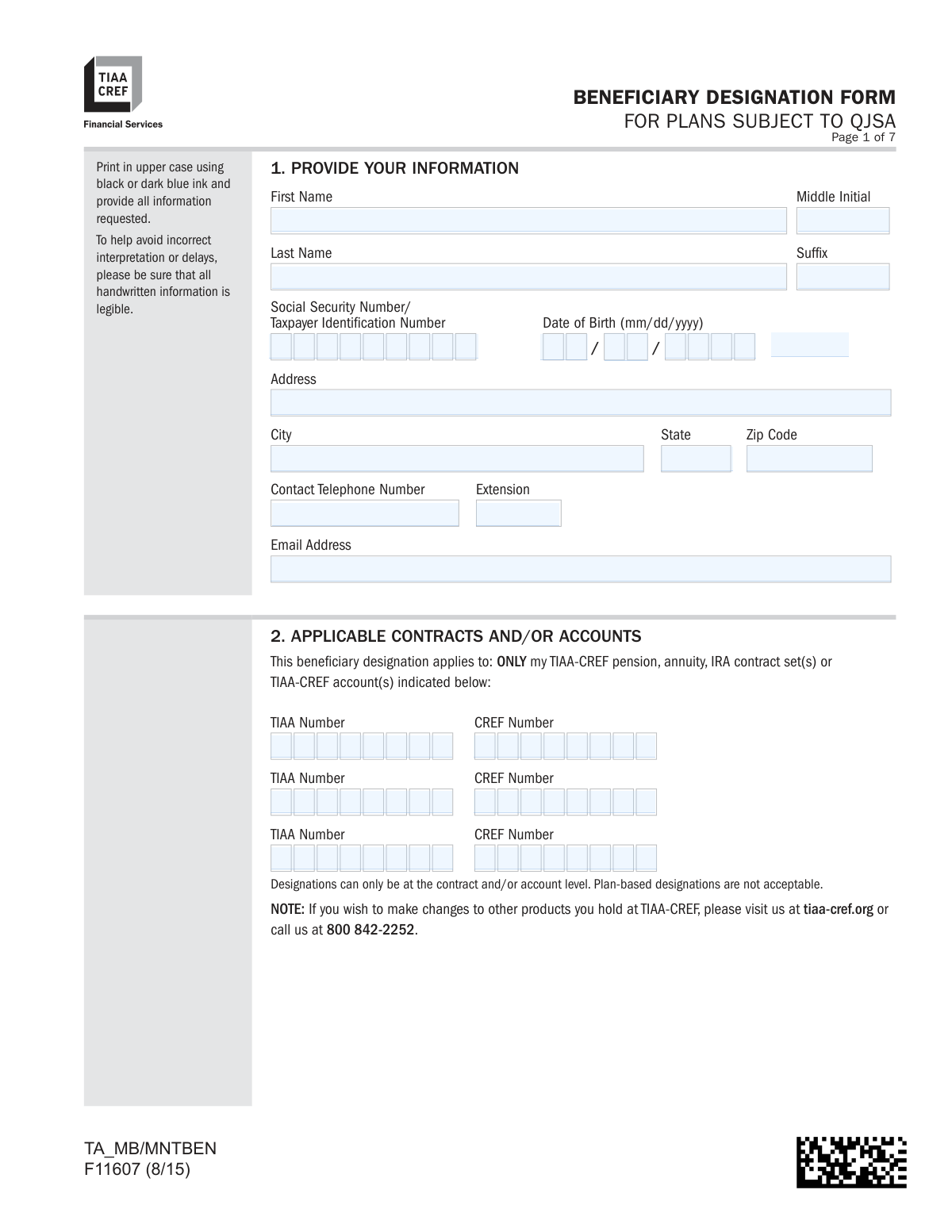
- Beneficiary Designation Form for Plans Subject to QJSA (Form F11607): This form is essential for TIAA-CREF account holders. Because QJSA plans prioritize spousal protection, this document ensures your primary and contingent beneficiaries are legally recognized according to federal pension law. It is the correct choice if you are married and need to navigate spousal rights or if your employer-sponsored plan specifically mandates QJSA compliance for beneficiary changes.
Withdrawing Funds from Non-QJSA Plans
If your goal is to access your money rather than designate a recipient, and your plan does *not* require the specific protections of a QJSA, you should select:
- Form F11610, Cash Withdrawal from your Retirement Investments for Plans Not Subject to QJSA: Also referred to as TAXCW/OTCPAYCSH, this form is used to request a cash distribution. Use this when you need to specify a withdrawal amount, set up tax withholding preferences, and provide delivery instructions for your funds. It is specifically designed for plans where the complex spousal annuity requirements of QJSA do not apply, making the withdrawal process more straightforward.
Quick Selection Summary
- Choose Form F11607 if you are planning for the future and need to name an heir for a plan that requires spousal consent or follows federal ERISA pension laws.
- Choose Form F11610 if you need immediate access to your retirement savings and your plan documentation indicates it is not subject to QJSA restrictions.
Form Comparison
| Form | Primary Purpose | QJSA Applicability | Key Information Required |
|---|---|---|---|
| Beneficiary Designation Form for Plans Subject to QJSA (Form F11607) | Assigns individuals to inherit account assets upon the participant's death. | Mandatory for retirement plans governed by QJSA and ERISA regulations. | Names of primary and contingent beneficiaries and potential spousal consent. |
| Form F11610, Cash Withdrawal from your Retirement Investments for Plans Not Subject to QJSA | Facilitates the request for a cash distribution from retirement accounts. | Used only for plans that are exempt from QJSA requirements. | Specified withdrawal amounts, tax withholding choices, and fund delivery methods. |
Tips for QJSA forms
For plans subject to QJSA, your spouse generally has a legal right to the survivor benefit. If you are designating a non-spouse beneficiary or choosing a payout that isn't a joint annuity, ensure you obtain a witnessed or notarized spousal signature to avoid immediate rejection.
Before starting your paperwork, confirm whether your specific retirement plan is subject to QJSA requirements. Using a non-QJSA withdrawal form for a QJSA-regulated plan can lead to significant processing delays and will likely require you to refile the entire application.
When filling out beneficiary designations, include full legal names, Social Security numbers, and dates of birth for all individuals listed. Providing complete data ensures that assets are distributed according to your wishes and prevents long-term legal complications for your heirs.
Withdrawal forms like Form F11610 require you to specify how much federal and state tax should be withheld from your distribution. Carefully review these sections to ensure you meet minimum requirements, as incorrect withholding can result in unexpected liabilities or penalties during tax season.
AI-powered tools like Instafill.ai can complete these complex retirement forms in under 30 seconds with high accuracy. This is a major time-saver for those managing multiple accounts, and your sensitive financial data remains secure throughout the entire process.
Always save a digital or physical copy of your completed and signed forms before submitting them to the plan administrator. These documents serve as vital evidence of your intent and can resolve discrepancies if the financial institution's records are ever updated incorrectly.
Simple administrative errors, such as mismatched dates or missing signatures on specific pages, are the most common reasons for processing delays. Review every page of your QJSA forms to ensure that all required signature fields are signed and dated consistently.
Frequently Asked Questions
QJSA stands for Qualified Joint and Survivor Annuity, which is a standard payment method for retirement plans that provides a lifetime income to both the participant and their spouse. Under ERISA regulations, certain plans require specific forms to ensure that spousal rights are protected or properly waived when making beneficiary or withdrawal changes.
Whether a plan is subject to QJSA typically depends on the type of retirement account, such as a 401(k) or a pension plan, and the specific rules set by the employer. You can check your Summary Plan Description (SPD) or contact your plan administrator to confirm if your account follows QJSA rules before selecting a form.
Plans subject to QJSA have strict legal requirements regarding who can be named as a beneficiary, often requiring the spouse's written consent if they are not the primary beneficiary. Using a specific QJSA beneficiary form ensures that all necessary spousal waivers and notarizations are included to meet federal compliance standards.
Yes, you can use AI-powered platforms like Instafill.ai to complete QJSA and related retirement forms. These tools can accurately extract data from your source documents and place it into the correct fields, ensuring the forms are filled out precisely and professionally.
Using modern AI technology, filling out complex retirement forms like the F11607 or F11610 can take under 30 seconds. The AI automates the data entry process, which significantly reduces the time spent on manual typing and helps prevent common clerical errors.
Form F11610 is used for requesting cash withdrawals from retirement accounts that do not fall under the strict QJSA annuity requirements. This form allows participants to specify their desired withdrawal amount, tax withholding preferences, and how they would like the funds to be delivered.
You should update your beneficiary designation whenever you experience a major life event, such as marriage, divorce, or the birth of a child. Keeping these forms current ensures that your assets are distributed according to your wishes and that all legal requirements for spousal consent are met at the time of your passing.
In most cases, if you are married and want to name someone other than your spouse as a primary beneficiary or choose a distribution method other than a joint annuity, spousal consent is required. This consent usually needs to be witnessed by a notary public or a plan representative to be legally valid.
You will generally need your account numbers, personal identification details, and the full names and Social Security numbers of your intended beneficiaries. If the plan is subject to QJSA and you are married, you will also need your spouse's information and potentially a notary for their signature.
Once the forms are filled and signed, they are typically submitted directly to the plan provider, such as TIAA, or your employer's human resources department. It is important to follow the specific delivery instructions on the form, whether they require mail, fax, or secure digital upload.
Glossary
- QJSA (Qualified Joint and Survivor Annuity)
- A retirement plan payment structure that provides a lifetime monthly benefit to the participant and continues to provide at least 50% of that benefit to the surviving spouse after the participant's death.
- Spousal Consent
- A legal requirement under ERISA where a participant's spouse must sign a notarized waiver to allow the participant to name a non-spouse beneficiary or choose a non-QJSA payment option.
- ERISA
- The Employee Retirement Income Security Act, a federal law that establishes the rules for how private-sector retirement plans must protect participants and their spouses.
- Primary Beneficiary
- The person or entity first in line to receive the assets of a retirement account upon the death of the account holder.
- Contingent Beneficiary
- A secondary person or entity who receives the account assets only if the primary beneficiary has passed away or is unable to claim them.
- Qualified Plan
- A retirement plan, such as a 403(b) or 401(k), that meets specific IRS requirements to receive favorable tax treatment and is subject to federal protection laws.
- Tax Withholding
- The portion of a retirement distribution that is kept by the plan administrator and sent directly to the IRS or state tax authorities as an advance payment of income taxes.
- Survivor Benefit
- The portion of a retirement plan's value that is paid out to a spouse or designated beneficiary after the original account holder dies.