Fill out regulatory complaint forms
with AI.
Regulatory complaint forms are essential tools for consumers and businesses to report grievances to government-appointed oversight bodies. These documents serve as a formal bridge between the public and regulatory authorities, ensuring that industry standards are upheld and consumer rights are protected. Whether you are dealing with financial disputes, unfair trade practices, or service failures, filing an official complaint is often the necessary first step in seeking mediation or a legal resolution that the regulator can investigate.
By continuing, you acknowledge Instafill's Privacy Policy and agree to get occasional product update and promotional emails.
About regulatory complaint forms
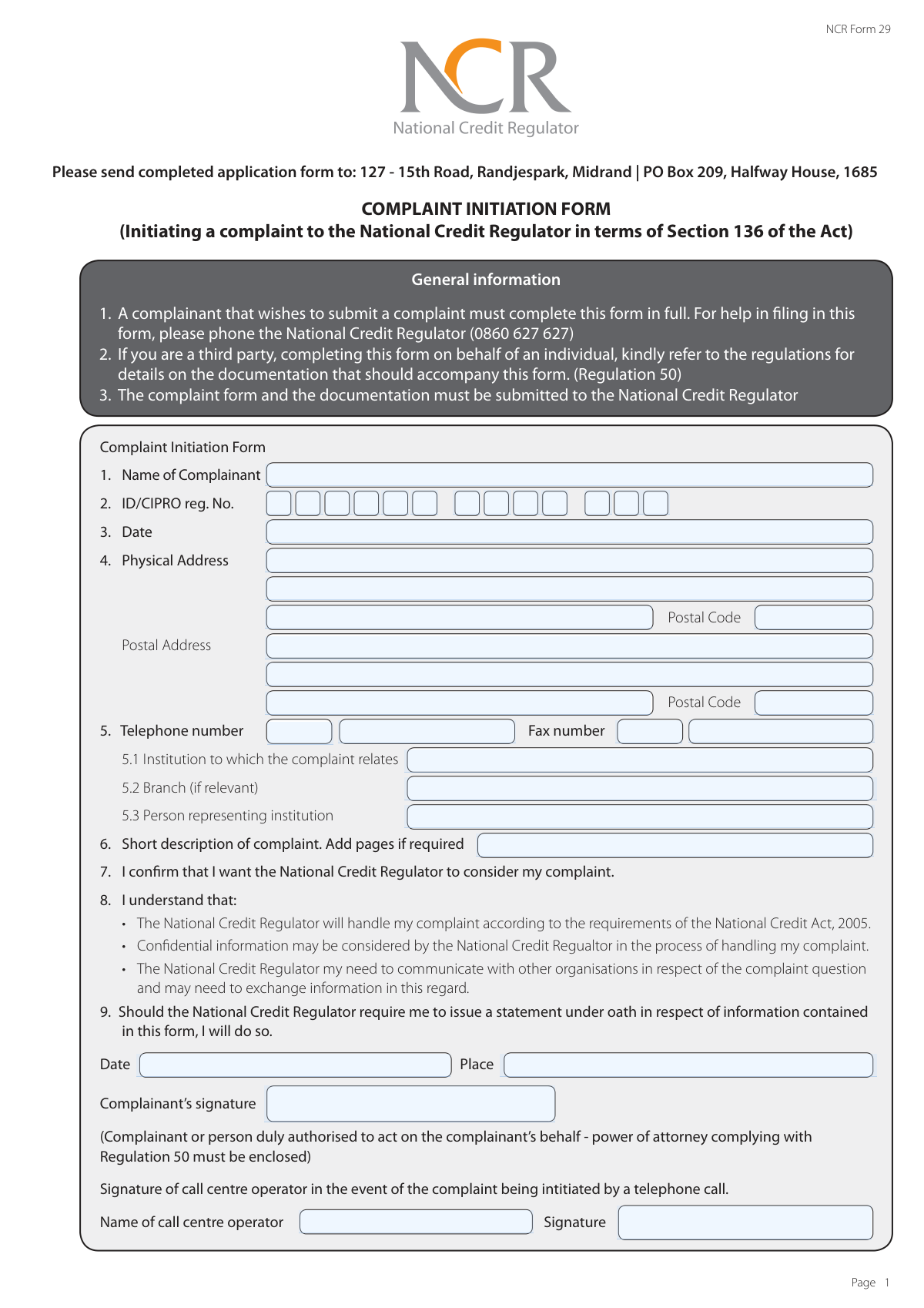
Individuals typically require these forms when they encounter issues such as predatory lending, hidden fees, or contractual breaches that cannot be resolved directly with a service provider. For instance, a consumer in South Africa might use specific documentation like the NCR Form 29 to report a credit provider to the National Credit Regulator. Because these forms are legal records, they require precise personal information, a detailed account of the incident, and supporting evidence to be considered valid by the investigating agency.
Navigating the complexities of regulatory paperwork can be time-consuming, especially when dealing with non-interactive PDF files or technical terminology. Tools like Instafill.ai use AI to fill these forms in under 30 seconds, handling your data accurately and securely to streamline the submission process. This allows you to focus on the details of your case rather than the technicalities of the paperwork.
Every form on this page can be completed without typing. Instafill is form filling software that reads a PDF and fills it for you — including flat and scanned documents that carry no fillable fields at all.
Forms in This Category
The forms in this category have a median Form Complexity Index of 54/100 (Moderate), measured across 1 forms by field count, input difficulty, length, conditional logic and structure. See how it is calculated.
| Form Name | Pages | FCI | |
|---|---|---|---|
| 1. | NCR Form 29, Complaint Initiation Form | 3 | Moderate 54 |
- Enterprise-grade security & data encryption
- 99%+ accuracy powered by AI
- 1,000+ forms from all industries
- Complete forms in under 60 seconds
How to Choose the Right Form
If you are dealing with a dispute involving a credit provider in South Africa, choosing the correct documentation is essential for your case to be heard by the National Credit Regulator (NCR). While there are various regulatory complaint forms across different industries, the forms in this category are specifically designed for credit-related grievances.
Filing a Formal Credit Complaint
If your issue relates to a credit agreement—such as a loan, credit card, or retail account—and you have been unable to resolve the matter directly with the provider, you should use NCR Form 29, Complaint Initiation Form. This is the standard legal document required under Section 136 of the National Credit Act to formally notify the regulator of your dispute.
When to Choose NCR Form 29
Select this form if your situation involves any of the following issues with a registered credit provider:
- Reckless Lending: You believe a credit provider granted you credit without properly assessing your ability to repay it.
- Overcharging: You are being charged interest rates, initiation fees, or service fees that exceed the legal limits set by the NCR.
- Unfair Practices: You have experienced harassment, misleading information, or unauthorized debits from a credit provider.
- Credit Bureau Disputes: You need to dispute incorrect information on your credit report that the provider has failed to rectify after a direct request.
Preparing Your Submission
Before you begin filling out NCR Form 29, Complaint Initiation Form, ensure you have your supporting evidence ready. The regulator will require a clear summary of your grievance and documentation such as account statements, copies of the credit agreement, and any correspondence you have had with the provider regarding the issue.
Using Instafill.ai, you can complete this form digitally in minutes. Our AI-powered platform ensures your information is formatted correctly, helping you submit a professional and legible complaint to the NCR without the need for manual printing or scanning.
Form Comparison
| Form | Purpose | Target Entity | Regulatory Authority | Key Requirement |
|---|---|---|---|---|
| NCR Form 29, Complaint Initiation Form | To formally file a complaint regarding credit agreements or provider misconduct. | Registered credit providers, credit bureaus, or debt counselors in South Africa. | The National Credit Regulator (NCR) under the National Credit Act. | A detailed description of the grievance and supporting evidence of the dispute. |
Tips for regulatory complaint forms
Regulatory bodies require proof to investigate your claims effectively. Before filling out the form, ensure you have digital copies of your credit agreements, relevant bank statements, and any written correspondence with the credit provider ready to attach.
Most regulators expect you to have tried resolving the dispute directly with the company before escalating. Be sure to include the dates of your previous attempts and any reference numbers provided by the company’s internal dispute department.
AI-powered tools like Instafill.ai can complete these regulatory forms in under 30 seconds with high accuracy. Your data stays secure during the process, making it an essential time-saver for those managing complex paperwork or multiple filings.
When describing your grievance, stick to the facts such as specific transaction dates, disputed amounts, and the exact terms you believe were violated. Clear, concise, and objective descriptions allow investigators to process your complaint much faster than emotional accounts.
A single typo in an account number or a South African ID number can lead to your complaint being rejected or delayed. Double-check that all identifying information matches your official credit statements exactly before you submit the form.
Always download and store a copy of your completed form and any submission receipts for your own records. This documentation is vital if you need to follow up on the status of your case or if the regulator requests additional clarification later.
Frequently Asked Questions
Regulatory complaint forms allow consumers or businesses to formally report grievances to a governing body that oversees specific industries. These forms initiate an official investigation into potential violations of laws, standards, or ethical practices within sectors like finance, trade, or consumer services.
You should select a form based on the industry and the nature of your dispute, such as credit, trade, or consumer rights. For instance, if your issue involves a credit provider in South Africa, you would specifically look for forms governed by the National Credit Regulator (NCR).
It is generally best to file a complaint after you have attempted to resolve the issue directly with the service provider or company involved. If the internal dispute resolution process fails or the provider does not respond within a reasonable timeframe, a regulatory form is the next step to seek external intervention.
Most regulatory bodies require evidence to support your claim, such as copies of contracts, email correspondence, billing statements, or proof of payment. Ensuring these documents are organized and attached to your form will help the regulator understand the context and expedite the review process.
Yes, AI tools like Instafill.ai can significantly simplify the process by accurately extracting data from your supporting documents and placing it into the correct fields. This technology ensures that complex forms are completed with high precision and minimal manual effort.
While manual entry can take 20 to 30 minutes depending on the complexity of the grievance, using AI-powered services can reduce this time to under 30 seconds. These platforms automate the data entry process, allowing for rapid completion without sacrificing accuracy.
Once submitted, the regulatory body typically reviews the information to determine if they have jurisdiction over the matter. They may then contact the respondent for their version of events or initiate a formal mediation, arbitration, or investigation process to resolve the dispute.
Generally, regulatory complaint forms are designed to be accessible to the public without the need for a lawyer. However, if the matter is highly complex or involves significant financial stakes, consulting a legal professional can provide additional guidance on how to frame your complaint.
No, filing a regulatory complaint is an administrative process aimed at resolving disputes through a governing authority rather than a court of law. While the outcome can lead to a resolution, refund, or settlement, it is a distinct process from civil litigation.
In many cases, you can file a complaint on behalf of another person if you have their written authorization or legal power of attorney. This is common in situations involving elderly family members or individuals who cannot navigate the digital or legal process themselves.
Most government and industry regulators provide complaint services free of charge to consumers as part of their mandate to protect public interests. You should check the specific instructions on the form or the regulator's website to confirm if any small administrative fees apply.
Most modern online tools allow you to save your progress or edit fields before final submission. Using an interactive PDF filler makes it easy to correct mistakes or update information as new details about your dispute emerge before you send it to the regulator.
Glossary
- Form Complexity Index
- Instafill’s 0–100 measure of how much effort a form takes to complete, calculated deterministically from the form’s own structure rather than estimated. It combines the number of fillable fields (the largest factor), how difficult those fields are to complete based on their type, the number of pages that contain fields, the amount of conditional “fill-only-if” logic, and how many sections the form is divided into, then adds modifiers for tables and repeating lists, bundled instruction pages, and dense page layouts. A higher score means the form is harder to fill out by hand. The forms in this category have a median Form Complexity Index of 54/100 (Moderate). See exactly how it is calculated.
- National Credit Regulator (NCR)
- The administrative body in South Africa responsible for regulating the credit industry and ensuring that all credit providers comply with the law.
- National Credit Act (NCA)
- The primary legislation in South Africa designed to protect consumers in the credit market and ensure fair, transparent lending practices.
- Credit Provider
- Any entity, such as a bank, microlender, or retail store, that lends money or provides goods and services to consumers on credit.
- Section 136
- The specific legal clause in the National Credit Act that gives any individual the right to file a formal complaint with the regulator regarding a credit agreement.
- Debt Review
- A legal process where a debt counsellor assists over-indebted consumers to restructure their debts; disputes involving this process are frequently reported to the NCR.
- National Credit Tribunal (NCT)
- An independent adjudicating body that hears cases and makes legal rulings on credit disputes that cannot be resolved by the NCR alone.
- Alternative Dispute Resolution (ADR)
- A method of resolving conflicts between a consumer and a credit provider through mediation or conciliation rather than through a formal court trial.
- Prescribed Form
- A standardized document, such as Form 29, that is legally required by a regulatory body to ensure all necessary information is captured for a valid submission.