Fill out residential utility forms
with AI.
Residential utility forms are the bridge between homeowners and the essential services required to keep a household running, such as electricity, water, and gas. These documents are necessary whenever there is a change in the physical infrastructure or the contractual relationship with a provider. Whether you are moving into a new property, upgrading your current service to support modern energy needs like solar panels, or preparing a site for demolition, these forms ensure that utility companies have the precise technical and personal data required to manage your connection safely and legally.
By continuing, you acknowledge Instafill's Privacy Policy and agree to get occasional product update and promotional emails.
About residential utility forms
These forms are typically used by residential property owners, developers, and electrical contractors across various regions. For example, if you are building a new home, an Application for Electricity is required to establish a new meter and connection. Similarly, homeowners looking to upgrade to a 3-phase supply for high-powered appliances or those needing to abolish a service before a renovation will find these documents indispensable. Navigating these requirements can often be a bottleneck in construction or relocation timelines, making it crucial to provide accurate information to avoid delays in service activation.
Managing these technical documents can be time-consuming, but modern tools have simplified the process significantly. Instafill.ai uses AI to help you complete residential utility forms in under 30 seconds, ensuring that data is handled accurately and securely. This approach eliminates the frustration of manual data entry or dealing with non-interactive PDFs, allowing you to focus on your move or renovation while the AI manages the paperwork.
Every form on this page can be completed without typing. Instafill is form filling software that reads a PDF and fills it for you — including flat and scanned documents that carry no fillable fields at all.
Forms in This Category
The forms in this category have a median Form Complexity Index of 67/100 (Complex), measured across 1 forms by field count, input difficulty, length, conditional logic and structure. See how it is calculated.
| Form Name | Pages | FCI | |
|---|---|---|---|
| 1. | Application for Electricity (New South Wales / Victoria / South Australia / Queensland) | 4 | Complex 67 |
- Enterprise-grade security & data encryption
- 99%+ accuracy powered by AI
- 1,000+ forms from all industries
- Complete forms in under 60 seconds
How to Choose the Right Form
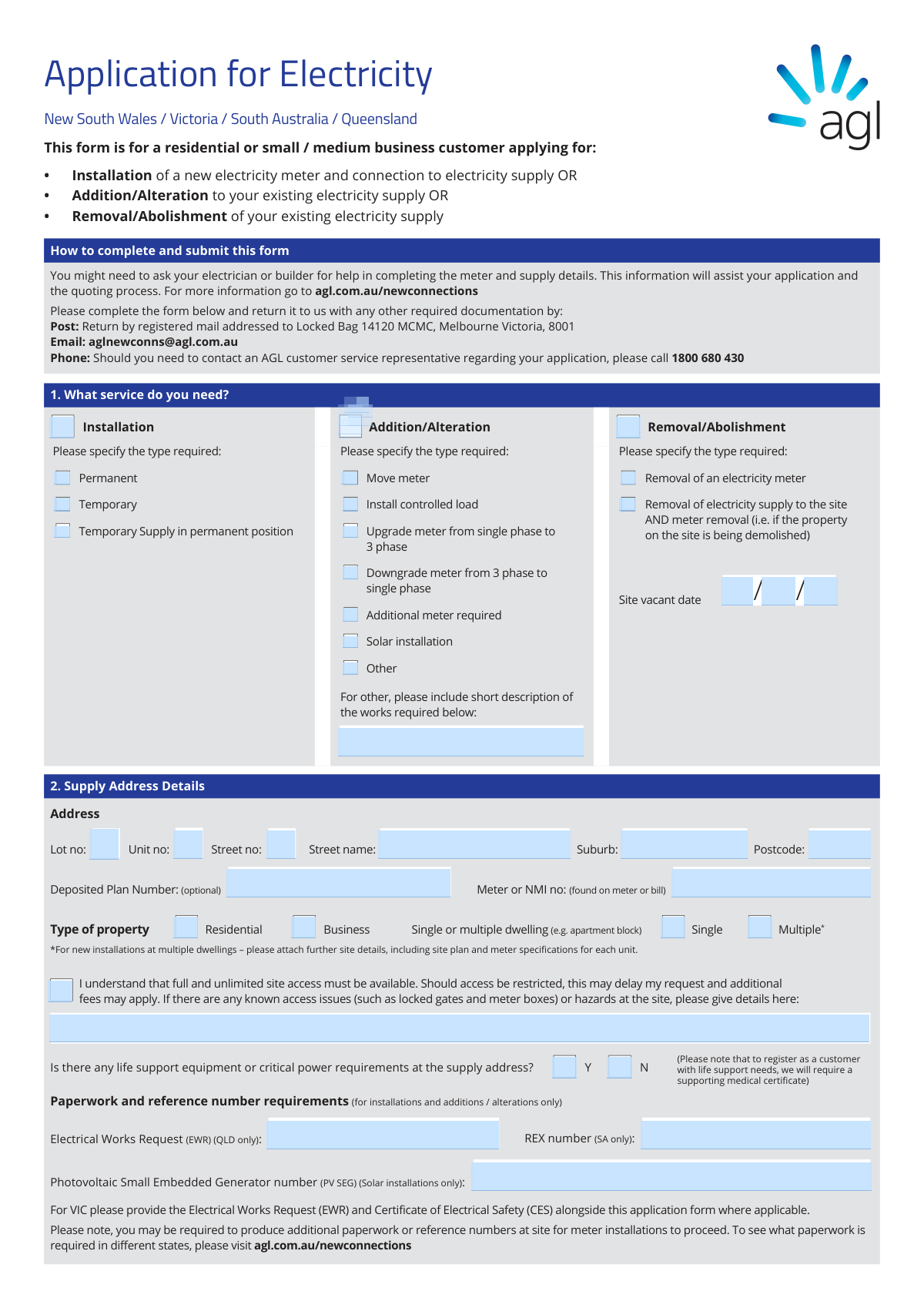
Navigating residential utility requirements can be complex, especially when moving house or upgrading your property's infrastructure. In this category, the primary document provided is the Application for Electricity (New South Wales / Victoria / South Australia / Queensland), specifically tailored for AGL customers across several Australian states.
When to Use This Form
This form is versatile and covers several distinct scenarios. To ensure you are choosing the right path within the application, identify your specific project needs:
- Installing a New Meter: If you are building a new home or granny flat and need a connection to the grid for the first time, this is the essential starting point for your electricity account.
- Altering an Existing Supply: Use this form if you already have power but need to modify the setup. Common examples include upgrading to a 3-phase supply for high-power appliances or integrating solar panels into your existing system to ensure your meter is compatible with feed-in credits.
- Abolishing a Service: If you are planning a demolition or the permanent removal of electrical infrastructure, you must fill out the abolition section to ensure the site is made safe and the service is officially disconnected.
Geographic Eligibility
Before proceeding with the Application for Electricity, confirm that your property is located in one of the supported Australian states. This specific form is valid for residents in:
- New South Wales (NSW)
- Victoria (VIC)
- South Australia (SA)
- Queensland (QLD)
Streamlining the Process
Utility forms often require technical details about your meter and connection points that can be difficult to track down. Using Instafill.ai allows you to complete the application quickly by using AI to help extract data from your previous bills or property documents. This turns a static PDF into a smart, interactive experience that minimizes errors and helps you get your power connected or modified without the usual paperwork headaches.
Form Comparison
| Form | Purpose | Service Areas | Key Actions |
|---|---|---|---|
| Application for Electricity (New South Wales / Victoria / South Australia / Queensland) | Managing residential electricity service connections, upgrades, or service abolishments. | New South Wales, Victoria, South Australia, and Queensland. | New meter installation, solar upgrades, or supply removal for demolition. |
Tips for residential utility forms
Double-check that you have the correct NMI for your property, which is typically found on a previous bill or the physical meter box. Providing an incorrect identifier is a common mistake that can lead to significant delays in processing your electricity application.
Most residential utility forms require specific technical details, such as the electrician's license number and compliance certificate details. Have this information ready beforehand to ensure the technical sections of the form are accurate and meet provider standards.
AI-powered tools like Instafill.ai can complete these complex utility forms in under 30 seconds with high accuracy. This is a massive time-saver for homeowners and developers, and your sensitive data stays completely secure during the entire process.
Be specific about whether you are requesting a new meter installation, a supply upgrade for solar panels, or a service abolition for demolition. Selecting the wrong service type can result in the utility provider dispatching the wrong technician or equipment to your site.
Utility providers need to know about obstacles like locked gates, unrestrained pets, or hazardous materials on the property. Providing clear access instructions directly on the form helps you avoid 'no-access' fees and the need for rescheduling.
Depending on your state, you may need to attach a Certificate of Electrical Safety or a similar compliance document to your application. Having these documents scanned and ready for upload ensures you can finish the submission process without interruption.
Frequently Asked Questions
These forms are typically required by homeowners, builders, or developers who need to establish a new electricity connection at a residential property. They are also necessary for existing customers who need to make significant changes to their current electrical setup, such as upgrading supply or removing a meter.
It is best to submit your application as early as possible during the construction or renovation process to avoid delays in power availability. Most providers recommend filing the paperwork several weeks before the date you actually need the electricity to be active.
You will generally need the property address, the National Metering Identifier (NMI) if available, and contact details for both the owner and the licensed electrician performing the work. Technical details regarding the requested load and the type of meter required are also standard requirements.
Yes, residential utility forms are used for supply alterations such as upgrading from single-phase to 3-phase power or adding solar PV systems. These applications ensure the utility provider can update their records and verify that the local grid can support the increased load or feed-in.
Service abolition is required when a building is being demolished and the electricity connection must be permanently removed for safety. You must fill out the specific section of the utility form for 'abolishment' to notify the provider to remove the meter and disconnect the service lines from the street.
Completed forms are usually submitted directly to the energy retailer or the local distribution network service provider (DNSP) via their online portal or email. In many cases, your licensed electrician may handle the submission on your behalf as part of their service.
Filling out complex utility forms manually can take 15 to 30 minutes, but using AI tools like Instafill.ai can reduce this to under 30 seconds. These tools accurately extract data from your existing documents and place it directly into the required fields, significantly speeding up the process.
Yes, AI-powered platforms can assist in completing residential utility forms by automatically identifying and filling in the necessary data points. This technology ensures high accuracy and can even convert static PDF forms into interactive, fillable documents for easier management.
While the property owner can initiate the application, many sections of the form require technical details that only a licensed electrical contractor can provide. It is common practice for the electrician to complete the technical portions to ensure the installation meets safety and regulatory standards.
Many utility providers use standardized forms that cover multiple regions including New South Wales, Victoria, South Australia, and Queensland. However, it is important to check the specific form instructions to ensure it is valid for the state where the property is located.
A new connection involves installing a meter and service at a property that previously had no electricity, while an alteration refers to changes made to an existing setup. Alterations might include moving a meter, upgrading the fuse box, or changing the phase of the supply.
If you have a non-interactive PDF, you can use online AI services to convert it into a fillable format. This allows you to type directly into the document rather than printing it out and filling it by hand, which helps maintain legibility and professional presentation.
Glossary
- Form Complexity Index
- Instafill’s 0–100 measure of how much effort a form takes to complete, calculated deterministically from the form’s own structure rather than estimated. It combines the number of fillable fields (the largest factor), how difficult those fields are to complete based on their type, the number of pages that contain fields, the amount of conditional “fill-only-if” logic, and how many sections the form is divided into, then adds modifiers for tables and repeating lists, bundled instruction pages, and dense page layouts. A higher score means the form is harder to fill out by hand. The forms in this category have a median Form Complexity Index of 67/100 (Complex). See exactly how it is calculated.
- NMI (National Metering Identifier)
- A unique 10 or 11-digit identification number assigned to the electricity connection point at your property, which can usually be found on your electricity bill.
- DNSP (Distribution Network Service Provider)
- The company that owns and maintains the physical electricity poles, wires, and meters in your specific geographic area, distinct from your energy retailer.
- Supply Abolition
- The permanent removal of electricity infrastructure and meters from a site, typically required as a safety measure before a building is demolished.
- 3-Phase Power
- An upgraded electrical connection that provides three alternating currents, used for properties with high energy demands like large air conditioners or electric vehicle fast chargers.
- Meter Alteration
- A request to change your existing meter setup, such as upgrading to a digital smart meter, relocating the meter box, or adding a secondary meter for solar.
- Solar Export
- The process of sending surplus electricity generated by your solar panels back into the main power grid, which requires a compatible bi-directional meter.
- Single-Phase Power
- The standard electrical supply found in most residential homes, consisting of one live wire that is sufficient for typical household appliances and lighting.
- Point of Attachment
- The specific location on a building where the overhead power lines from the street connect to the property's private electrical system.