Fill out resource expense forms
with AI.
Resource expense forms are specialized documents used primarily within the energy, mining, and natural resource sectors to track and report costs associated with exploration and development projects. These forms are essential for facilitating the transfer of tax benefits—such as Canadian Exploration Expenses (CEE) or Canadian Development Expenses (CDE)—from a corporation to its investors. By formalizing these expenditures, companies can provide the necessary documentation for shareholders to claim significant deductions and investment tax credits on their tax returns.
By continuing, you acknowledge Instafill's Privacy Policy and agree to get occasional product update and promotional emails.
About resource expense forms
These forms are typically required by corporate tax professionals, resource-based businesses, and individual investors who have purchased flow-through shares. They come into play during tax filing season or when a corporation renounces specific expenses to its investors, as seen with documents like the Statement of Resource Expenses. Accurate reporting is vital in these situations, as any discrepancies can lead to delays in tax processing or issues with regulatory compliance. Tools like Instafill.ai use AI to fill these forms in under 30 seconds, handling the complex data accurately and securely to streamline the filing process.
Whether you are managing a large portfolio of resource investments or handling the filings for a single corporation, having a clear understanding of these forms ensures that all available tax incentives are properly utilized. Using modern automation simplifies the transition from raw financial data to a completed, submission-ready document, allowing you to focus on your core investment or business activities.
Every form on this page can be completed without typing. Instafill is form filling software that reads a PDF and fills it for you — including flat and scanned documents that carry no fillable fields at all.
Forms in This Category
The forms in this category have a median Form Complexity Index of 68/100 (Complex), measured across 1 forms by field count, input difficulty, length, conditional logic and structure. See how it is calculated.
| Form Name | Pages | FCI | |
|---|---|---|---|
| 1. | Form T101, Statement of Resource Expenses | 4 | Complex 68 |
- Enterprise-grade security & data encryption
- 99%+ accuracy powered by AI
- 1,000+ forms from all industries
- Complete forms in under 60 seconds
How to Choose the Right Form
Identifying the Correct Slip for Flow-Through Shares
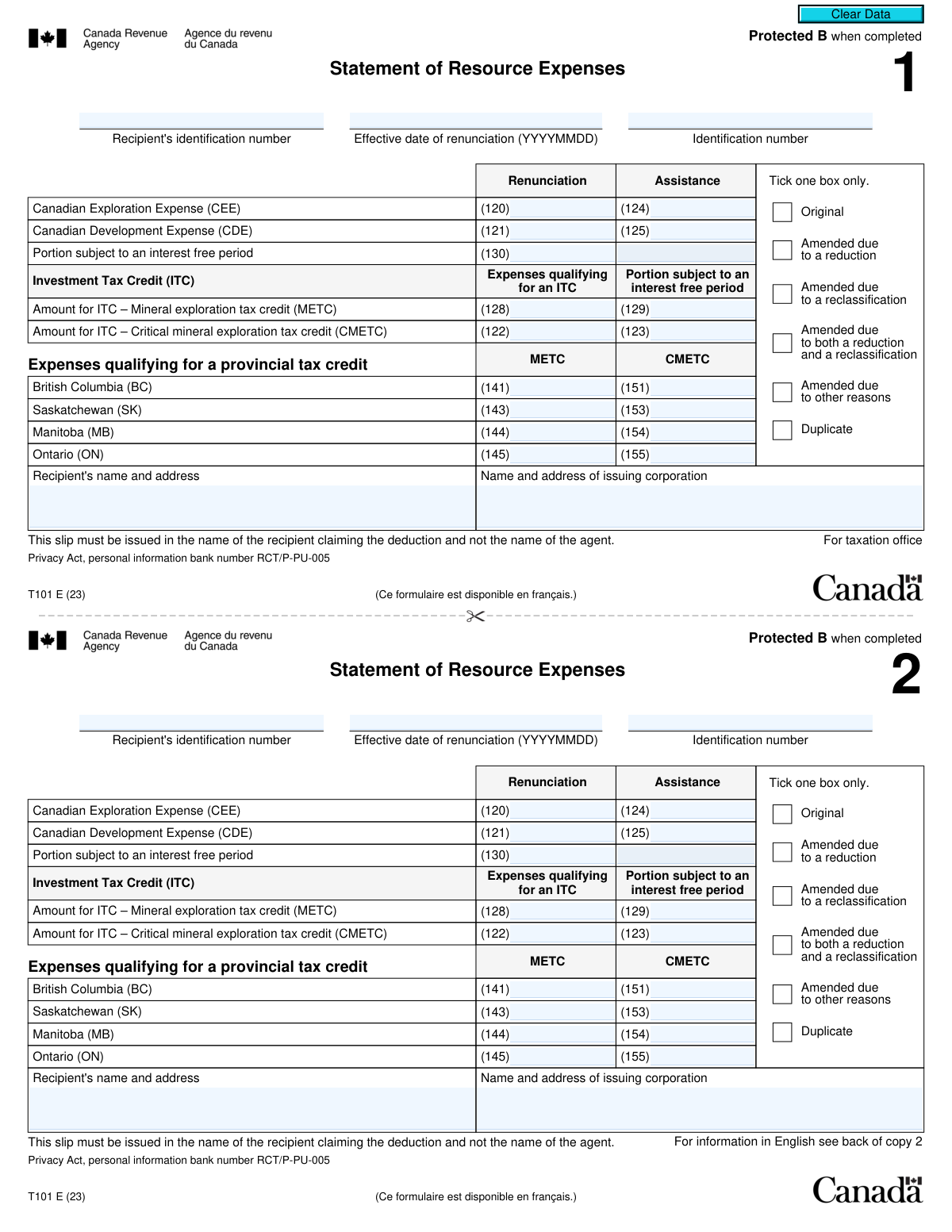
When dealing with resource-related tax deductions in Canada, the primary document you will encounter is Form T101, Statement of Resource Expenses. This form is specifically designed for the flow-through share system, which allows corporations to transfer certain resource expenses to their investors.
If you have invested in a corporation that operates in the mining, oil, or gas sectors and you have purchased flow-through shares, you will need to utilize this form to claim your tax benefits.
Who Should Use Form T101?
This form is essential for two distinct groups involved in resource investment:
- Individual and Corporate Investors: You will use the information provided on the Form T101 slip to claim deductions and investment tax credits on your personal or corporate income tax returns. It serves as your official proof of the expenses transferred to you.
- Issuing Corporations: Companies use this form as an information slip to report the specific amount of resource expenses being renounced in favor of the shareholders.
Key Expenses Reported on Form T101
Before filling out the form, ensure your investment qualifies under the specific categories outlined by the Canada Revenue Agency (CRA). Form T101 is used to detail:
- Canadian Exploration Expenses (CEE): Costs incurred in the search for mineral resources, petroleum, or natural gas.
- Canadian Development Expenses (CDE): Costs associated with bringing a resource into production, such as sinking a mine shaft or drilling a productive well.
- Investment Tax Credits: Any related credits that can be applied against your tax payable.
Streamlining Your Tax Filing
Because Form T101 involves precise financial figures and specific tax codes, accuracy is critical to avoid audits or rejected claims. Using Instafill.ai allows you to quickly convert static PDF versions of this form into interactive, fillable documents. Our AI tools help ensure that the data from your corporate investment statements is accurately captured and placed into the correct fields on the Statement of Resource Expenses, making your tax season significantly more manageable.
Form Comparison
| Form | Purpose | Issued By | Recipient Use | Key Expenses Covered |
|---|---|---|---|---|
| Form T101, Statement of Resource Expenses | Reports resource expenses and tax credits transferred to flow-through share investors. | Corporations that have issued flow-through shares to their investors. | Used by investors to claim tax deductions on personal or corporate returns. | Includes Canadian Exploration Expenses (CEE) and Canadian Development Expenses (CDE). |
Tips for resource expense forms
Ensure the figures for Canadian Exploration Expenses (CEE) and Canadian Development Expenses (CDE) on your T101 match your tax return exactly. Discrepancies between the corporation's report and your individual claim can trigger manual reviews or delays in processing your credits.
Beyond the T101 slip itself, keep copies of your original flow-through share purchase agreements. These documents provide the necessary context for the timing of the renunciation and are essential if you are audited regarding the eligibility of the resource expenses.
Resource expenses are often renounced to investors for a specific tax year, which may differ from the year the investment was made. Verify the effective date on the form to ensure you are claiming the deductions in the correct fiscal period.
Be careful not to conflate CEE and CDE, as they often have different deduction rates and tax implications. Categorizing these correctly on your supplemental tax schedules is vital for a successful claim of the Investment Tax Credit.
AI-powered tools like Instafill.ai can complete these forms in under 30 seconds with high accuracy, and the data stays secure during the process. This is a significant time-saver for investors or accountants dealing with multiple resource expense slips across different portfolios.
If you cannot use the full amount of the tax credit reported on your T101 in the current year, keep a detailed log of the carry-forward amounts. Organizing these records annually ensures you do not lose out on future tax savings as your income levels fluctuate.
Always double-check that the corporation's identification number is entered correctly on your filing. An incorrect ID number can prevent tax authorities from cross-referencing your slip with the corporation’s master filing, leading to a potential rejection of the claim.
Frequently Asked Questions
Resource expense forms act as information slips that allow corporations to transfer tax deductions to their investors. These forms detail specific expenditures related to resource exploration and development, which the investor can then claim on their own income tax return to reduce their taxable income.
The corporation that issued the flow-through shares is responsible for preparing and issuing the resource expense forms to its investors. They must report the renounced expenses to the relevant tax authorities and provide the investor with a slip detailing their share of those expenses.
Flow-through shares are a financing mechanism used by resource companies to raise capital for exploration and development. In exchange for the investment, the company 'flows through' its tax deductions for these expenses to the shareholder, who can then use them to offset their own personal or corporate income.
Corporations generally issue these slips in the first quarter of the year following the period in which the expenses were renounced. Most investors receive them by late March, providing enough time to include the information in their annual tax filings.
Yes, resource expense forms can be completed quickly using AI-powered tools. Platforms like Instafill.ai can extract relevant data from your investment documents and automatically populate the form fields in under 30 seconds, ensuring high accuracy and reducing manual entry errors.
Filling out these forms online with AI is significantly faster than manual entry. Using automated extraction technology, the process of identifying data from source documents and placing it into the PDF typically takes less than 30 seconds.
The forms typically detail Canadian Exploration Expenses (CEE) and Canadian Development Expenses (CDE). These categories represent different stages of resource extraction, from the initial search for minerals or oil to the actual development of a productive site.
The data from a T101 slip is reported on your annual income tax return, specifically on the schedules designated for resource deductions and investment tax credits. While you should keep the physical slip for your records, the figures must be accurately transcribed into your tax software or paper return.
Yes, in addition to deductions for the expenses themselves, investors may be eligible for various Investment Tax Credits (ITC). These credits further incentivize investment in certain sectors, such as mining or renewable energy, and are often listed directly on the resource expense form.
If you receive a static or non-fillable PDF version of a resource expense form, AI services like Instafill.ai can convert it into an interactive, fillable document. This allows you to easily input data or use automated tools to complete the form digitally.
Many provinces offer their own tax credits for resource exploration conducted within their borders. These provincial credits are often reported on the same federal resource expense slips, allowing investors to claim both federal and provincial incentives simultaneously.
Glossary
- Form Complexity Index
- Instafill’s 0–100 measure of how much effort a form takes to complete, calculated deterministically from the form’s own structure rather than estimated. It combines the number of fillable fields (the largest factor), how difficult those fields are to complete based on their type, the number of pages that contain fields, the amount of conditional “fill-only-if” logic, and how many sections the form is divided into, then adds modifiers for tables and repeating lists, bundled instruction pages, and dense page layouts. A higher score means the form is harder to fill out by hand. The forms in this category have a median Form Complexity Index of 68/100 (Complex). See exactly how it is calculated.
- Flow-through Shares (FTS)
- A type of share issued by resource companies that allows the corporation to transfer its tax-deductible exploration and development expenses to its investors.
- Canadian Exploration Expense (CEE)
- Costs incurred to determine the existence, location, or quality of a mineral resource or oil and gas well in Canada, which are often fully deductible in the year they are renounced.
- Canadian Development Expense (CDE)
- Expenses related to the development of a resource property, such as drilling or mine excavation, which are typically deducted at a lower annual rate than exploration expenses.
- Renunciation
- The legal act where a corporation formally gives up its right to claim specific resource expenses and transfers those tax benefits to the individual investors.
- Investment Tax Credit (ITC)
- A credit that reduces the amount of tax you owe dollar-for-dollar, often granted for qualifying resource activities in specific regions or industries.
- CRCE (Canadian Renewable and Conservation Expense)
- A category of expenses for renewable energy and energy conservation projects that receive similar tax treatment to exploration expenses.
- Look-back Rule
- A tax provision that allows a corporation to renounce expenses to investors in the current year for work that will actually be performed in the following calendar year.
- Adjusted Cost Base (ACB)
- The value used to calculate capital gains; for flow-through shares, the ACB is usually considered zero because the tax benefits have already been passed to the investor.