Yes! You can use AI to fill out ACORD 90, Personal Auto Application
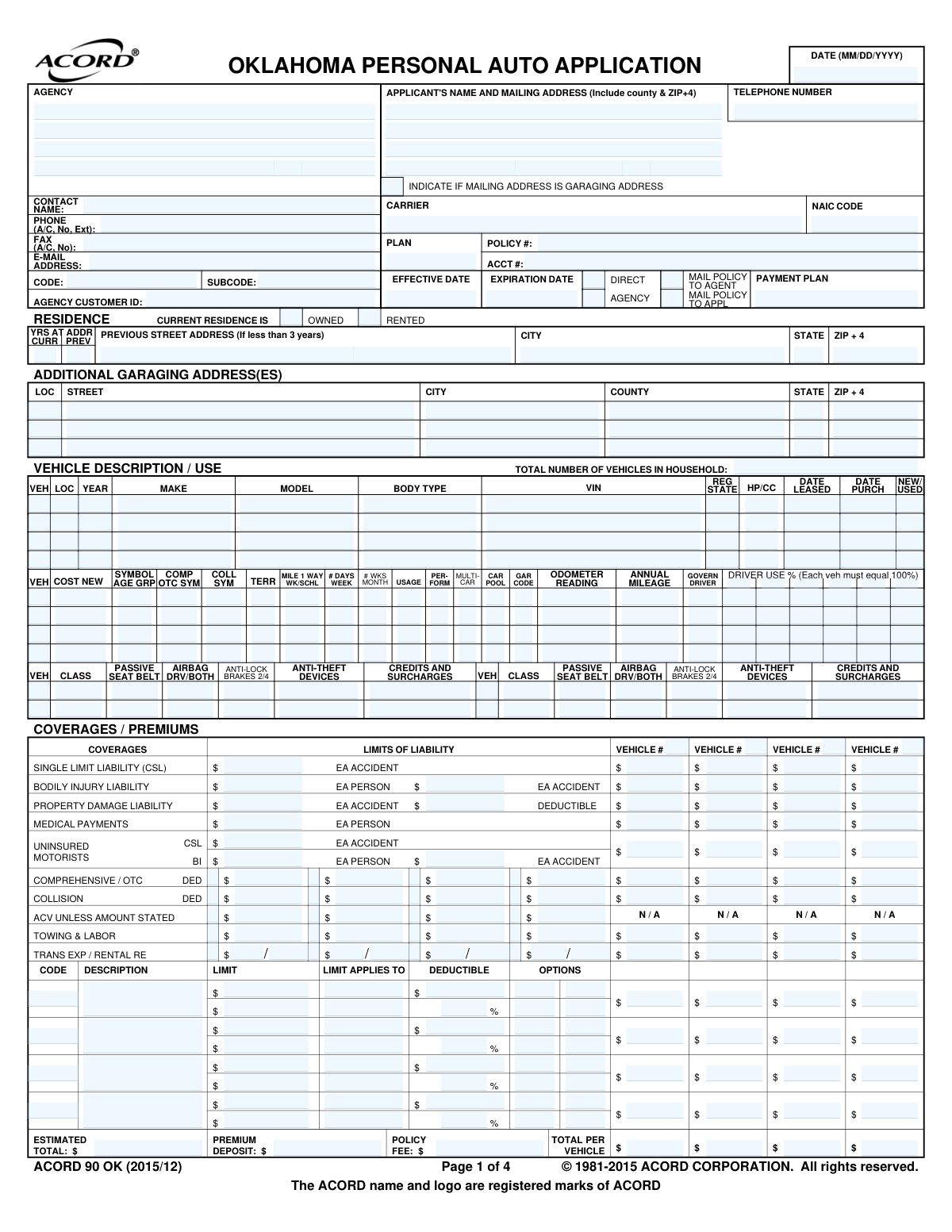
The ACORD 90, Personal Auto Application, is a comprehensive document used throughout the insurance industry to collect necessary data from individuals applying for personal automobile insurance. It standardizes the application process by capturing detailed information about the applicant, drivers, vehicles, coverage needs, and driving history, ensuring the insurance carrier has all the information needed for underwriting and rating. Today, this form can be filled out quickly and accurately using AI-powered services like Instafill.ai, which can also convert non-fillable PDF versions into interactive fillable forms.
Our AI automatically handles information lookup, data retrieval, formatting, and form filling.
It takes less than a minute to fill out ACORD 90 using our AI form filling.
Securely upload your data. Information is encrypted in transit and deleted immediately after the form is filled out.
Form specifications
| Form name: | ACORD 90, Personal Auto Application |
| Number of fields: | 699 |
| Number of pages: | 4 |
| Language: | English |
Instafill Demo: How to fill out PDF forms in seconds with AI
How to Fill Out ACORD 90 Online for Free in 2026
Are you looking to fill out a ACORD 90 form online quickly and accurately? Instafill.ai offers the #1 AI-powered PDF filling software of 2026, allowing you to complete your ACORD 90 form in just 37 seconds or less.
Follow these steps to fill out your ACORD 90 form online using Instafill.ai:
- 1 Navigate to Instafill.ai and upload or select the ACORD 90 form.
- 2 Provide agency, applicant, and policy information in the initial sections.
- 3 Enter detailed information for each vehicle, including make, model, VIN, and usage details.
- 4 Input personal and licensing information for all drivers in the household.
- 5 Select desired coverage types and limits, such as liability, collision, and comprehensive, and specify any additional interests like lenders.
- 6 Disclose any accident history, answer all general questions, and list any attachments.
- 7 Review the completed application for accuracy, then have the applicant and producer sign and date the form before submission.
Our AI-powered system ensures each field is filled out correctly, reducing errors and saving you time.
Why Choose Instafill.ai for Your Fillable ACORD 90 Form?
Speed
Complete your ACORD 90 in as little as 37 seconds.
Up-to-Date
Always use the latest 2026 ACORD 90 form version.
Cost-effective
No need to hire expensive lawyers.
Accuracy
Our AI performs 10 compliance checks to ensure your form is error-free.
Security
Your personal information is protected with bank-level encryption.
Frequently Asked Questions About Form ACORD 90
This form is a comprehensive application for personal auto insurance. It is used by insurance agents and applicants to gather the necessary information to generate a quote and issue a policy.
An applicant seeking auto insurance, typically with the assistance of an insurance producer or agent, will complete this form. Information for all drivers and vehicles in the household must be included.
You should gather personal information for all drivers, including their full names, dates of birth, and driver's license numbers. You will also need the Vehicle Identification Number (VIN), make, and model for each vehicle, as well as details from your prior insurance policy.
Your mailing address is where you receive mail from the insurance company. The garaging address is the physical location where your vehicle is primarily parked overnight, which is used to determine your insurance rates.
The NAIC code is a unique five-digit number assigned to each insurance company by the National Association of Insurance Commissioners. You can typically find this on your current insurance card or policy documents.
Insurance companies use your driving history, including any accidents or moving violations, to assess risk and determine your eligibility and premium. You must disclose all incidents for all listed drivers as requested.
A loss payee is a person or entity, like a bank or leasing company, that has a financial interest in your vehicle. This section ensures they are notified and included in any claim payments for damage to the vehicle.
This form has sections for up to four vehicles and six drivers. If you have more, you should use the 'Remarks' section to provide the additional information or attach a separate sheet with the required details.
After you and the producer sign the form, it is submitted to the insurance carrier for underwriting. The carrier will then issue a policy, a temporary binder of coverage, or a notice of declination.
Yes, services like Instafill.ai use AI to auto-fill form fields accurately and save time. This can be especially helpful for long, detailed forms like this insurance application.
To fill this form online, you can upload the PDF to the Instafill.ai platform. The service will make the form interactive, allowing you to easily type in your information, which it then populates into the correct fields for you.
If you have a flat, non-fillable PDF, you can use a service like Instafill.ai. It can convert the non-fillable PDF into an interactive form that you can complete easily on your computer.
Compliance ACORD 90
Validation Checks by Instafill.ai
1
Validates Policy Date Chronology
This check ensures that the 'Expiration Date' of the policy is on or after the 'Effective Date'. A policy cannot expire before it begins, and this validation prevents logical impossibilities in the policy term. If this validation fails, the system should flag the date fields for correction, as it would lead to invalid policy records and billing errors.
2
Ensures Vehicle Identification Number (VIN) Format is Correct
This validation confirms that the 'Vehicle Identification Number (VIN)' field contains exactly 17 alphanumeric characters, excluding 'I', 'O', and 'Q'. This is a global standard crucial for uniquely identifying a vehicle for registration, insurance rating, and history reports. An invalid VIN will prevent the policy from being rated correctly and may cause issues with claims or legal documentation.
3
Verifies Driver Licensing Age
This check cross-references a driver's 'Date of Birth' with their 'Date Licensed' to ensure there is a reasonable time gap (e.g., at least 15 years). This is important for verifying the driver's experience and eligibility for certain rates or discounts. A failure indicates a data entry error that could significantly impact risk assessment and premium calculation.
4
Conditional Requirement for Previous Address
This validation enforces that if the 'Years at Current Address' is less than a specified threshold (e.g., 3 years), the 'Previous Street Address', 'Previous City', 'Previous State', and 'Previous ZIP Code' fields must be completed. This information is vital for underwriting to assess applicant stability and review prior address history for rating purposes. Failure to provide this information when required will result in an incomplete application.
5
Conditional Requirement for Garaging Address
This check verifies that if the 'Mailing Address is Garaging Address' box is unchecked, the fields for the 'First Additional Garaging Address' are mandatory. The garaging location is a primary factor in determining insurance premiums due to varying risks by territory. If the garaging address is different from the mailing address and is not provided, the policy cannot be accurately rated.
6
Validates Sum of Driver Use Percentages
For each vehicle, this check calculates the sum of all associated 'Driver Use Percentage' fields to ensure they total exactly 100%. This is critical for accurately assigning risk and calculating premiums based on which driver uses the vehicle most often. If the percentages do not sum to 100, the submission is considered invalid as it represents an incomplete or inaccurate allocation of vehicle use.
7
Ensures Accident History Details are Provided
This validation rule ensures that if the 'Accident/Violation History Confirmation' field is marked 'Yes', then at least one 'Accident/Conviction Record' section must be filled out. This prevents contradictory submissions where an applicant declares a history but provides no details. Providing these details is mandatory for accurate risk assessment and to avoid policy cancellation for misrepresentation.
8
Validates State Abbreviation Format
This check ensures that all fields intended for a state, such as 'Agency State' and 'License State', contain a valid two-letter postal abbreviation. Using standardized state codes is essential for address verification, data integrity, and integration with other systems. An invalid code would cause address validation to fail and could lead to mail being returned.
9
Verifies Total Vehicle Count Consistency
This validation compares the number entered in the 'Total Number of Vehicles' field against the number of vehicle detail sections that have been completed. This ensures the application accurately reflects all vehicles intended for coverage and that no vehicle data is missing or extraneous. A mismatch would require the user to correct either the total count or the vehicle sections provided.
10
Validates Bodily Injury Limit Hierarchy
This check ensures the 'Limit Per Accident' for Bodily Injury Liability is greater than or equal to the 'Limit Per Person'. It is a fundamental structural rule of liability coverage that the total payout in an accident cannot be less than the maximum for a single person. An inversion of these values would represent an invalid coverage structure and must be corrected.
11
Ensures Exclusive Vehicle Acquisition Dates
This validation confirms that for any given vehicle, either 'Date Leased' or 'Date Purchased' is filled, but not both. A vehicle is either owned or leased at a point in time, and providing both dates is a logical contradiction. This check prevents data entry errors and ensures the correct ownership status is recorded for rating and coverage purposes.
12
Validates Social Security Number Format
This check verifies that the 'Social Security Number' for each driver is entered in a valid 9-digit format (e.g., XXX-XX-XXXX or XXXXXXXXX). The SSN is a critical piece of personally identifiable information used for identity verification, credit checks, and retrieving motor vehicle reports. An incorrectly formatted SSN will cause these backend processes to fail, halting the application.
13
Checks for Logical Commute Frequencies
This validation ensures that the 'Commute Days Per Week' is not greater than 7 and 'Commute Weeks Per Month' is not greater than 5. These fields are used to calculate annual mileage and assess risk, so the data must be realistic. Illogical values would lead to incorrect premium calculations and require user correction.
Common Mistakes in Completing ACORD 90
Entering an incorrect or incomplete 17-character VIN is a frequent error, often due to a simple typo. Since the VIN is used to identify the exact vehicle, including its make, model, year, and factory-installed features, an error will lead to incorrect premium calculations, coverage issues, or outright rejection of the application. To avoid this, carefully transcribe the VIN from the vehicle's registration or door jamb, and double-check each character before submission. AI-powered tools like Instafill.ai can automatically validate the VIN's format and checksum to catch errors instantly.
Applicants often mistakenly check the box indicating their mailing address is their garaging address when the vehicle is actually kept elsewhere, such as at a different residence or a student's apartment. Insurance rates are heavily dependent on the garaging location's risk profile, so this discrepancy can be considered misrepresentation, potentially leading to claim denial or policy cancellation. Always provide the exact address where each vehicle is primarily kept overnight, and fill out the 'Additional Garaging Address' sections if necessary.
When providing prior insurance details, applicants often list the insurer's group or trade name (e.g., 'The Hartford') instead of the specific legal company name (e.g., 'Hartford Fire Insurance Co.'). This, along with an incorrect or missing NAIC code, makes it difficult for the new insurer to verify coverage history and apply relevant discounts or surcharges, delaying the application. To prevent this, refer to your old policy's declaration page for the exact legal name and NAIC code. AI form-fillers like Instafill.ai can help by maintaining a database of carrier information to ensure accuracy.
The form requires assigning usage percentages to each driver for a specific vehicle, and the sum must equal 100%. People often make rough estimates for each driver and fail to ensure the total adds up correctly, which causes an automatic validation failure and processing delays. Before submitting, calculate and confirm that the percentages for each vehicle's drivers sum to exactly 100%. This ensures the risk is accurately distributed and the policy is rated correctly.
Answering 'Yes' to having a prior accident or violation but then failing to fill out the corresponding detailed sections is a common oversight. Applicants may also be tempted to omit minor incidents, not realizing that insurers will discover them when pulling Motor Vehicle Reports (MVRs). This omission can be flagged as material misrepresentation, leading to premium adjustments, policy cancellation, or denial of future claims. It is crucial to disclose all incidents and complete all required follow-up fields for each one.
These terms are not interchangeable, and confusing them has significant consequences. A 'Loss Payee' (typically a lender like a bank) has a financial interest and is entitled to payment for damages to the vehicle, while an 'Additional Insured' receives liability protection under the policy. Incorrectly designating a lender can leave their financial interest unprotected, violating the terms of a loan agreement. Always verify the requirement with the interested party and select the correct designation on the form.
The form requires providing previous address and employment details if the applicant has been at their current residence or job for a short period (e.g., less than 2 or 3 years). Applicants frequently overlook these conditional fields, leaving them blank even when required. This incomplete information prevents the insurer from properly assessing stability and risk, leading to follow-up requests and delays. Pay close attention to fields that depend on previous answers to ensure all required history is provided.
Applicants may check boxes for discounts like 'Good Student' or 'Driver Training' without having the required proof or meeting the specific criteria. The form notes that certificates (like ACORD 91) are often required, and failure to provide them upon request will result in the discount being removed and the premium increasing. Before claiming a discount, ensure you meet all qualifications and have the necessary documentation ready to submit.
Many fields, such as 'Vehicle Usage,' 'Marital Status,' and 'Garaging Code,' require a specific one-letter code instead of the full word. Applicants often write out the full description (e.g., 'Pleasure' instead of 'P') or use an incorrect code, which can cause data entry failures in the insurer's system. Carefully read the instructions for each field to ensure you are using the precise format and codes requested. If the form is a non-fillable PDF, a tool like Instafill.ai can convert it to a fillable version with dropdowns for these codes to prevent errors.
Throughout the form, there are numerous yes/no questions regarding physical impairments, license suspensions, special equipment, and other critical risk factors. A common mistake is answering 'Yes' to a question but then failing to provide the mandatory detailed explanation in the subsequent fields. This renders the application incomplete and requires the agent or underwriter to contact the applicant for clarification, delaying the entire process. If you answer 'Yes' to any such question, be prepared to immediately provide a full and accurate explanation as required.
Saved over 80 hours a year
“I was never sure if my IRS forms like W-9 were filled correctly. Now, I can complete the forms accurately without any external help.”
Kevin Martin Green
Your data stays secure with advanced protection from Instafill and our subprocessors




Robust compliance program
Transparent business model
You’re not the product. You always know where your data is and what it is processed for.
ISO 27001, HIPAA, and GDPR
Our subprocesses adhere to multiple compliance standards, including but not limited to ISO 27001, HIPAA, and GDPR.
Security & privacy by design
We consider security and privacy from the initial design phase of any new service or functionality. It’s not an afterthought, it’s built-in, including support for two-factor authentication (2FA) to further protect your account.
Fill out ACORD 90 with Instafill.ai
Worried about filling PDFs wrong? Instafill securely fills acord-90-personal-auto-application forms, ensuring each field is accurate.
