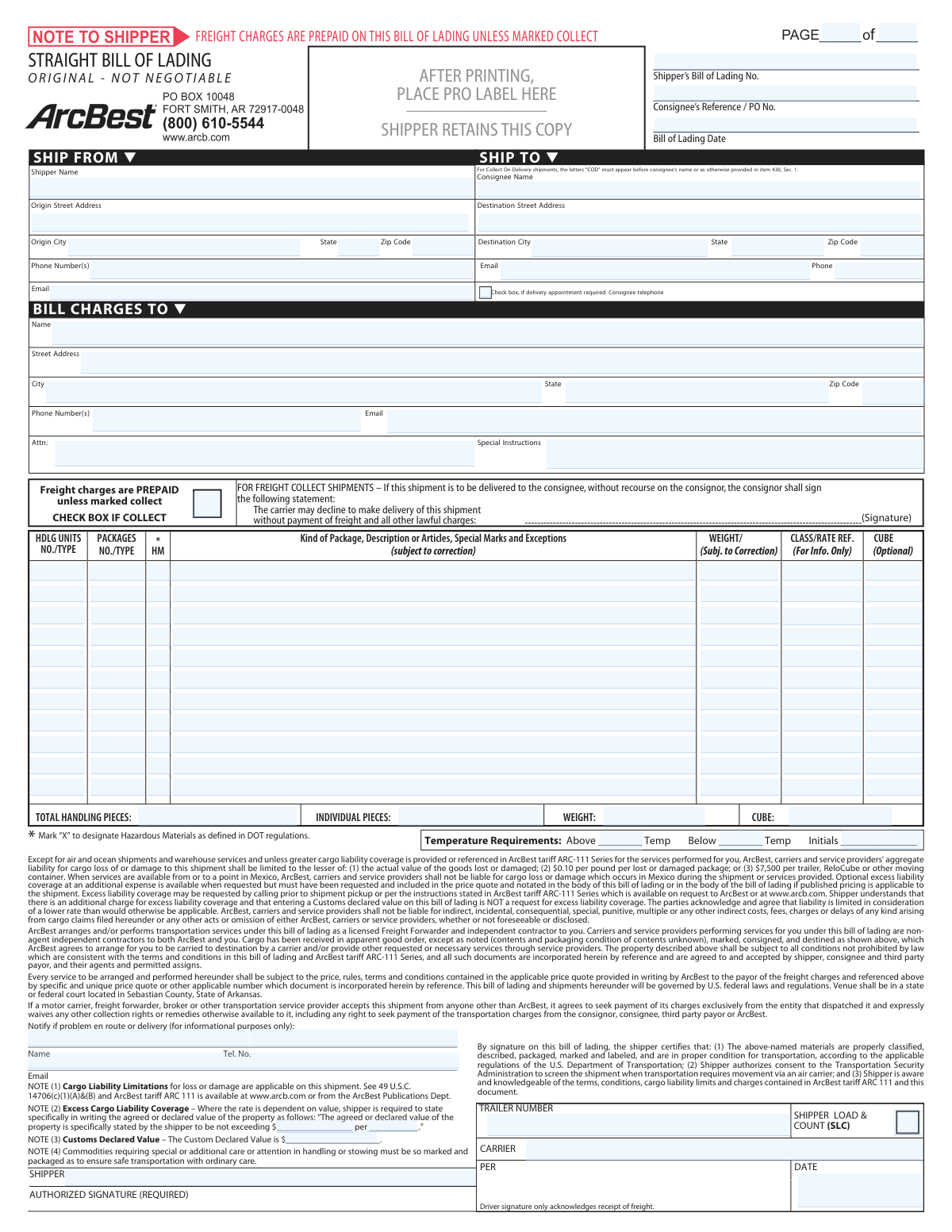
Yes! You can use AI to fill out Uniform Straight Bill of Lading

A Uniform Straight Bill of Lading (BOL) is a legal document issued by a carrier to a shipper, detailing the type, quantity, and destination of goods being shipped. It serves as a contract of carriage, a receipt for the goods, and a document of title, making it one of the most important documents in the shipping industry. Today, this form can be filled out quickly and accurately using AI-powered services like Instafill.ai, which can also convert non-fillable PDF versions into interactive fillable forms.
Our AI automatically handles information lookup, data retrieval, formatting, and form filling.
It takes less than a minute to fill out BOL using our AI form filling.
Securely upload your data. Information is encrypted in transit and deleted immediately after the form is filled out.

Form specifications

Form name: Uniform Straight Bill of Lading
Number of fields: 125
Number of pages: 1
Filled form examples: Form BOL Examples
Language: English
main-image

Instafill Demo: How to fill out PDF forms in seconds with AI

How to Fill Out BOL Online for Free in 2026

Are you looking to fill out a BOL form online quickly and accurately? Instafill.ai offers the #1 AI-powered PDF filling software of 2026, allowing you to complete your BOL form in just 37 seconds or less.
Follow these steps to fill out your BOL form online using Instafill.ai:
  1. 1 Navigate to Instafill.ai and upload your Bill of Lading form. The AI will automatically identify all the fields for you.
  2. 2 Enter the complete Shipper (sender) and Consignee (recipient) information, including names, full addresses, and contact details.
  3. 3 Detail each item in the shipment. For each line, provide the number of handling units, a description of the articles, weight, and freight class.
  4. 4 Specify billing information if different from the shipper, and indicate how freight charges will be paid (e.g., prepaid or collect).
  5. 5 Provide any special instructions, temperature requirements, declared values, and note if a delivery appointment is needed.
  6. 6 Review all entered information for accuracy, then provide the shipper's authorized signature and the date to execute the contract.
  7. 7 Download, print, or securely share the completed Bill of Lading with the carrier and for your own records.

Our AI-powered system ensures each field is filled out correctly, reducing errors and saving you time.

Why Choose Instafill.ai for Your Fillable BOL Form?

Speed

Complete your BOL in as little as 37 seconds.

Up-to-Date

Always use the latest 2026 BOL form version.

Cost-effective

No need to hire expensive lawyers.

Accuracy

Our AI performs 10 compliance checks to ensure your form is error-free.

Security

Your personal information is protected with bank-level encryption.

Frequently Asked Questions About Form BOL

This is a Shipper's Bill of Lading, a legal contract between the entity shipping goods and the carrier. It is typically completed by the shipper (the party sending the goods) to detail the shipment's contents, origin, and destination.

The Shipper is the person or company sending the shipment from the origin address. The Consignee is the person or company who is the intended recipient of the shipment at the destination address.

You should only complete the 'Billing Information' section if a third party, who is neither the shipper nor the consignee, is responsible for paying the freight charges. This section is not required if charges are prepaid by the shipper or collected from the consignee.

Checking this box indicates that the freight charges are to be paid by the consignee upon delivery of the shipment. If left unchecked, the charges are considered prepaid by the shipper or billed to a third party.

A 'Handling Unit' is the primary, outermost shipping container, such as a pallet or crate. 'Packages' refer to the individual boxes or items that are consolidated within a single handling unit.

This form has space to detail up to eleven different articles. If your shipment contains more, you should attach a separate, clearly-labeled sheet with the additional items and make a note in the 'Special Instructions' section, such as 'See attached for additional articles'.

Checking the 'Shipper Load & Count (SLC)' box signifies that the shipper was responsible for loading and counting the items in the trailer, and the carrier did not verify the count. This can limit the carrier's liability for shortages discovered at the destination.

Use this section to note any critical delivery requirements, such as 'Delivery appointment required,' 'Liftgate service needed,' specific delivery hours, or contact information for the receiving department.

For each article that is a hazardous material, you must mark the 'Hazardous Material Indicator' (HM) box associated with that item's line. Ensure you also comply with all other regulations for shipping hazardous goods, which may require additional paperwork.

The 'Declared Value' establishes the maximum liability of the carrier in the event the cargo is lost or damaged. Declaring a value higher than the carrier's standard limit may increase your shipping rate but provides additional financial protection.

Yes, services like Instafill.ai use AI to help you fill out forms like this accurately and efficiently. These tools can auto-fill information, reduce manual data entry, and save you time.

You can use a tool like Instafill.ai to fill out your form online. Simply upload the PDF, and you can type directly into the fields, add your signature, and then download or share the completed document.

If you have a non-fillable or 'flat' PDF, you can upload it to a platform like Instafill.ai. It will automatically convert the document into an interactive, fillable form that you can complete on your computer.

Compliance BOL
Validation Checks by Instafill.ai

1
Conditional Billing Information Requirement
This check verifies that if the 'Collect Freight Charges' option is 'No' (or unchecked), then the billing information section is completely filled out. This includes 'Billing Name', 'Billing Street Address', 'Billing City', 'Billing State', and 'Billing Zip Code'. This is critical for ensuring the carrier knows who to invoice for prepaid or third-party shipments, preventing payment delays and disputes. If this validation fails, the form submission should be rejected with an error indicating that billing details are required.
2
Total Weight Calculation Verification
This validation ensures that the value entered in the 'Total Weight' field under 'Shipment Totals' is equal to the sum of all individual 'Weight' fields from each shipped article row. This cross-field check is vital for accurate freight charge calculation, load planning, and regulatory compliance. A mismatch could lead to incorrect billing, potential fines for overloaded vehicles, or logistical issues, so a failure should prompt the user to correct either the individual article weights or the total.
3
Total Handling Units Calculation Verification
This check confirms that the 'Total Handling Pieces' field accurately reflects the sum of the 'Handling Units Number' from all listed shipped articles. This ensures the carrier has an accurate count of the total units (e.g., pallets, crates) they are responsible for. Discrepancies can lead to lost items, disputes at delivery, and incorrect handling. If the sum does not match the total, the system should flag the inconsistency for user correction.
4
Shipper Information Completeness
This validation ensures that all mandatory fields for the shipper are provided, including 'Shipper Name', 'Origin Street Address', 'Origin City', 'Origin State', and 'Origin Zip Code'. This information is fundamental to a bill of lading, as it legally identifies the party initiating the shipment and the physical location of pickup. Missing information would render the document incomplete and could cause significant delays or prevent the shipment from being processed.
5
Consignee Information Completeness
This check verifies that all required fields for the consignee (recipient) are filled out, specifically 'Consignee Name', 'Destination Street Address', 'Destination City', 'Destination State', and 'Destination Zip Code'. The destination address is essential for the carrier to perform the delivery. An incomplete or missing address makes delivery impossible and would require halting the process until the information is provided and verified.
6
Distinct Origin and Destination Addresses
This logical check ensures that the full origin address (street, city, state, zip) is not identical to the full destination address. A shipment, by definition, involves moving goods from one location to another. If the origin and destination are the same, it likely indicates a data entry error that needs to be corrected before the shipment can be logically planned and executed.
7
Logical Temperature Range
This validation checks that if both 'Above Temperature' and 'Below Temperature' fields are filled, the value for 'Above Temperature' is less than the value for 'Below Temperature'. This ensures the temperature requirement is a valid, logical range and not an impossible instruction (e.g., 'keep above 70F and below 50F'). An invalid range would make it impossible for the carrier to comply, potentially damaging the cargo. A failure should block submission until the values are corrected.
8
Signature Date Chronology
This check verifies that the 'Signature Date' is on or after the 'Bill of Lading Date'. The bill of lading is created first, and then signed by the shipper to confirm the details. A signature date that precedes the document's creation date is chronologically impossible and indicates a data entry error. This validation maintains the legal integrity and timeline of the document.
9
Minimum Shipped Article Requirement
This validation ensures that at least the first shipped article has been detailed, meaning fields like 'Article Description (First Shipped Article)' and 'Weight (First Shipped Article)' are not empty. A bill of lading must describe the goods being transported; a document with no articles listed is invalid. This check prevents the submission of empty or incomplete bills of lading that serve no purpose.
10
Phone Number Format Validation
This check ensures that all phone number fields ('Shipper Phone Number', 'Consignee Phone', 'Billing Phone Number', etc.) adhere to a standard format (e.g., (XXX) XXX-XXXX or similar). Proper formatting is crucial for ensuring the numbers are valid and can be used by automated systems for communication or in case of delivery issues. An invalid format could prevent a driver or dispatcher from being able to contact a necessary party, causing delays.
11
Email Address Format Validation
This validation verifies that all email address fields ('Shipper Email', 'Consignee Email', 'Billing Email', etc.) contain a string that matches a standard email format (e.g., [email protected]). This is essential for sending automated notifications, billing documents, and other electronic communications. An invalid email address will result in failed communication, potentially delaying payment or problem resolution.
12
Zip Code and State Correlation
This check validates that the provided 'Origin Zip Code' is a valid zip code within the specified 'Origin State', and similarly for the destination. This helps catch common data entry errors where a user might enter the wrong zip code for a city or transpose digits. Correcting this at the source prevents routing errors, delivery delays, and incorrect rate calculations that depend on accurate zip-to-zip information.
13
Declared Value Unit Requirement
This validation ensures that if a value is entered into the 'Declared Value Limit' field, the 'Declared Value Unit' field must also be filled. A declared value number is meaningless without its unit (e.g., USD, per pound, per shipment). This check is critical for defining the carrier's liability in case of loss or damage. Failure to provide the unit makes the declared value ambiguous and legally unenforceable.

Common Mistakes in Completing BOL

Incorrect Calculation of Shipment Totals

Users often make simple mathematical errors when manually adding the weights, handling units, and total pieces from the individual article lines. This discrepancy between the itemized list and the 'Shipment Totals' section can lead to billing disputes, carrier re-weigh fees, and delays while the carrier verifies the actual shipment details. To avoid this, carefully double-check all calculations before finalizing the form. AI-powered tools like Instafill.ai can eliminate this risk by automatically calculating the totals based on the line-item entries.

Vague or Inaccurate Article Descriptions

Shippers frequently use generic terms like 'General Merchandise' or 'Parts' in the 'Article Description' fields, which is insufficient. This lack of specificity can cause issues with freight classification, leading to incorrect pricing, and can create significant problems during customs clearance. Always provide a clear, detailed description of the items, including the material and how they are packaged, to ensure accurate rating and smooth transit.

Confusion Between 'Handling Units' and 'Packages'

A common point of confusion is differentiating between 'Handling Units' and 'Packages'. A handling unit is the outermost container handled by the carrier (e.g., a pallet or crate), while packages are the individual boxes on that unit. Incorrectly reporting these numbers can lead to confusion during loading and disputes over piece counts if a shipment is lost or damaged. Clearly define if you are shipping 1 pallet (handling unit) containing 50 boxes (packages), or 50 loose boxes (50 handling units).

Billing Information Errors Based on Payment Terms

Users often misunderstand when to complete the 'Billing Information' section. The form specifies filling this out only if freight charges are not 'Collect' (i.e., prepaid), but people may fill it unnecessarily for collect shipments or forget to fill it when a third party is paying. This causes invoices to be sent to the wrong entity, resulting in payment delays and administrative headaches. Always verify the payment terms and fill out the billing section accurately only when required.

Incomplete or Incorrect Address Information

Omitting suite numbers, using P.O. boxes instead of physical street addresses, or making typos in zip codes are frequent errors in the Shipper and Consignee sections. These mistakes are a primary cause of delivery delays, failed delivery attempts, and costly re-delivery fees. Always verify the full, complete, and correct physical address for both origin and destination. AI form-filling tools like Instafill.ai can help by validating addresses against postal databases to ensure accuracy.

Neglecting to Indicate Hazardous Materials (HM)

Failing to check the 'Hazardous Material Indicator' box for regulated items is a serious compliance violation that often happens due to oversight. Shipping undeclared HM can result in substantial fines, carrier refusal, and poses a significant safety risk to personnel and equipment. Always consult regulations to determine if any articles qualify as hazardous and declare them accurately on the Bill of Lading.

Missing Critical Special Instructions

Shippers may forget to include vital information in the 'Special Instructions' field or neglect to check the 'Delivery Appointment Required' box. Carriers assume a standard dock-to-dock delivery unless specified, so the absence of instructions like 'Liftgate service required' or 'Inside delivery' can lead to failed delivery attempts and additional accessorial charges. Always consider the delivery location's capabilities and note any non-standard requirements.

Incorrectly Stating Declared Value

Leaving the 'Declared Value' field blank or entering a nominal amount severely limits the carrier's liability in the event of loss or damage, often defaulting to a low per-pound rate. Shippers may do this to avoid extra fees but don't realize the financial risk they are taking. To be properly covered, you must declare the cargo's full value and be prepared to pay for additional insurance if necessary.

Using Abbreviations for Legal Company Names

People often enter a common name or abbreviation for the 'Shipper Name' or 'Consignee Name' instead of the full legal entity name. A Bill of Lading is a legal contract, and using an incorrect name can create legal and financial complications, especially if there is a claim or dispute. Always use the complete, official legal name as it would appear on an invoice or other legal document.

Missing Shipper Signature or Date

A Bill of Lading is not legally binding until it is signed and dated by the shipper's representative. Forgetting to sign the document is a simple but critical error that can render the contract's terms unenforceable, leading to disputes over liability and charges. Always ensure an authorized person signs and dates the form before handing the shipment to the carrier. If the form is a non-fillable PDF, a tool like Instafill.ai can convert it to a fillable version to easily add digital signatures.
Saved over 80 hours a year

“I was never sure if my IRS forms like W-9 were filled correctly. Now, I can complete the forms accurately without any external help.”

Kevin Martin Green

Your data stays secure with advanced protection from Instafill and our subprocessors

Robust compliance program

Transparent business model

You’re not the product. You always know where your data is and what it is processed for.

ISO 27001, HIPAA, and GDPR

Our subprocesses adhere to multiple compliance standards, including but not limited to ISO 27001, HIPAA, and GDPR.

Security & privacy by design

We consider security and privacy from the initial design phase of any new service or functionality. It’s not an afterthought, it’s built-in, including support for two-factor authentication (2FA) to further protect your account.

Fill out BOL with Instafill.ai

Worried about filling PDFs wrong? Instafill securely fills uniform-straight-bill-of-lading forms, ensuring each field is accurate.