Fill out accredited investor forms
with AI.
Accredited investor forms are essential legal documents used primarily in the world of private equity, venture capital, and real estate syndications. These documents serve as a verification mechanism to ensure that individuals or entities participating in private offerings meet the specific financial and professional criteria set by securities regulators. By confirming an investor's status, these forms enable companies to offer securities without the need for a full public registration, making them a cornerstone of private placement transactions.
By continuing, you acknowledge Instafill's Privacy Policy and agree to get occasional product update and promotional emails.
About accredited investor forms
Typically, high-net-worth individuals, institutional investors, and sophisticated entities encounter these forms when subscribing to private funds or specialized investment vehicles like Delaware Statutory Trusts (DSTs). Whether you are completing a Confidential Purchaser Questionnaire or a complex Subscription Agreement for an infrastructure project, these documents require detailed information regarding your financial background and investment experience. Accurate completion is vital, as it confirms your eligibility for exclusive opportunities that are not available to the general public.
Filling out these multi-page documents can be time-consuming and requires careful attention to detail to remain compliant. Tools like Instafill.ai use AI to fill these forms in under 30 seconds, handling your data accurately and securely to help you move through the investment process more efficiently.
Every form on this page can be completed without typing. Instafill is form filling software that reads a PDF and fills it for you — including flat and scanned documents that carry no fillable fields at all.
Forms in This Category
The forms in this category have a median Form Complexity Index of 65/100 (Complex), measured across 3 forms by field count, input difficulty, length, conditional logic and structure. See how it is calculated.
| Form Name | Pages | FCI | |
|---|---|---|---|
| 1. | Aviation Infrastructure, DST — Investor Questionnaire & Subscription Agreement | 1 | Very Complex 90 |
| 2. | Confidential Purchaser Questionnaire | 1 | Basic 43 |
| 3. | FSC Industrial 6, DST Investor Questionnaire, Including Qualification Certifications and Privacy Notice | 1 | Complex 65 |
- Enterprise-grade security & data encryption
- 99%+ accuracy powered by AI
- 1,000+ forms from all industries
- Complete forms in under 60 seconds
How to Choose the Right Form
To participate in private placements or Delaware Statutory Trusts (DSTs), you must verify your status as an accredited investor. Selecting the correct document depends on whether you are undergoing a general screening or committing to a specific investment project.
General Investor Screening
If you are being vetted by a company, hedge fund, or private equity group to determine if you meet SEC income or net worth requirements, use the Confidential Purchaser Questionnaire. This is a standard, versatile form used to gather essential financial and background information. It is typically the first step in the process, allowing sponsors to confirm your status as an 'accredited investor' before providing detailed offering materials.
Specific Real Estate & DST Opportunities
If you have already identified a specific project managed by a trust, you will need a more specialized questionnaire and agreement packet:
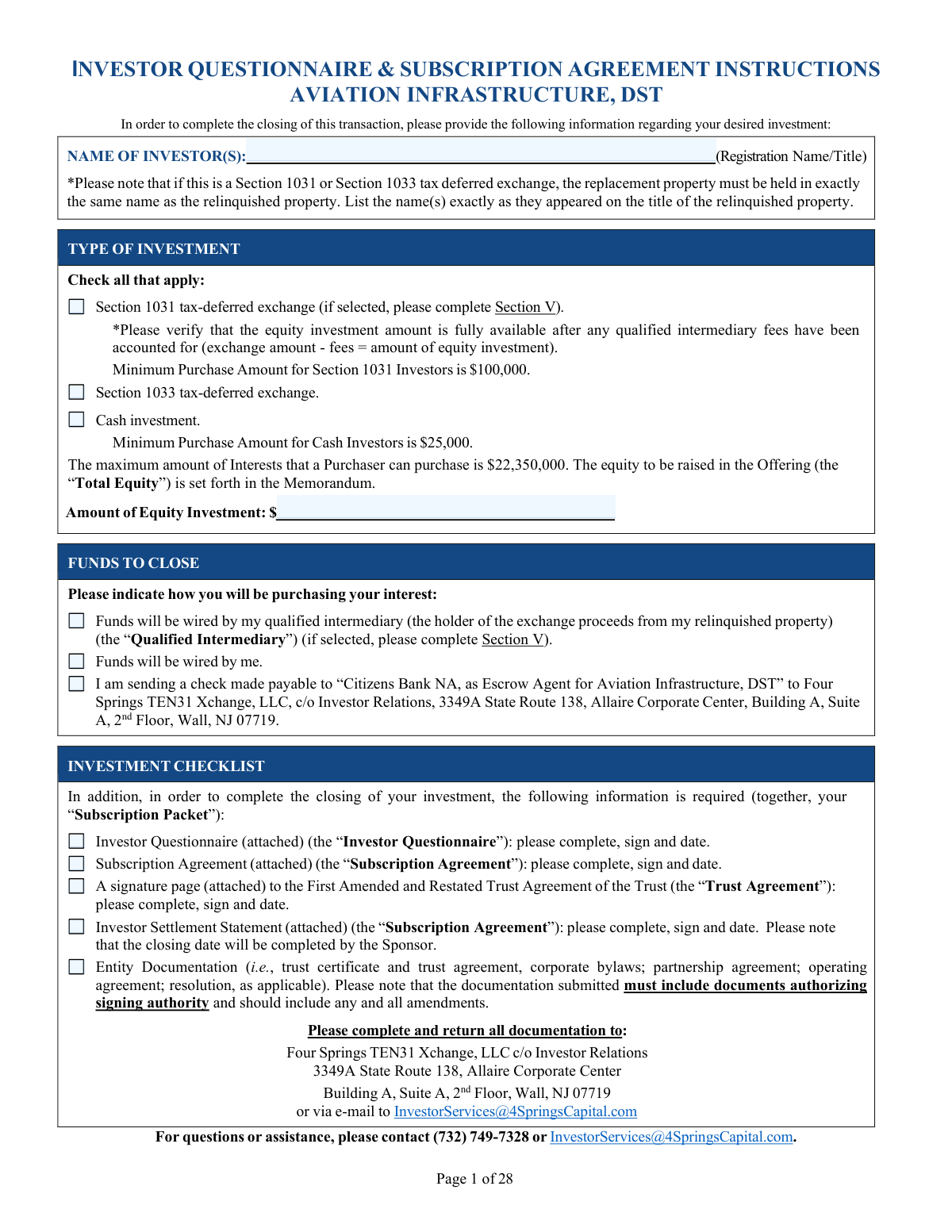
- Aviation Infrastructure, DST — Investor Questionnaire & Subscription Agreement: Choose this form if you are investing in the Miami-based aviation property sub-leased to Jet Aviation. This is a comprehensive "subscription packet" that includes not just the questionnaire, but also the Subscription Agreement, W-9, and ACH authorization. It is the correct choice for both cash investors (minimum $25,000) and Section 1031 exchange investors (minimum $100,000).
- FSC Industrial 6, DST Investor Questionnaire: Select this document if you are pursuing a private placement through a Four Springs-sponsored industrial trust. This form focuses specifically on qualification certifications and privacy notices required for this particular industrial asset class.
Which Form is Right for You?
- For 1031 Exchanges: Use the Aviation Infrastructure, DST packet, as it contains the specific exchange information sections required for tax-deferred transactions.
- For Early-Stage Vetting: If a broker-dealer or issuer just needs to confirm your eligibility, the Confidential Purchaser Questionnaire is usually sufficient.
- For Specific Industrial Projects: Use the FSC Industrial 6, DST form to satisfy the legal requirements for that specific trust's private placement.
Form Comparison
| Form | Primary Purpose | Target Investor | Investment Focus |
|---|---|---|---|
| Aviation Infrastructure, DST — Investor Questionnaire & Subscription Agreement | Facilitates the purchase of beneficial interests in an aviation-themed Delaware Statutory Trust. | Accredited individuals or entities, including Section 1031 tax-deferred exchange participants. | Specific aviation property in Miami, Florida, managed as a Delaware Statutory Trust. |
| Confidential Purchaser Questionnaire | Verifies financial background and accredited status for general private investment opportunities. | Potential investors needing to prove SEC Regulation D qualification to private companies. | General private placements, hedge funds, or startups requiring accredited investor certification. |
| FSC Industrial 6, DST Investor Questionnaire, Including Qualification Certifications and Privacy Notice | Confirms investor eligibility for a specific Four Springs-sponsored industrial property trust. | Accredited investors seeking to meet SEC Regulation D compliance for private offerings. | Industrial real estate assets held within a specialized Delaware Statutory Trust structure. |
Tips for accredited investor forms
Accreditation can be based on annual income, net worth, or specific professional certifications. Ensure you select the correct criteria on the questionnaire and have supporting documentation, such as tax returns or brokerage statements, ready to back up your selection.
When filling out multi-part packets for DSTs, ensure your entity name, tax ID, and contact details are identical on every page. Discrepancies between the Investor Questionnaire and the W-9 or Settlement Statement can lead to significant processing delays.
If you are investing through an LLC, Trust, or IRA, provide the entity’s financial details rather than your personal information where requested. Using the wrong Taxpayer Identification Number (TIN) for the investing entity is a common error that complicates future tax reporting.
AI-powered tools like Instafill.ai can complete these detailed forms in under 30 seconds with high accuracy, ensuring your data stays secure during the process. This is a major time-saver for investors dealing with multiple private placement documents or DST subscriptions.
Most accredited investor forms require bank routing and account numbers for automated distributions. Double-check these numbers against a voided check or bank statement to ensure your investment income is routed correctly without requiring manual corrections later.
These forms include legal acknowledgments regarding the risks of private placements and your status as a sophisticated investor. Read these sections carefully before signing to ensure you fully understand your obligations and the nature of the investment.
If you are using these forms for a tax-deferred exchange, have your Qualified Intermediary (QI) information ready to include in the settlement section. Proper coordination ensures that the Investor Settlement Statement aligns with your exchange timeline to preserve your tax benefits.
Frequently Asked Questions
These forms are used by companies and investment funds to verify that a potential investor meets specific financial criteria set by securities regulators. This process ensures that the offering complies with laws like SEC Regulation D, which permits the sale of private securities to sophisticated investors who can bear the financial risk.
In the United States, an individual is typically considered accredited if they have a net worth exceeding $1 million, excluding their primary residence, or an annual income of at least $200,000 ($300,000 for couples) for the last two years. Certain entities, such as trusts or businesses with assets over $5 million, may also qualify.
An investor questionnaire is used to gather data and certifications to prove your eligibility to invest. A subscription agreement is the actual legal contract between the investor and the issuer detailing the terms of the purchase and the number of shares or interests being acquired.
Yes, AI tools like Instafill.ai can fill these complex forms in under 30 seconds. The technology accurately extracts data from your source documents and places it into the correct fields, ensuring that multi-page subscription packets are completed without manual entry errors.
While manually filling out these multi-section documents can take 20 to 30 minutes, using AI-powered automation reduces the process to less than a minute. This is particularly helpful for forms like the Aviation Infrastructure DST packet, which contains numerous certifications and tax forms.
You should have your tax identification numbers, banking information for distributions, and financial statements or tax returns ready. If the form requires third-party verification, you may also need a letter signed by a CPA, attorney, or investment advisor.
Many accredited investor forms in this category relate to DSTs, which are popular investment vehicles for Section 1031 tax-deferred exchanges. These forms include specific sections to help investors move capital from a recently sold property into a new fractional real estate interest.
Yes, these documents contain legal representations and warranties regarding your financial status and intent to invest. Once signed and accepted by the issuer, they form a binding agreement for the purchase of securities.
Once completed and signed, these forms are typically submitted directly to the investment sponsor, a broker-dealer, or a designated platform handling the private placement. They must be reviewed and approved before the investor is permitted to wire funds.
Generally, yes. Each investment issuer is responsible for performing their own due diligence to ensure you are qualified for their specific offering. However, using automated tools can make it much easier to reuse your data across multiple different questionnaires.
Glossary
- Form Complexity Index
- Instafill’s 0–100 measure of how much effort a form takes to complete, calculated deterministically from the form’s own structure rather than estimated. It combines the number of fillable fields (the largest factor), how difficult those fields are to complete based on their type, the number of pages that contain fields, the amount of conditional “fill-only-if” logic, and how many sections the form is divided into, then adds modifiers for tables and repeating lists, bundled instruction pages, and dense page layouts. A higher score means the form is harder to fill out by hand. The forms in this category have a median Form Complexity Index of 65/100 (Complex). See exactly how it is calculated.
- Accredited Investor
- An individual or entity that meets specific financial thresholds, such as a net worth over $1 million (excluding their primary residence) or a high annual income, allowing them to invest in private securities.
- Regulation D (Reg D)
- A set of SEC rules that allows companies to sell securities in private offerings without a full public registration, provided they follow specific disclosure and investor qualification requirements.
- Delaware Statutory Trust (DST)
- A legal entity that allows multiple investors to hold fractional ownership in a single piece of professional real estate, often used to satisfy tax-deferred exchange requirements.
- Section 1031 Exchange
- A provision of the Internal Revenue Code that allows an investor to defer paying capital gains taxes on the sale of an investment property by reinvesting the proceeds into a 'like-kind' property.
- Subscription Agreement
- The formal contract between an investor and an issuer that outlines the terms of the investment and the investor's commitment to purchase a specific number of shares or interests.
- Private Placement
- The sale of securities directly to a select group of private investors rather than through a public offering on the open market.
- Beneficial Interest
- The right to receive benefits, such as income or profits, from an asset or trust even though the legal title is held by another party.
- Purchaser Questionnaire
- A form used by investment issuers to collect financial and background information to verify that a potential investor meets legal eligibility requirements.