Fill out annuity forms
with AI.
Annuity forms are essential financial documents used to manage long-term retirement savings and insurance-based investment contracts. These forms govern how funds are moved, distributed, or modified within an annuity account, serving as the formal link between the policyholder and the financial institution. They are critical because they ensure that your financial instructions—whether you are requesting a distribution, rolling over funds from another plan, or updating beneficiary designations—are executed in compliance with internal revenue codes and insurance regulations.
By continuing, you acknowledge Instafill's Privacy Policy and agree to get occasional product update and promotional emails.
About annuity forms
These documents are typically required by individual policyholders, retirees, and beneficiaries dealing with various providers. You might encounter these financial forms when you need to initiate a cash withdrawal, consolidate retirement assets through a rollover, or update your policy details following a major life event. They are also vital for survivors managing a spouse’s estate or for individuals navigating qualified domestic relations orders to ensure assets are divided correctly. Tools like Instafill.ai use AI to fill these annuity forms in under 30 seconds, handling your sensitive data accurately and securely to streamline the administrative process.
Every form on this page can be completed without typing. Instafill is form filling software that reads a PDF and fills it for you — including flat and scanned documents that carry no fillable fields at all.
Forms in This Category
The forms in this category have a median Form Complexity Index of 41/100 (Basic), measured across 16 forms by field count, input difficulty, length, conditional logic and structure. See how it is calculated.
- Enterprise-grade security & data encryption
- 99%+ accuracy powered by AI
- 1,000+ forms from all industries
- Complete forms in under 60 seconds
How to Choose the Right Form
Navigating annuity paperwork depends heavily on your specific insurance provider and the life event driving your request. Whether you are looking to withdraw funds, consolidate retirement accounts, or update your policy details, selecting the correct form ensures your transaction is processed without tax penalties or delays.
Transamerica Annuity Management
If you hold a policy with Transamerica, your choice depends on whether you are moving money or updating records:
- For Withdrawals: Use the Transamerica Annuity Distribution Form for partial withdrawals or full surrenders. If your plan is a 403(b), use the Tax Sheltered Annuity (TSA) IRC Section 403(b) Distribution Request.
- For Updates: To change your beneficiary, transfer ownership, or update personal details, use the Transamerica Annuity Policy Change Form.
TIAA Withdrawals and Transfers
TIAA forms are often specific to the type of transfer you are performing:
- Moving to another company: The TIAA 1035 Exchange Authorization (Form F10926) is essential for tax-free transfers to alternate investment companies.
- Cashing out: Use Form F10794 (Cash Withdrawal or Rollover Transfer) for private employer plans involving a Transfer Payout Annuity.
- Estate Planning: Use the TIAA Non-Qualified Annuity Beneficiary Designation Form to ensure your death benefits are allocated according to your wishes.
Union and Specialized Fund Forms
Participants in specific union funds should look for forms tailored to their plan’s rules:
- Elevator Constructors Union: Use the Distribution Due to Death for Spouse Beneficiary for survivor benefits, or the Distribution Request Due to Qualified Domestic Relations Order if assets are being divided due to a legal settlement. For consolidating outside funds, use the Incoming Rollover Election.
- Iron Workers: If you need to borrow against your account, download the General Purpose Loan Application Packet, IW DC of SOV Annuity Trust.
- NYPD Superior Officers: Use the NYPD Superior Officers Council Annuity Trust Fund Plan Rollover Form to move external retirement savings into your council plan.
Form Comparison
| Form | Primary Action | Applicable Plan/Provider | Key Requirement or Trigger |
|---|---|---|---|
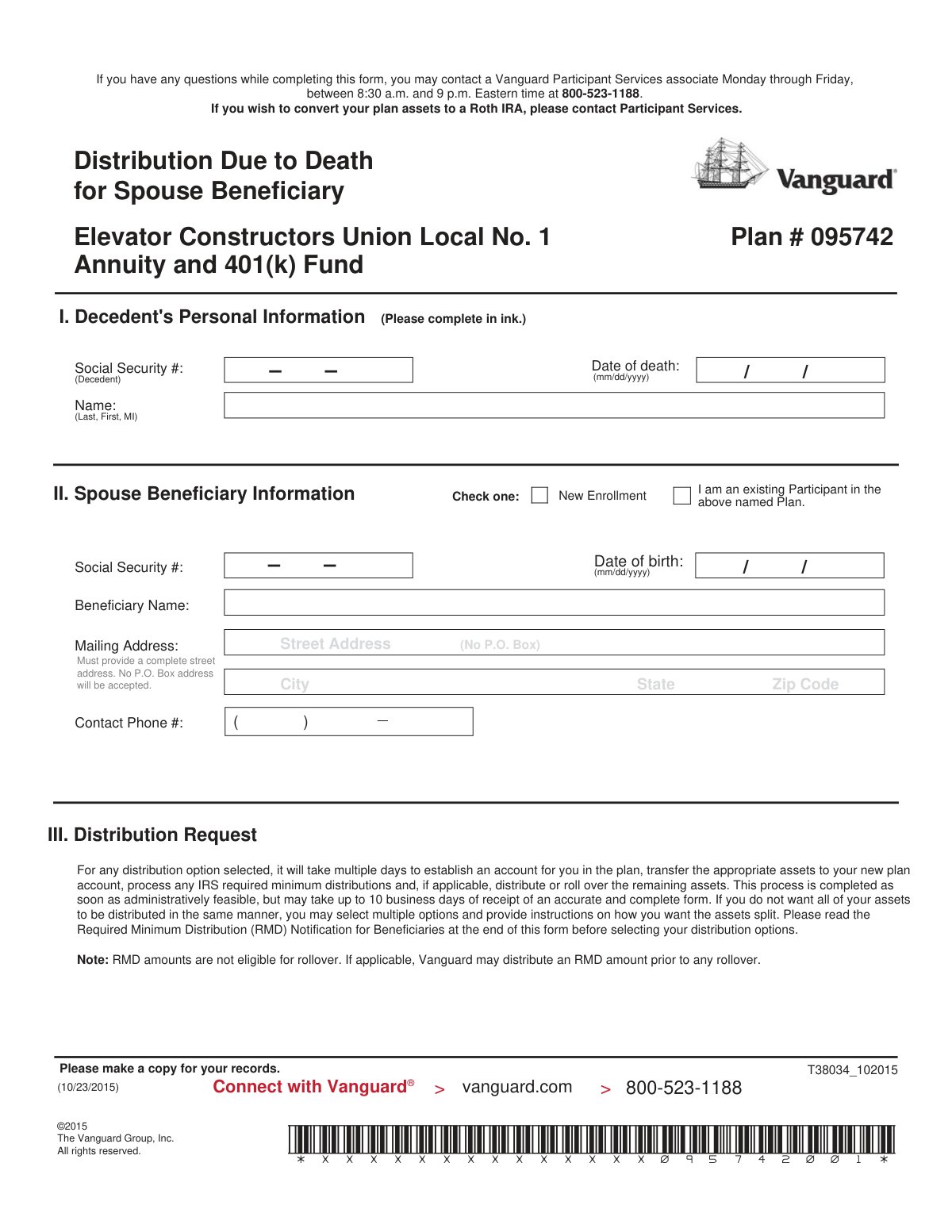
| Distribution Due to Death for Spouse Beneficiary - Elevator Constructors Union Local No. 1 Annuity and 401(k) Fund | Request death benefit distribution | Elevator Constructors Union (Vanguard) | Death of a spouse who was a plan participant |
| Elevator Constructors Union Local No.1 Annuity and 401(k) Fund Distribution Request Due to Qualified Domestic Relations Order | Distribute assets to alternate payee | Elevator Constructors Union | Valid court-ordered Qualified Domestic Relations Order (QDRO) |
| Incoming Rollover Election for Elevator Constructors Annuity and 401(k) Retirement Plan | Consolidate external retirement funds | Elevator Constructors Union | Moving funds from another qualified employer plan or IRA |
| General Purpose Loan Application Packet, IW DC of SOV Annuity Trust | Apply for a general-purpose loan | Iron Workers DC of Southern Ohio | Requires spousal waiver for married participants and repayment terms |
| NYPD Superior Officers Council Annuity Trust Fund Plan Rollover Form | Transfer external assets into fund | NYPD Superior Officers Council (Principal) | Consolidating Police Pension Fund or 401(k) retirement savings |
| Transamerica Annuity Distribution Form | Request partial or full withdrawal | Transamerica | One-time withdrawal, policy surrender, or Required Minimum Distribution |
| Tax Sheltered Annuity (TSA) IRC Section 403(b) Distribution Request | Withdraw funds from 403(b) plan | Transamerica | Severance from employment, disability, or reaching age 59.5 |
| Transamerica Annuity Policy Change Form | Update policy or ownership details | Transamerica | Changes to beneficiaries, personal information, or ownership transfers |
| Form F10794, Cash Withdrawal or Rollover Transfer Payout Annuity for Private Employer Plans | Initiate cash withdrawal or rollover | TIAA (Private Employer Plans) | Disbursed as 10 payments over a 9-year period |
| TIAA 1035 Exchange Authorization to Alternate Investment Company Transfer Payout Annuity for ATRA | Tax-free transfer to another company | TIAA (ATRA Accounts) | Authorized 1035 exchange with a 9-year payout structure |
| TIAA Non-Qualified Annuity Beneficiary Designation Form | Designate death benefit recipients | TIAA (Non-Qualified Annuities) | Naming primary and contingent beneficiaries to avoid probate |
Tips for annuity forms
One of the most common errors is providing incorrect or outdated information for beneficiaries. Ensure that names, addresses, and Social Security numbers are current to prevent significant delays in asset distribution or legal disputes during the probate process.
Annuity distributions are often subject to federal and state income taxes. Carefully review the withholding section of your form to avoid unexpected tax liabilities at the end of the year, especially when requesting lump-sum payouts or Required Minimum Distributions.
Many annuity plans, particularly union-based funds, require a spouse's signature to authorize loans or distributions. Ensure these sections are signed and notarized where required by the plan administrator to avoid having your application rejected immediately.
Use rollover and incoming election forms to move funds from disparate accounts into a single plan. This centralization makes it easier to track investment performance and ensures you only have one set of forms to manage for future distributions.
When moving funds between non-qualified annuities, ensure you use the specific 1035 Exchange authorization forms. This allows for a direct transfer between insurance companies, preserving the tax-deferred status of your investment without triggering a taxable event.
AI-powered tools like Instafill.ai can complete complex annuity and insurance forms in under 30 seconds with high accuracy. Your sensitive financial data stays secure during the process, making it a reliable way to handle multiple documents without manual data entry errors.
Always save a copy of your completed and signed annuity forms before mailing or uploading them to providers like Transamerica or TIAA. Having a digital record of your distribution requests or policy changes helps resolve discrepancies and provides a clear audit trail for your records.
Frequently Asked Questions
Annuity forms are legal and financial documents used to manage, update, or withdraw funds from an annuity contract. They cover a wide range of actions, including changing beneficiaries, requesting one-time distributions, rolling over funds into other retirement accounts, or updating personal contact information with providers like Transamerica or TIAA.
The correct form depends on your specific life event and the financial institution managing your plan. For example, a surviving spouse would use a 'Distribution Due to Death' form, while an employee leaving a company might use a 'Severance from Employment' or 'Rollover' form to move their funds to a new provider.
A 1035 Exchange form authorizes the tax-free transfer of funds from one annuity to another. It is specifically used for non-qualified annuities to ensure the policyholder does not incur immediate tax liabilities when moving their investment to an alternate insurance or investment company.
Most major providers like Transamerica and TIAA require a specific 'Beneficiary Designation Form' to update who receives death benefits. Completing these forms accurately is vital for ensuring assets are distributed according to your wishes and can help your heirs avoid the legal complications of probate.
Generally, you will need your policy or contract number, Social Security number, and current contact details. If you are requesting a distribution or rollover, you will also need to provide bank account information for direct deposits or the details of the receiving financial institution.
The policy owner must always sign the form, but additional signatures are often required for specific plans. For instance, many union-based annuity funds, such as the Iron Workers or Elevator Constructors plans, require a spousal waiver or signature if the participant is married.
A cash withdrawal sends funds directly to the policyholder, which usually triggers income taxes and potential early-withdrawal penalties. A rollover moves the funds directly to another qualified retirement account, such as an IRA or a new employer's 401(k), preserving the tax-deferred status of the money.
Completed annuity forms are typically submitted to the plan administrator or insurance company via their secure online portal, fax, or physical mail. Always check the specific instructions on the form to ensure you are sending it to the correct department for processing.
Yes, you can fill out complex annuity and insurance forms using AI tools like Instafill.ai. These tools can accurately extract data from your personal or source documents and place it into the correct fields, completing the entire form in under 30 seconds.
Manually filling out multi-page financial forms can be time-consuming and prone to errors. Using an AI-powered service like Instafill.ai allows you to complete these forms accurately and efficiently in less than 30 seconds, ensuring all required fields are addressed.
Glossary
- Form Complexity Index
- Instafill’s 0–100 measure of how much effort a form takes to complete, calculated deterministically from the form’s own structure rather than estimated. It combines the number of fillable fields (the largest factor), how difficult those fields are to complete based on their type, the number of pages that contain fields, the amount of conditional “fill-only-if” logic, and how many sections the form is divided into, then adds modifiers for tables and repeating lists, bundled instruction pages, and dense page layouts. A higher score means the form is harder to fill out by hand. The forms in this category have a median Form Complexity Index of 41/100 (Basic). See exactly how it is calculated.
- Direct Rollover
- A process where retirement funds are moved directly from one plan or IRA to another, preventing the funds from being taxed as a premature distribution.
- Beneficiary (Primary vs. Contingent)
- A primary beneficiary is the first person in line to receive account assets upon the owner's death, while a contingent beneficiary receives the assets only if the primary beneficiary is no longer living.
- Required Minimum Distribution (RMD)
- The minimum amount that the IRS requires retirement plan participants to withdraw annually once they reach a specific age, usually 72 or 73.
- QDRO (Qualified Domestic Relations Order)
- A legal judgment or order that grants a spouse, former spouse, child, or other dependent the right to receive all or part of a participant's retirement benefits.
- 1035 Exchange
- A provision in the tax code that allows for the tax-free transfer of funds from an existing annuity or life insurance policy to a new, similar contract.
- Spousal Waiver
- A legal document signed by a spouse to formally give up their right to a death benefit or to provide consent for the account holder to take a loan against the plan.
- 403(b) Plan
- Also known as a Tax Sheltered Annuity (TSA), this is a retirement plan for employees of public schools, certain non-profits, and cooperative hospital service organizations.
- Non-Qualified Annuity
- An annuity contract purchased with after-tax dollars, meaning the principal has already been taxed and is not part of an employer-sponsored retirement plan.
- Transfer Payout Annuity (TPA)
- A specific distribution method where funds are released in a series of fixed payments over several years rather than as a single lump sum.