Fill out capital budget forms
with AI.
Capital budget forms are essential tools for organizations seeking funding for long-term physical assets. Unlike operating budgets, which cover day-to-day expenses, capital budgets focus on major investments like land acquisition, infrastructure construction, and facility renovations. These forms serve as formal requests to government bodies or internal boards, detailing the scope, cost, and community impact of a proposed project. Securing this funding is often the critical first step in launching large-scale developments that serve the public interest or expand organizational capacity.
By continuing, you acknowledge Instafill's Privacy Policy and agree to get occasional product update and promotional emails.
About capital budget forms
These forms are typically used by non-profit organizations, local government agencies, and educational institutions when they need to secure legislative grants or bond initiatives. For example, an entity might use a Capital Funding Request Form to ask for state-level support for a new community center or a hospital renovation. Because these requests involve public or institutional funds, the documentation requirements are stringent, requiring precise details about project timelines, matching funds, and legislative sponsorship to ensure accountability.
Navigating the complexities of these documents can be time-consuming, but tools like Instafill.ai use AI to fill these forms in under 30 seconds while ensuring data is handled accurately and securely. This allows project managers and administrators to focus more on the strategic goals of their funding requests rather than the repetitive manual data entry of technical paperwork.
Every form on this page can be completed without typing. Instafill is form filling software that reads a PDF and fills it for you — including flat and scanned documents that carry no fillable fields at all.
Forms in This Category
| Form Name | Pages | FCI | |
|---|---|---|---|
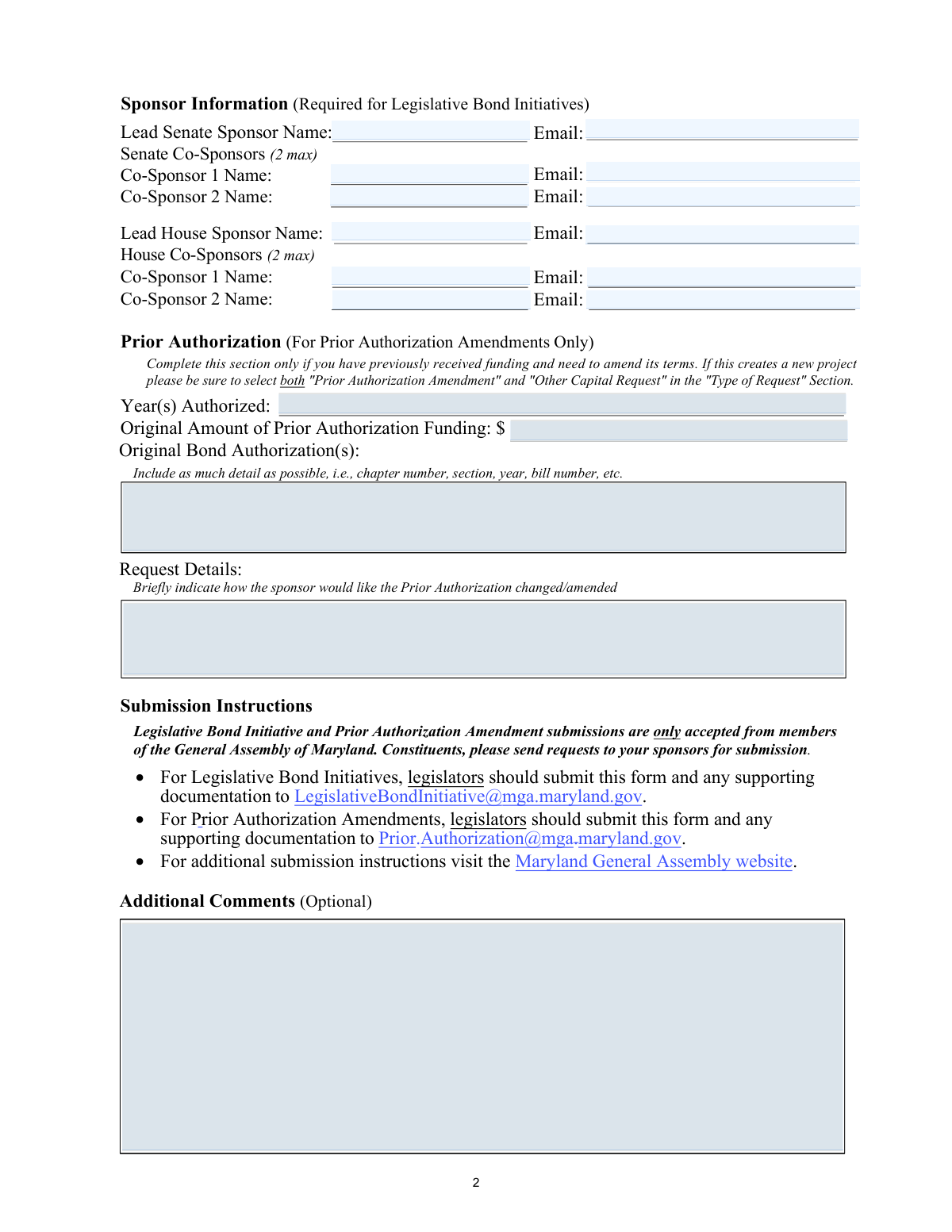
| 1. | Maryland General Assembly Capital Funding Request Form | 1 | – |
- Enterprise-grade security & data encryption
- 99%+ accuracy powered by AI
- 1,000+ forms from all industries
- Complete forms in under 60 seconds
How to Choose the Right Form
Identifying Your Capital Funding Needs
Capital budget forms are essential for organizations seeking significant financial support for infrastructure and long-term assets. Currently, our collection focuses on specific state-level funding in Maryland, specifically for those navigating the legislative bond process.
When to Use the Maryland General Assembly Capital Funding Request Form
If your project is located in Maryland and involves seeking state-level legislative support, the Maryland General Assembly Capital Funding Request Form is the primary document you will need. This form is tailored for several specific use cases:
- New Infrastructure Projects: Use this form for funding requests related to the acquisition of land or buildings, as well as the initial planning and design phases of a project.
- Construction and Renovation: This is the correct choice for requests involving the physical construction of new facilities or the significant renovation and repair of existing community or state assets.
- Amending Prior Authorizations: If your organization has previously received a Legislative Bond Initiative (LBI) but needs to modify the scope, purpose, or details of that authorization, this form serves as the official request for those amendments.
Key Requirements for a Successful Submission
To ensure you are selecting and completing this form correctly, keep these procedural requirements in mind:
- Legislative Sponsorship: This form cannot be submitted directly to the Assembly by an individual; it must be submitted through a legislative sponsor (a member of the Maryland House of Delegates or the State Senate).
- Public Benefit: Ensure your project meets the criteria for a Legislative Bond Initiative, which typically supports capital projects that serve a clear public interest.
- Detailed Documentation: Be prepared to provide specific details regarding the project's total cost, timeline, and any other funding sources that have already been secured.
Using Instafill.ai, you can quickly complete the Maryland General Assembly Capital Funding Request Form with AI assistance, ensuring your data is formatted correctly before you present it to your legislative sponsor.
Form Comparison
| Form | Purpose | Who Files It | Key Requirements |
|---|---|---|---|
| Maryland General Assembly Capital Funding Request Form | Request state funding for project acquisition, planning, design, construction, or renovation. | Organizations seeking capital funds via a legislative sponsor in the Maryland General Assembly. | Requires a legislative sponsor to secure a Legislative Bond Initiative or amendment. |
Tips for capital budget forms
AI-powered tools like Instafill.ai can complete complex capital budget forms in under 30 seconds with high accuracy. Your sensitive organizational data stays secure during the process, providing a reliable way to manage multiple legislative requests efficiently.
Avoid vague language when describing the scope of your acquisition, design, or renovation. Clearly define the specific phase of the project to ensure reviewers understand exactly how the capital funds will be utilized for long-term assets.
Since capital funding requests often require a legislative sponsor, initiate contact well before the submission deadline. Ensuring your sponsor is fully briefed on the project's community impact helps facilitate a smoother submission through the General Assembly.
A common mistake is including recurring costs like staff salaries or office supplies in a capital budget request. Focus exclusively on physical infrastructure, land acquisition, or major equipment upgrades that have a long-term useful life.
Check if your specific project requires a local or private match to qualify for state capital funding. Having documentation or commitment letters for these funds ready can prevent your application from being flagged as incomplete during the review process.
Ensure all budget figures are based on recent professional quotes or appraisals rather than rounded estimates. Inaccurate or outdated figures can lead to significant funding gaps that are difficult to rectify once the legislative session has concluded.
Frequently Asked Questions
Capital budget forms are used to request financial support for long-term physical assets such as land acquisition, building construction, or major renovations. In the context of the Maryland General Assembly, these forms allow organizations to apply for state-funded grants or legislative bond initiatives for specific infrastructure projects.
Typically, local government entities and non-profit organizations with 501(c)(3) status are eligible to submit these requests. The projects must serve a public purpose and usually require a legislative sponsor from the State Senate or House of Delegates to move forward.
Applicants should contact their local state Senator or Delegate to discuss the project and request sponsorship. It is advisable to reach out well before the legislative session begins to ensure the representative has time to review the project's merits and community impact.
Yes, you can use AI-powered tools like Instafill.ai to complete complex capital budget forms. These tools can accurately extract data from your project proposals and supporting documents, placing the information into the correct fields in under 30 seconds.
Qualifying projects generally include the acquisition of property, architectural planning, engineering design, and the actual construction or renovation of facilities. These funds are specifically for capital expenses and cannot be used for the daily operating costs of an organization.
While manual entry for detailed legislative forms can take several hours, using an AI service reduces the time significantly. AI tools can process the entire document and populate all required fields accurately in less than 30 seconds.
Yes, the Maryland General Assembly Capital Funding Request Form is designed to handle both new requests and amendments to prior authorizations. This is common when a project's scope changes or when an organization needs to extend the time allowed to utilize previously granted funds.
Applicants should be prepared to provide detailed cost estimates, proof of matching funds if required, and a clear description of the project's public benefit. Having these documents ready in digital format allows AI tools to more effectively pull the necessary data for the form.
Many capital grants require the applicant to provide a 'match,' meaning the organization must raise a specific amount of money from other sources to complement the state's contribution. The form will require you to certify the status and source of these matching funds.
Once the form is completed and signed, it is typically submitted through the office of your legislative sponsor to the Department of Legislative Services. Ensure you are following the specific submission portal instructions or physical mailing requirements for the current legislative session.
Glossary
- Capital Budget
- A financial plan specifically for long-term investments in physical assets like buildings, infrastructure, and land, rather than day-to-day operating costs.
- Legislative Bond Initiative (LBI)
- A formal request for state funding, often referred to as a 'bond bill,' used to finance local community projects through the sale of state bonds.
- Legislative Sponsor
- A member of the Maryland House of Delegates or State Senate who introduces a funding request and represents the project during the legislative session.
- Matching Funds
- A requirement for the recipient to secure a specific amount of non-state money to complement the funding provided by the General Assembly.
- Authorization
- The official legal approval by the legislature that allows a specific amount of money to be spent on a particular project or purpose.
- Board of Public Works (BPW)
- The Maryland state agency that must give final approval for the expenditure of capital funds and the awarding of project contracts.
- Acquisition
- The act of purchasing or obtaining legal ownership of land, property, or existing structures as part of a capital project.
- Enabling Act
- The specific legislation passed by the General Assembly that creates the legal framework and authority for the state to fund capital projects.