Fill out corporate investment forms
with AI.
Corporate investment forms are the foundational documents required for businesses, trusts, and institutional entities to deploy capital into various financial products. These forms act as a formal gateway between a corporation and fund managers or investment houses. They are essential because they establish the legal framework of the investment relationship, detailing fee structures, risk disclosures, and the specific terms of the agreement. Without precise documentation, entities cannot move forward with strategic asset allocation or portfolio diversification.
By continuing, you acknowledge Instafill's Privacy Policy and agree to get occasional product update and promotional emails.
About corporate investment forms
These forms are typically managed by Chief Financial Officers, corporate treasurers, or legal counsel when a company decides to invest surplus cash or manage institutional wealth. Whether a firm is applying to join a wholesale fund or establishing a relationship with a global investment servicer, the process involves significant due diligence. Notable examples include corporate application agreements for specialized sub-funds or wholesale fund applications for companies. These documents require detailed disclosures regarding beneficial ownership, tax residency status, and compliance with anti-money laundering (AML) and Know Your Customer (KYC) regulations.
Completing these multi-page documents manually is often a tedious task that requires cross-referencing complex corporate data. Tools like Instafill.ai use AI to fill these forms in under 30 seconds while ensuring data is handled accurately and securely. By automating the data entry process, financial teams can focus on their investment strategy rather than the administrative burden of paperwork.
Every form on this page can be completed without typing. Instafill is form filling software that reads a PDF and fills it for you — including flat and scanned documents that carry no fillable fields at all.
Forms in This Category
The forms in this category have a median Form Complexity Index of 66/100 (Complex), measured across 2 forms by field count, input difficulty, length, conditional logic and structure. See how it is calculated.
| Form Name | Pages | FCI | |
|---|---|---|---|
| 1. | Corporate Investor Application and Agreement - SEI | 1 | Complex 66 |
| 2. | Vanguard Wholesale Funds - Application Form – Companies | 1 | Complex 63 |
- Enterprise-grade security & data encryption
- 99%+ accuracy powered by AI
- 1,000+ forms from all industries
- Complete forms in under 60 seconds
How to Choose the Right Form
Navigating corporate investment applications requires matching your entity's goals with the specific fund manager's requirements. These forms are not interchangeable, as they represent legal agreements with different financial institutions and regulatory jurisdictions.
Investing in SEI Sub-Funds
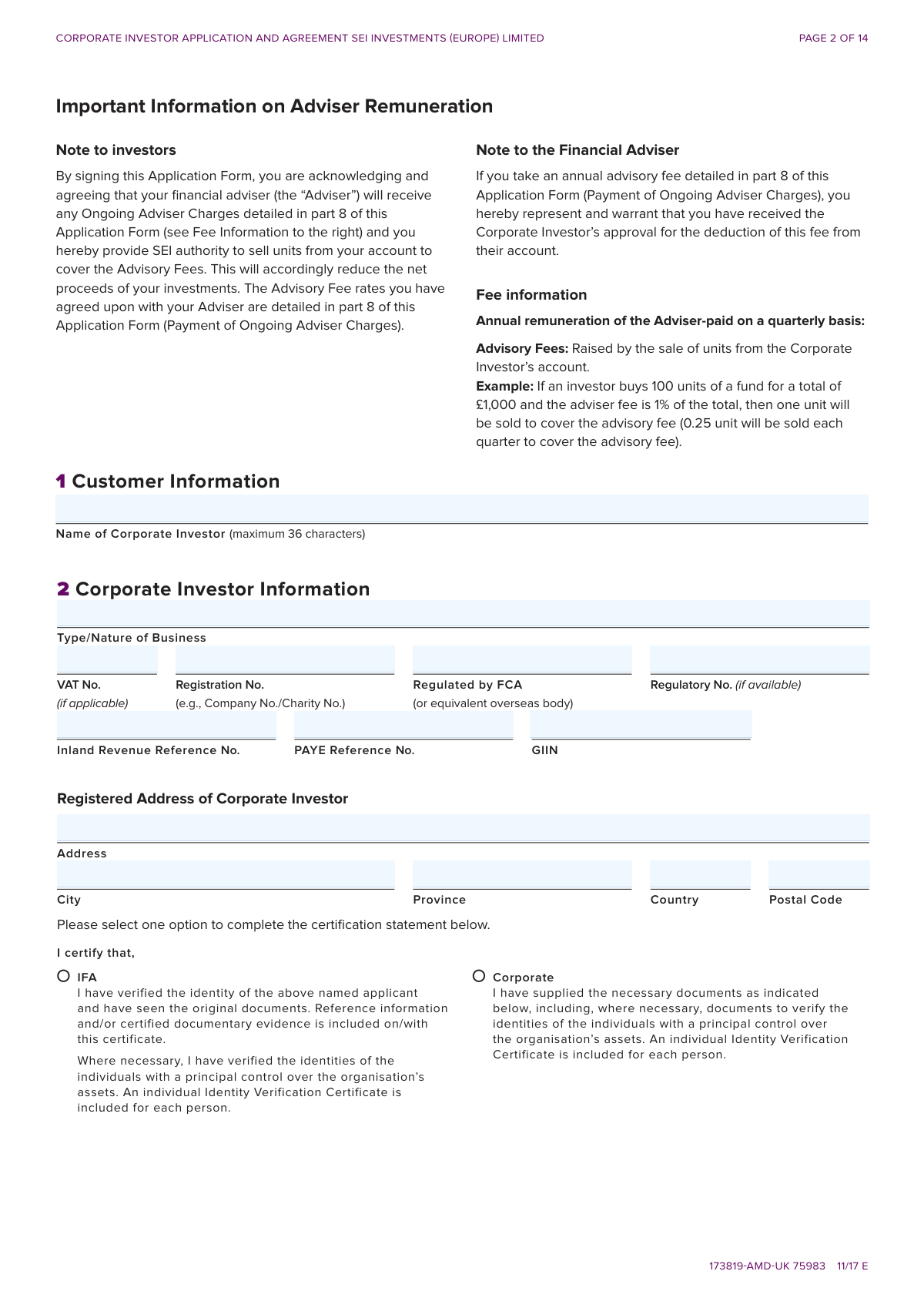
If your organization is targeting the diversified range of funds managed by SEI, you will need the Corporate Investor Application and Agreement - SEI. This document is more than just an application; it is a comprehensive binding agreement that outlines the specific terms of your relationship with the fund. Choose this form if you need to:
- Establish a New Account: Open a corporate investment account specifically for SEI’s range of sub-funds.
- Formalize Terms: Review and accept SEI-specific fee structures and regulatory disclosures.
- Initiate Trades: Complete the necessary paperwork to begin active trading within the SEI ecosystem.
Investing in Vanguard Wholesale Funds
For companies, platforms, or custodians looking to access Vanguard’s wholesale suite, the Vanguard Wholesale Funds - Application Form – Companies is the correct choice. This form is heavily focused on regulatory compliance within specific regions. You should select this form if:
- Regional Compliance: Your entity is an Australian or New Zealand company, or you are acting as a custodian or platform operator.
- Tax Reporting: You are required to provide detailed information regarding FATCA (Foreign Account Tax Compliance Act) or CRS (Common Reporting Standard) tax residency status.
- Identity Verification: You need to fulfill strict AML/CTF (Anti-Money Laundering and Counter-Terrorism Financing) requirements for corporate beneficial owners.
Which Should You Choose?
- Choose the SEI form if your primary goal is to gain access to SEI’s specific sub-funds and you are prepared to enter into their standard global investment agreement.
- Choose the Vanguard form if you are an Australian or New Zealand corporate entity looking for wholesale fund access and need to satisfy rigorous regional tax and identity compliance standards.
Using Instafill.ai, you can quickly populate these complex, multi-page documents. Our AI ensures that critical data like beneficial ownership and tax residency are placed correctly, saving your legal or treasury team hours of manual entry.
Form Comparison
| Form | Primary Purpose | Eligible Applicants | Compliance Focus |
|---|---|---|---|
| Corporate Investor Application and Agreement - SEI | Opening accounts and establishing binding agreements for SEI sub-fund investments. | Corporate entities and organizations looking to invest in SEI products. | Regulatory disclosures, fee agreements, and account setup for SEI trades. |
| Vanguard Wholesale Funds - Application Form – Companies | Setting up new accounts for corporate investors in Vanguard Wholesale Funds. | Australian and New Zealand companies, custodians, and investment platforms. | AML/CTF checks, beneficial ownership details, and global tax residency status. |
Tips for corporate investment forms
AI-powered tools like Instafill.ai can complete these complex corporate investment forms in under 30 seconds with high accuracy. Your data stays secure during the process, providing a practical and efficient solution for managers handling multiple fund applications simultaneously.
Before starting your application, ensure you have your Certificate of Incorporation and proof of registered address readily available. Most wholesale fund applications require these supporting documents to verify the legal existence of the entity before they can process the investment.
Accurate reporting of Ultimate Beneficial Owners (UBOs) is mandatory for anti-money laundering compliance. Double-check that you have the full names, addresses, and identification details for any individual holding a significant percentage of shares or voting rights in the company.
Be prepared to provide specific tax residency information, including FATCA and CRS classifications for your corporate entity. Incorrectly identifying your organization's tax status can lead to significant processing delays or issues with international withholding taxes.
Corporate forms often require signatures from specific officers, such as Directors or Company Secretaries, as defined in your company constitution. Ensure your internal board resolutions align with the individuals signing the application to prevent the fund manager from rejecting the document.
Always save a digital copy of the completed form and all submitted attachments for your internal corporate records. Having these documents organized makes it significantly easier to handle future compliance reviews or update information if your corporate structure changes.
Frequently Asked Questions
Corporate investment forms are legal documents that allow businesses, trusts, and other organizations to open investment accounts or purchase shares in managed funds. These forms establish the relationship between the entity and the fund manager, outlining the terms of the investment and ensuring compliance with financial regulations.
Generally, authorized signatories such as directors, company secretaries, or designated officers listed in the company's constitutional documents must sign these forms. The specific requirements for signatures may vary depending on the fund manager and the jurisdiction where the company is registered.
Regulatory bodies require this information to prevent money laundering and financial crimes by identifying the individuals who ultimately own or control the entity. Providing details about beneficial owners is a standard part of the 'Know Your Customer' (KYC) process for institutional investments.
Most fund managers require a certified copy of the entity's Certificate of Incorporation, a list of authorized signatories, and proof of tax residency. For trusts or complex corporate structures, additional documents like trust deeds or organizational charts may also be necessary to verify the entity's status.
Yes, AI tools like Instafill.ai can fill out complex corporate investment forms in under 30 seconds by accurately extracting data from your source documents and placing it into the correct fields. This technology minimizes manual entry errors and ensures that all required sections are addressed efficiently.
While manual completion can take several hours due to the detailed regulatory and tax information required, using an AI-powered service can reduce this time significantly. These tools can process multi-page applications instantly, allowing for a much faster submission process.
Corporate investment forms often include sections for FATCA (Foreign Account Tax Compliance Act) and CRS (Common Reporting Standard) declarations. These sections help the fund manager determine the entity's tax residency status and fulfill reporting obligations to relevant tax authorities.
Many corporate application forms allow you to select multiple sub-funds or investment options within a single document. However, if you are looking to invest in different fund families or wholesale platforms, you will likely need to complete a separate application for each provider.
Completed forms are usually submitted directly to the fund manager or the designated registry service provider via mail, email, or a secure online portal. It is important to check the specific instructions on the form, as some providers may require original 'wet ink' signatures for certain documents.
Wholesale investment forms are specifically designed for institutional investors, companies, or high-net-worth individuals who meet specific financial thresholds. These forms often involve different fee structures and disclosure requirements compared to standard retail investment applications intended for the general public.
Yes, once signed and accepted by the fund manager, these forms constitute a binding legal agreement between the corporate entity and the investment provider. They outline the rights of the investor, the responsibilities of the manager, and the terms under which the investment will be governed.
Most modern digital platforms and AI-assisted tools allow you to save your progress or generate a draft of the form. This is particularly helpful for corporate forms, which often require gathering information from multiple departments or directors before the document can be finalized.
Glossary
- Form Complexity Index
- Instafill’s 0–100 measure of how much effort a form takes to complete, calculated deterministically from the form’s own structure rather than estimated. It combines the number of fillable fields (the largest factor), how difficult those fields are to complete based on their type, the number of pages that contain fields, the amount of conditional “fill-only-if” logic, and how many sections the form is divided into, then adds modifiers for tables and repeating lists, bundled instruction pages, and dense page layouts. A higher score means the form is harder to fill out by hand. The forms in this category have a median Form Complexity Index of 66/100 (Complex). See exactly how it is calculated.
- Beneficial Owner
- An individual who ultimately owns or controls a legal entity, typically identified by holding a significant percentage of shares or voting rights.
- AML/CTF
- Stands for Anti-Money Laundering and Counter-Terrorism Financing, which are legal requirements for financial institutions to verify the identity of their clients.
- FATCA
- The Foreign Account Tax Compliance Act, a US law requiring international financial institutions to report the assets and identities of US taxpayers.
- CRS
- The Common Reporting Standard, a global framework for the automatic exchange of financial account information between countries to prevent tax evasion.
- Wholesale Fund
- An investment fund specifically designed for institutional investors or high-net-worth individuals, usually featuring higher minimum investment thresholds.
- Custodian
- A financial institution that holds and safeguards a company's securities and other assets to prevent loss or theft.
- Tax Residency
- The country or jurisdiction where a corporate entity is legally obligated to pay taxes based on its location of incorporation or business activities.
- Sub-fund
- A distinct pool of assets within an umbrella fund structure that has its own specific investment objectives and policies.