Fill out CPP survivor forms
with AI.
The Canada Pension Plan (CPP) survivor forms represent a critical set of documents designed to provide financial security to the family members of a deceased contributor. These benefits are not automatic; they require formal applications to ensure that the government accurately assesses eligibility and distributes monthly payments to those entitled to support. Navigating these forms is a necessary step in securing the survivor's pension and child benefits that help bridge the financial gap left after a loved one passes away.
By continuing, you acknowledge Instafill's Privacy Policy and agree to get occasional product update and promotional emails.
About CPP survivor forms
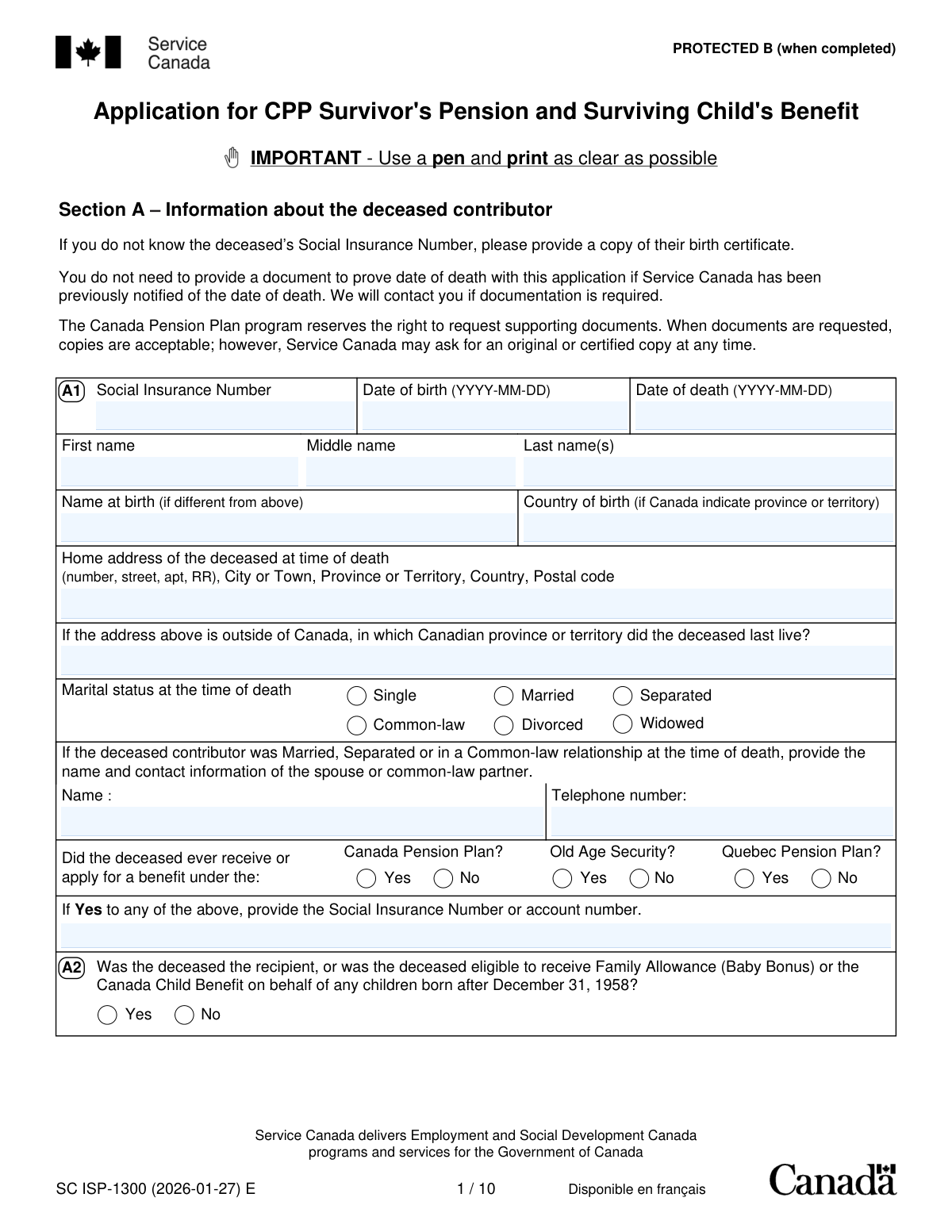
Typically, these forms are needed by surviving legal spouses, common-law partners, or the guardians of dependent children. The process usually begins shortly after a contributor's death, as timely filing is essential to avoid delays in receiving monthly assistance. While the paperwork can feel daunting during a period of grief, completing documents like the Application for CPP Survivor's Pension and Surviving Child's Benefit is a vital part of settling an estate and ensuring long-term stability for the household.
Managing this administrative burden can be made significantly easier with modern technology. Tools like Instafill.ai use AI to fill these forms in under 30 seconds, ensuring the data is handled accurately and securely so you can submit your application with confidence. This streamlined approach removes the manual stress of data entry, allowing you to focus on your family's needs while the software handles the complexities of the paperwork.
Every form on this page can be completed without typing. Instafill is form filling software that reads a PDF and fills it for you — including flat and scanned documents that carry no fillable fields at all.
Forms in This Category
The forms in this category have a median Form Complexity Index of 76/100 (Complex), measured across 2 forms by field count, input difficulty, length, conditional logic and structure. See how it is calculated.
| Form Name | Pages | FCI | |
|---|---|---|---|
| 1. | Form SC ISP-1300, Application for CPP Survivor's Pension and Surviving Child's Benefit | 15 | Complex 73 |
| 2. | Form SC ISP-1300, Canada Pension Plan Survivor's Pension and Surviving Child's Benefit Application | 15 | Complex 76 |
- Enterprise-grade security & data encryption
- 99%+ accuracy powered by AI
- 1,000+ forms from all industries
- Complete forms in under 60 seconds
How to Choose the Right Form
Applying for Canada Pension Plan (CPP) benefits after the loss of a loved one is a sensitive and important task. The forms in this category are designed to help the family of a deceased contributor access essential financial support during a difficult transition.
Understanding the Primary Form
In this category, you will find variations of the same essential document: Form SC ISP-1300, Application for CPP Survivor's Pension and Surviving Child's Benefit. Whether it is listed as the "Application" or the "Canada Pension Plan Survivor's Pension and Surviving Child's Benefit Application," the purpose remains the same. This single form allows you to apply for two distinct types of monthly payments:
- Survivor’s Pension: This is a monthly payment intended for the legal spouse or common-law partner of the deceased contributor.
- Surviving Child’s Benefit: This is a monthly payment for dependent children of the deceased contributor. This usually applies to children under age 18, or those between 18 and 25 who are attending a recognized school or university full-time.
Who Should Use These Forms?
To determine if you need to complete Form SC ISP-1300, identify your relationship to the deceased:
- Spouses and Common-Law Partners: Use this form to claim your pension. If you also have dependent children living with you, you can apply for their benefits using the same application.
- Legal Guardians: If you are the primary caregiver for the child of a deceased CPP contributor but are not the surviving spouse, you use this form to secure the child's benefit.
- Children Aged 18–25: If you are a student in this age bracket, you may need to provide additional school attendance proof alongside this application to maintain eligibility.
Streamlining Your Application
Because these forms require detailed information—including Social Insurance Numbers (SIN), dates of birth, and marriage or common-law details—it is helpful to use a digital tool. Using Instafill.ai to complete Form SC ISP-1300 ensures that your information is clear and legible, which helps Service Canada process your benefits more efficiently and reduces the likelihood of administrative delays.
Form Comparison
| Form | Primary Purpose | Eligible Applicants | Key Benefits |
|---|---|---|---|
| Form SC ISP-1300, Application for CPP Survivor's Pension and Surviving Child's Benefit | Apply for financial assistance following the death of a CPP contributor. | Surviving legal spouses, common-law partners, or guardians of dependent children. | Monthly survivor's pension and benefits for eligible surviving children. |
| Form SC ISP-1300, Canada Pension Plan Survivor's Pension and Surviving Child's Benefit Application | Request monthly pension payments for survivors of a deceased CPP member. | Surviving spouse, common-law partner, or individual caring for dependent children. | Financial support through survivor pensions and child-specific benefit payments. |
Tips for CPP survivor forms
To complete the application efficiently, have the deceased contributor's Social Insurance Number and your own identification ready. You will also need documents such as marriage certificates or proof of a common-law relationship to verify your eligibility.
AI-powered tools like Instafill.ai can complete these forms in under 30 seconds with high accuracy. This is a significant time-saver for those handling multiple administrative tasks, and your data stays secure throughout the automated filling process.
An incorrect SIN for either the deceased or the applicant is one of the most common reasons for processing delays. Carefully verify these nine-digit numbers against official government documents before submitting your forms.
Ensure you include every eligible child under age 18, or those aged 18 to 25 attending school full-time, to maximize the Surviving Child's Benefit. Leaving out a dependent can lead to a loss of monthly financial support for the family.
If you were not legally married, you must provide specific evidence that you lived in a conjugal relationship for at least one continuous year. Ensuring this section is thorough prevents the pension office from having to request additional follow-up documentation.
Always save a copy of your completed Form SC ISP-1300 before sending it to Service Canada. Having a record of exactly what you submitted makes it much easier to provide updates or corrections if the pension office has questions.
Frequently Asked Questions
Benefits are generally available to the legal spouse or common-law partner of a deceased person who made sufficient contributions to the Canada Pension Plan. Additionally, dependent children under age 18, or between 18 and 25 if attending school full-time, may be eligible for the Surviving Child's Benefit.
Form SC ISP-1300 is the standard application used for both the CPP Survivor's Pension and the Surviving Child's Benefit. This form allows the surviving partner or the guardian of the deceased's children to apply for monthly financial support.
It is recommended to apply as soon as possible after the death of the contributor to ensure benefits begin promptly. While Service Canada may provide some retroactive payments, long delays in filing can sometimes result in a loss of potential monthly benefits.
The Survivor's Pension is a monthly payment intended for the surviving spouse or common-law partner of the deceased. The Surviving Child's Benefit is a separate monthly payment made to the dependent children of the contributor, provided they meet specific age and educational criteria.
Yes, AI tools like Instafill.ai can fill out CPP survivor forms by accurately extracting data from your source documents and placing it directly into the required fields. This ensures that sensitive information is transcribed correctly without the need for manual data entry.
Using AI-powered automation, you can complete CPP survivor forms in under 30 seconds. The software handles the complex task of mapping your personal information to the PDF, significantly speeding up the application process.
Commonly required documents include the deceased's Social Insurance Number (SIN), a death certificate, and a marriage certificate or proof of common-law status. If you are applying for children, you will also need to provide their birth certificates and, if they are over 18, proof of full-time school enrollment.
Common-law partners qualify if they lived with the deceased in a conjugal relationship for at least one continuous year prior to the death. You may be required to submit additional declarations or evidence to verify the duration and nature of the relationship.
Once the form is completed and signed, it should be mailed to the Service Canada office that serves your specific province or territory. You can find the correct mailing address on the official Service Canada website or within the form's instruction guide.
No, the CPP Death Benefit is a one-time payment that requires a separate application, Form SC ISP-1200. While they are different benefits, many applicants choose to fill out and submit both the Death Benefit and the Survivor's Pension forms at the same time.
Glossary
- Form Complexity Index
- Instafill’s 0–100 measure of how much effort a form takes to complete, calculated deterministically from the form’s own structure rather than estimated. It combines the number of fillable fields (the largest factor), how difficult those fields are to complete based on their type, the number of pages that contain fields, the amount of conditional “fill-only-if” logic, and how many sections the form is divided into, then adds modifiers for tables and repeating lists, bundled instruction pages, and dense page layouts. A higher score means the form is harder to fill out by hand. The forms in this category have a median Form Complexity Index of 76/100 (Complex). See exactly how it is calculated.
- Contributor
- The deceased individual who made valid contributions to the Canada Pension Plan (CPP) through their employment earnings during their lifetime.
- Survivor's Pension
- A monthly financial payment provided to the legal spouse or common-law partner of a deceased Canada Pension Plan contributor.
- Surviving Child's Benefit
- A monthly payment intended for the dependent children of a deceased contributor, generally available until the child turns 18, or 25 if they are a full-time student.
- Common-law Partner
- A person who lived with the deceased contributor in a conjugal relationship for at least 12 consecutive months immediately prior to the contributor's death.
- Service Canada
- The federal agency responsible for processing Canada Pension Plan applications and managing the delivery of social benefit payments.
- Full-time Attendance
- A mandatory requirement for adult children aged 18 to 25 to receive benefits, requiring proof of enrollment in a recognized school, college, or university.
- Social Insurance Number (SIN)
- A unique nine-digit identification number required on CPP forms to accurately identify the contributor and verify the applicant's eligibility for benefits.
- Death Benefit
- A one-time, lump-sum payment often applied for alongside survivor benefits to help the estate or family cover the final expenses of the deceased contributor.