Fill out employer injury forms
with AI.
Employer injury forms are critical documents used to document workplace incidents, occupational illnesses, or fatalities. These forms serve as the official record required by state agencies and insurance carriers to initiate the workers' compensation process. Timely filing is essential not only for legal compliance—often required within a few days of the incident—but also to ensure that injured employees receive the medical benefits and wage replacement they are entitled to without unnecessary delays.
By continuing, you acknowledge Instafill's Privacy Policy and agree to get occasional product update and promotional emails.
About employer injury forms
These forms are primarily utilized by business owners, HR managers, and risk management officers who must report incidents such as a sudden injury on the job or the discovery of a work-related disease. In Texas, for instance, documents like the DWC Form-001 or the DWC001S are mandatory filings that bridge the gap between the employer, the insurance carrier, and state regulatory bodies. Accurate documentation at this stage is vital to prevent disputes and ensure the claims process moves forward smoothly for all parties involved.
Managing the paperwork for workplace incidents can be stressful, especially when deadlines are tight. Tools like Instafill.ai use AI to fill these forms in under 30 seconds, ensuring data is handled accurately and securely. This allows employers to focus on supporting their team members and managing workplace safety rather than getting bogged down in repetitive data entry.
Every form on this page can be completed without typing. Instafill is form filling software that reads a PDF and fills it for you — including flat and scanned documents that carry no fillable fields at all.
Forms in This Category
The forms in this category have a median Form Complexity Index of 59/100 (Moderate), measured across 2 forms by field count, input difficulty, length, conditional logic and structure. See how it is calculated.
| Form Name | Pages | FCI | |
|---|---|---|---|
| 1. | DWC Form-001, Employer’s first report of injury or illness | 2 | Moderate 59 |
| 2. | DWC001S, Employer’s first report of injury or illness | 2 | Moderate 58 |
- Enterprise-grade security & data encryption
- 99%+ accuracy powered by AI
- 1,000+ forms from all industries
- Complete forms in under 60 seconds
How to Choose the Right Form
In Texas, reporting a workplace injury, illness, or fatality is a time-sensitive legal obligation. Selecting the correct version of the "Employer’s First Report of Injury or Illness" depends entirely on the type of organization you represent and who provides your workers' compensation coverage.
Private Sector and Standard Employers
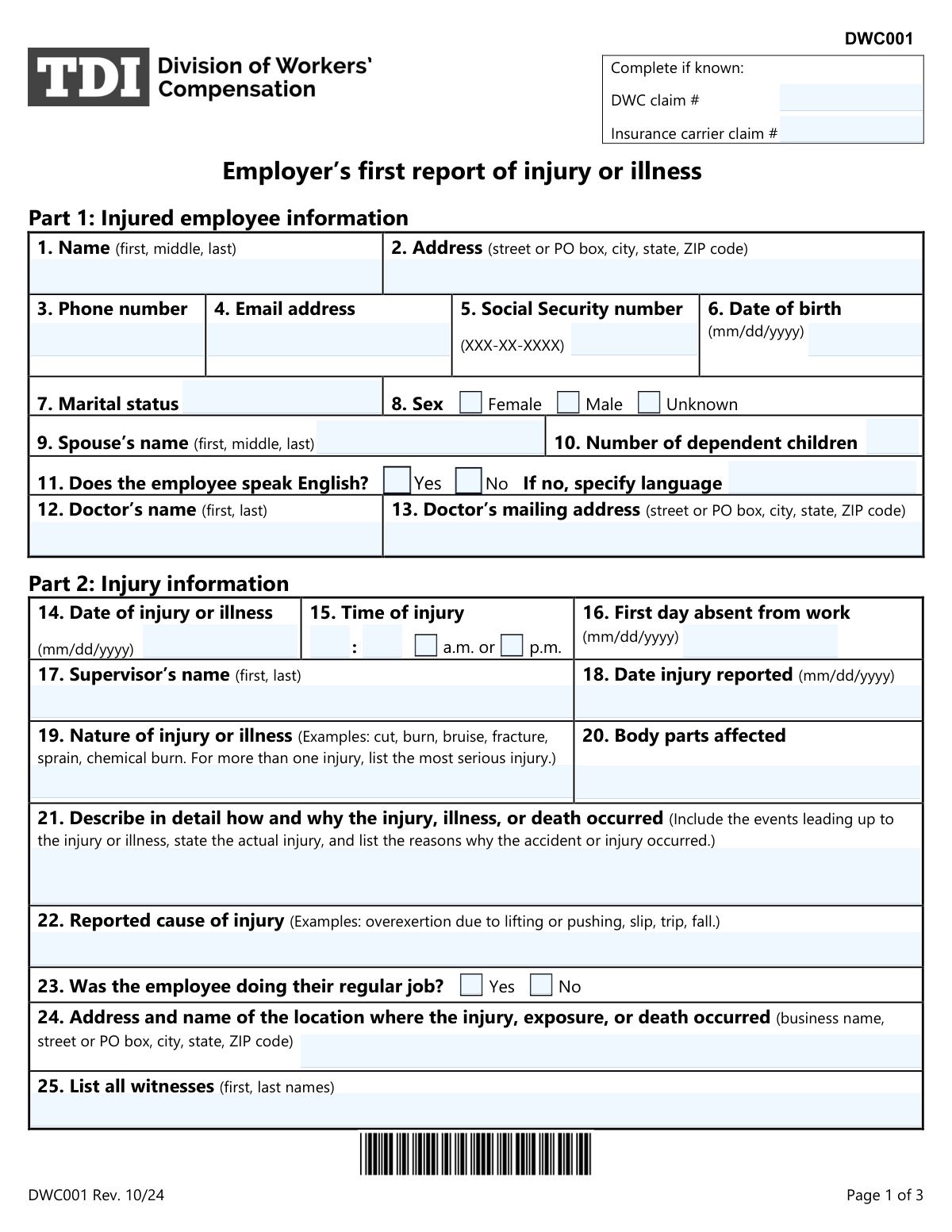
If you are a private business owner or an employer whose workers' compensation insurance is provided through a commercial carrier, you should use DWC Form-001, Employer’s first report of injury or illness. This is the standard document required by the Texas Department of Insurance, Division of Workers' Compensation (DWC).
Key requirements for DWC Form-001 include:
- Deadline: You must file this form within eight days of the employee's first day of absence from work, or within eight days of being notified of an occupational disease or death.
- Recipient: This form is typically sent to your insurance carrier, who then handles the filing with the DWC.
State Agencies and SORM-Covered Entities
If you are a state agency or an entity that falls under the jurisdiction of the State Office of Risk Management, you must utilize DWC001S, Employer’s first report of injury or illness. While the data collected is largely the same as the standard version, the DWC001S is specifically tailored for the SORM reporting workflow.
Quick Selection Guide
To ensure you are using the right document for your specific situation, follow these criteria:
- Choose DWC Form-001 if you are a private employer reporting to a private insurance company.
- Choose DWC001S if you are a Texas state agency reporting a claim for a state employee to the State Office of Risk Management (SORM).
Failure to file the correct form within the legal timeframe can lead to administrative penalties. Using Instafill.ai allows you to quickly complete these forms with AI assistance, ensuring that all mandatory fields are filled accurately before you submit them to the appropriate carrier or agency.
Form Comparison
| Form | Primary Recipient | Filing Deadline | User Type |
|---|---|---|---|
| DWC Form-001, Employer’s first report of injury or illness | Private workers' compensation insurance carrier | Within 8 days of employee absence, notice, or death | Private Texas employers and insurance subscribers |
| DWC001S, Employer’s first report of injury or illness | State Office of Risk Management (SORM) | Immediately after injury, illness, or death occurs | Texas state agencies and covered state employees |
Tips for employer injury forms
Ensure you describe exactly how the injury occurred and the specific body parts affected. Inaccurate or vague descriptions can lead to delays in claim processing or potential disputes with insurance carriers and state agencies.
Workplace injury reporting is highly time-sensitive and usually required very shortly after the incident or notice of illness. Familiarize yourself with the specific submission windows for your state to ensure compliance and avoid potential administrative penalties.
Using AI-powered tools like Instafill.ai can complete these complex employer injury forms in under 30 seconds with high accuracy. Your sensitive data stays secure during the process, providing a practical and fast solution for managers handling multiple incident reports.
Always keep a signed and dated copy of every submitted injury report in a secure, confidential employee file. This creates a clear audit trail for your business and provides a reference point if there are future inquiries regarding the claim.
Before submitting, double-check whether the specific form needs to be sent to your private insurance carrier or a state-specific office of risk management. Sending the report to the wrong entity can stall the benefits process for your injured employee.
Check that the details on the DWC form match your internal incident logs and any initial medical documentation. Discrepancies between different sets of paperwork can trigger unnecessary investigations or complicate the workers' compensation process.
Frequently Asked Questions
Employer injury forms are used to officially record and report workplace accidents, illnesses, or fatalities to the relevant insurance carriers or state agencies. Filing these forms is the primary step in starting the workers' compensation claims process for an injured employee.
The specific form depends on who you are reporting to; for example, DWC Form-001 is generally for private employers reporting to their insurance carrier. In contrast, DWC001S is used by state agencies to report injuries to the State Office of Risk Management (SORM).
In many jurisdictions, employers must file the report within a very short window, often within eight days of the injury, death, or the date the employer was notified of an occupational disease. Prompt filing is essential to comply with legal requirements and ensure the employee receives timely benefits.
Once the form is filled out, it is typically submitted to the employer's workers' compensation insurance carrier or a specific state office like SORM. Employers should also provide a copy to the injured employee and keep a copy for their own business records.
Yes, modern AI tools like Instafill.ai can be used to fill out these forms by accurately extracting data from incident reports or other source documents. This technology ensures that information is placed in the correct fields without the need for manual data entry.
Using AI-powered services, you can complete complex employer injury forms in under 30 seconds. These tools automate the process of mapping employee and incident data directly into the PDF, significantly reducing the time spent on administrative paperwork.
The responsibility for completing and filing these forms lies with the employer or a designated representative, such as a supervisor or HR manager. While the employee provides the details of the incident, the legal obligation to notify the insurance carrier or state falls on the business.
You will generally need the employee's personal information, details of the injury or illness, the specific location and time of the incident, and information regarding the employee's wages and job duties. Having these details ready beforehand can help expedite the filing process.
Failing to submit these reports within the state-mandated timeframe can lead to administrative penalties or fines. It can also cause significant delays in the employee's ability to receive medical treatment or income replacement benefits through workers' compensation.
No, filing a first report of injury is a procedural requirement for insurance and regulatory purposes and does not constitute an admission of liability or fault. It simply initiates the investigation process by the insurance carrier to determine if the claim is compensable.
Glossary
- Form Complexity Index
- Instafill’s 0–100 measure of how much effort a form takes to complete, calculated deterministically from the form’s own structure rather than estimated. It combines the number of fillable fields (the largest factor), how difficult those fields are to complete based on their type, the number of pages that contain fields, the amount of conditional “fill-only-if” logic, and how many sections the form is divided into, then adds modifiers for tables and repeating lists, bundled instruction pages, and dense page layouts. A higher score means the form is harder to fill out by hand. The forms in this category have a median Form Complexity Index of 59/100 (Moderate). See exactly how it is calculated.
- Workers' Compensation
- A state-mandated insurance program that provides medical benefits and wage replacement to employees who are injured or become ill due to their job.
- DWC (Division of Workers' Compensation)
- The section of the Texas Department of Insurance that regulates the state's workers' compensation system and processes injury reports.
- Insurance Carrier
- The insurance company that provides workers' compensation coverage to an employer and handles the financial aspects of an injury claim.
- Occupational Disease
- An illness or chronic condition caused by factors in the workplace, such as exposure to chemicals or repetitive physical stress over a long period.
- SORM (State Office of Risk Management)
- The agency responsible for managing workers' compensation claims specifically for Texas state government employees and agencies.
- Nature of Injury
- A specific description of the physical damage sustained by the employee, such as a laceration, sprain, or respiratory condition.
- First Report of Injury (FROI)
- The initial administrative filing used to notify insurance companies and state regulators that a workplace accident or illness has occurred.
- TDI (Texas Department of Insurance)
- The parent state agency that oversees the insurance industry in Texas, including the regulations governing workplace injury reporting.