Fill out healthcare agreement forms
with AI.
Healthcare agreement forms are essential legal and administrative documents that define the terms of the relationship between medical providers and their patients. These forms ensure transparency and mutual understanding regarding the scope of services, financial obligations, and patient rights. In a complex medical landscape, clear documentation is vital for preventing billing disputes and ensuring that both parties are aligned on expectations before treatment begins. By formalizing these arrangements, healthcare facilities can maintain compliance while providing patients with the clarity they need to make informed decisions about their care.
By continuing, you acknowledge Instafill's Privacy Policy and agree to get occasional product update and promotional emails.
About healthcare agreement forms
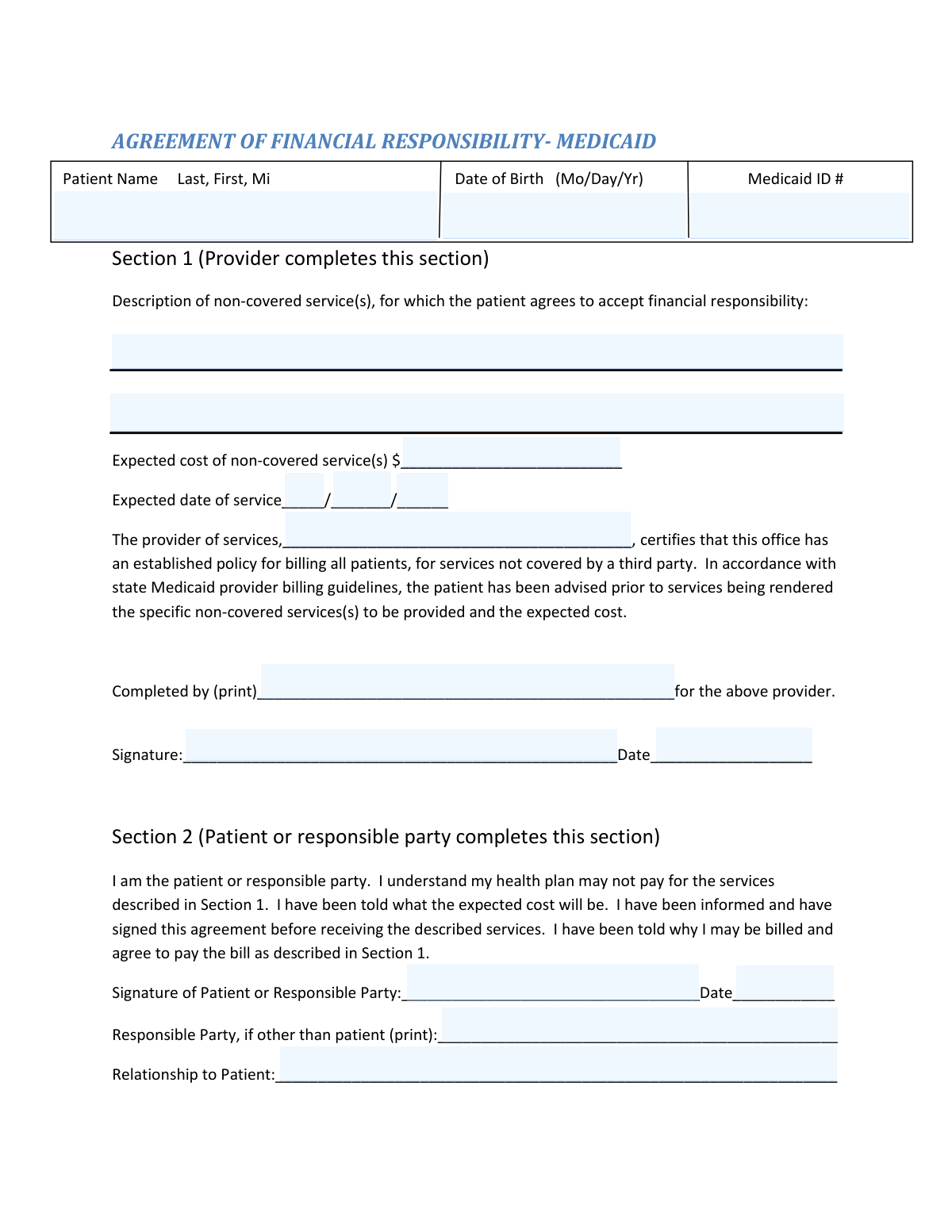
These forms are typically used by medical office managers, billing specialists, and patients during the intake or consultation process. They become particularly important in situations where insurance coverage may be limited or where specific services fall outside of standard benefit plans. For example, an Agreement of Financial Responsibility is often required when a patient elects to receive a service not covered by Medicaid, requiring a formal acknowledgment of personal payment responsibility. Properly executed agreements protect healthcare providers from financial loss and help patients avoid unexpected medical debt by outlining potential costs upfront.
Managing the administrative burden of these documents can be time-consuming for both staff and patients. Tools like Instafill.ai use AI to fill these forms in under 30 seconds, handling the data accurately and securely to streamline the entire documentation process. This technology allows healthcare professionals to focus more on patient care and less on manual data entry.
Every form on this page can be completed without typing. Instafill is form filling software that reads a PDF and fills it for you — including flat and scanned documents that carry no fillable fields at all.
Forms in This Category
The forms in this category have a median Form Complexity Index of 32/100 (Basic), measured across 1 forms by field count, input difficulty, length, conditional logic and structure. See how it is calculated.
| Form Name | Pages | FCI | |
|---|---|---|---|
| 1. | Agreement of Financial Responsibility - Medicaid | 1 | Basic 32 |
- Enterprise-grade security & data encryption
- 99%+ accuracy powered by AI
- 1,000+ forms from all industries
- Complete forms in under 60 seconds
How to Choose the Right Form
Navigating healthcare billing can be complex, especially when dealing with government-funded programs. Choosing the right agreement form ensures that both the healthcare provider and the patient are protected legally and financially. In this category, the focus is on clarifying payment obligations before services are rendered.
Understanding the Primary Medicaid Agreement
Currently, the central document in this category is the Agreement of Financial Responsibility - Medicaid. Unlike a standard patient intake form, this specific agreement is used only when a patient is covered by Medicaid but requires services that fall outside of their standard benefit package.
When to Use This Specific Form
You should select the Agreement of Financial Responsibility - Medicaid if any of the following scenarios apply to the upcoming medical service:
- Non-Covered Services: The treatment, diagnostic test, or medical supply is explicitly excluded from the patient’s state Medicaid coverage.
- Exceeded Benefit Limits: The patient has already utilized the maximum number of allowed visits or services for the current period (e.g., a limit on physical therapy sessions) but wishes to continue treatment.
- Elective Procedures: The patient chooses to undergo a procedure that Medicaid deems medically unnecessary or cosmetic.
- Lack of Prior Authorization: In cases where Medicaid has denied a prior authorization request, but the patient still wishes to proceed with the service at their own expense.
Why Accuracy is Critical
Because Medicaid regulations are strict, using a generic financial agreement is often insufficient. The Agreement of Financial Responsibility - Medicaid is designed to meet specific disclosure requirements, ensuring the patient is fully informed of the costs before the appointment.
Using Instafill.ai to complete this form helps providers maintain compliance by ensuring all fields are legible and accurate, reducing the risk of billing disputes or regulatory audits. Simply upload your document to our AI-powered platform to create a professional, interactive version for your patients to sign.
Form Comparison
| Form | Primary Purpose | Financial Responsibility | Prerequisite |
|---|---|---|---|
| Agreement of Financial Responsibility - Medicaid | Confirms patient will pay for medical services not covered by Medicaid benefits. | The patient assumes full personal liability for the cost of non-covered treatments. | Provider must disclose estimated costs and non-coverage status before treatment begins. |
Tips for healthcare agreement forms
Before agreeing to pay out-of-pocket, verify with your Medicaid caseworker or the insurance portal that the specific service is indeed excluded from your plan. Sometimes a simple prior authorization request can prevent the need for this form entirely.
Never sign a financial responsibility form with blank spaces where the estimated cost should be. Request that the provider include a specific dollar amount or a clear price range so you are fully aware of your potential liability.
Using AI-powered tools like Instafill.ai can help you complete these complex healthcare forms in under 30 seconds with high accuracy. Your sensitive medical and personal data remains secure during the process, making it an efficient way to handle repetitive paperwork.
Make sure the agreement clearly identifies which procedures or appointments are covered by the waiver. Avoid broad language that might inadvertently commit you to paying for future services that Medicaid might actually cover.
After signing, always save a digital copy of the completed agreement to compare against any later bills you receive. This documentation is essential if a provider accidentally bills you for a service that was supposed to be covered by insurance.
Small errors in your Medicaid ID number or legal name can lead to significant billing disputes. Take a moment to double-check that all identifying information matches your official insurance card exactly to ensure smooth processing.
Frequently Asked Questions
Healthcare agreement forms are legal documents that establish clear expectations and responsibilities between a patient and a medical provider. They are frequently used to outline financial obligations, especially when certain services may not be covered by the patient's insurance or Medicaid plan.
This form should be signed before medical services are rendered if there is a possibility that the patient's insurance will not pay for the treatment. It ensures the patient is fully informed of potential out-of-pocket costs and agrees to pay them directly to the provider.
The healthcare provider or the facility's administrative staff is responsible for presenting these forms to the patient. They must explain which services are being documented as non-covered before asking for a signature to ensure compliance with transparency regulations.
Yes, once signed, these forms serve as a contract between the patient and the provider. By signing, the patient acknowledges their understanding of the costs and accepts the legal obligation to pay for the specified services if insurance coverage is denied.
If a patient declines to sign the agreement, the healthcare provider may refuse to perform the specific services that are not covered by insurance. This is because the provider requires a guarantee of payment before dedicating resources to treatments that will not be reimbursed by a third-party payer.
These forms protect providers by documenting that the patient was notified of their financial liability in advance. This documentation is essential for billing and collection purposes if the patient later disputes the charges for services they received.
Yes, you can use AI tools like Instafill.ai to complete these forms quickly and accurately. The AI can extract relevant patient and provider data from source documents and automatically place it into the correct fields, reducing the risk of manual entry errors.
Using AI-powered automation, these forms can be filled out in under 30 seconds. This significantly speeds up the intake process for clinics and allows patients to review and sign their paperwork much faster than traditional manual methods.
While these forms are common for Medicaid patients, they are also used for private insurance and Medicare. Any time a service is deemed 'elective' or 'not medically necessary' by an insurer, a provider will likely request a signed financial responsibility agreement.
The form usually requires the patient's identification details, a specific description of the service being provided, the reason the service is not covered by Medicaid, and the estimated cost. Both the patient and a witness or provider representative must sign and date the document.
Glossary
- Form Complexity Index
- Instafill’s 0–100 measure of how much effort a form takes to complete, calculated deterministically from the form’s own structure rather than estimated. It combines the number of fillable fields (the largest factor), how difficult those fields are to complete based on their type, the number of pages that contain fields, the amount of conditional “fill-only-if” logic, and how many sections the form is divided into, then adds modifiers for tables and repeating lists, bundled instruction pages, and dense page layouts. A higher score means the form is harder to fill out by hand. The forms in this category have a median Form Complexity Index of 32/100 (Basic). See exactly how it is calculated.
- Medicaid
- A joint federal and state program that provides health coverage to eligible low-income adults, children, pregnant women, elderly adults, and people with disabilities.
- Non-Covered Services
- Medical treatments, supplies, or procedures that an insurance plan or government program specifically excludes from its payment responsibility.
- Financial Responsibility
- A legal obligation where a patient or their representative agrees to pay for medical costs that are not reimbursed by an insurance provider.
- Provider
- A licensed healthcare professional, hospital, or clinic that delivers medical services and bills for them.
- Beneficiary
- The individual who is officially enrolled in a health insurance plan and is eligible to receive its benefits.
- Prior Authorization
- A process where a healthcare provider must obtain approval from an insurer before performing a service to ensure it will be covered for payment.
- Guarantor
- The person identified as being legally responsible for paying the patient's medical bills, which may be the patient themselves or a legal guardian.
- Waiver
- A legal document signed by a patient acknowledging they understand a service may not be covered and voluntarily agreeing to pay for it anyway.