Fill out healthcare credentialing forms
with AI.
Healthcare credentialing is the critical process of verifying the qualifications and professional backgrounds of medical practitioners. These forms are essential for maintaining high standards of patient safety and ensuring that every doctor, nurse, or specialist has the necessary training, licensure, and experience to provide care. This category includes comprehensive documents such as the Healthcare Professional Credentialing Application, which serves as a standard requirement for practitioners seeking hospital privileges or affiliation with managed care networks.
By continuing, you acknowledge Instafill's Privacy Policy and agree to get occasional product update and promotional emails.
About healthcare credentialing forms
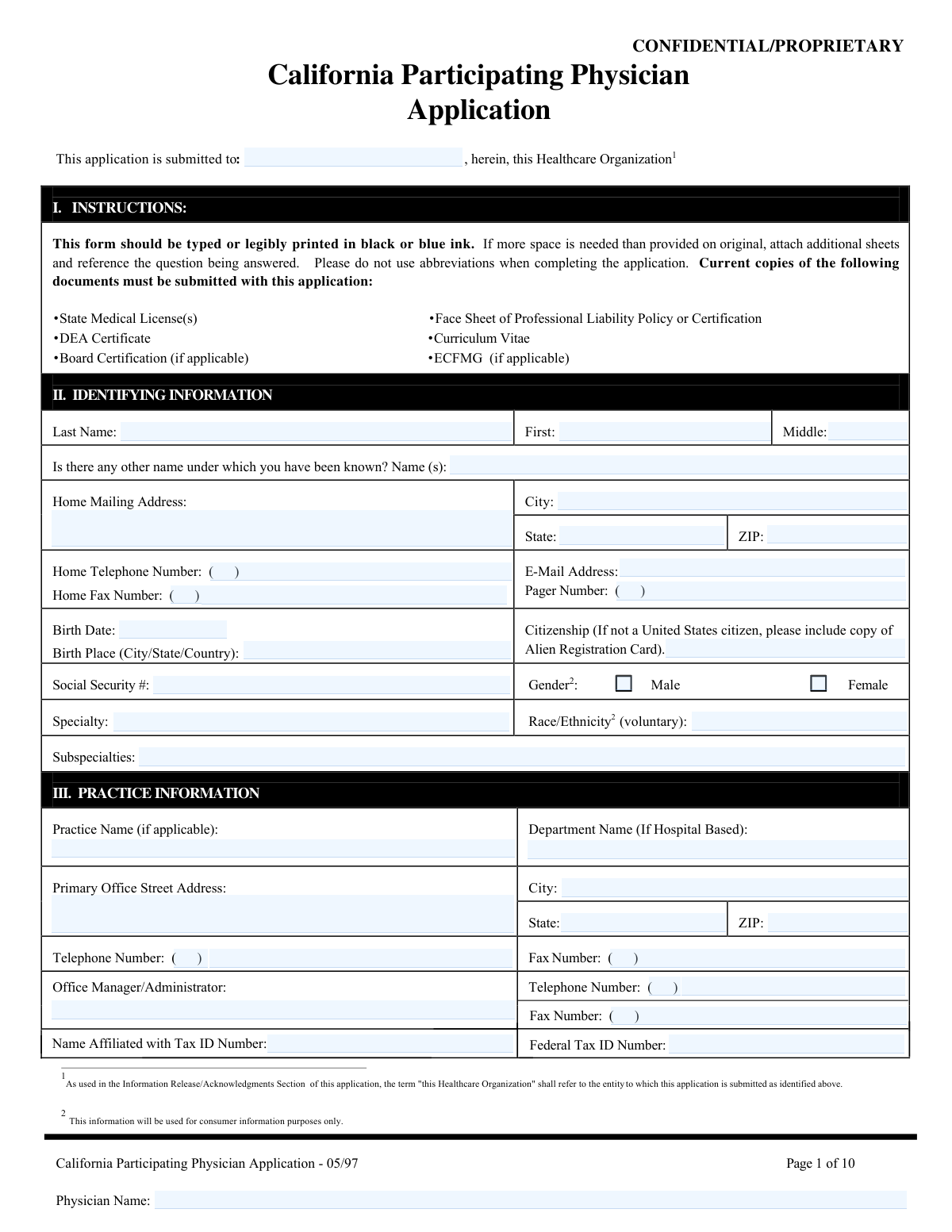
Clinicians typically encounter these forms when starting a new position, joining a medical group, or renewing their credentials with insurance providers. For instance, the California Participating Physician Application is a staple for those practicing in the state, requiring an exhaustive history of education, work experience, and malpractice records. Because the verification process is so rigorous, any errors or omissions can lead to significant delays in a professional's ability to practice or receive reimbursement.
Given the meticulous detail required for these applications, manual entry is often a source of frustration and administrative bottleneck. Tools like Instafill.ai use AI to fill these healthcare credentialing forms in under 30 seconds, handling complex data accurately and securely. This allows medical professionals to focus on patient care rather than spending hours on repetitive paperwork.
Every form on this page can be completed without typing. Instafill is form filling software that reads a PDF and fills it for you — including flat and scanned documents that carry no fillable fields at all.
Forms in This Category
The forms in this category have a median Form Complexity Index of 100/100 (Very Complex), measured across 2 forms by field count, input difficulty, length, conditional logic and structure. See how it is calculated.
| Form Name | Pages | FCI | |
|---|---|---|---|
| 1. | California Participating Physician Application | 10 | Very Complex 85 |
| 2. | Healthcare Professional Credentialing Application | 20 | Very Complex 100 |
- Enterprise-grade security & data encryption
- 99%+ accuracy powered by AI
- 1,000+ forms from all industries
- Complete forms in under 60 seconds
How to Choose the Right Form
Choosing the correct healthcare credentialing form is critical for ensuring your application is processed without delays. Credentialing is a meticulous process that verifies your education, training, and professional history to ensure patient safety. Use the following guide to determine which form fits your current professional needs.
If You Are Practicing in California
If you are a physician applying to join a medical group, hospital, or health plan specifically within the state of California, you should select the California Participating Physician Application. This document is the industry standard for the region and is designed to meet the specific regulatory and administrative requirements of California-based healthcare organizations. It is the most efficient choice for practitioners focused on the California healthcare market.
For General or Multi-Disciplinary Applications
If your practice is located outside of California, or if you are a healthcare professional other than a physician—such as a nurse, physician assistant, or specialized clinician—the Healthcare Professional Credentialing Application is likely the correct choice. This form is more versatile and is commonly used for:
- Hospital Privileges: Applying for the right to treat patients at specific facilities.
- Managed Care Networks: Enrolling in insurance panels and provider networks.
- General Verification: Providing a comprehensive record of education, training, and malpractice history across various medical disciplines.
Key Differences to Consider
- Geographic Scope: The California Participating Physician Application is highly specialized for one state’s ecosystem, whereas the Healthcare Professional Credentialing Application is used more broadly across the country.
- Professional Role: While both forms require detailed histories of malpractice claims and licensure, the Healthcare Professional Credentialing Application is structured to accommodate a wider variety of medical roles beyond just MDs.
Filling out these extensive forms manually can take hours and leads to potential errors. Using Instafill.ai allows you to automate the data entry for these complex documents, ensuring every section is completed accurately and professionally.
Form Comparison
| Form | Geographic Scope | Eligible Professionals | Primary Purpose |
|---|---|---|---|
| California Participating Physician Application | Specific to healthcare organizations and health plans within California. | Licensed physicians applying for participation in California medical groups. | Standardizes credentialing for California-based hospitals, medical groups, and plans. |
| Healthcare Professional Credentialing Application | General application used across various states and healthcare networks. | Broad range of professionals including physicians, nurses, and specialists. | Applying for hospital privileges and joining managed care provider networks. |
Tips for healthcare credentialing forms
Credentialing requires specific dates for medical school, residency, and previous employment. Having your CV, board certifications, and DEA registration handy will prevent you from having to stop and search for details mid-form.
Review boards scrutinize chronological history for any periods of inactivity. If you have a gap of more than 30 days, include a brief explanation to avoid having the form returned for clarification or further investigation.
AI-powered tools like Instafill.ai can complete these complex credentialing forms in under 30 seconds with high accuracy. This approach saves hours of manual entry while ensuring your sensitive professional data stays secure throughout the process.
Many credentialing forms contain multiple signature lines for different authorizations and releases. Missing even one signature can halt the entire verification process, so perform a final sweep specifically for signature and date fields before submission.
Ensure the peers you list as references are aware they may be contacted and that their contact information is up to date. Delays often occur when credentialing coordinators cannot reach the individuals listed on your application, stalling your privileges.
Store a digital copy of every submitted application and its supporting documents in a dedicated folder. Since credentialing must be updated periodically, having a historical record allows you to quickly cross-reference previous entries for consistency.
Frequently Asked Questions
Healthcare credentialing is the formal process of verifying a provider's qualifications, including their education, clinical training, licensure, and professional experience. It is a vital step for ensuring patient safety and meeting the regulatory standards required by hospitals, insurance networks, and government agencies.
These forms are mandatory for physicians, nurses, physician assistants, and other healthcare practitioners seeking hospital privileges or enrollment in managed care networks. Medical groups and health plans use these documents to vet new staff and maintain accurate provider directories.
Physicians applying to participate in California-based healthcare organizations, hospitals, or medical groups should use the California Participating Physician Application. For practitioners in other regions or those in non-physician roles, the general Healthcare Professional Credentialing Application is the standard document used to capture professional data.
You will generally need to provide a complete history of your medical education, residency, board certifications, and state licenses. Additionally, these forms require a comprehensive work history, professional references, and disclosures regarding any past malpractice claims or disciplinary actions.
While initial credentialing occurs during hiring or network enrollment, most organizations require re-credentialing every two to three years. This periodic review ensures that a provider's certifications remain current and that their professional standing has not changed since the last application.
Completed forms are typically submitted to a hospital's Medical Staff Office, a health plan's credentialing department, or a centralized credentialing verification organization (CVO). Always verify the specific submission instructions with the entity requesting the form, as they may require digital uploads or physical copies.
Yes, you can use AI tools like Instafill.ai to automate the process of filling out these complex documents. These tools accurately extract information from your source documents, such as a CV or license, and place the data into the correct fields on the PDF form.
While manually filling out these extensive applications can take several hours, AI-powered services like Instafill.ai can complete them in under 30 seconds. This technology ensures that data is mapped quickly and accurately from your professional records directly into the application.
Credentialing is the verification of a provider's background and qualifications, whereas privileging is the process of authorizing a practitioner to perform specific medical procedures within a facility. Credentialing is a necessary prerequisite that must be successfully completed before privileges can be granted.
Leaving sections blank or providing incomplete information can lead to significant delays in processing your application or even a summary rejection. If a specific question does not apply to your situation, it is best practice to enter 'N/A' to show that the field was reviewed and not simply overlooked.
Glossary
- Form Complexity Index
- Instafill’s 0–100 measure of how much effort a form takes to complete, calculated deterministically from the form’s own structure rather than estimated. It combines the number of fillable fields (the largest factor), how difficult those fields are to complete based on their type, the number of pages that contain fields, the amount of conditional “fill-only-if” logic, and how many sections the form is divided into, then adds modifiers for tables and repeating lists, bundled instruction pages, and dense page layouts. A higher score means the form is harder to fill out by hand. The forms in this category have a median Form Complexity Index of 100/100 (Very Complex). See exactly how it is calculated.
- Credentialing
- The formal process of verifying a healthcare provider's qualifications, including education, training, licensure, and work history, to ensure they meet standards for patient care.
- NPI (National Provider Identifier)
- A unique 10-digit identification number issued by the Centers for Medicare & Medicaid Services (CMS) that must be included on all standard healthcare transactions.
- CAQH (Council for Affordable Quality Healthcare)
- A non-profit alliance that maintains a centralized database where providers can store and share their credentialing information with multiple health plans simultaneously.
- Privileging
- The specific authorization granted by a healthcare facility allowing a provider to perform certain medical procedures or clinical tasks based on their expertise.
- DEA Registration
- A number assigned by the Drug Enforcement Administration that authorizes a healthcare professional to prescribe, dispense, and administer controlled substances.
- Professional Liability Insurance
- Often called malpractice insurance, this is a required policy that protects healthcare providers against claims of negligence or errors in patient care.
- Board Certification
- A voluntary designation indicating that a physician has passed rigorous exams and met the highest standards of a specific medical specialty board.
- Peer Reference
- A formal recommendation from a professional colleague who can personally attest to the applicant's clinical skills, ethics, and professional performance.