Fill out insurance provider forms
with AI.
Insurance provider forms serve as the essential bridge between healthcare organizations and the insurance networks that reimburse them. These documents are foundational for credentialing, contracting, and maintaining legal compliance with both federal mandates and private payer requirements. By completing these forms, providers establish the formal agreements necessary to participate in health programs, ensuring they can legally and operationally provide care to insured patient populations.
By continuing, you acknowledge Instafill's Privacy Policy and agree to get occasional product update and promotional emails.
About insurance provider forms
Healthcare administrators, practice managers, and facility owners typically manage these forms when joining a new network or updating their organizational status. For instance, providers seeking to participate in Medicare must complete the Health Insurance Benefit Agreement (CMS-1561), while those looking to join private networks might encounter facility applications like the RA-02. These documents require meticulous attention to detail, including licensing information, National Provider Identifier (NPI) numbers, and affirmations of compliance with civil rights and rehabilitation acts. Accuracy is vital, as errors in these filings can lead to significant delays in enrollment or reimbursement.
Navigating the complexities of healthcare administration can be demanding, but modern technology helps streamline the process. Tools like Instafill.ai use AI to fill these insurance provider forms in under 30 seconds, handling sensitive data accurately and securely. This approach reduces the manual effort involved in repetitive paperwork, allowing administrative teams to focus on the essential aspects of practice management.
Every form on this page can be completed without typing. Instafill is form filling software that reads a PDF and fills it for you — including flat and scanned documents that carry no fillable fields at all.
Forms in This Category
The forms in this category have a median Form Complexity Index of 59/100 (Moderate), measured across 2 forms by field count, input difficulty, length, conditional logic and structure. See how it is calculated.
| Form Name | Pages | FCI | |
|---|---|---|---|
| 1. | Form CMS-1561, Health Insurance Benefit Agreement | 2 | Basic 36 |
| 2. | Provider Group/Facility Application (RA-02) | 1 | Moderate 59 |
- Enterprise-grade security & data encryption
- 99%+ accuracy powered by AI
- 1,000+ forms from all industries
- Complete forms in under 60 seconds
How to Choose the Right Form
Navigating insurance provider forms often depends on whether you are seeking to participate in federal government programs or join a specific private insurance network. Choosing the correct document is the first step toward ensuring timely reimbursements and network compliance.
Federal Medicare Agreements
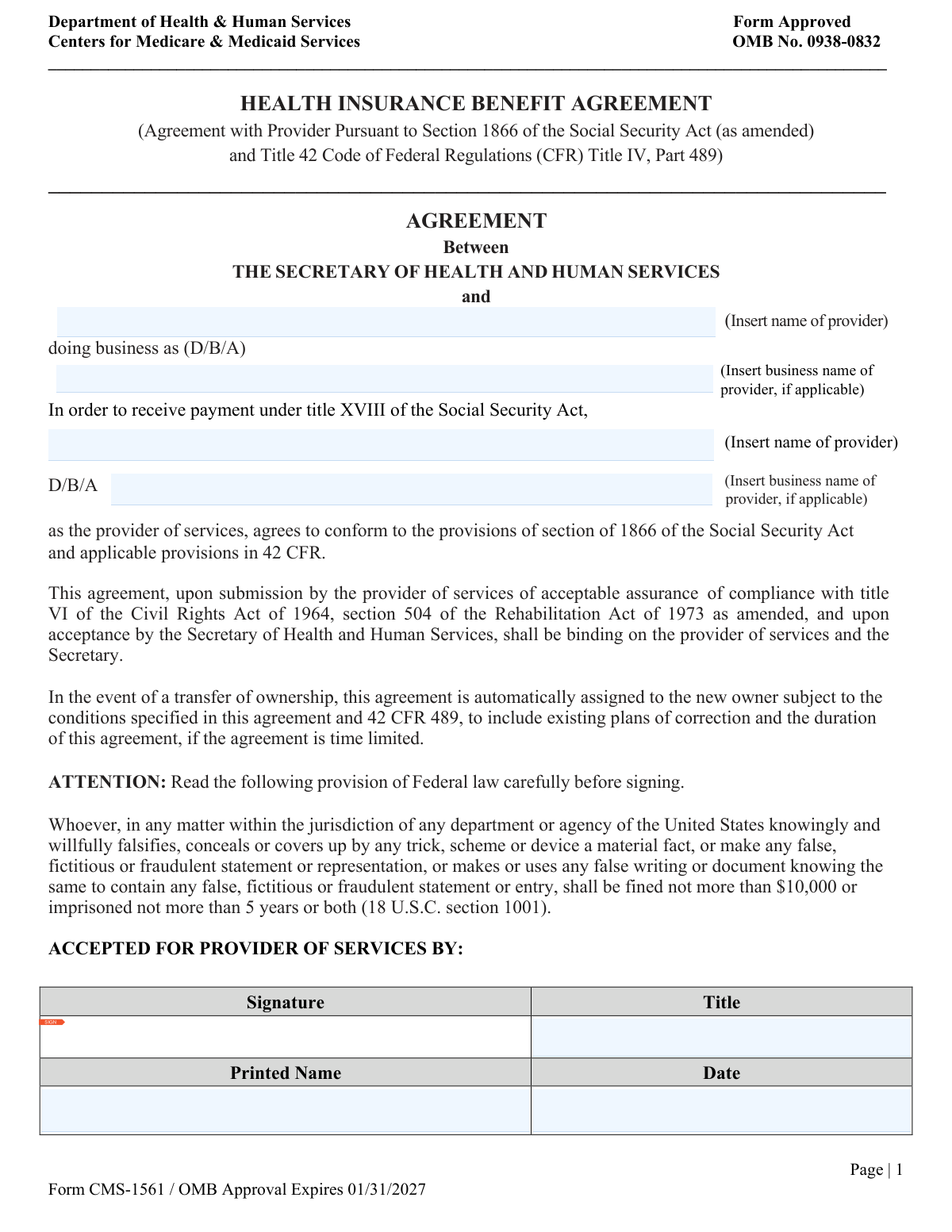
If your facility needs to establish eligibility for reimbursement through federal programs, you likely need Form CMS-1561, Health Insurance Benefit Agreement. This form is a critical requirement for healthcare entities that must interface with the Centers for Medicare & Medicaid Services (CMS). Use this form for:
- Medicare Authorization: Establishing a legally binding agreement with the Secretary of Health and Human Services to receive payments under Title XVIII of the Social Security Act.
- Regulatory Compliance: Formally agreeing to abide by civil rights laws, including the Rehabilitation Act and the Civil Rights Act of 1964.
- Ownership Transfers: Documenting the automatic assignment of provider contracts when a healthcare facility changes ownership.
Private Network Enrollment (California)
If you are a medical group or facility looking to expand your patient base through private commercial insurance, you will need provider-specific enrollment applications.
- Blue Shield of California: Select the Provider Group/Facility Application (RA-02) if you are applying to become a part of the Blue Shield network specifically.
- Roster Management: This form is the correct choice if you need to submit a comprehensive roster of your organization’s professional practitioners, including their specific NPI numbers, licensing details, and current patient acceptance policies.
Quick Selection Tips
- Check the Payer: If the payer is the federal government (Medicare), prioritize Form CMS-1561. If the payer is a private entity like Blue Shield, use Form RA-02.
- Identify the Scope: Use the CMS form for broad legal agreements regarding federal benefit participation. Use the RA-02 for detailed facility and practitioner credentialing within a specific commercial network.
Form Comparison
| Form | Primary Network | Purpose | Key Requirements |
|---|---|---|---|
| Form CMS-1561, Health Insurance Benefit Agreement (Agreement with Provider Pursuant to Section 1866 of the Social Security Act) | Medicare (Centers for Medicare & Medicaid Services) | Legal agreement required to receive reimbursement payments under the Medicare program. | Commitment to Section 1866 compliance and federal civil rights laws. |
| Provider Group/Facility Application (RA-02) | Blue Shield of California network | Application for medical groups or facilities to join a specific insurance network. | Organization details and a comprehensive roster of all professional practitioners. |
Tips for insurance provider forms
Double-check that National Provider Identifier (NPI) and Tax Identification Numbers (TIN) are entered correctly on every section of the form. These identifiers are the primary keys used by CMS and private insurers to verify your facility, and even a single digit error can cause a total rejection of your application.
When submitting group applications like the RA-02, ensure your practitioner list matches your internal HR records and state licensing boards exactly. Inconsistencies in medical license numbers or specialization codes can lead to delays in network credentialing for your entire organization.
Forms like the CMS-1561 are legally binding agreements that require your facility to adhere to federal regulations and civil rights laws. Before signing, ensure your administrative team understands the specific commitments regarding Title VI and Section 504 to maintain your eligibility for Medicare payments.
AI-powered tools like Instafill.ai can complete these complex provider forms in under 30 seconds with high accuracy. Your sensitive data stays secure during the process, providing a practical and fast way to handle high volumes of paperwork without manual data entry errors.
Insurance provider forms often require supplementary documents such as state licenses, board certifications, and proof of professional liability insurance. Organizing these digital files in advance allows you to cross-reference data points quickly and avoid having to stop mid-form to find missing information.
Ensure that the person signing the agreement has the legal authority to bind the organization to the contract. Pay close attention to required date formats, as some forms may require specific MM/DD/YYYY layouts that, if ignored, can trigger automated system errors during processing.
Frequently Asked Questions
Insurance provider forms are used by healthcare facilities and practitioners to establish formal agreements with insurance carriers or government programs like Medicare. These documents ensure that the provider is authorized to receive payments and agrees to follow specific regulatory and compliance standards.
These forms are generally required for medical groups, hospitals, clinics, and individual healthcare professionals. They are necessary when a provider wants to join an insurance network, participate in federal health programs, or update their existing facility information.
Form CMS-1561 must be completed when a provider intends to participate in the Medicare program under the Social Security Act. It is also a critical document during a transfer of ownership, as the existing agreement is typically assigned to the new owner of the facility.
Most provider group applications, such as the RA-02, require detailed organizational information including Tax IDs, National Provider Identifier (NPI) numbers, and licensing details. You will also likely need a comprehensive roster of all practitioners within the group, including their specialties and patient acceptance status.
Yes, insurance provider forms can be filled out efficiently using AI tools like Instafill.ai. These systems can accurately extract data from your credentials or source documents and populate the necessary fields in under 30 seconds.
Submission locations depend on the form's origin; federal forms like those for Medicare are often sent to the Centers for Medicare & Medicaid Services (CMS) or a designated contractor. Private insurance forms, such as those for Blue Shield, are typically submitted directly to the insurer's provider enrollment or relations department.
In many cases, such as with Medicare agreements, the contract is automatically assigned to the new owner to ensure service continuity. However, the new owner must still sign and submit updated documentation to certify they will comply with the existing terms and federal regulations.
Many insurance forms are provided as static PDFs that cannot be typed into directly. AI-powered services can convert these non-fillable versions into interactive forms, allowing you to complete them digitally without the need for manual printing and handwriting.
Errors in licensing numbers, tax information, or NPI data can lead to the immediate rejection of an application or long-term delays in claim reimbursements. Using AI to fill these forms helps minimize human error by pulling data directly from verified source files.
Yes, many provider agreements, particularly federal ones like CMS-1561, require the signer to agree to comply with civil rights laws. This includes Title VI of the Civil Rights Act of 1964 and Section 504 of the Rehabilitation Act of 1973, which prohibit discrimination in healthcare services.
Using modern AI tools, you can complete complex insurance provider forms in under 30 seconds. The technology automates the data entry process by identifying required fields and matching them with information from your uploaded business or professional documents.
Glossary
- Form Complexity Index
- Instafill’s 0–100 measure of how much effort a form takes to complete, calculated deterministically from the form’s own structure rather than estimated. It combines the number of fillable fields (the largest factor), how difficult those fields are to complete based on their type, the number of pages that contain fields, the amount of conditional “fill-only-if” logic, and how many sections the form is divided into, then adds modifiers for tables and repeating lists, bundled instruction pages, and dense page layouts. A higher score means the form is harder to fill out by hand. The forms in this category have a median Form Complexity Index of 59/100 (Moderate). See exactly how it is calculated.
- NPI (National Provider Identifier)
- A unique 10-digit identification number issued to healthcare providers in the United States, required for all administrative and financial transactions under HIPAA.
- CMS (Centers for Medicare & Medicaid Services)
- The federal agency that administers the Medicare program and works with state governments to manage Medicaid and the Health Insurance Marketplace.
- Credentialing
- The process used by insurance networks to verify a provider's qualifications, including their education, license, and clinical experience, before allowing them to treat members.
- Provider Network
- A group of healthcare professionals and facilities that have agreed to provide services to an insurance company's members, often at discounted or negotiated rates.
- Practitioner Roster
- A detailed list of all licensed medical professionals working within a group or facility, including their specialties and individual identification numbers.
- Section 1866 Agreement
- A legal contract under the Social Security Act that allows a healthcare provider to receive payments for services rendered to Medicare beneficiaries.
- Assignment of Agreement
- The process of transferring an existing insurance or Medicare contract from one owner to another, usually occurring when a medical facility is sold or changes ownership.
- 42 CFR Part 489
- Federal regulations that define the specific rules healthcare providers must follow to maintain their eligibility and participation in the Medicare program.