Fill out investment advisor forms
with AI.
Investment advisor forms are essential tools for professional wealth management, retirement planning, and charitable giving. These documents facilitate the legal and operational setup of investment accounts, ensuring that both the financial advisor and the client remain in compliance with regulatory standards and institutional requirements. By formalizing the relationship between investors and their advisors, these forms provide a clear framework for asset management, beneficiary designations, and investment allocations.
By continuing, you acknowledge Instafill's Privacy Policy and agree to get occasional product update and promotional emails.
About investment advisor forms
Typically, these forms are used by financial professionals, plan trustees, and individual donors during key transitions, such as establishing a new retirement plan or integrating professional management into a charitable account. For example, a trustee might use a Retirement Plan Master Application to set up a new plan for an organization, while a donor might complete an Investment Advisor Program Application to grant their advisor control over specific contributions. Given the complexity of the financial data involved, accuracy is critical to ensure that assets are managed according to the client's intent and that all legal disclosures are properly documented.
Completing these documents manually can be a tedious process, but tools like Instafill.ai use AI to fill these forms in under 30 seconds, handling data accurately and securely. This automated approach reduces the administrative burden on advisors and clients, allowing them to focus on long-term financial strategies rather than manual data entry.
Every form on this page can be completed without typing. Instafill is form filling software that reads a PDF and fills it for you — including flat and scanned documents that carry no fillable fields at all.
Forms in This Category
The forms in this category have a median Form Complexity Index of 64/100 (Complex), measured across 3 forms by field count, input difficulty, length, conditional logic and structure. See how it is calculated.
| Form Name | Pages | FCI | |
|---|---|---|---|
| 1. | Fidelity Advisor Investment-Only Retirement Plan Master Application | 1 | Complex 65 |
| 2. | Fidelity Charitable Investment Advisor Program Application | 1 | Complex 64 |
| 3. | HTK Investment Advisory Agreement for Selection of Third Party Investment Advisory Services | 4 | Basic 44 |
- Enterprise-grade security & data encryption
- 99%+ accuracy powered by AI
- 1,000+ forms from all industries
- Complete forms in under 60 seconds
How to Choose the Right Form
Selecting the correct investment advisor form is essential for ensuring that assets are managed according to the proper legal and tax frameworks. In this category, the forms are split between corporate retirement planning and individual philanthropic management.
Retirement Plan Administration
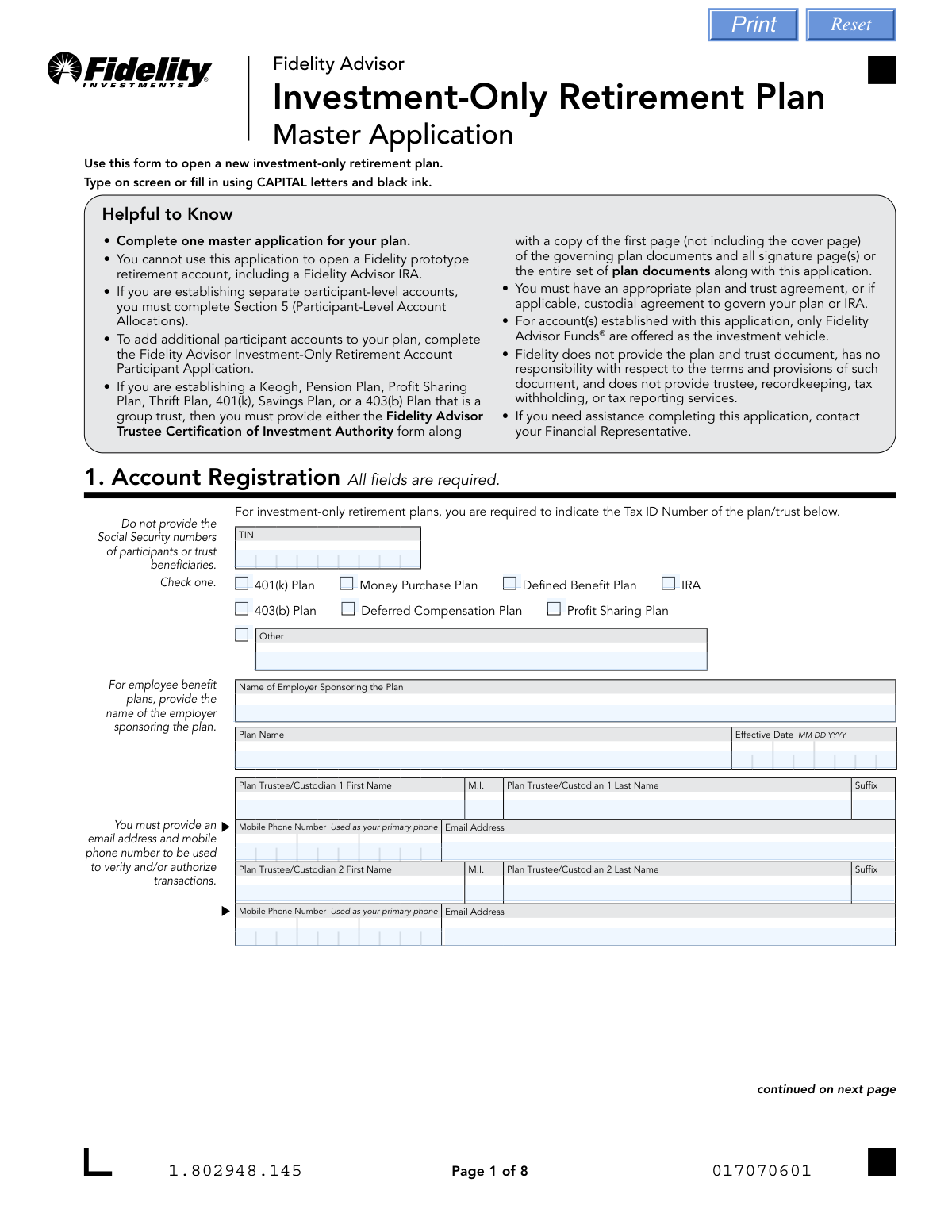
For employers, plan sponsors, or trustees, the primary document is the Fidelity Advisor Investment-Only Retirement Plan Master Application. This is the "master" document required to kickstart a retirement plan structure. You should select this form if your goal is to:
- Establish a New Plan: Use this to set up a brand-new investment-only retirement plan with Fidelity Advisor Funds.
- Define Account Structure: Choose this if you need to specify whether the plan will operate via a single plan-level (omnibus) account or through separate participant-level accounts.
- Assign Roles: Use this to formalize the roles of trustees, financial representatives, and specify investment allocations.
Philanthropic Asset Management
If your focus is on individual philanthropy rather than corporate retirement benefits, you will likely need the Fidelity Charitable Investment Advisor Program Application. This is a specialized form designed for the Fidelity Charitable Investment Advisor Program (CIAP). Choose this form if:
- Managing a Giving Account®: You are a donor who already has an established Giving Account and wants to integrate professional management.
- Advisor Nomination: You wish to grant your personal financial advisor the authority to manage the assets held within your charitable account.
- Asset Contribution: You need to provide specific details regarding the account holder, the nominated advisor, and the nature of the contribution being made.
Quick Selection Tip
- Choose the Master Application if you are representing a company or a trust setting up a retirement vehicle.
- Choose the Charitable Application if you are an individual donor looking to give your financial advisor control over your charitable investments.
Once you have selected the correct document, you can use Instafill.ai to quickly complete the PDF, ensuring all financial and trustee details are entered accurately before submission.
Form Comparison
| Form | Primary Purpose | Target User | Asset Type |
|---|---|---|---|
| Fidelity Advisor Investment-Only Retirement Plan Master Application | Establish a new investment-only retirement plan for employer-sponsored benefits. | Employers or plan trustees responsible for retirement plan administration. | Retirement plan assets and employer-sponsored investment allocations. |
| Fidelity Charitable Investment Advisor Program Application | Enroll in a program for professional management of charitable assets. | Individual donors with an existing Fidelity Charitable Giving Account. | Charitable contributions and donor-advised fund investment assets. |
Tips for investment advisor forms
Ensure the name of the retirement plan or charitable account matches your official legal documentation exactly. Discrepancies in Tax Identification Numbers (TIN) or Employer Identification Numbers (EIN) are common reasons for application rejection or processing delays.
Before submitting, double-check that the nominated investment advisor's CRD number and firm details are current. Providing accurate professional information ensures that the advisor can be properly linked to the account for management purposes without administrative friction.
Carefully detail how assets should be distributed across selected funds to avoid costly administrative errors. For charitable applications, confirm that the initial contribution amount matches the source of funds to prevent reconciliation issues during the onboarding phase.
These forms often require signatures from multiple parties, including plan trustees, donors, and financial representatives. Missing a single signature can halt the entire process, so review the authorized signers section thoroughly before final submission.
AI-powered tools like Instafill.ai can complete these complex investment advisor forms in under 30 seconds with high accuracy. Your sensitive financial data stays secure during the process, making it a reliable way to handle high-stakes paperwork efficiently.
When setting up retirement plans, decide early whether you need a single plan-level omnibus account or individual participant-level accounts. Making this distinction clearly on the form prevents the need for complex account re-registration or structural changes later on.
Ensure the information provided on the application aligns with your existing investment policy statements or trust agreements. Consistent data across all supporting documents reduces the risk of compliance flags during the financial institution's review period.
Frequently Asked Questions
Investment advisor forms are used to establish and manage professional relationships between financial advisors, clients, and investment platforms. They facilitate the setup of retirement plans, charitable accounts, and other managed investment vehicles where an advisor oversees the assets on behalf of a client or organization.
Generally, the account holder, plan trustee, or donor initiates the application, but the investment advisor often provides the technical details regarding fund selection and management. Both parties must typically sign the documents to verify the agreement and the proposed investment strategy.
You should use this form if you are an employer or trustee looking to establish a new retirement plan that utilizes specific fund families for investment without full recordkeeping services. It is designed for those who want an omnibus or participant-level account structure for their organization's retirement assets.
This form allows donors with an existing charitable giving account to nominate their personal financial advisor to manage the assets within that account. It bridges the gap between charitable giving and professional investment management, ensuring the donated assets are invested according to the donor's preferences.
Yes, AI tools like Instafill.ai can process investment advisor forms in under 30 seconds by accurately extracting data from your source documents and placing it directly into the required fields. This technology also helps convert static PDF applications into interactive, easy-to-complete digital forms.
Most forms require the legal names and tax identification numbers of the account holders or entities, detailed contact information for the financial advisor, and specific investment allocation instructions. For retirement plans, you may also need to provide details about plan trustees and authorized signers.
Completed forms are typically submitted directly to the investment firm or financial institution managing the funds. Many institutions now accept digital uploads through their secure advisor portals or via encrypted email, though some may still require physical copies for certain plan types.
While manually filling out complex investment forms can take 20 to 30 minutes, using an AI-powered service like Instafill.ai can reduce this time to less than 30 seconds. The AI ensures that data like account numbers and legal names are transferred accurately from your records without manual typing.
Yes, typically the donor must have a minimum balance in their giving account, and the nominated advisor must meet certain professional qualifications and regulatory registrations. The application form captures this information to ensure compliance with the program’s standards.
Yes, most investment advisor applications require authorized signatures from both the client (or trustee) and the investment advisor. Depending on the institution's policies, these signatures can often be provided electronically or through a scanned copy of a wet-ink signature.
Glossary
- Form Complexity Index
- Instafill’s 0–100 measure of how much effort a form takes to complete, calculated deterministically from the form’s own structure rather than estimated. It combines the number of fillable fields (the largest factor), how difficult those fields are to complete based on their type, the number of pages that contain fields, the amount of conditional “fill-only-if” logic, and how many sections the form is divided into, then adds modifiers for tables and repeating lists, bundled instruction pages, and dense page layouts. A higher score means the form is harder to fill out by hand. The forms in this category have a median Form Complexity Index of 64/100 (Complex). See exactly how it is calculated.
- Omnibus Account
- A single, master account that holds the pooled assets of multiple individual participants, simplifying record-keeping for the plan sponsor or financial institution.
- Plan Trustee
- An individual or organization legally responsible for managing a retirement plan's assets and ensuring they are used solely for the benefit of the participants.
- Giving Account®
- A donor-advised fund used to manage charitable contributions, allowing donors to receive tax deductions upfront and recommend grants to charities over time.
- Investment-Only (IO) Plan
- A retirement plan setup where the financial institution provides the investment vehicles, but the employer or a third party handles the administrative and record-keeping tasks.
- Fiduciary
- A professional or entity obligated by law to act solely in the client's best interest, often required for those managing retirement or charitable assets.
- CIAP
- The Charitable Investment Advisor Program, which allows a donor’s personal financial advisor to manage the investments within their charitable giving account.
- Participant-level Account
- An individual account created for a specific person within a retirement plan to track their specific contributions, earnings, and balances separately from other participants.
- Financial Representative
- A professional authorized to provide investment advice and execute trades on behalf of a client or a retirement plan.