Fill out investment company forms
with AI.
Investment company forms are essential for maintaining the regulatory and operational framework of the financial sector. This category encompasses a wide range of documents required for compliance with the Investment Company Act of 1940, as well as administrative filings for both individual and institutional investors. These forms facilitate critical actions such as applying for convertible preferred stock, requesting SEC exemptions for affiliated transactions, or authorizing tax-free 1035 exchanges. Properly managing these documents ensures that investment activities remain transparent, legally compliant, and aligned with fiduciary responsibilities.
By continuing, you acknowledge Instafill's Privacy Policy and agree to get occasional product update and promotional emails.
About investment company forms
These forms are typically used by fund managers, legal counsel, and individual investors who need to navigate complex financial transitions or regulatory requirements. For instance, an investor might use these documents to transfer annuity balances between companies, while a firm might submit an application to the SEC to ensure an asset transfer between affiliates meets fairness standards. Because these filings involve sensitive financial data and strict legal deadlines, accuracy is paramount to avoid administrative delays or regulatory scrutiny.
Navigating these dense documents can be time-consuming, but tools like Instafill.ai use AI to fill these forms in under 30 seconds while ensuring data is handled accurately and securely. This technology simplifies the process of completing detailed applications and authorizations, allowing professionals and individuals to focus on their investment strategies rather than manual paperwork.
Every form on this page can be completed without typing. Instafill is form filling software that reads a PDF and fills it for you — including flat and scanned documents that carry no fillable fields at all.
Forms in This Category
The forms in this category have a median Form Complexity Index of 52/100 (Moderate), measured across 3 forms by field count, input difficulty, length, conditional logic and structure. See how it is calculated.
- Enterprise-grade security & data encryption
- 99%+ accuracy powered by AI
- 1,000+ forms from all industries
- Complete forms in under 60 seconds
How to Choose the Right Form
Selecting the correct investment company form depends on whether you are an individual investor looking to purchase stock, a policyholder managing a retirement account, or a corporate entity seeking regulatory approval.
For New Stock Subscriptions
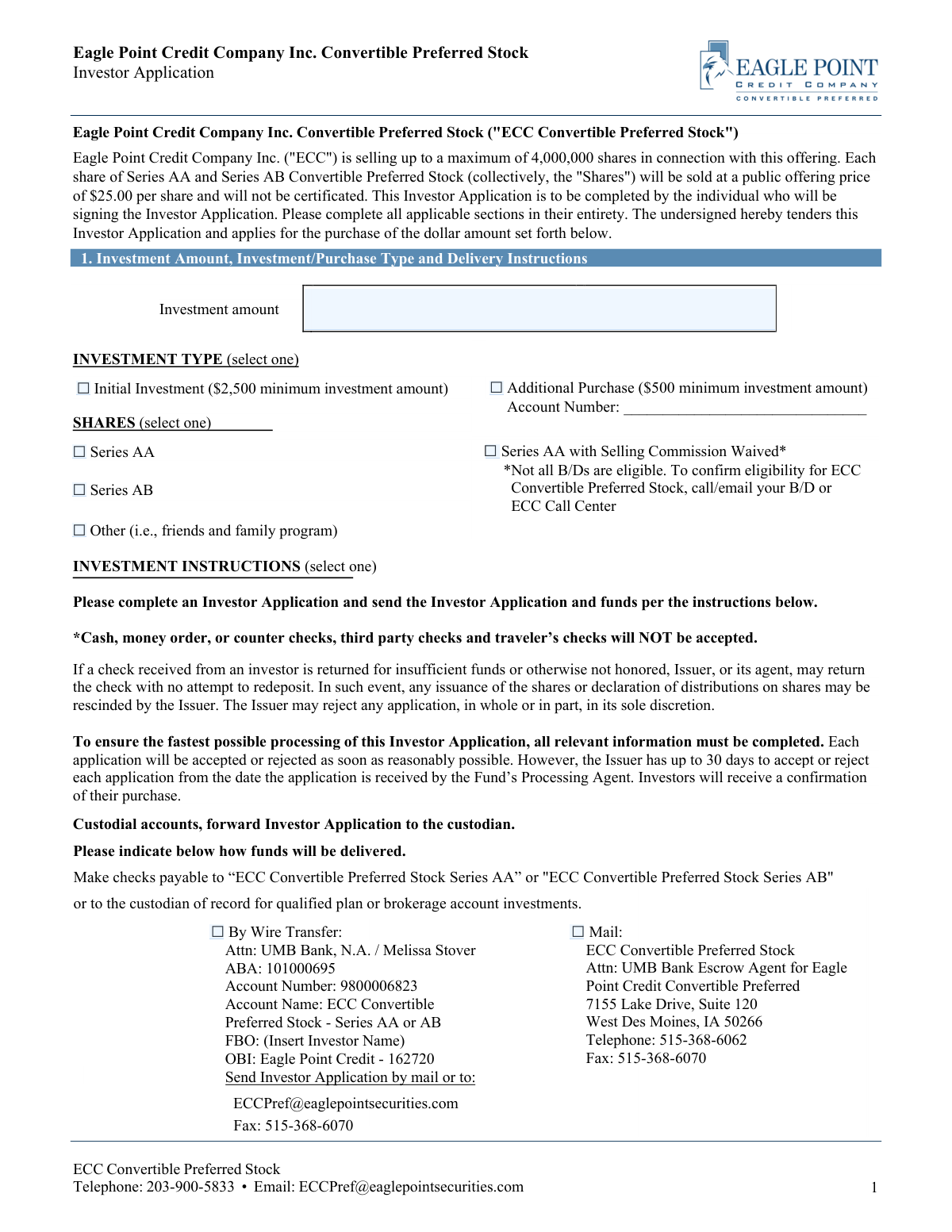
If you are an individual or institutional investor looking to acquire equity in a specific credit company, use the Eagle Point Credit Company Inc. Convertible Preferred Stock Investor Application. This document is essential for the subscription process and is used to provide ownership details, investment amounts, and payment instructions. It is the primary gateway for setting up a new account and ensuring compliance with the company’s investor requirements.
For Retirement Account Transfers
If you are managing an existing annuity and wish to move funds without triggering a tax event, look for the TIAA 1035 Exchange Authorization to Alternate Investment Company Transfer Payout Annuity for ATRA. This form (F10926) is specifically designed for:
- Authorizing a tax-free 1035 Exchange.
- Moving TIAA Traditional account balances to a different investment company.
- Structuring the transfer as a payout over a 9-year period for After-Tax Retirement Annuities (ATRA).
For Regulatory and Legal Compliance
Institutional users and legal teams dealing with federal oversight should use the SEC Application for an Order under Section 17(b) of the Investment Company Act of 1940 (File No. 812-11000). This is not an investor application but a formal request for a legal exemption. You need this form if your company is seeking to execute transactions between affiliated entities—such as asset transfers—that would otherwise be prohibited by the SEC. It requires a detailed demonstration that the proposed terms are fair, reasonable, and in the best interest of the investment company's shareholders.
Form Comparison
| Form | Primary Purpose | Who Files It | Key Benefit |
|---|---|---|---|
| Eagle Point Credit Company Inc. Convertible Preferred Stock Investor Application | Applying to purchase convertible preferred stock from Eagle Point Credit Company. | Individual or institutional investors. | Ensures compliant account setup and accurate subscription processing for investors. |
| SEC Application for an Order under Section 17(b) of the Investment Company Act of 1940 (File No. 812-11000) | Seeking SEC exemption for transactions between affiliated entities. | Investment companies or their affiliated persons. | Obtains legal approval for asset transfers while ensuring fairness to investors. |
| TIAA 1035 Exchange Authorization to Alternate Investment Company Transfer Payout Annuity for ATRA | Authorizing the transfer of annuity balances to an alternate company. | TIAA annuity contract holders. | Facilitates tax-free transfers of funds via structured payments over nine years. |
Tips for investment company forms
Ensure that the name of the investing entity or individual matches exactly with official government identification or articles of incorporation. Discrepancies in Taxpayer Identification Numbers (TINs) can lead to immediate rejection by investment firms or regulatory bodies like the SEC.
Before filling out applications for preferred stock or annuities, confirm whether the account is held individually, jointly, or through a trust. Selecting the incorrect ownership type can complicate future tax reporting and asset distribution, often requiring a total re-submission of the form.
Completing complex investment documents manually is prone to error and time-consuming. AI-powered tools like Instafill.ai can complete these forms in under 30 seconds with high accuracy, and your data stays secure during the process, making it a reliable choice for high-stakes filings.
When authorizing a 1035 exchange, verify the receiving institution's specific transfer instructions to maintain the tax-free status of the transaction. Incorrectly routed funds might be treated as a taxable distribution, leading to unnecessary financial penalties and complex IRS reporting.
For applications involving Section 17(b) exemptions, clearly articulate why the proposed transaction terms are reasonable and fair to all parties involved. Including specific data points or valuation methods helps the SEC review your application more efficiently and reduces the likelihood of follow-up inquiries.
Many investment company forms require supplemental documents like trust agreements, corporate resolutions, or power of attorney papers. Keep digital copies of these ready to upload alongside your primary application to prevent processing delays and ensure a complete submission package.
Investment applications often require precise banking information for distributions or initial purchases. Always cross-reference routing and account numbers with a voided check or official bank letter to avoid the risk of funds being delayed or sent to the wrong account.
Frequently Asked Questions
Investment company forms are legal and administrative documents used to manage transactions, regulatory compliance, and investor relations. They cover a wide range of activities, including applying for stock purchases, requesting regulatory exemptions from the SEC, or transferring funds between financial institutions.
The responsibility depends on the specific form; individual investors typically complete application or transfer forms, while corporate officers or legal counsel handle SEC applications. These forms ensure that all parties involved in an investment transaction are properly identified and that the movement of capital adheres to federal regulations.
Companies file these applications with the SEC to seek exemptions from rules that prohibit certain transactions between affiliated persons or entities. This is necessary to ensure that asset transfers or shared transactions are fair, reasonable, and do not involve overreaching, protecting the interests of the shareholders.
To authorize a 1035 exchange, the account holder must provide specific transfer instructions and authorization to move funds between carriers. This process allows for the tax-free exchange of an existing annuity contract for a new one, provided the IRS requirements for such transfers are met.
Yes, most investment company forms are legally binding documents that establish the terms of an investment or a regulatory request. It is essential to ensure all data is accurate before submission, as errors can lead to transaction delays, tax complications, or regulatory scrutiny.
You should select a form based on the specific action you intend to take, such as purchasing stock, requesting an SEC exemption, or transferring an annuity. If you are unsure, consulting with a financial advisor or reviewing the specific instructions provided by the investment company or regulatory body is recommended.
Yes, AI tools like Instafill.ai can be used to fill out these forms in under 30 seconds by accurately extracting and placing data from your source documents. This technology helps reduce manual entry errors and ensures that complex fields are completed consistently across multiple forms.
While manual completion can take significant time due to the technical nature of investment data, using AI-powered services can finalize a document in less than a minute. These platforms can also convert static PDF versions into interactive, fillable forms to streamline the entire submission process.
Most investor applications require personal identification details, the desired investment amount, and the type of ownership for the account. Additionally, you may need to provide payment instructions or banking details to facilitate the purchase of shares or stock.
Submission locations vary by form; application and transfer forms are usually sent directly to the investment company's administrative office or transfer agent. Regulatory applications, such as those for SEC orders, must be filed through the SEC’s electronic filing systems or specific legal channels.
Glossary
- Form Complexity Index
- Instafill’s 0–100 measure of how much effort a form takes to complete, calculated deterministically from the form’s own structure rather than estimated. It combines the number of fillable fields (the largest factor), how difficult those fields are to complete based on their type, the number of pages that contain fields, the amount of conditional “fill-only-if” logic, and how many sections the form is divided into, then adds modifiers for tables and repeating lists, bundled instruction pages, and dense page layouts. A higher score means the form is harder to fill out by hand. The forms in this category have a median Form Complexity Index of 52/100 (Moderate). See exactly how it is calculated.
- SEC (Securities and Exchange Commission)
- The primary U.S. federal agency responsible for regulating the securities industry, protecting investors, and overseeing investment companies and stock markets.
- 1035 Exchange
- A provision in the tax code that allows for a tax-free transfer of funds from an existing annuity or life insurance policy to a new one.
- Investment Company Act of 1940
- The primary federal law that regulates the organization and activities of investment companies, including mutual funds and closed-end funds, to ensure transparency and fairness.
- Convertible Preferred Stock
- A type of investment security that pays fixed dividends and gives the holder the option to convert the shares into a specific number of common stock shares.
- Affiliated Entity
- A person or company that is connected to another through common ownership, control, or partnership, often requiring specific legal disclosures in investment transactions.
- Section 17(b) Exemption
- A legal request to the SEC to permit a transaction between an investment company and an affiliate that would otherwise be prohibited under federal law.
- Payout Annuity
- A contract with an insurance or investment company that converts a lump sum of money into a series of regular payments over a set period or for life.
- ATRA (After-Tax Retirement Annuity)
- A retirement savings vehicle funded with income that has already been taxed, allowing the investment to grow tax-deferred until the funds are withdrawn.