Fill out liquidity fund forms
with AI.
Liquidity fund forms are essential documents for investors looking to allocate capital into short-term, highly liquid investment vehicles. These funds, which include retail and qualified investor hedge funds, are designed for those who require the flexibility of monthly liquidity while seeking competitive returns. The forms serve as the primary gateway for establishing a relationship with fund managers, ensuring that all necessary financial and personal data is recorded to facilitate seamless transactions and fund management.
By continuing, you acknowledge Instafill's Privacy Policy and agree to get occasional product update and promotional emails.
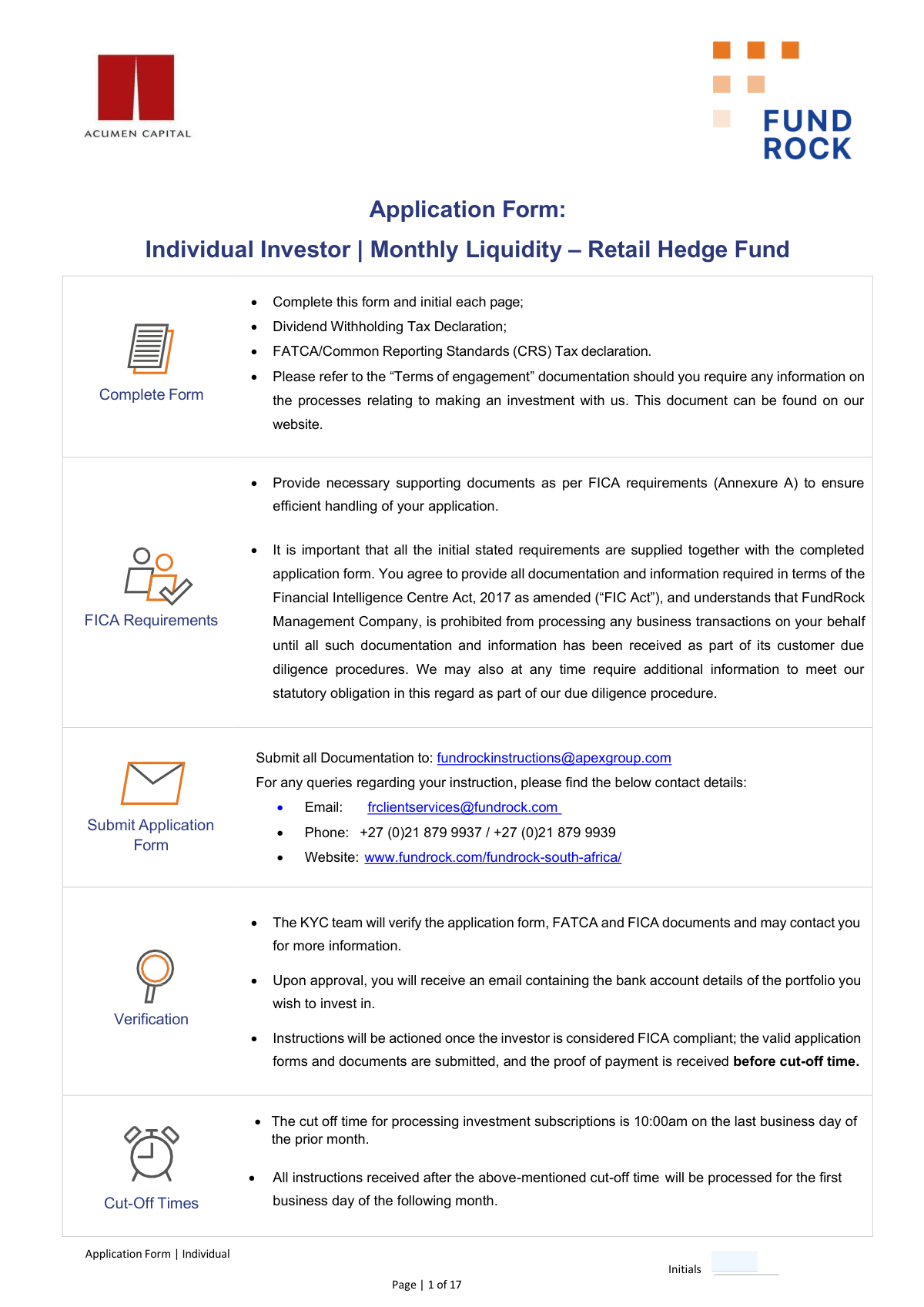
About liquidity fund forms
These forms are typically required by both individual retail investors and large legal entities, such as trusts or corporations, during the onboarding process. Because these investments are subject to strict international regulations, the paperwork often involves detailed disclosures regarding tax residency (FATCA/CRS), anti-money laundering (AML) checks, and "Know Your Customer" (KYC) protocols. Whether you are an institutional investor setting up a JPMorgan Liquidity Fund account or a qualified individual entering a Fundrock hedge fund, providing accurate banking information and source-of-funds documentation is a critical step in the application process.
Completing these extensive documents can be time-consuming, but tools like Instafill.ai use AI to fill these forms in under 30 seconds, ensuring that data is handled accurately and securely. This allows investors and financial advisors to focus on strategy rather than administrative paperwork.
Every form on this page can be completed without typing. Instafill is form filling software that reads a PDF and fills it for you — including flat and scanned documents that carry no fillable fields at all.
Forms in This Category
The forms in this category have a median Form Complexity Index of 63/100 (Complex), measured across 5 forms by field count, input difficulty, length, conditional logic and structure. See how it is calculated.
| Form Name | Pages | FCI | |
|---|---|---|---|
| 1. | Application Form: Individual Investor | Monthly Liquidity – Retail Hedge Fund | 1 | Complex 63 |
| 2. | Application Form: JPMorgan Liquidity Funds | 1 | Complex 63 |
| 3. | Fundrock Application Form: Individual Investor | Monthly Liquidity – Qualified Investor Hedge Fund | 1 | Complex 63 |
| 4. | Fundrock Application Form: Legal Entities | Monthly Liquidity – Qualified Investor Hedge Fund | 1 | Complex 63 |
| 5. | Fundrock Application Form: Legal Entities | Monthly Liquidity – Retail Hedge Fund | 1 | Complex 70 |
- Enterprise-grade security & data encryption
- 99%+ accuracy powered by AI
- 1,000+ forms from all industries
- Complete forms in under 60 seconds
How to Choose the Right Form
Selecting the correct liquidity fund application depends primarily on two factors: your legal status (individual vs. entity) and the specific type of hedge fund you are entering (Retail vs. Qualified).
Individual Investors
If you are an individual looking to invest personal capital, your choice depends on your investor status:
- Standard Retail Access: For most individual investors, the Application Form: Individual Investor | Monthly Liquidity – Retail Hedge Fund is the standard requirement. This form is designed for general access to Fundrock’s retail hedge fund products.
- Sophisticated Investors: If you meet the specific financial thresholds or experience criteria of a "Qualified Investor," you should instead use the Fundrock Application Form: Individual Investor | Monthly Liquidity – Qualified Investor Hedge Fund.
Legal Entities and Organizations
Companies, trusts, and partnerships must use forms specifically designed to capture organizational details, beneficial ownership, and corporate tax residency:
- Retail Funds: Use the Fundrock Application Form: Legal Entities | Monthly Liquidity – Retail Hedge Fund for standard corporate investments.
- Qualified Funds: Use the Fundrock Application Form: Legal Entities | Monthly Liquidity – Qualified Investor Hedge Fund if the entity is applying for a qualified investor hedge fund portfolio.
Institutional and International Funds
If you are representing a large-scale institution or seeking to invest in a Luxembourg-based SICAV, the Application Form: JPMorgan Liquidity Funds is the appropriate choice. Unlike the Fundrock forms which are often tailored for specific hedge fund tiers, this JPMorgan form is focused on institutional account opening and cross-border regulatory compliance.
Key Requirements for All Forms
Whichever form you select, you will be required to provide details for FICA, FATCA, and CRS compliance. This includes your tax residency, source of funds, and banking information. Using Instafill.ai allows you to quickly populate these detailed fields and convert static PDFs into fillable documents to ensure your application is submitted accurately and professionally.
Form Comparison
| Form | Target Investor | Fund Classification | Key Requirements |
|---|---|---|---|
| Application Form: Individual Investor | Monthly Liquidity – Retail Hedge Fund | Individual investors | Retail Hedge Fund (Monthly Liquidity) | FICA, FATCA, CRS compliance, and personal banking details |
| Application Form: JPMorgan Liquidity Funds | Institutional investors | Luxembourg-based open-ended SICAV | Entity details, FATCA/CRS status, and transaction banking info |
| Fundrock Application Form: Individual Investor | Monthly Liquidity – Qualified Investor Hedge Fund | Qualified individual investors | Qualified Investor Hedge Fund | Financial advisor info, KYC due diligence, and tax residency |
| Fundrock Application Form: Legal Entities | Monthly Liquidity – Qualified Investor Hedge Fund | Companies, trusts, and legal entities | Qualified Investor Hedge Fund | Beneficial ownership declarations, FICA, and entity tax status |
| Fundrock Application Form: Legal Entities | Monthly Liquidity – Retail Hedge Fund | Companies, trusts, and legal entities | Retail Hedge Fund (Monthly Liquidity) | Entity financial standing and ultimate beneficial owner details |
Tips for liquidity fund forms
Liquidity funds often have different forms for 'Retail' versus 'Qualified' investors, each with distinct regulatory requirements. Choosing the wrong form can result in your application being rejected, so confirm your status with your financial advisor before you begin filling out the paperwork.
These forms heavily focus on FATCA, CRS, and FICA compliance, which require specific tax identification numbers and residency details. Having your tax certificates and identification documents ready will prevent you from having to pause mid-form to search for sensitive data.
Since these funds are designed for liquidity, any error in your banking information—such as a mistyped IBAN or SWIFT code—can lead to significant delays in withdrawals. Always cross-reference your bank statement with the details entered on the form to ensure seamless fund transfers.
AI-powered tools like Instafill.ai can complete these multi-page liquidity fund forms in under 30 seconds with high accuracy. This is a practical time-saver for investors or fund managers dealing with multiple applications, and the data stays secure throughout the automated filling process.
When filling out forms for a legal entity, you must provide a clear breakdown of ultimate beneficial owners to meet KYC (Know Your Customer) standards. Incomplete ownership information is a common mistake that causes compliance teams to flag applications for manual review.
Liquidity fund applications require a specific declaration regarding the origin of the investment capital. Ensure your explanation is concise and matches your supporting financial records to avoid unnecessary follow-up questions from the fund's compliance department.
Frequently Asked Questions
Liquidity fund forms are application documents used by investors to open accounts and allocate capital into specific investment vehicles like hedge funds or money market funds. These forms ensure that the fund manager has all the necessary information to meet regulatory, tax, and operational requirements before accepting an investment.
Retail investor forms are generally designed for the broader public with standard entry thresholds, while Qualified Investor forms are reserved for those who meet specific financial criteria or have significant investment experience. You should consult the fund's prospectus or your financial advisor to determine which category your financial status falls under.
Individual forms are for natural persons investing in their own capacity, requiring personal identification and individual tax details. Legal entity forms are for companies, trusts, or partnerships and require additional documentation such as registration papers, proof of authority to invest, and details about ultimate beneficial owners.
Most applications require 'Know Your Customer' (KYC) documents, including proof of identity (like a passport or ID), proof of residence, and proof of bank account details. For legal entities, you may also need to provide incorporation documents and a formal resolution authorizing the investment.
FATCA and CRS are international tax reporting standards designed to prevent tax evasion across borders. These sections allow fund managers to determine your tax residency and report relevant financial information to the appropriate tax authorities as required by global regulations.
Yes, you can fill out liquidity fund forms using AI tools like Instafill.ai. These tools can accurately extract data from your source documents and place it directly into the relevant form fields in under 30 seconds, ensuring high accuracy for complex financial data.
While manual completion of these detailed forms can take a significant amount of time, using an AI-powered service can complete the process in less than a minute. The AI automatically maps your personal or entity data into the PDF, significantly reducing the administrative burden.
Monthly liquidity indicates that the fund allows investors to subscribe to or redeem their investment on a monthly basis. The application forms help establish the administrative framework needed to process these recurring transaction requests within the fund's specific notice periods.
Yes, several forms in this category, such as the JPMorgan Liquidity Funds application and the Fundrock Legal Entity forms, are specifically designed for institutional investors. These documents focus on corporate governance, entity-level tax compliance, and authorized signatory information.
Completed forms are usually submitted directly to the fund manager or the designated administrative service provider via email or a secure upload portal. Submission instructions, including the relevant contact details and required physical signatures, are typically found at the end of the form or in the accompanying investment guide.
While many forms include a section for financial advisor details, it is not always mandatory to have one to apply. However, certain funds, particularly Qualified Investor Hedge Funds, may require you to sign declarations confirming you understand the risks involved, which may be easier to navigate with professional guidance.
Glossary
- Form Complexity Index
- Instafill’s 0–100 measure of how much effort a form takes to complete, calculated deterministically from the form’s own structure rather than estimated. It combines the number of fillable fields (the largest factor), how difficult those fields are to complete based on their type, the number of pages that contain fields, the amount of conditional “fill-only-if” logic, and how many sections the form is divided into, then adds modifiers for tables and repeating lists, bundled instruction pages, and dense page layouts. A higher score means the form is harder to fill out by hand. The forms in this category have a median Form Complexity Index of 63/100 (Complex). See exactly how it is calculated.
- KYC
- Short for 'Know Your Customer,' this is a mandatory regulatory process where financial institutions verify the identity, suitability, and risks of an investor.
- FATCA
- The Foreign Account Tax Compliance Act is a U.S. law requiring international financial institutions to report information about accounts held by U.S. taxpayers.
- CRS
- The Common Reporting Standard is an international framework for the automatic exchange of financial information between countries to combat global tax evasion.
- FICA
- The Financial Intelligence Centre Act is a set of regulations requiring institutions to perform due diligence and report suspicious financial activities to prevent money laundering.
- Qualified Investor
- An investor who meets specific high-net-worth or professional experience criteria, allowing them to access complex investment products not available to the general public.
- Beneficial Owner
- The individual who ultimately owns or controls a legal entity, or the person who benefits from the assets even if the title is in another name.
- SICAV
- A Société d'Investissement à Capital Variable is a common European type of open-ended investment fund where the capital fluctuates based on investor participation.
- Retail Hedge Fund
- A hedge fund structured to be accessible to individual investors, often with lower entry requirements than funds reserved for institutional or qualified investors.
- Monthly Liquidity
- A fund provision that allows investors to withdraw or redeem their capital from the investment only once per month, usually on a specific date.