Fill out medical consent forms
with AI.
Medical consent forms are essential legal documents designed to protect patient privacy while ensuring that necessary healthcare information is accessible to the right people. These forms serve as formal authorizations that allow healthcare providers to share protected health information, perform specific medical procedures, or coordinate care with third parties. By establishing a clear legal framework for the release of health information, these documents ensure compliance with regulations like HIPAA and various state-specific health record acts, safeguarding sensitive data throughout the treatment process.
By continuing, you acknowledge Instafill's Privacy Policy and agree to get occasional product update and promotional emails.
About medical consent forms
Patients, family caregivers, and healthcare professionals typically encounter these forms during transitions of care, insurance evaluations, or when setting up in-home support services. For example, a patient may need to authorize the release of records to a new specialist, or a licensed professional might need to document the medical necessity of paramedical services for a home-bound individual. Because these documents often require precise medical terminology and strict adherence to legal standards, accuracy is critical to prevent administrative delays or interruptions in care. Tools like Instafill.ai use AI to fill these forms in under 30 seconds, ensuring that data is handled accurately and securely to save time for both patients and providers.
Every form on this page can be completed without typing. Instafill is form filling software that reads a PDF and fills it for you — including flat and scanned documents that carry no fillable fields at all.
Forms in This Category
The forms in this category have a median Form Complexity Index of 51/100 (Moderate), measured across 3 forms by field count, input difficulty, length, conditional logic and structure. See how it is calculated.
| Form Name | Pages | FCI | |
|---|---|---|---|
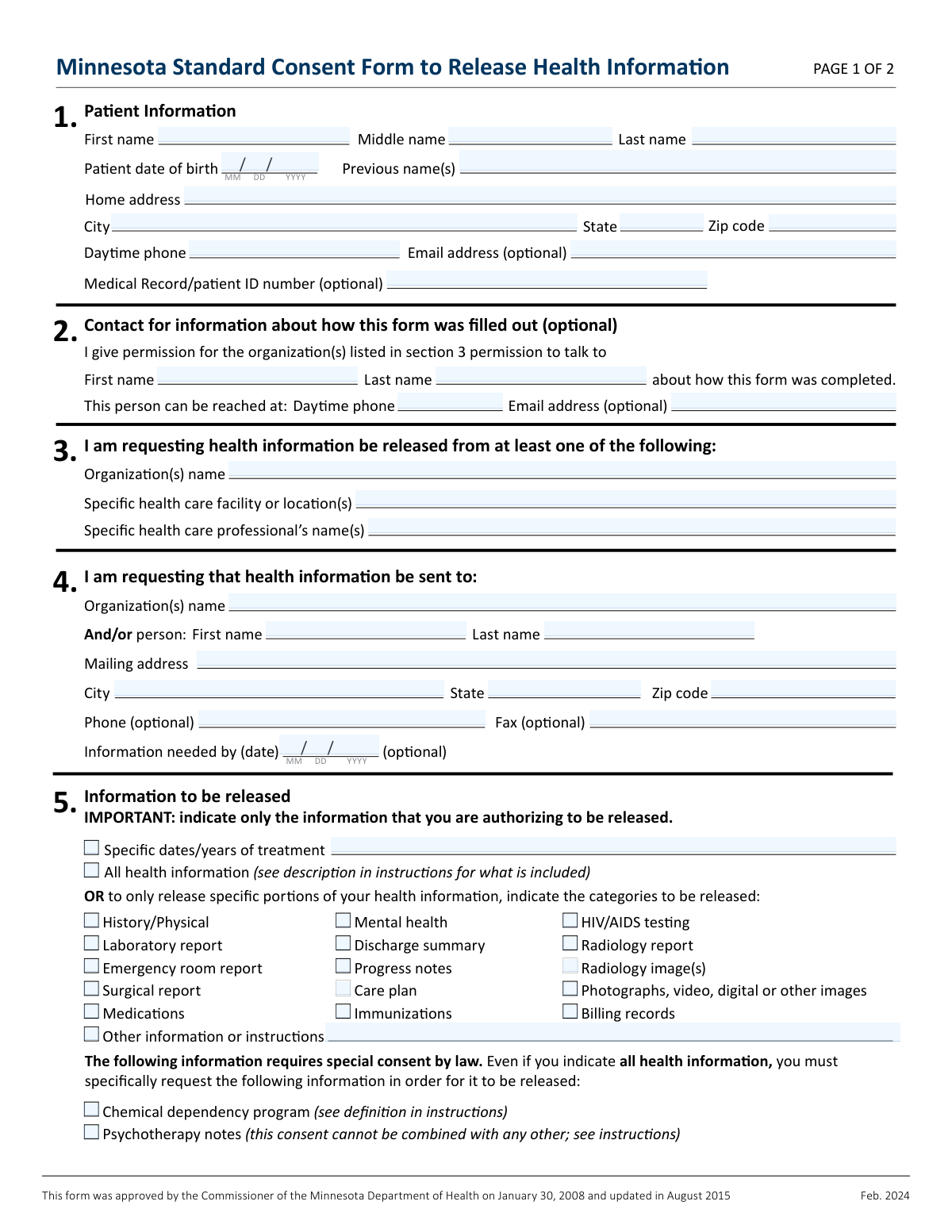
| 1. | Minnesota Standard Consent Form to Release Health Information | 1 | Basic 41 |
| 2. | SOC 821, Request for Order and Consent for Paramedical Services | 3 | Moderate 51 |
| 3. | State of California Form SOC 321, Request for Order and Consent - Paramedical Services | 2 | Moderate 57 |
- Enterprise-grade security & data encryption
- 99%+ accuracy powered by AI
- 1,000+ forms from all industries
- Complete forms in under 60 seconds
How to Choose the Right Form
Releasing Medical Records vs. Authorizing Care
Choosing the right medical consent form depends primarily on two factors: your geographic location and the specific action you are authorizing. While both forms involve patient privacy and medical authorization, they serve very different legal purposes within their respective states.
Sharing Health Information for Legal or Insurance Needs
If your goal is to share your existing medical history with a third party—such as an insurance provider, a legal representative, or a new healthcare specialist—you need a records release form.
- Minnesota Standard Consent Form to Release Health Information: Choose this form if you are receiving care in the state of Minnesota. It is the official, legally required document under the Minnesota Health Records Act to authorize the transfer of protected health information (PHI). This form is essential for ensuring continuity of care or providing necessary documentation for insurance and legal matters.
Authorizing Specialized In-Home Services
If you are seeking medical services that will be performed in a residential setting by a caregiver, you need a form that authorizes specific medical tasks rather than just the release of data.
- State of California Form SOC 321, Request for Order and Consent - Paramedical Services: Select this form if you are a participant in California’s In-Home Supportive Services (IHSS) program. Unlike a standard record release, this form acts as a formal medical order. It allows non-licensed providers to perform specific tasks—such as medication administration, catheter care, or wound dressing—that are necessary for a patient to remain safely in their home.
Quick Decision Checklist
- Location: Are you in Minnesota? Use the Minnesota Standard Consent Form. Are you in California? Use Form SOC 321.
- Purpose: Do you need to send files to a new doctor? Use the Minnesota Standard Consent Form. Do you need to authorize a caregiver to perform medical tasks at home? Use the California SOC 321.
- Program Specifics: The California form is strictly for the IHSS program, whereas the Minnesota form is a general-purpose health information release.
Form Comparison
| Form | Primary Purpose | Jurisdiction | Who Completes It | Key Use Case |
|---|---|---|---|---|
| Minnesota Standard Consent Form to Release Health Information | Authorizes the release of protected health records to designated third parties. | Minnesota | The patient or their authorized legal representative. | Transferring records for insurance, legal matters, or continuity of medical care. |
| State of California Form SOC 321, Request for Order and Consent - Paramedical Services | Orders medical services to be performed by non-licensed IHSS home providers. | California | A licensed healthcare professional and the IHSS recipient. | Securing approval for in-home services like medication administration or wound care. |
Tips for medical consent forms
When filling out medical consent forms, avoid broad terms like 'all records' unless absolutely necessary. Specifying exact dates of service or specific medical conditions helps protect your privacy and ensures only relevant data is shared.
Medical release forms often require signatures from the patient, healthcare providers, or witnesses. Missing a signature is a common reason for processing delays, so double-check every signature line before submitting your request.
Managing multiple medical forms can be overwhelming, but AI-powered tools like Instafill.ai can complete these documents in under 30 seconds with high accuracy. Your sensitive data stays secure during the process, making it a reliable time-saver for complex paperwork.
Most health information forms allow you to set an expiration date for the authorization. If you are providing a one-time release for a specific insurance or legal matter, ensure you fill in the end date to prevent indefinite access to your records.
Providing an incorrect fax number or address for the receiving provider can lead to significant delays in care or privacy breaches. Always verify the destination's contact details to ensure your health information reaches the correct party safely.
Always save a copy of the signed consent form for your own files after completion. Having a digital or physical copy allows you to track who has access to your health information and serves as proof of authorization if records are not transferred.
For forms like the California SOC 321, it is essential to clearly list the exact paramedical tasks required, such as injections or wound care. Providing specific instructions from a licensed professional ensures caregivers are properly authorized to perform necessary medical duties.
Frequently Asked Questions
These forms are legal documents that authorize healthcare providers to share protected health information or perform specific medical services. They ensure compliance with privacy laws like HIPAA and state regulations, protecting patient confidentiality while facilitating necessary care or legal processes.
The correct form depends on your specific goal and location. If you need to transfer medical records for insurance or a new doctor in Minnesota, you would use a standard health information release; however, if you are requesting home-based medical services in California, a paramedical services consent form like the SOC 321 is required.
Typically, the patient must sign the form if they are an adult. If the patient is a minor or unable to make their own decisions, a legally authorized representative, such as a parent, legal guardian, or someone with medical power of attorney, must provide the signature.
Yes, AI tools like Instafill.ai can fill out complex medical consent forms in under 30 seconds. These tools accurately extract data from your source documents and place it into the required fields, reducing the risk of manual entry errors.
Filling these forms online is significantly faster than manual completion, often taking less than a minute with the help of automation. AI-powered services can also convert non-fillable PDF versions into interactive forms, making the process seamless for users.
Most consent forms are not permanent and include an expiration date or a specific condition that ends the authorization. If no date is provided, the validity is often determined by state law or the specific policies of the healthcare organization receiving the form.
You will generally need the patient's full legal name, date of birth, and contact information, as well as the specific names of the providers sending and receiving the records. You must also specify exactly what information is being released, such as lab results, immunization records, or full medical history.
Submission instructions vary by form: a standard release of information is usually sent to the medical records department of your healthcare provider. Program-specific forms, such as those for California's IHSS, are typically submitted to the local county social services office or a designated caseworker.
Yes, patients generally have the right to revoke their consent at any time. To do so, you typically need to submit a written request to the healthcare provider or agency that was originally authorized to share or act on your information.
While federal HIPAA laws provide a baseline for privacy, many states have additional statutes, such as the Minnesota Health Records Act, that require specific language or formats. Using a state-approved form ensures that your request meets all local legal requirements for the disclosure of sensitive health data.
Glossary
- Form Complexity Index
- Instafill’s 0–100 measure of how much effort a form takes to complete, calculated deterministically from the form’s own structure rather than estimated. It combines the number of fillable fields (the largest factor), how difficult those fields are to complete based on their type, the number of pages that contain fields, the amount of conditional “fill-only-if” logic, and how many sections the form is divided into, then adds modifiers for tables and repeating lists, bundled instruction pages, and dense page layouts. A higher score means the form is harder to fill out by hand. The forms in this category have a median Form Complexity Index of 51/100 (Moderate). See exactly how it is calculated.
- HIPAA
- The Health Insurance Portability and Accountability Act is a federal law that establishes national standards to protect sensitive patient health information from being disclosed without the patient's consent.
- PHI (Protected Health Information)
- Any individually identifiable health information, such as medical history, test results, or insurance details, that is protected under federal privacy laws.
- Disclosure
- The act of releasing, transferring, or providing access to a patient's health information to an outside individual or organization.
- Revocation
- The legal right of a patient to cancel or withdraw a previously signed consent form, usually requiring a written request to the healthcare provider.
- Medical Necessity
- A formal justification by a licensed healthcare professional stating that a specific service or treatment is required to treat a patient's medical condition.
- Paramedical Services
- Specific health-related tasks, such as administering medication or catheter care, that are ordered by a doctor but performed by a non-licensed caregiver.
- IHSS (In-Home Supportive Services)
- A California state program that provides assistance to elderly or disabled individuals so they can remain safely in their own homes rather than in a care facility.
- Legal Representative
- An individual, such as a court-appointed guardian or a person with power of attorney, who is authorized to sign medical forms on behalf of a patient.