Fill out medical release forms
with AI.
Medical release forms, often referred to as HIPAA authorization forms, are critical legal documents that allow healthcare providers to share a patient's protected health information (PHI) with third parties. These forms are designed to protect patient privacy while providing a legal framework for the secure transfer of sensitive medical records. Whether you are dealing with state-specific regulations like those in California or specific institutional requirements, these documents ensure that healthcare data is disclosed only with explicit, informed consent.
By continuing, you acknowledge Instafill's Privacy Policy and agree to get occasional product update and promotional emails.
About medical release forms
Patients, family members, and legal professionals typically require these forms during major life transitions or legal events. Common scenarios include transferring medical records to a new specialist, providing documentation for insurance claims, or authorizing a law firm to access health history for a legal case. For example, specific forms like the UCLA Authorization for Release of Health Information or general authorization letters are essential for coordinating care between different facilities or ensuring legal representatives have the necessary information to act on your behalf.
Completing these documents accurately is vital to avoid delays in medical treatment or legal proceedings. Tools like Instafill.ai use AI to fill these forms in under 30 seconds, handling complex data accurately and securely to save you time. This technology simplifies the administrative burden, allowing you to focus on your health or legal priorities rather than tedious paperwork.
Every form on this page can be completed without typing. Instafill is form filling software that reads a PDF and fills it for you — including flat and scanned documents that carry no fillable fields at all.
Forms in This Category
The forms in this category have a median Form Complexity Index of 47/100 (Moderate), measured across 4 forms by field count, input difficulty, length, conditional logic and structure. See how it is calculated.
| Form Name | Pages | FCI | |
|---|---|---|---|
| 1. | California HIPAA Authorization Form, Authorization for the Release of Protected Health Information | 4 | Moderate 48 |
| 2. | Friedman, Framme & Thrush, P.A. General Authorization Letter and Request for Letter or Telephone Call | 1 | Basic 39 |
| 3. | MC 315, Authorization for Release of Medical Information | 1 | Basic 37 |
| 4. | UCLA Form #30910, Authorization for Release of Health Information | 4 | Moderate 47 |
- Enterprise-grade security & data encryption
- 99%+ accuracy powered by AI
- 1,000+ forms from all industries
- Complete forms in under 60 seconds
How to Choose the Right Form
Choosing the right medical release form depends primarily on who holds your records and what you intend to do with that information. Whether you are transferring records between doctors or authorizing a legal representative to act on your behalf, selecting the correct document ensures compliance with HIPAA and state privacy laws.
For General Medical Records in California
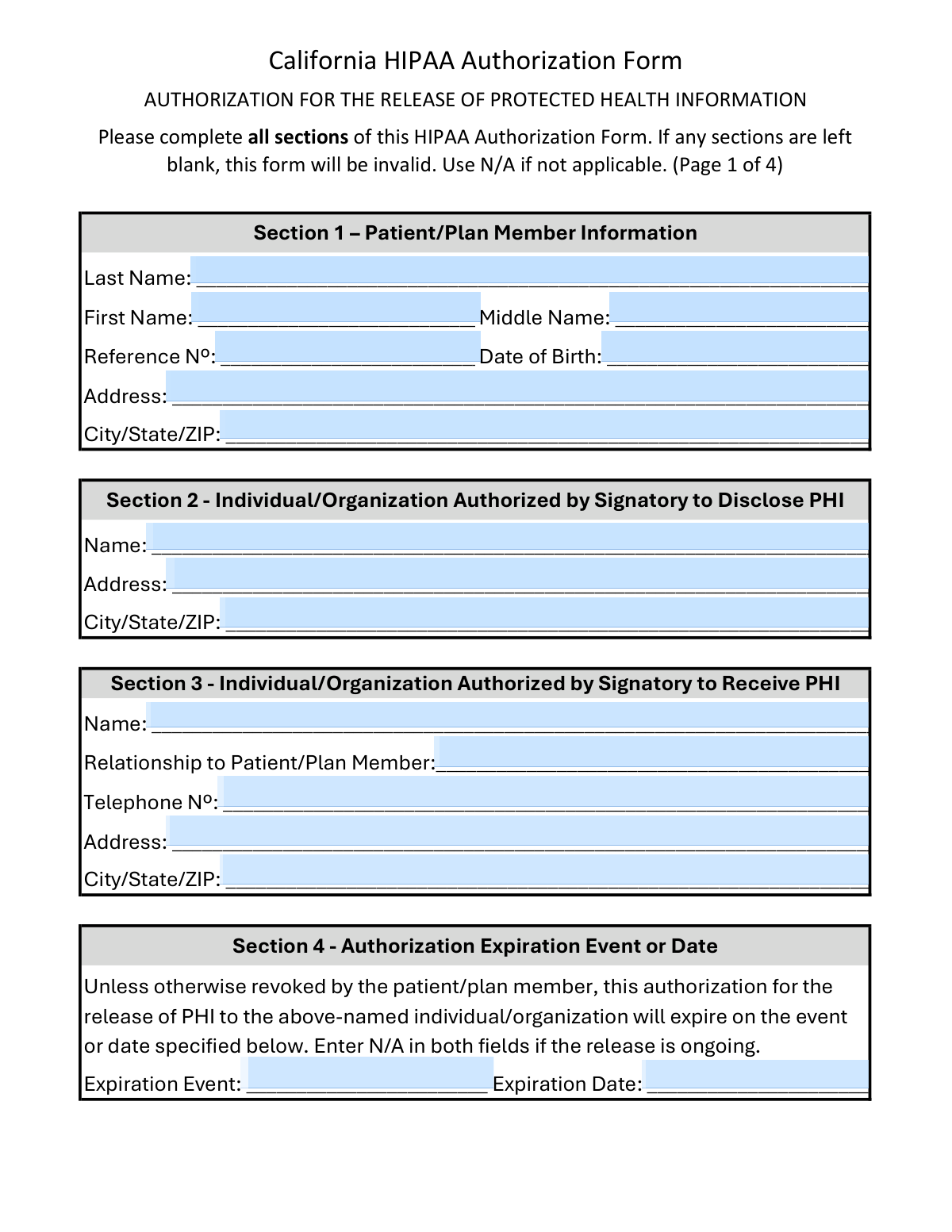
If you are a patient or healthcare provider in the state of California, the California HIPAA Authorization Form, Authorization for the Release of Protected Health Information is the standard choice. This form is designed to meet both federal HIPAA requirements and California’s strict Confidentiality of Medical Information Act (CMIA). Use this when you need to grant permission for a healthcare entity to share your sensitive health info with another person or organization within the state.
For UCLA Health Patients
If you have received care specifically through the UCLA Health system, you should use the UCLA Form #30910, Authorization for Release of Health Information. While general state forms exist, using the facility-specific UCLA form ensures that their records department can process your request without administrative delays. This is the correct choice for transferring UCLA records for continuing care, legal requirements, or personal archives.
For Legal Representation and Disputes
Sometimes, a medical release is needed as part of a broader legal strategy. The Friedman, Framme & Thrush, P.A. General Authorization Letter and Request for Letter or Telephone Call is specifically tailored for LegalShield members. Unlike a standard healthcare release, this document grants the law firm permission to contact an opposing party via phone or mail regarding a specific legal matter. Choose this if you need your attorney to initiate communication to resolve a dispute.
Summary Checklist
- UCLA Patient? Use UCLA Form #30910.
- General CA Healthcare? Use the California HIPAA Authorization Form.
- LegalShield Member? Use the Friedman, Framme & Thrush, P.A. General Authorization Letter.
Form Comparison
| Form | Primary Purpose | Target Entity | Primary Use Case |
|---|---|---|---|
| California HIPAA Authorization Form, Authorization for the Release of Protected Health Information | Authorize release of protected health information under California privacy laws. | Patients and healthcare providers operating within the state of California. | Transferring sensitive medical records to external organizations or legal entities. |
| Friedman, Framme & Thrush, P.A. General Authorization Letter and Request for Letter or Telephone Call | Grant law firm permission to contact opposing parties regarding legal matters. | LegalShield members working with the firm Friedman, Framme & Thrush. | Initiating attorney-led communication to resolve specific disputes or legal claims. |
| UCLA Form #30910, Authorization for Release of Health Information | Request the transfer of confidential medical records from UCLA Health. | Patients seeking records specifically held by the UCLA health system. | Facilitating continuing care, legal requests, or personal medical record retrieval. |
Tips for medical release forms
Avoid requesting 'all records' if you only need a specific lab result or visit summary. Narrowing the scope can significantly speed up the processing time at the hospital or clinic and ensures only necessary information is shared.
Most medical release forms require a date or a specific event, such as 'conclusion of litigation,' when the authorization expires. Leaving this blank can lead to the form being rejected or the authorization remaining open longer than you intended.
Forms like the California HIPAA Authorization often require separate, explicit consent for records related to mental health, substance abuse, or HIV/AIDS. Review these sections carefully to ensure you aren't inadvertently withholding information your recipient needs to see.
Managing healthcare paperwork for multiple providers can be repetitive and time-consuming. AI-powered tools like Instafill.ai can complete these forms in under 30 seconds with high accuracy while keeping your data secure, providing a practical solution for complex filing tasks.
Ensure the name, address, and fax number of the receiving party are perfectly accurate before submitting. Medical offices follow strict protocols and will often refuse to release information if the delivery details are ambiguous or incorrect.
Whether the records are for 'personal use' or 'continuing care,' stating the purpose helps the provider categorize the request correctly. Some healthcare providers prioritize requests for 'continuing care' over 'personal use,' which can affect how quickly your records are delivered.
Once you sign and submit a release, always save a copy of the completed form for your own files. This allows you to track exactly what you authorized and serves as a reference if there are any future questions about what information was shared.
Frequently Asked Questions
A medical release form is a legal document that allows healthcare providers to share your protected health information with a third party, such as another doctor, an insurance company, or an attorney. These forms are essential for maintaining privacy while ensuring that necessary medical data is available for your ongoing care or legal needs.
HIPAA forms ensure that your sensitive health data is handled according to federal privacy standards defined by the Health Insurance Portability and Accountability Act. By signing these documents, you provide explicit permission for specific entities to disclose your records, protecting you from unauthorized data sharing and ensuring compliance with privacy laws.
If you are a patient specifically within the UCLA Health system, you should use UCLA Form #30910 for record transfers or releases. For other healthcare providers across California, the standard California HIPAA Authorization Form is used to ensure compliance with both federal law and the state's Confidentiality of Medical Information Act (CMIA).
This specific authorization is intended for LegalShield members working with the law firm Friedman, Framme & Thrush, P.A. It grants the firm permission to contact an opposing party via letter or telephone to discuss a legal matter, which may involve the disclosure of relevant personal or medical information.
Yes, AI tools like Instafill.ai can fill out complex medical release forms in under 30 seconds. These tools accurately extract data from your source documents and place it into the correct fields, ensuring that the form is completed precisely to avoid processing delays.
While manual entry can be tedious, using an AI-powered platform allows you to complete these forms almost instantly. Instafill.ai can convert non-fillable PDF versions into interactive forms and populate the required data accurately in a fraction of the time it takes to do so by hand.
Generally, the patient must sign the form if they are an adult with the legal capacity to do so. If the patient is a minor, a parent or legal guardian typically signs, and if an adult is incapacitated, an individual with a designated power of attorney for healthcare may sign.
Yes, most forms, including those for California providers, require you to specifically indicate if you want to include sensitive information. You may need to provide separate initials or check specific boxes to authorize the release of records related to mental health, substance abuse, or HIV/AIDS status.
Completed forms should be submitted to the Health Information Management (HIM) department or the Privacy Officer of the facility that holds the records. Many modern healthcare systems allow you to submit these forms through secure patient portals, though fax and mail remain common options.
Most medical release forms include a section where you can specify an expiration date or an event that will trigger the end of the authorization. If no date is provided, the authorization is typically valid for a period determined by state law or the specific policy of the healthcare provider.
Glossary
- Form Complexity Index
- Instafill’s 0–100 measure of how much effort a form takes to complete, calculated deterministically from the form’s own structure rather than estimated. It combines the number of fillable fields (the largest factor), how difficult those fields are to complete based on their type, the number of pages that contain fields, the amount of conditional “fill-only-if” logic, and how many sections the form is divided into, then adds modifiers for tables and repeating lists, bundled instruction pages, and dense page layouts. A higher score means the form is harder to fill out by hand. The forms in this category have a median Form Complexity Index of 47/100 (Moderate). See exactly how it is calculated.
- HIPAA
- The Health Insurance Portability and Accountability Act, a federal law that sets national standards for protecting sensitive patient health information from being disclosed without consent.
- Protected Health Information (PHI)
- Any individually identifiable health information, such as medical records, lab results, or billing details, that is protected under privacy laws.
- CMIA
- The Confidentiality of Medical Information Act, a California-specific law that provides stricter privacy protections for medical data than federal regulations.
- Sensitive Health Information
- A sub-category of medical data, including mental health records or HIV status, that usually requires a separate, specific check-box or signature to release.
- Covered Entity
- Any healthcare provider, health plan, or healthcare clearinghouse that is legally required to follow HIPAA regulations when handling patient data.
- Revocation
- The act of canceling a previously signed authorization, which prevents any future release of medical records after the request is processed.
- LegalShield Member
- An individual enrolled in a prepaid legal services plan, often requiring specific authorization forms for law firms to act on their behalf.
- Expiration Event
- A specific date or occurrence, such as the end of a legal case, after which the permission to share medical records is no longer valid.