Fill out organizational forms
with AI.
Organizational forms serve as the structural framework for any professional entity, providing the necessary documentation to manage internal governance and external business relations. This category includes a broad range of legal forms and business forms designed to formalize company actions, from simple administrative updates to complex board resolutions. Maintaining accurate records through these corporate forms is vital for ensuring legal compliance, protecting stakeholders, and establishing a clear paper trail for financial and operational decisions.
By continuing, you acknowledge Instafill's Privacy Policy and agree to get occasional product update and promotional emails.
About organizational forms
Typically, these documents are essential for business owners, legal counsel, and administrative executives who oversee the formal requirements of a corporation or non-profit. Whether an organization is applying for a charitable giving account to manage corporate philanthropy or documenting a change in leadership, these forms provide the standardized format required by banks, government agencies, and internal auditors. Having the correct paperwork on hand allows leadership to execute strategic plans with confidence and transparency.
Completing these documents accurately is crucial, yet the process can often be time-consuming. Tools like Instafill.ai use AI to fill these forms in under 30 seconds, handling data with high precision and security. This technology streamlines the administrative process by automatically populating required fields, helping organizations maintain their records without the burden of manual data entry.
Every form on this page can be completed without typing. Instafill is form filling software that reads a PDF and fills it for you — including flat and scanned documents that carry no fillable fields at all.
Forms in This Category
The forms in this category have a median Form Complexity Index of 63/100 (Complex), measured across 1 forms by field count, input difficulty, length, conditional logic and structure. See how it is calculated.
| Form Name | Pages | FCI | |
|---|---|---|---|
| 1. | Organizational Giving Account® Application | 1 | Complex 63 |
- Enterprise-grade security & data encryption
- 99%+ accuracy powered by AI
- 1,000+ forms from all industries
- Complete forms in under 60 seconds
How to Choose the Right Form
Organizational forms serve as the foundational documents for corporate structure, governance, and philanthropic initiatives. When navigating these documents, the primary goal is to ensure legal compliance while streamlining administrative tasks. In this category, the focus is on bridging the gap between corporate assets and charitable impact.
Managing Corporate Philanthropy
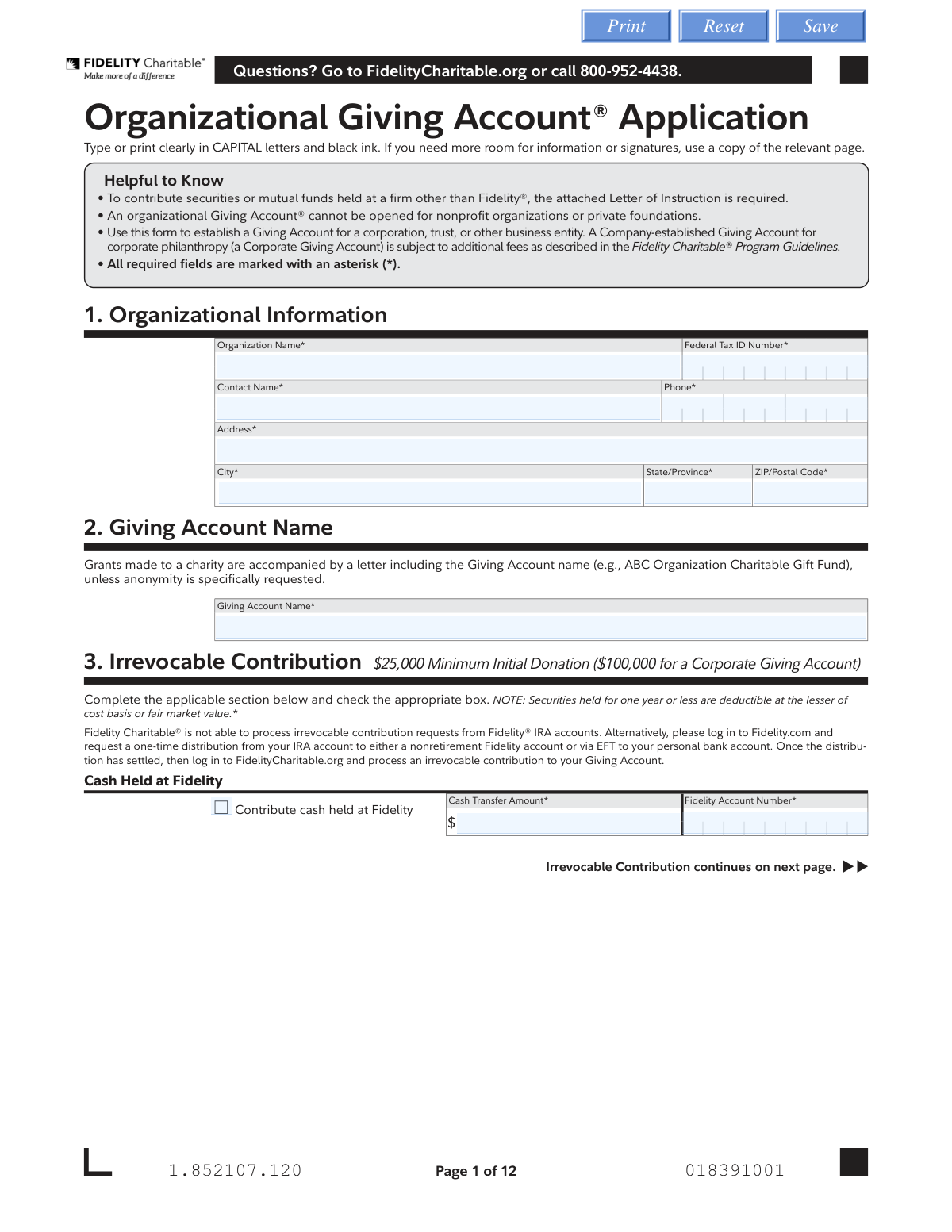
If your business is looking to formalize its charitable contributions, the Organizational Giving Account® Application is the essential tool in this category. This form is specifically designed for business entities—including corporations, partnerships, and certain non-profit organizations—that wish to establish a donor-advised fund (DAF) through Fidelity Charitable.
You should choose this form if your organization needs to:
- Centralize Giving: Consolidate various charitable contributions into a single, manageable account for better tracking and reporting.
- Optimize Tax Strategy: Make irrevocable contributions of cash or appreciated securities to potentially receive an immediate tax deduction for the business entity.
- Plan Long-Term Grants: Establish a fund now to secure the tax benefit, while recommending grants to specific 501(c)(3) charities over time as your philanthropic strategy evolves.
Is This Form Right for Your Entity?
While many organizational forms deal with internal governance, the Organizational Giving Account® Application is tailored for institutional outreach. It is the right choice for companies that want to build a legacy of corporate social responsibility (CSR) without the high administrative costs and complexity associated with starting a private foundation.
Efficiency with AI
Filling out detailed financial applications requires precision. By using Instafill.ai, you can complete the Organizational Giving Account® Application more efficiently. Our AI-powered tools help you navigate the requirements of the form and can even transform static PDF versions into interactive, fillable documents, ensuring your organization’s charitable mission gets started without unnecessary delays.
Form Comparison
| Form | Purpose | Who Files It | Key Benefit |
|---|---|---|---|
| Organizational Giving Account® Application | Establish a donor-advised fund for corporate philanthropy and charitable asset management. | Business entities, including corporations and partnerships, seeking tax-efficient giving options. | Provides immediate tax deductions while allowing grant recommendations to charities over time. |
Tips for organizational forms
To complete organizational forms efficiently, have your Employer Identification Number (EIN) and official articles of incorporation ready. These documents provide the exact legal details required for most business applications and prevent errors that could delay processing.
Many corporate and legal forms must be signed by a specific officer, such as the Secretary or Treasurer. Check your organization’s bylaws to ensure the individual signing the document has the designated authority to bind the entity to the agreement.
Avoid using 'Doing Business As' (DBA) names unless the form specifically asks for them. Always use the full legal name registered with the Secretary of State to ensure the form is legally binding and recognized by financial or government institutions.
You can significantly speed up your workflow by using AI-powered tools like Instafill.ai to complete complex organizational forms in under 30 seconds with high accuracy. These tools ensure your data stays secure throughout the process, making it a reliable choice for handling sensitive corporate information.
For significant actions like opening a giving account or changing corporate structure, a board resolution is often required as an attachment. Ensure the resolution is dated and signed by the appropriate board members before you begin the application process.
Organizational forms often require repetitive data entry across different departments. Saving a digital copy of your completed forms allows you to quickly reference previous answers, ensuring consistency and saving time on future administrative tasks.
Frequently Asked Questions
Organizational forms are legal and administrative documents used to establish, manage, or modify a business entity's structure and operations. They often cover activities such as incorporating a business, documenting board resolutions, or applying for corporate accounts and charitable funds.
These forms are usually handled by business owners, corporate officers, or authorized representatives like legal counsel or financial advisors. For specific applications like charitable accounts, an authorized signatory must provide the necessary entity information and financial details.
Companies use these accounts to manage their corporate philanthropy more efficiently. By contributing to a donor-advised fund, a business can receive potential tax deductions immediately while recommending grants to specific charities over a longer period.
Most forms in this category require basic entity details, such as the legal name, Employer Identification Number (EIN), and business address. Depending on the specific form, you may also need to provide documentation regarding board resolutions or the identities of authorized individuals.
Yes, modern AI tools like Instafill.ai can process organizational forms by accurately extracting data from your source documents and placing it into the correct fields. This technology can even convert static or non-fillable PDF versions of these forms into interactive, fillable documents.
Using manual methods can take significant time, but with AI-powered services like Instafill.ai, most organizational forms can be completed in under 30 seconds. This efficiency reduces the risk of manual entry errors and ensures that all required fields are addressed quickly.
Many organizational forms, such as board resolutions or account applications, become legally binding agreements once they are signed by an authorized representative and accepted by the receiving institution. It is important to ensure all information is accurate before submission.
Submission requirements vary depending on the form's purpose. Some are filed with state agencies for legal registration, while others, like the Organizational Giving Account application, are submitted directly to financial institutions or charitable organizations.
Many financial and legal applications for businesses require proof that the action has been approved by the company's leadership. A board resolution is a standard document used to demonstrate that the board of directors has authorized a specific person to open accounts or enter into agreements.
While the terms are often used interchangeably, business forms typically focus on daily operations and administrative tasks, whereas legal forms are specifically designed to ensure compliance with laws or to create binding contracts. Organizational forms often bridge both categories by documenting internal governance.
Glossary
- Form Complexity Index
- Instafill’s 0–100 measure of how much effort a form takes to complete, calculated deterministically from the form’s own structure rather than estimated. It combines the number of fillable fields (the largest factor), how difficult those fields are to complete based on their type, the number of pages that contain fields, the amount of conditional “fill-only-if” logic, and how many sections the form is divided into, then adds modifiers for tables and repeating lists, bundled instruction pages, and dense page layouts. A higher score means the form is harder to fill out by hand. The forms in this category have a median Form Complexity Index of 63/100 (Complex). See exactly how it is calculated.
- EIN (Employer Identification Number)
- A unique nine-digit number assigned by the IRS to business entities for identification and tax reporting purposes, similar to a Social Security number for individuals.
- Board Resolution
- A formal document that records a decision made by an organization's board of directors, often required to prove that the entity has authorized the opening of a specific account or financial action.
- Authorized Signatory
- An individual who has been legally empowered by an organization to sign documents and enter into binding agreements on its behalf.
- Donor-Advised Fund (DAF)
- A private fund managed by a third party that allows organizations to make charitable contributions, receive immediate tax benefits, and recommend grants to charities over time.
- Irrevocable Contribution
- A gift of cash or assets that cannot be rescinded or returned to the donor once the transaction is complete, ensuring the contribution is eligible for tax deductions.
- Grant Recommendation
- A formal request made by an account holder to the sponsoring organization to distribute funds from a donor-advised fund to a specific qualified charity.
- Sponsoring Organization
- A tax-exempt entity, such as Fidelity Charitable, that owns and controls donor-advised funds while handling all administrative and investment responsibilities.
- Qualified Charity
- An organization recognized by the IRS as eligible to receive tax-deductible contributions, typically those designated under section 501(c)(3) of the Internal Revenue Code.