Fill out overpayment waiver forms
with AI.
Overpayment waiver forms are essential legal documents used when a government agency or organization mistakenly pays an individual more than they were entitled to receive. These forms serve as a formal request to have the debt forgiven, preventing the agency from recouping the funds through benefit reductions or direct collection. They are vital because they provide a mechanism for individuals to protect their financial stability when an administrative error occurs through no fault of their own.
By continuing, you acknowledge Instafill's Privacy Policy and agree to get occasional product update and promotional emails.
About overpayment waiver forms
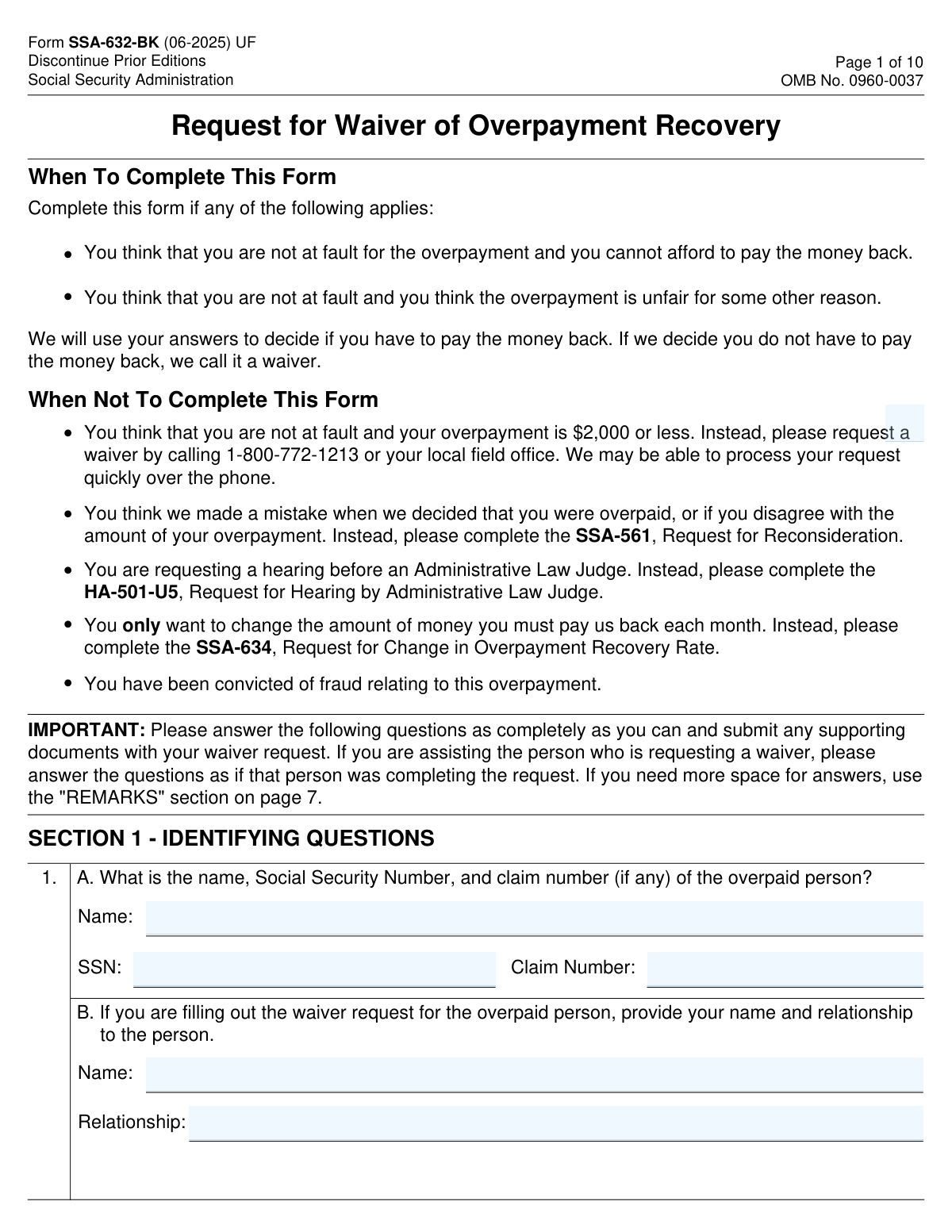
Typically, these forms are needed by beneficiaries of Social Security, disability, or unemployment programs who have received a notice of overpayment. For instance, documents like Form SSA-632-BK and Form SSA-632 are used by the Social Security Administration to evaluate whether a recipient should be held responsible for repayment. To successfully obtain a waiver, the applicant generally must demonstrate that they were not at fault for the overage and that repaying the money would cause extreme financial hardship or be fundamentally unfair. Providing accurate financial disclosures is critical to the success of these applications.
Navigating the specific fields and financial data required for these requests can be a daunting task during an already stressful time. Tools like Instafill.ai use AI to fill these forms in under 30 seconds, handling your data accurately and securely to ensure your waiver request is professional and complete. This technology simplifies the process, allowing you to focus on resolving your case rather than struggling with complex PDF layouts.
Every form on this page can be completed without typing. Instafill is form filling software that reads a PDF and fills it for you — including flat and scanned documents that carry no fillable fields at all.
Forms in This Category
The forms in this category have a median Form Complexity Index of 72/100 (Complex), measured across 2 forms by field count, input difficulty, length, conditional logic and structure. See how it is calculated.
| Form Name | Pages | FCI | |
|---|---|---|---|
| 1. | Form SSA-632-BK, Request for Waiver of Overpayment Recovery | 10 | Complex 68 |
| 2. | Form SSA-632, Request for Waiver of Overpayment Recovery | 6 | Complex 72 |
- Enterprise-grade security & data encryption
- 99%+ accuracy powered by AI
- 1,000+ forms from all industries
- Complete forms in under 60 seconds
How to Choose the Right Form
If you have received a notice from the Social Security Administration (SSA) stating you were overpaid benefits, you likely need to file a waiver request to avoid paying the money back. Both forms on this page serve the same primary function: proving that the overpayment wasn't your fault and that repayment would cause financial hardship.
Choosing Between SSA-632 and SSA-632-BK
While these forms are nearly identical in purpose, the distinction usually comes down to the format you prefer or the specific version requested by your local SSA office:
- Form SSA-632 (Request for Waiver of Overpayment Recovery): This is the standard request form. Use this if you need a straightforward document to declare your income, assets, and expenses. It is the core document required to initiate a waiver review.
- Form SSA-632-BK (Request for Waiver of Overpayment Recovery): The "BK" suffix stands for "Booklet." This version is often more comprehensive in its instructional layout. It is frequently used for physical mailing or when a user needs the full context of the SSA’s rules and definitions integrated directly into the filing process.
Key Criteria for a Successful Waiver
Regardless of which version you select, the SSA will evaluate your submission based on two specific legal standards. You should choose the form that allows you to best document the following:
- Fault Status: You must prove that the overpayment was not your fault. This involves showing that you provided all necessary information to the SSA and did not knowingly withhold facts.
- Financial Hardship: You must demonstrate that recovery of the overpayment would "defeat the purpose" of the Social Security Act—meaning it would deprive you of income needed for ordinary and necessary living expenses like food, rent, and medicine.
Using Instafill.ai, you can quickly complete either Form SSA-632 or Form SSA-632-BK. Our AI-powered tools help you navigate the complex financial disclosure sections, ensuring your request is clear, legible, and professionally prepared.
Form Comparison
| Form | Primary Purpose | Who Files It | Key Requirements |
|---|---|---|---|
| Form SSA-632-BK, Request for Waiver of Overpayment Recovery | Request to waive repayment of Social Security or SSI overpaid benefits. | Beneficiaries who received overpayments and cannot afford to repay the debt. | Detailed financial records and proof that the overpayment wasn't your fault. |
| Form SSA-632, Request for Waiver of Overpayment Recovery | Formal application to forgive debt owed to the Social Security Administration. | Individuals seeking relief from repaying overpaid Social Security funds. | Documentation of income, expenses, and evidence of no-fault in the overpayment. |
Tips for overpayment waiver forms
To qualify for a waiver, you must demonstrate that the overpayment was not caused by your actions or negligence. Provide specific details about any updates you reported to the SSA regarding your income or living situation to show you acted in good faith.
The SSA uses your financial data to determine if repayment would cause an 'undue hardship.' Be thorough when listing costs for housing, groceries, and medical care to ensure the reviewer understands your true monthly financial obligations.
AI-powered tools like Instafill.ai can complete these complex overpayment waiver forms in under 30 seconds with high accuracy. This is a significant time-saver for those managing multiple documents, and your sensitive data remains secure throughout the entire process.
Don't rely on the form alone; include copies of bank statements, pay stubs, or utility bills that verify the numbers you provided. Including these documents upfront makes it easier for the SSA to verify your claim and can prevent lengthy processing delays.
If a particular question or section does not apply to your situation, write 'N/A' or 'None' rather than leaving it empty. This confirms to the reviewer that you didn't accidentally skip a required field, which helps ensure your application is processed correctly the first time.
Always save a copy of the completed form and all supporting evidence before you submit them to the SSA. Having a record of exactly what you sent allows you to answer follow-up questions consistently and provides a backup if the original document is misplaced.
Frequently Asked Questions
Overpayment waiver forms, such as those provided by the Social Security Administration (SSA), are used by individuals who have received more benefit money than they were entitled to. Filing these forms is a formal request for the agency to forgive the debt so that you do not have to pay it back.
Generally, you may be eligible if you can prove that the overpayment was not your fault and that repaying the money would cause you significant financial hardship. You must provide detailed information about your income, expenses, and assets to support your claim.
The most common forms for Social Security benefits are the SSA-632 and its variants like the SSA-632-BK. While they serve the same purpose of requesting debt forgiveness, you should check your overpayment notice to see if a specific version is recommended for your benefit type.
You will need to provide your personal identification details, information about why the overpayment occurred, and a comprehensive breakdown of your monthly household budget. This includes details on your rent or mortgage, utilities, food costs, and any other regular financial obligations.
Yes, you can use AI tools like Instafill.ai to complete overpayment waiver forms efficiently. These tools can accurately extract data from your source documents and place it into the correct fields, ensuring your request is legible and complete.
Using AI-powered services like Instafill.ai, you can complete these complex forms in under 30 seconds. This significantly reduces the time spent on manual data entry and helps prevent errors that could delay the processing of your waiver request.
Once you have filled out and signed the form, it should typically be submitted to your local Social Security office. You can usually mail the document or deliver it in person, though it is often recommended to keep a copy for your own records.
After submission, the agency will review your financial situation and the circumstances of the overpayment. They may contact you for additional documentation or schedule a personal conference before making a final decision on whether to grant the waiver.
While you can technically file a waiver request at any time, it is best to do so as soon as you receive an overpayment notice. Filing promptly can sometimes help pause the debt collection process while your request is being evaluated.
Yes, if your initial request for a waiver is denied, you generally have the right to ask for a reconsideration. The denial notice will typically include instructions on how to appeal the decision and the timeframe in which you must act.
Yes, the agency often requires supporting documentation such as bank statements, utility bills, and pay stubs to verify the financial information provided on the form. Having these documents ready can speed up the review process.
An appeal challenges the fact that an overpayment occurred or the amount calculated, while a waiver admits the overpayment happened but asks the agency to forgive the debt. You can file both an appeal and a waiver request simultaneously if you disagree with the overpayment and cannot afford to pay it back.
Glossary
- Form Complexity Index
- Instafill’s 0–100 measure of how much effort a form takes to complete, calculated deterministically from the form’s own structure rather than estimated. It combines the number of fillable fields (the largest factor), how difficult those fields are to complete based on their type, the number of pages that contain fields, the amount of conditional “fill-only-if” logic, and how many sections the form is divided into, then adds modifiers for tables and repeating lists, bundled instruction pages, and dense page layouts. A higher score means the form is harder to fill out by hand. The forms in this category have a median Form Complexity Index of 72/100 (Complex). See exactly how it is calculated.
- Overpayment
- A situation where the Social Security Administration (SSA) pays an individual more money in benefits than they were actually eligible to receive.
- Waiver
- A formal request to the SSA to forgive an overpayment debt, meaning you would not be required to pay the money back.
- Without Fault
- A legal requirement for a waiver where the claimant must prove they did not intentionally provide false information or fail to report changes that led to the overpayment.
- Financial Hardship
- A condition where repaying an overpayment would deprive a person of the income needed to pay for ordinary and necessary living expenses like food and housing.
- Recovery
- The process the SSA uses to get overpaid funds back, which often involves withholding a portion of the person's future monthly benefit checks.
- Representative Payee
- An individual or organization appointed by the SSA to manage benefit payments for someone who is unable to manage their own finances.
- Adjustment
- A method of recovery where the SSA reduces future benefit payments to offset the amount of a previous overpayment.
- Administrative Review
- The formal evaluation process where the SSA examines the evidence provided in your waiver request to decide if the debt should be forgiven.