Fill out ownership declaration forms
with AI.
Ownership declaration forms are essential legal documents used to identify the individuals or entities that exercise ultimate control over a company or asset. These declarations are critical for transparency in high-stakes financial transactions and are a standard requirement for complying with Anti-Money Laundering (AML) and Know Your Customer (KYC) regulations. By documenting the 'beneficial owners' of an organization, these forms help financial institutions and regulatory bodies prevent financial crimes and ensure that all business relationships are fully transparent.
By continuing, you acknowledge Instafill's Privacy Policy and agree to get occasional product update and promotional emails.
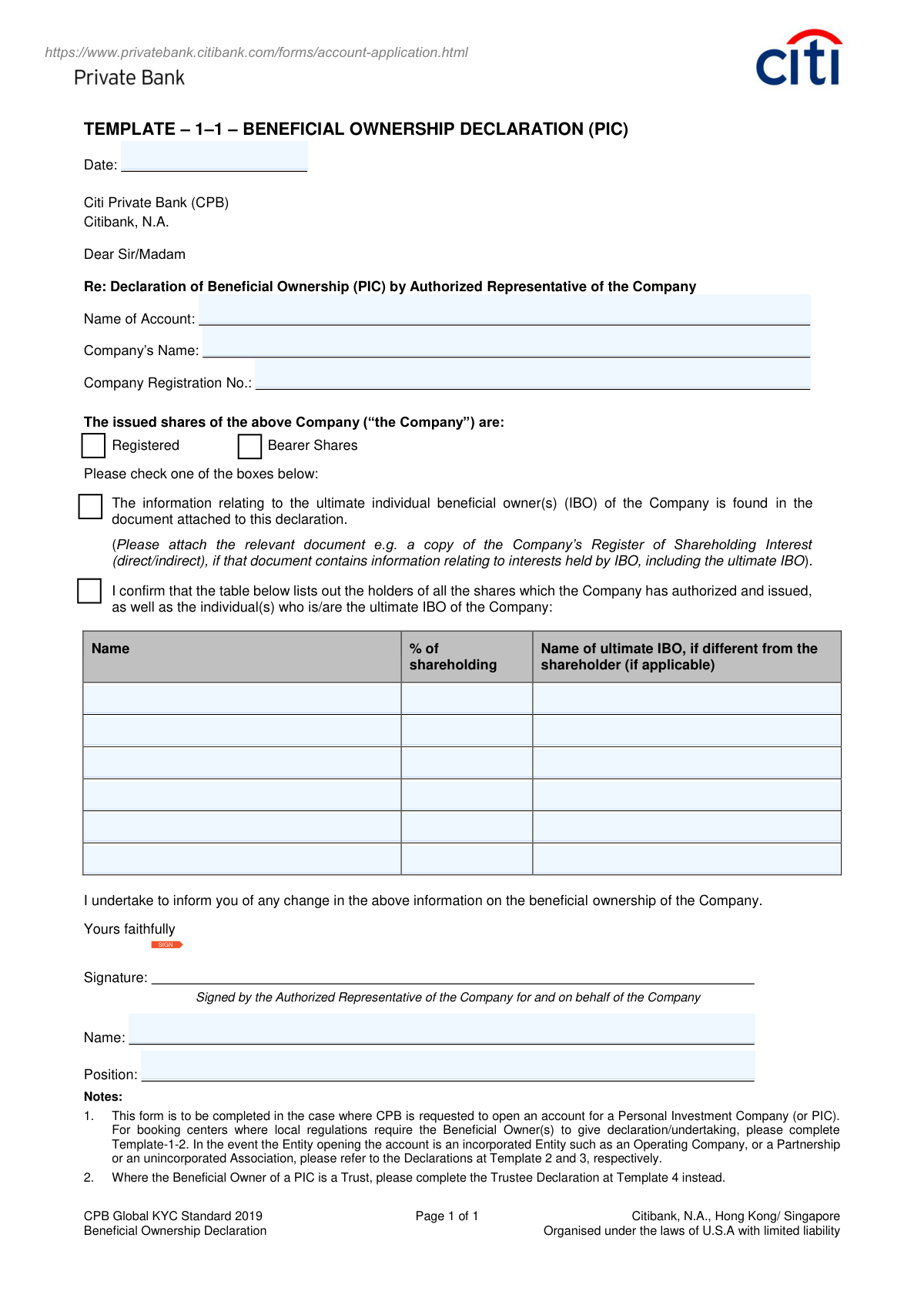
About ownership declaration forms
These forms are typically required by business owners, investors, and legal representatives during the onboarding process for corporate accounts or investment vehicles. For instance, when establishing a Personal Investment Company (PIC) or a trust, private banks require formal declarations to verify the identities of the ultimate individuals behind the entity. Whether you are managing a single-owner business or a complex international structure, providing accurate ownership information is a mandatory step in securing banking services and maintaining legal compliance.
Manually completing these detailed documents can be a tedious and error-prone process. Tools like Instafill.ai use AI to fill these ownership declaration forms in under 30 seconds, handling the data accurately and securely to ensure your submissions are professional and compliant. This streamlined approach saves valuable time, allowing you to focus on managing your investments while the AI handles the administrative heavy lifting.
Every form on this page can be completed without typing. Instafill is form filling software that reads a PDF and fills it for you — including flat and scanned documents that carry no fillable fields at all.
Forms in This Category
The forms in this category have a median Form Complexity Index of 34/100 (Basic), measured across 1 forms by field count, input difficulty, length, conditional logic and structure. See how it is calculated.
| Form Name | Pages | FCI | |
|---|---|---|---|
| 1. | Template 1-1, Beneficial Ownership Declaration (PIC) | 1 | Basic 34 |
- Enterprise-grade security & data encryption
- 99%+ accuracy powered by AI
- 1,000+ forms from all industries
- Complete forms in under 60 seconds
How to Choose the Right Form
Selecting the correct ownership declaration form is a critical step in meeting anti-money laundering (AML) and "Know Your Customer" (KYC) requirements. While these forms all share the goal of identifying who ultimately controls an entity, the specific version you need depends entirely on the financial institution and the type of legal structure involved.
Identifying the Correct Entity Type
The primary form in this category is intended for a very specific corporate structure and banking relationship:
- Template 1-1, Beneficial Ownership Declaration (PIC): This form is specifically designed for Personal Investment Companies (PICs). If your entity is a standard operating corporation, a non-profit, or a trust not classified as a PIC, you should verify with your compliance officer if this template is appropriate for your needs.
Banking and Compliance Requirements
Ownership declarations are usually mandated by the specific bank where you are opening or maintaining an account.
- Citibank Private Bank Users: If you are currently in the process of onboarding or updating records with Citibank Private Bank, Template 1-1 is the standard requirement for documenting individual beneficial owners (IBOs).
- Regulatory Standards: Use this form to ensure you are meeting the latest financial regulatory standards. It is designed to capture the details of individuals who own or control a significant percentage of the company or those who exercise ultimate effective control over the PIC.
How to Complete Your Declaration
If you have been provided a non-fillable or static version of the Template 1-1, Beneficial Ownership Declaration (PIC), you can use Instafill.ai to streamline the process. Our AI-powered tools can convert the document into an interactive format, allowing you to accurately input the necessary personal details of all beneficial owners. This ensures that your submission is legible, professional, and compliant with the bank's strict documentation standards.
Form Comparison
| Form | Purpose | Target Entity | Primary Use Case |
|---|---|---|---|
| Template 1-1, Beneficial Ownership Declaration (PIC) | Identifies ultimate individual beneficial owners for AML and regulatory compliance. | Personal Investment Companies (PICs) opening private banking accounts. | Required for account opening procedures with Citibank Private Bank. |
Tips for ownership declaration forms
Ensure that names, birth dates, and addresses exactly match the government-issued IDs provided with the declaration. Discrepancies between the form and your supporting documents can lead to significant delays in account approval or compliance reviews.
Most financial institutions require any individual owning 25% or more of the entity to be disclosed, but some jurisdictions or banks have lower thresholds. Carefully review the specific instructions for your Personal Investment Company (PIC) to ensure every qualifying individual is documented.
Before starting the form, have your company's articles of incorporation and a current share registry on hand. Having these details ready allows you to accurately trace the path from the entity back to the ultimate individual beneficial owners without searching for records mid-process.
AI-powered tools like Instafill.ai can complete ownership declaration forms in under 30 seconds with high accuracy. This is a significant time-saver for complex filings, and the data stays secure during the process, making it ideal for handling sensitive financial documentation.
If your PIC is owned by another company or a trust, clearly outline each layer of ownership until the individual human owners are identified. Failing to provide a clear chain of command is a common reason forms are returned for further clarification.
Ensure the information provided in the ownership declaration aligns perfectly with other account opening documents, such as the board resolution or the authorized signatory list. Banks use cross-referencing to verify the legitimacy of the declaration, and mismatches can trigger additional scrutiny.
Frequently Asked Questions
These forms are used by financial institutions to identify the actual individuals who own or control a legal entity, such as a Personal Investment Company. This process helps banks comply with Anti-Money Laundering (AML) and Know Your Customer (KYC) regulations by ensuring they know exactly who they are doing business with.
A beneficial owner is typically any individual who ultimately owns or controls the company, either through direct or indirect ownership of shares or voting rights. For Citibank Private Bank accounts, all ultimate individual beneficial owners must be documented to satisfy regulatory requirements.
You will generally need to provide this declaration when opening a new account for a corporate entity or investment company. Additionally, you may be asked to submit a fresh form if there are changes to the company's ownership structure or during a periodic compliance review by the bank.
Yes, AI tools like Instafill.ai can fill out these forms in under 30 seconds by accurately extracting data from your source documents and mapping it to the required fields. This technology ensures that complex information, such as addresses and identification numbers, is entered without manual typing errors.
In addition to the form, you will usually need to provide valid identification for each beneficial owner, such as a passport or national ID card. Some institutions may also require proof of address or corporate documents that verify the ownership structure of the entity.
Completing these forms manually can be time-consuming due to the level of detail required for each owner, but using AI-powered services can reduce the process to less than a minute. These services can also convert non-fillable PDF templates into interactive forms, making the digital completion process much smoother.
Citibank uses Template 1-1 to ensure they capture all the specific data points required by their internal compliance policies and international banking laws. Using the standardized template helps the bank process your account application more efficiently and reduces the risk of missing critical information.
Providing inaccurate or incomplete information can lead to significant delays in account opening or the eventual freezing of existing accounts. It is critical to ensure that all names, addresses, and ownership percentages match your official corporate records and identification documents.
Once the form is filled and signed, it should be submitted directly to your bank representative or uploaded through the bank's secure digital portal. Because these forms contain sensitive personal and financial data, you should always use secure transmission methods rather than standard email.
While these forms focus on beneficial owners rather than directors, any change in control or ownership usually triggers the need for an update. If a director also holds an ownership stake that changes, or if the bank's policy requires disclosure of controlling persons, a new form will likely be necessary.
Glossary
- Form Complexity Index
- Instafill’s 0–100 measure of how much effort a form takes to complete, calculated deterministically from the form’s own structure rather than estimated. It combines the number of fillable fields (the largest factor), how difficult those fields are to complete based on their type, the number of pages that contain fields, the amount of conditional “fill-only-if” logic, and how many sections the form is divided into, then adds modifiers for tables and repeating lists, bundled instruction pages, and dense page layouts. A higher score means the form is harder to fill out by hand. The forms in this category have a median Form Complexity Index of 34/100 (Basic). See exactly how it is calculated.
- Beneficial Owner
- The individual who ultimately owns or controls an entity, or the person on whose behalf a transaction is being conducted, even if the legal title is held by someone else.
- Personal Investment Company (PIC)
- A private corporation or legal entity established specifically to hold and manage the personal investments and assets of an individual or a family.
- Individual Beneficial Owner (IBO)
- A natural person who exercises effective control over a company or receives the primary economic benefits of its assets and income.
- Ultimate Beneficial Owner (UBO)
- The person at the very top of an ownership chain who maintains a significant percentage of ownership or voting rights, usually 25% or more.
- Anti-Money Laundering (AML)
- A framework of laws and regulations requiring financial institutions to verify customer identities to prevent the disguising of illegally obtained funds.
- Know Your Customer (KYC)
- A mandatory process for financial institutions to verify the identity, suitability, and risks involved with maintaining a business relationship with a client.
- Controlling Person
- An individual who has the power to influence or direct the management and policies of a company through ownership, contract, or position.
- Nominee Shareholder
- A person or entity that appears on the public record as the holder of shares, but is actually holding them on behalf of the true owner.