Fill out private equity investment forms
with AI.
Private equity investment forms are specialized documents used to authorize and direct capital into private companies, venture funds, or alternative assets. Unlike public market trades, these transactions require rigorous documentation to ensure legal compliance, proper asset titling, and clear authorization between the investor and the custodian. These forms are critical because they serve as the official paper trail for high-stakes capital movements, often involving self-directed IRAs or trust accounts where regulatory oversight is stringent. They ensure that all parties agree on the terms of the investment and that the custodian has the necessary legal protection to move funds.
By continuing, you acknowledge Instafill's Privacy Policy and agree to get occasional product update and promotional emails.
About private equity investment forms
These documents are typically used by sophisticated individual investors, institutional fund managers, and account holders of self-directed retirement plans. You will encounter these forms when initiating a new capital call, making a follow-on investment, or directing a custodian to execute a Buy Direction Letter. Because these investments are often time-sensitive and involve complex entity structures, accuracy in detailing ownership information and funding methods is paramount to avoid delays in closing a deal. Notable examples include the IRA-5054 Authorization or the Private Equity Buy Direction Letter, both of which require precise data to satisfy compliance requirements.
Completing these multi-page documents manually can be a significant bottleneck in the investment process, especially when dealing with non-interactive PDFs. Tools like Instafill.ai use AI to fill these forms in under 30 seconds, ensuring that data is handled accurately and securely while saving significant administrative time. By automating the data entry for authorizations like Form AOB-03, investors can focus on their portfolio strategy rather than repetitive paperwork.
Every form on this page can be completed without typing. Instafill is form filling software that reads a PDF and fills it for you — including flat and scanned documents that carry no fillable fields at all.
Forms in This Category
The forms in this category have a median Form Complexity Index of 43/100 (Basic), measured across 3 forms by field count, input difficulty, length, conditional logic and structure. See how it is calculated.
| Form Name | Pages | FCI | |
|---|---|---|---|
| 1. | Form AOB-03, Private Equity Investment Authorization | 1 | – |
| 2. | IRA-5054 Private Equity Investment Authorization | 1 | – |
| 3. | The Entrust Group - Private Equity Buy Direction Letter | 1 | Basic 43 |
- Enterprise-grade security & data encryption
- 99%+ accuracy powered by AI
- 1,000+ forms from all industries
- Complete forms in under 60 seconds
How to Choose the Right Form
Selecting the correct private equity investment form is primarily determined by where your funds are held and which custodian is facilitating the transaction. Because private equity involves complex asset titling and regulatory compliance, each trust company requires its own proprietary documentation to authorize the movement of funds.
By Custodian and Account Type
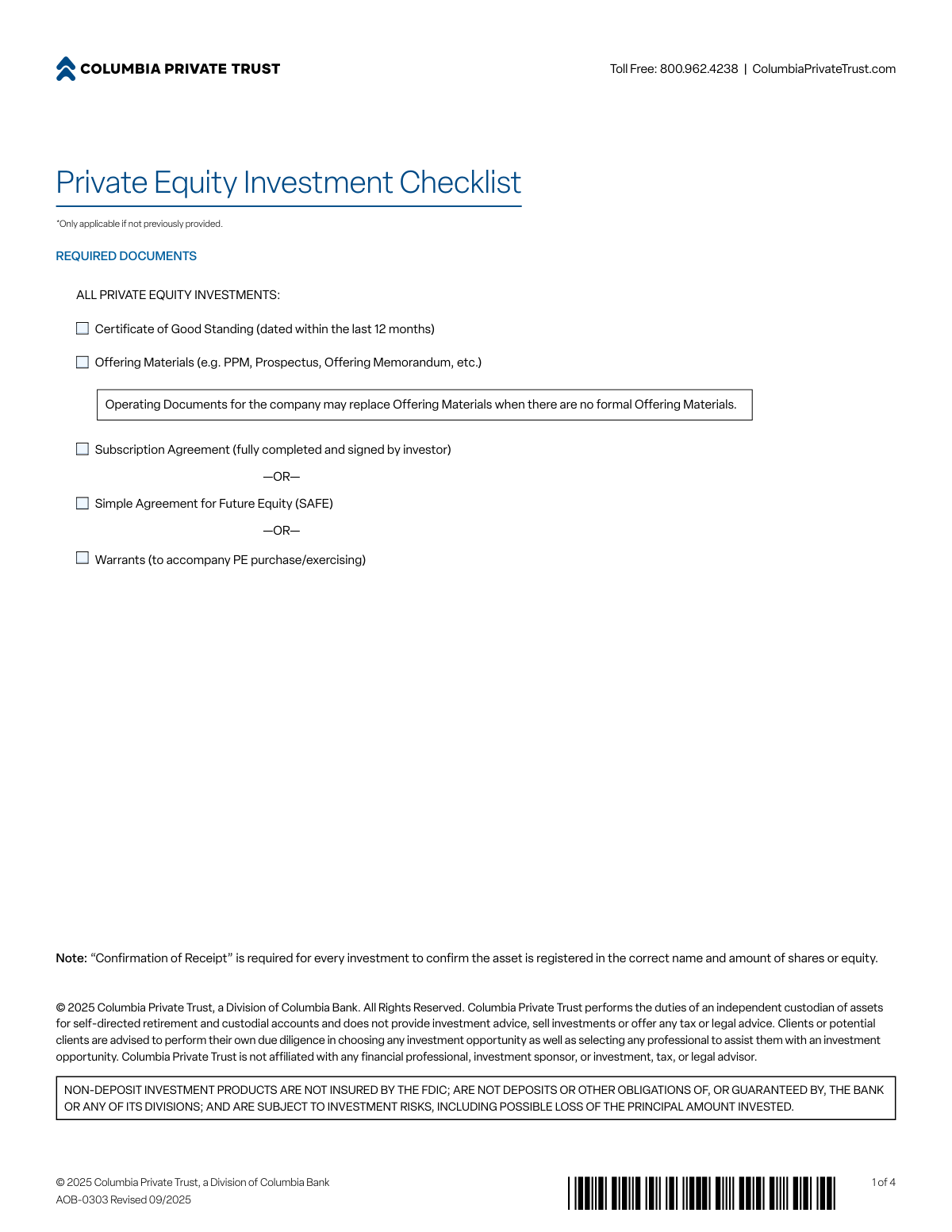
- Columbia Private Trust Accounts: If you are an account holder with Columbia Private Trust, you should select Form AOB-03, Private Equity Investment Authorization. This form is the standard document for account holders to provide formal instructions to the custodian, covering essential funding methods and specific investment details for non-deposit products.
- Pacific Premier Trust (Self-Directed IRAs): For investors managing a self-directed IRA through Pacific Premier Trust, the IRA-5054 Private Equity Investment Authorization is the required document. It is specifically tailored to satisfy retirement account regulations and ensures the purchase is executed correctly within the tax-advantaged shell of an IRA.
- The Entrust Group: If your retirement funds are held with The Entrust Group, you will need The Entrust Group - Private Equity Buy Direction Letter. This is the necessary paperwork to ensure the investment is properly titled in the name of your specific retirement account.
By Investment Action
- Initiating New Purchases: All three forms—Form AOB-03, IRA-5054, and the Private Equity Buy Direction Letter—are designed to authorize a brand-new purchase of private equity shares or interests.
- Adding Capital or Exchanging Assets: If you are not making a new purchase but rather adding funds to an existing investment or exchanging assets within your portfolio, The Entrust Group - Private Equity Buy Direction Letter is the most versatile option for these specific administrative actions.
Using Instafill.ai to complete these forms helps ensure that critical details like account numbers and funding instructions are accurate, reducing the risk of your investment being delayed by the custodian due to clerical errors.
Form Comparison
| Form | Custodian | Primary Purpose | Account Type |
|---|---|---|---|
| Form AOB-03, Private Equity Investment Authorization | Columbia Private Trust | Authorizes the custodian to execute specific private equity investments and funding instructions. | Columbia Private Trust investment accounts |
| IRA-5054 Private Equity Investment Authorization | Pacific Premier Trust | Formally directs the purchase of private equity assets and acknowledges investment risks. | Self-directed IRAs held at Pacific Premier Trust |
| The Entrust Group - Private Equity Buy Direction Letter | The Entrust Group | Directs new purchases, additional funding, or asset exchanges for private equity holdings. | Self-directed retirement accounts and IRAs |
Tips for private equity investment forms
When investing through a self-directed IRA, the investment must be titled in the name of the custodian for the benefit of your account. Incorrect titling is a frequent cause of form rejection and can lead to unintended tax consequences or reporting errors.
Before submitting your authorization letter, double-check the wire instructions and total investment amount with the private equity firm. Any discrepancy between your direction letter and the sponsor’s records will likely stall the funding process.
Private equity deals often have strict capital call deadlines. Submit your forms well in advance of the closing date to allow the custodian sufficient time to review the documents, perform due diligence, and execute the transfer of funds.
Most custodians require a copy of the fully executed subscription agreement or operating agreement to accompany your buy direction. Ensure these documents are finalized and ready to be uploaded to avoid back-and-forth communication that delays your investment.
Managing multiple investment directives can be time-consuming, but AI-powered tools like Instafill.ai can complete these forms in under 30 seconds with high accuracy. Your sensitive financial data stays secure during the process, providing a fast and reliable way to handle complex private equity documentation.
Clearly indicate on the form whether transaction and processing fees should be deducted from your account cash balance or billed separately. Leaving this section blank can lead to unexpected account deficits or delays in the execution of your investment.
Frequently Asked Questions
These forms are legal authorizations used by account holders to instruct their custodian or trust company to invest funds into private equity assets. They ensure that the transaction is properly documented for tax purposes and that the asset is correctly titled in the name of the retirement or trust account.
Individuals who maintain self-directed IRAs or specialized trust accounts need these forms when they want to invest in non-traditional assets like private companies or venture capital. The specific form you need depends on the institution holding your account, such as Columbia Private Trust, Pacific Premier Trust, or The Entrust Group.
The choice of form is dictated by your custodian; for instance, account holders at Pacific Premier Trust use the IRA-5054, while those at Columbia Private Trust use the AOB-03. You should select the form that corresponds exactly to the financial institution where your investment funds are currently held.
Yes, AI tools like Instafill.ai can fill these forms by accurately extracting data from your source documents and placing it into the correct fields. This technology can also convert standard PDF versions into interactive, fillable forms to streamline the completion process.
Using AI-powered services like Instafill.ai, these private equity forms can be completed in under 30 seconds. The AI handles the data entry automatically, ensuring high accuracy while significantly reducing the manual effort required for complex financial paperwork.
A Buy Direction Letter is a formal instruction to your custodian to release funds, whereas a Subscription Agreement is the legal contract between you and the private equity firm. You generally need to submit the Buy Direction Letter to your custodian along with a copy of the signed Subscription Agreement to finalize the investment.
Most forms require your account details, the name of the private equity entity, the specific dollar amount of the investment, and instructions for how the funds should be wired. You will also be asked to acknowledge the risks associated with non-deposit investment products that are not FDIC-insured.
After completion, the form must be submitted to your specific custodian or trust company for processing. Most institutions allow for digital submission through a secure portal or email, though some may require original signatures via physical mail for certain types of transactions.
Yes, a new authorization form is typically required for every new purchase or additional capital contribution made within a self-directed account. This ensures that the custodian has a clear paper trail for every movement of cash out of the account into a private asset.
No, these forms are administrative directives and do not imply that the custodian has performed due diligence on the investment's merits. The forms include legal disclosures stating that the account owner assumes all risks associated with the private equity investment.
It is best to submit these forms at least several business days before the investment's funding deadline. Custodians require time to review the documents for accuracy and to coordinate the transfer of funds to the private equity issuer.
Certain forms, such as the Private Equity Buy Direction Letter, can be used to add funds to an existing investment or to exchange assets within your account. You should check the specific instructions on the form to see if it covers 'additional' or 'follow-on' investments.
Glossary
- Form Complexity Index
- Instafill’s 0–100 measure of how much effort a form takes to complete, calculated deterministically from the form’s own structure rather than estimated. It combines the number of fillable fields (the largest factor), how difficult those fields are to complete based on their type, the number of pages that contain fields, the amount of conditional “fill-only-if” logic, and how many sections the form is divided into, then adds modifiers for tables and repeating lists, bundled instruction pages, and dense page layouts. A higher score means the form is harder to fill out by hand. The forms in this category have a median Form Complexity Index of 43/100 (Basic). See exactly how it is calculated.
- Self-Directed IRA (SDIRA)
- A type of individual retirement account that allows the owner to invest in alternative assets, such as private equity and real estate, which are typically not available in traditional IRAs.
- Custodian
- A financial institution, such as a trust company or bank, that holds an account's assets and performs the administrative tasks required to maintain the account's tax-advantaged status.
- Buy Direction Letter
- A formal written instruction from an account owner to their custodian, authorizing the purchase of a specific asset using funds held within the retirement account.
- Accredited Investor
- An individual or entity that meets specific financial criteria, such as high net worth or income, allowing them to participate in private investment opportunities not available to the general public.
- Asset Titling
- The specific legal format used to name an investment, ensuring that the asset is owned by the retirement account (e.g., 'The Entrust Group FBO John Doe IRA') rather than the individual.
- Subscription Agreement
- A legal contract between an investor and a private equity fund that outlines the terms of the investment and the number of shares or interest being purchased.
- Capital Call
- A request from a private equity fund manager for investors to provide the capital they previously committed to the fund when a new investment opportunity arises.
- Private Equity (PE)
- An alternative investment class consisting of capital that is invested directly into private companies that are not listed on a public stock exchange.