Fill out securities account forms
with AI.
Securities account forms are the essential paperwork required to establish and maintain brokerage and investment accounts. These documents serve as the formal agreement between an investor—whether an individual or a legal entity—and a financial institution. They are critical for ensuring compliance with regulatory requirements, establishing tax status, and defining the scope of investment activities. Whether you are setting up a new retirement fund or consolidating assets from various sources, these forms capture the vital data needed to protect both the investor and the firm.
By continuing, you acknowledge Instafill's Privacy Policy and agree to get occasional product update and promotional emails.
About securities account forms
This category typically includes documents such as entity account applications for corporations or LLCs, account transfer requests for moving assets between institutions, and detailed investor profiles used to determine risk tolerance. Business owners, financial advisors, and individual investors frequently encounter these forms when managing portfolios or transitioning between service providers. Because these forms often require precise financial details and personal identification, accuracy is paramount to avoid processing delays or compliance issues.
Navigating the complexity of these documents can be time-consuming, but modern tools like Instafill.ai use AI to fill these forms in under 30 seconds while maintaining high standards of data accuracy and security. By automating the data entry process, investors can focus on their portfolio strategy rather than the administrative burden of manual paperwork.
Every form on this page can be completed without typing. Instafill is form filling software that reads a PDF and fills it for you — including flat and scanned documents that carry no fillable fields at all.
Forms in This Category
The forms in this category have a median Form Complexity Index of 64/100 (Complex), measured across 3 forms by field count, input difficulty, length, conditional logic and structure. See how it is calculated.
- Enterprise-grade security & data encryption
- 99%+ accuracy powered by AI
- 1,000+ forms from all industries
- Complete forms in under 60 seconds
How to Choose the Right Form
Navigating securities account forms depends primarily on whether you are opening a new account for yourself or a business, or if you are moving existing assets between financial institutions. Use the following breakdown to identify the correct document for your financial goals.
Opening a New Investment Account
If you are establishing a fresh brokerage presence, your choice depends on the legal nature of the account owner:
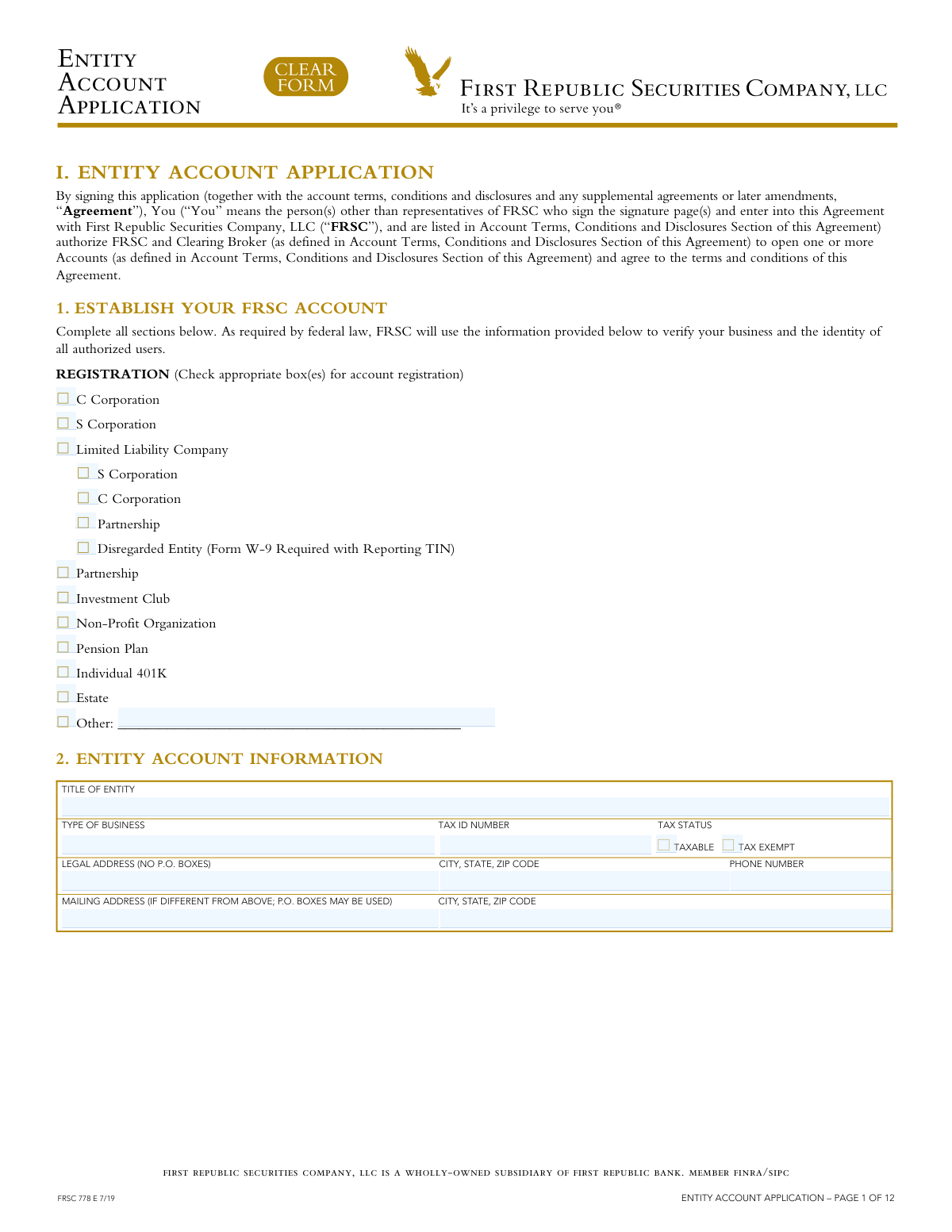
- For Corporations and LLCs: If you are acting on behalf of a legal entity such as a partnership, corporation, or limited liability company, use the First Republic Securities Company, LLC Entity Account Application (FRSC 778 E 7/19). This form is specifically designed to collect tax status and authorized signer details for non-individual accounts.
- For Personal Retirement: If you are an individual looking to set up a Traditional, Roth, or SEP IRA, choose the New York Life Investments Funds Individual Retirement Account Application and NYLIFE Securities LLC Investor Profile. This is a comprehensive package that not only opens the account but also establishes your investor profile to ensure your fund selections align with your risk tolerance.
Moving Existing Assets
If you already have a portfolio established at another brokerage and wish to consolidate your holdings, you will need a transfer-specific document:
- Consolidating Portfolios: To move cash, stocks, or mutual funds from an outside firm into a J.P. Morgan account, use the J.P. Morgan Securities LLC Account Transfer Request. This form serves as the formal authorization for the "ACATS" or manual transfer process, ensuring your assets are moved securely without needing to liquidate your positions.
Quick Selection Summary
- Business/Entity Account: Use First Republic FRSC 778 E.
- Personal IRA/Retirement: Use New York Life MSIRA03NYL.
- Transferring Assets: Use J.P. Morgan Account Transfer Request.
Form Comparison
| Form | Primary Purpose | Target User | Key Information Collected |
|---|---|---|---|
| First Republic Securities Company, LLC Entity Account Application (FRSC 778 E 7/19) | Opening a new brokerage account for a legal entity. | Corporations, LLCs, partnerships, and other legal entities. | Tax status, entity structure, and personal details of all authorized signers. |
| J.P. Morgan Securities LLC Account Transfer Request | Transferring assets from an external institution to J.P. Morgan. | Existing or new account holders consolidating their investment portfolios. | External account details and specific lists of securities or cash to transfer. |
| New York Life Investments Funds Individual Retirement Account Application and NYLIFE Securities LLC Investor Profile | Establishing a new IRA and assessing investor risk tolerance. | Individuals opening Traditional, Roth, or SEP retirement accounts. | Financial objectives, risk profile, and specific fund selections for investment. |
Tips for securities account forms
When filling out entity account applications, ensure you have your Articles of Incorporation, Operating Agreements, and Tax ID (EIN) ready. These forms require specific legal details about your business structure and authorized signers that are essential for compliance.
To avoid delays when transferring assets between institutions, ensure the account title and type on the transfer request perfectly match the source account. Discrepancies in names or tax IDs are the most common reasons for a firm to reject a transfer request.
Be meticulous when completing sections regarding risk tolerance, liquid net worth, and investment time horizons. These details are used by securities firms to ensure that the account type and selected funds are suitable for your specific financial situation.
Securities forms often require Social Security numbers and residential addresses for all individuals with control over the account. Double-check this sensitive information for accuracy to prevent identity verification flags during the account opening process.
AI-powered tools like Instafill.ai can complete these complex securities forms in under 30 seconds with high accuracy. Your sensitive data stays secure during the process, providing a practical and efficient solution for those managing multiple account setups or transfers.
Whether you are funding a new IRA or setting up recurring transfers, incorrect banking information can lead to failed transactions or lost funds. Always verify your routing and account numbers against an official bank statement before finalizing the form.
When a form package includes both an application and an investor profile, ensure the data provided is consistent across both documents. Inconsistencies in reported income or investment objectives can lead to processing delays and additional manual reviews.
Frequently Asked Questions
Securities account forms are official documents used to establish, manage, or transfer investment accounts with financial institutions. They are designed to collect necessary personal, financial, and tax information to ensure the brokerage complies with federal regulations and 'Know Your Customer' (KYC) requirements.
These forms are required for any individual, business entity, or trust that wishes to trade stocks, bonds, or mutual funds through a brokerage. Depending on the account type, the forms may need to be completed by the individual account holder, all joint owners, or authorized signers for a corporation or LLC.
You should use an entity account application if the securities account will be owned by a legal organization such as a corporation, partnership, or limited liability company. If the account is for personal use or a joint account with another person, you will typically use a standard individual or joint account application.
When moving assets between brokerages, you will need to provide the account number of the delivering firm, the specific assets being moved, and the account type. A transfer request form authorizes the receiving firm to coordinate with your current custodian to move cash or securities without liquidating them.
Financial institutions use Investor Profile forms to assess your risk tolerance, investment experience, and financial goals. This information is legally required to help the firm ensure that any investment products or strategies recommended to you are suitable for your specific financial situation.
Yes, AI tools like Instafill.ai can be used to fill out complex securities forms in under 30 seconds. These tools accurately extract data from your source documents and place it into the appropriate fields, significantly reducing the manual effort required for multi-page applications.
Manually completing detailed financial forms can take 15 to 30 minutes, but using an AI-powered service can complete the process almost instantly. By automating the data entry, you can ensure high accuracy and have the document ready for review and signature in a fraction of the time.
It is helpful to have your government-issued ID, Social Security Number or Taxpayer Identification Number, and employment information on hand. If you are opening an account for a business, you may also need your articles of incorporation or other organizational documents to verify authorized signers.
Completed forms are usually submitted directly to the brokerage or financial institution via their secure online portal, by mail to their processing center, or through your designated financial advisor. Always check the specific instructions provided by the firm, as some may require original 'wet' signatures for certain account types.
While most securities forms collect similar information to comply with industry-wide regulations, each financial institution has its own proprietary documents. It is important to use the specific form provided by the firm where you are opening the account to ensure your application is processed correctly.
Glossary
- Form Complexity Index
- Instafill’s 0–100 measure of how much effort a form takes to complete, calculated deterministically from the form’s own structure rather than estimated. It combines the number of fillable fields (the largest factor), how difficult those fields are to complete based on their type, the number of pages that contain fields, the amount of conditional “fill-only-if” logic, and how many sections the form is divided into, then adds modifiers for tables and repeating lists, bundled instruction pages, and dense page layouts. A higher score means the form is harder to fill out by hand. The forms in this category have a median Form Complexity Index of 64/100 (Complex). See exactly how it is calculated.
- Securities
- Financial instruments such as stocks, bonds, or mutual funds that represent an ownership position or a creditor relationship with a corporation or government entity.
- Authorized Signer
- An individual designated by a legal entity (such as a corporation or LLC) who has the legal power to manage the account and execute transactions on its behalf.
- ACATS
- Stands for Automated Customer Account Transfer Service, a standardized system used to transfer assets from one brokerage firm or financial institution to another.
- Investor Profile
- A collection of data regarding a person's financial situation, goals, and risk tolerance used to determine if specific investment strategies are suitable.
- IRA
- Short for Individual Retirement Account, a tax-advantaged savings plan that allows individuals to set aside money for retirement, including Traditional, Roth, and SEP versions.
- Broker-Dealer
- A person or firm in the business of buying and selling securities for its own account or on behalf of its customers, such as JPMS or NYLIFE Securities.
- TIN / EIN
- Taxpayer Identification Number or Employer Identification Number; a unique nine-digit number used by the IRS to identify individuals or business entities for tax reporting purposes.
- Risk Tolerance
- The degree of variability in investment returns that an individual is willing or able to withstand in their financial portfolio.