Fill out trading account forms
with AI.
Opening a brokerage account requires a specific set of trading account forms designed to satisfy both legal requirements and internal risk management policies. These documents serve as the foundation of the relationship between an investor and a financial institution, ensuring that the firm adheres to essential regulatory standards like 'Know Your Customer' (KYC) and the USA PATRIOT Act. By collecting information on financial status, risk tolerance, and investment objectives, these forms help brokerages provide appropriate services while maintaining market integrity.
By continuing, you acknowledge Instafill's Privacy Policy and agree to get occasional product update and promotional emails.
About trading account forms
Individual investors, corporate entities, and joint account holders typically encounter these forms when establishing new cash or margin accounts. Whether you are a first-time trader or an experienced professional moving assets to a new firm, documents such as the New Account Agreement are mandatory steps in the onboarding process. Because these forms require precise details regarding employment, tax identification, and prior investment experience, they can often be complex and time-consuming to complete by hand.
To streamline this administrative hurdle, tools like Instafill.ai use AI to fill these forms in under 30 seconds, handling your data accurately and securely. This technology eliminates the frustration of manual entry, allowing you to finalize your application quickly and move forward with your trading activities.
Every form on this page can be completed without typing. Instafill is form filling software that reads a PDF and fills it for you — including flat and scanned documents that carry no fillable fields at all.
Forms in This Category
The forms in this category have a median Form Complexity Index of 56/100 (Moderate), measured across 1 forms by field count, input difficulty, length, conditional logic and structure. See how it is calculated.
| Form Name | Pages | FCI | |
|---|---|---|---|
| 1. | New Account Agreement - Trading Direct | 1 | Moderate 56 |
- Enterprise-grade security & data encryption
- 99%+ accuracy powered by AI
- 1,000+ forms from all industries
- Complete forms in under 60 seconds
How to Choose the Right Form
Opening a Retail Trading Account
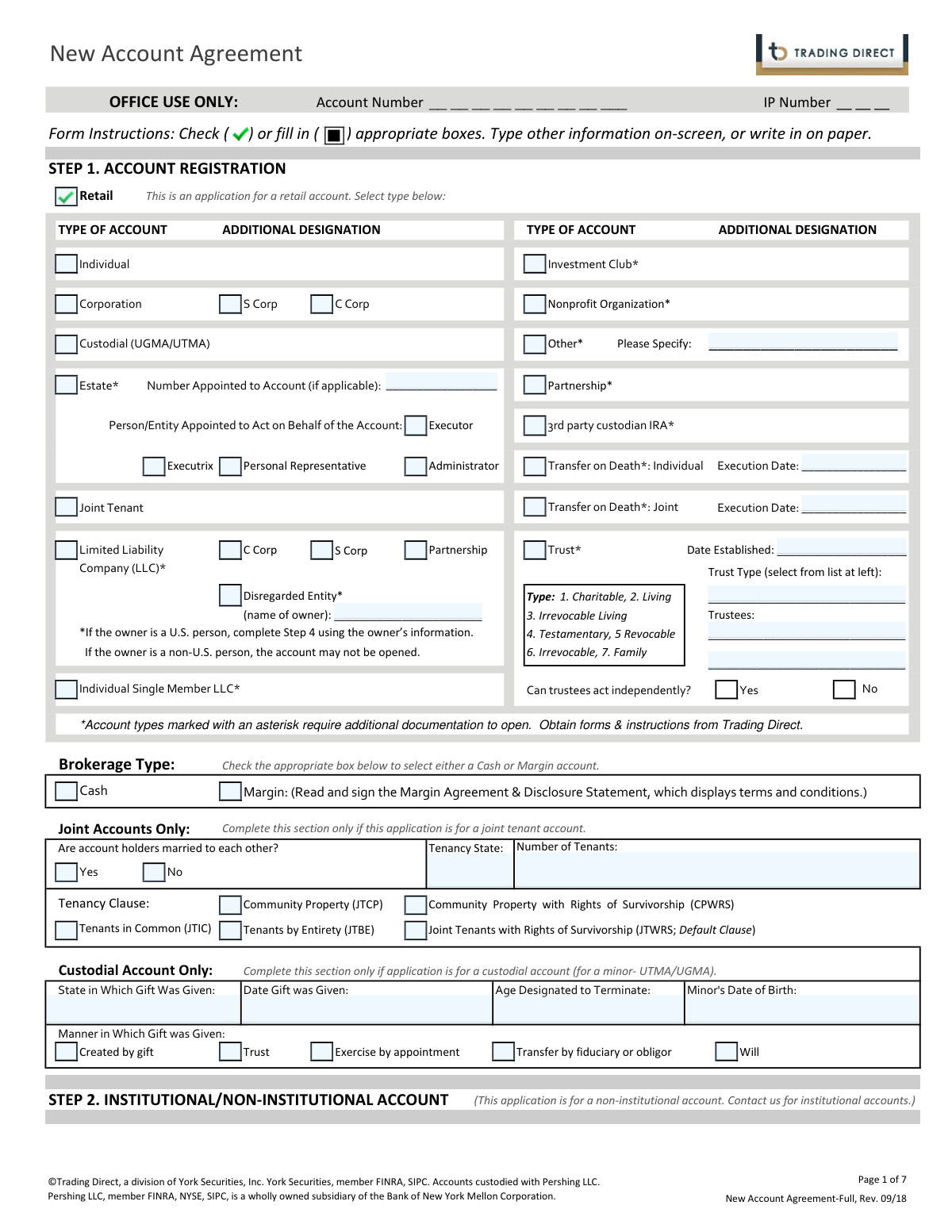
When you are ready to begin trading through a brokerage, the documentation required is designed to verify your identity and assess your financial profile. Currently, the primary document available in this category is the New Account Agreement - Trading Direct. This is the essential starting point for any individual looking to establish a retail trading relationship with York Securities, Inc.
Understanding the New Account Agreement - Trading Direct
This form is a comprehensive application that covers several regulatory and operational bases. You should choose this form if you need to:
- Establish a New Relationship: This is the foundational document for opening a retail account with the Trading Direct division.
- Select Account Type: Whether you are looking for a standard cash account or a margin trading account, this single agreement handles both requests.
- Provide Regulatory Disclosures: The form includes specific sections required under the USA PATRIOT Act to verify your identity and background.
- Outline Investment Experience: It features detailed fields for your financial status, net worth, and previous investment history, which are required for broker-dealer compliance.
Who Should Use This Form?
The New Account Agreement - Trading Direct is intended for retail investors. If you are an individual trader (rather than an institutional entity) looking to access the markets via Trading Direct, this is the correct document to download and complete.
Streamlining the Application Process
Filling out multi-step financial applications can be time-consuming and prone to errors. By using Instafill.ai, you can quickly navigate the New Account Agreement - Trading Direct. Our AI-powered tools help you accurately populate the personal and financial data fields, ensuring that your application is professional, legible, and ready for submission to York Securities, Inc. without the need for manual PDF editing or printing.
Form Comparison
| Form | Primary Purpose | Required Information | Account Types Supported |
|---|---|---|---|
| New Account Agreement - Trading Direct | Establish a retail brokerage account with Trading Direct and York Securities. | Personal details, financial status, investment experience, and regulatory disclosures. | Supports opening both standard cash accounts and margin trading accounts. |
Tips for trading account forms
Providing precise personal and financial data is essential for meeting federal Know Your Customer (KYC) regulations. Inaccurate information can lead to significant delays in account approval or complications when you attempt to withdraw funds later.
Carefully choose between a cash account and a margin account based on your intended trading strategy. Margin accounts involve borrowing funds and carry higher risks, so ensure you understand the specific terms and interest rates associated with the brokerage.
Before you begin, have your Social Security number, employment details, and a valid government-issued ID ready. Having these details on hand prevents the need to stop mid-form, ensuring a smoother and faster application process.
Brokerages use your reported experience to determine which trading levels or complex products you are qualified to use. Being truthful ensures you aren't approved for high-risk strategies that may not align with your actual financial knowledge or risk tolerance.
Many trading account forms include a section for Transfer on Death (TOD) or beneficiary designations. Completing this section now ensures your assets can be transferred directly to your heirs in the future without the lengthy delays of probate.
AI-powered tools like Instafill.ai can complete these complex trading forms in under 30 seconds with high accuracy. Your sensitive financial data stays secure during the process, making it an incredibly efficient way to handle multiple applications at once.
Frequently Asked Questions
Trading account forms are legal agreements used to establish a formal relationship between an investor and a brokerage firm. These documents collect necessary personal, financial, and regulatory information to ensure the firm meets legal requirements and understands the investor's financial goals.
Any individual or entity wishing to open a retail trading account for buying and selling securities must complete this agreement. This applies to private investors looking for standard cash accounts as well as those seeking margin trading privileges for more advanced strategies.
Applicants typically need to provide their full legal name, Social Security number or Taxpayer Identification Number, employment details, and annual income. These details are mandated by financial regulators to verify identity and assess the suitability of various investment products.
Brokerages are required to determine if specific types of trading, such as options or margin, are appropriate for the user based on their knowledge level. By disclosing your history with stocks, bonds, and other securities, the firm can comply with 'know your customer' (KYC) regulations and manage risk.
Yes, AI tools like Instafill.ai can be used to fill out trading account forms in under 30 seconds. The AI accurately extracts data from your existing source documents and places it into the correct fields, which helps reduce the risk of manual entry errors on sensitive financial paperwork.
While manual entry can take 15 to 20 minutes due to the complexity of financial disclosures, using an AI-powered service can complete the process in less than half a minute. This technology streamlines the application process by instantly populating repetitive fields and identifying required sections.
Federal law requires all financial institutions to obtain, verify, and record information that identifies each person who opens an account. This disclosure explains that the brokerage will use your provided identification data to help the government fight the funding of terrorism and money laundering activities.
Most standard trading account forms allow you to select whether you are applying for a basic cash account or a margin account. Choosing a margin account usually requires additional financial disclosures and signifies your agreement to the firm's specific lending terms and interest rates.
You may need to provide a copy of a government-issued ID, such as a driver's license or passport, to verify your identity to the compliance department. In some cases, the brokerage may also request proof of residency, such as a utility bill, or additional bank statements.
Once the form is filled out and signed, it is typically submitted directly to the brokerage firm's new accounts department. Many modern firms accept digital submissions through secure portals, though some may require a scanned version sent via email or a physical copy for certain account types.
While many forms are designed for individual retail investors, they often include sections for secondary applicants in the case of joint accounts. For corporate or institutional accounts, you may need to provide additional legal documentation, such as a corporate resolution, alongside the standard agreement.
Glossary
- Form Complexity Index
- Instafill’s 0–100 measure of how much effort a form takes to complete, calculated deterministically from the form’s own structure rather than estimated. It combines the number of fillable fields (the largest factor), how difficult those fields are to complete based on their type, the number of pages that contain fields, the amount of conditional “fill-only-if” logic, and how many sections the form is divided into, then adds modifiers for tables and repeating lists, bundled instruction pages, and dense page layouts. A higher score means the form is harder to fill out by hand. The forms in this category have a median Form Complexity Index of 56/100 (Moderate). See exactly how it is calculated.
- Margin Account
- A brokerage account that allows you to borrow money from the firm to purchase securities, using the stocks in your portfolio as collateral.
- Cash Account
- A standard trading account where you must pay the full amount for any securities purchased and are not permitted to borrow funds from the broker.
- USA PATRIOT Act Disclosure
- A mandatory section on financial forms used to verify your identity through your Social Security number and government ID to prevent money laundering.
- Investment Objective
- A category on the form where you indicate your primary financial goal, such as capital preservation, income, or aggressive growth.
- Liquid Net Worth
- The total value of your assets that can be quickly converted into cash, such as bank balances and stocks, excluding the value of your primary residence.
- FINRA (Financial Industry Regulatory Authority)
- The government-authorized organization that regulates brokerage firms and is frequently mentioned in the legal disclosures of account agreements.
- Suitability
- The regulatory requirement for brokers to ensure that the investment products and strategies they offer align with your financial status and risk tolerance.
- Trusted Contact Person
- An individual you authorize the brokerage to contact if they suspect financial exploitation or have concerns about your health and safety.