Fill out utility permit forms
with AI.
Utility permit forms are essential regulatory documents required by municipal and local government agencies to manage the impact of private operations on public infrastructure. These forms serve as a safeguard, ensuring that businesses and residents comply with environmental standards, safety protocols, and resource management guidelines. In this category, you will find documents such as wastewater discharge permits, which are critical for regulating how industrial waste enters public sewer systems to prevent contamination and infrastructure damage.
By continuing, you acknowledge Instafill's Privacy Policy and agree to get occasional product update and promotional emails.
About utility permit forms
These forms are typically handled by facility managers, environmental compliance officers, and business owners operating within the industrial or commercial sectors. Whether you are launching a new manufacturing plant or renewing an existing authorization, submitting accurate documentation is vital to avoid regulatory fines, legal complications, or operational delays. Because these applications often require precise technical data, the administrative burden of filing them can be significant for busy professionals.
Completing these complex documents manually is no longer the only option for staying compliant. Tools like Instafill.ai use AI to fill these forms in under 30 seconds, ensuring data is handled accurately and securely while saving significant manual effort. This allows teams to focus on their core operations while ensuring their utility and environmental documentation is filed correctly and on time.
Every form on this page can be completed without typing. Instafill is form filling software that reads a PDF and fills it for you — including flat and scanned documents that carry no fillable fields at all.
Forms in This Category
The forms in this category have a median Form Complexity Index of 70/100 (Complex), measured across 1 forms by field count, input difficulty, length, conditional logic and structure. See how it is calculated.
| Form Name | Pages | FCI | |
|---|---|---|---|
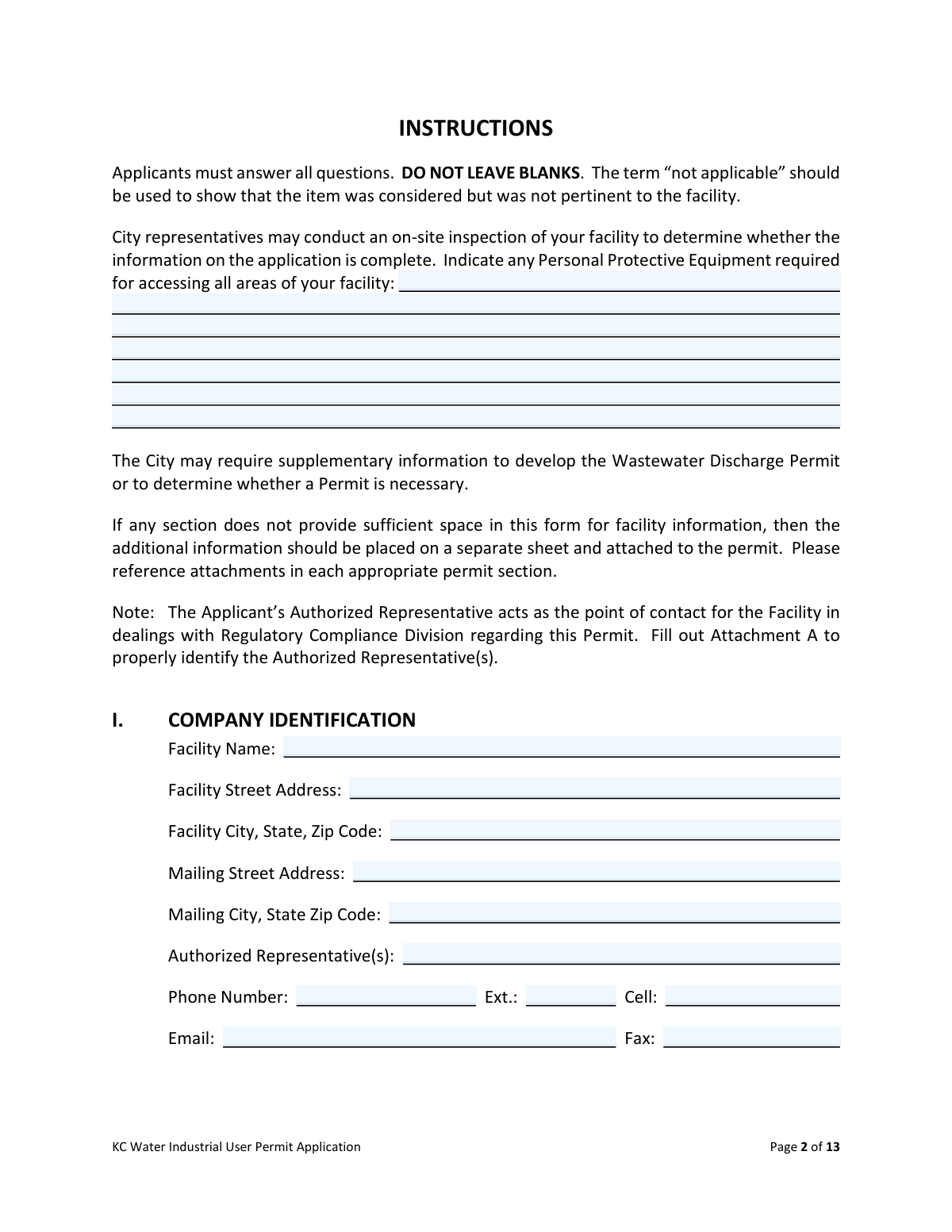
| 1. | KC Water Industrial User Wastewater Discharge Permit Application | 11 | Complex 70 |
- Enterprise-grade security & data encryption
- 99%+ accuracy powered by AI
- 1,000+ forms from all industries
- Complete forms in under 60 seconds
How to Choose the Right Form
Navigating utility permits can be complex, especially when dealing with environmental regulations and public infrastructure. In this category, we focus on specialized industrial discharge requirements within the Kansas City area to help your business stay compliant with local utility standards.
Determining if You Need the KC Water Permit
The KC Water Industrial User Wastewater Discharge Permit Application is the primary document required for businesses operating within Kansas City, Missouri, that produce industrial waste as a byproduct of their operations. You should select this form if your facility meets any of the following criteria:
- Industrial Discharge: Your facility discharges wastewater that is not strictly domestic (e.g., process water from manufacturing, cooling water, or pre-treated industrial effluent).
- Federal Standards: You operate a business that falls under specific federal categorical pretreatment standards.
- Significant Volume: Your business is classified as a Significant Industrial User (SIU) due to the volume or nature of the discharge into the public sewer system.
When to Submit This Application
Choosing the right time to file is just as important as choosing the form itself. You will typically need to complete the KC Water Industrial User Wastewater Discharge Permit Application in these specific scenarios:
- New Facility Setup: If you are opening a new industrial site that requires a connection to the public sewer system for the first time.
- Permit Renewal: Existing permits are not indefinite; you must re-apply before your current permit expires to ensure continuous legal operation.
- Process Changes: If your industrial processes change significantly, altering the volume or chemical composition of your wastewater, a new application or amendment is required to reflect these updates.
Why Accuracy Matters
Because these permits are regulated by both local and federal environmental standards, accuracy is paramount. Using Instafill.ai to complete your KC Water Industrial User Wastewater Discharge Permit Application ensures that all technical data—such as flow rates and pollutant concentrations—is clearly legible and correctly formatted. This reduces the risk of processing delays or regulatory scrutiny, allowing your business to maintain compliance while protecting the city's water treatment infrastructure.
Form Comparison
| Form | Purpose | Who Files It | Key Requirements | Geographic Scope |
|---|---|---|---|---|
| KC Water Industrial User Wastewater Discharge Permit Application | Request authorization to discharge industrial wastewater into the public sewer system. | Industrial facilities operating within Kansas City, Missouri municipal limits. | Detailed disclosure of wastewater characteristics, flow rates, and production processes. | Kansas City, Missouri municipal water and sewer service area. |
Tips for utility permit forms
AI-powered tools like Instafill.ai can complete these utility permit forms in under 30 seconds with high accuracy. The data stays secure during the process, providing a massive time-saver for businesses managing multiple industrial discharge or utility applications.
Utility permits are highly localized, so ensure you are using the form specific to your municipality or utility provider. Submitting a form intended for a neighboring district or a different water authority will lead to immediate rejection and project delays.
Industrial utility permits often require specific technical details such as average daily flow rates, chemical compositions, and production volumes. Having these metrics organized beforehand prevents the need to pause and restart your application mid-way.
Most utility permit applications require supplemental documents like plumbing layouts, site maps, or pretreatment system designs. Ensure these files are digitized and ready to upload as attachments to avoid a fragmented submission process.
For industrial wastewater and utility forms, providing accurate 24-hour contact information is often a mandatory safety requirement. Incomplete or outdated contact details are a common reason for permit processing holds or follow-up inquiries from regulators.
Ensure that all numerical data, such as gallons per day (GPD) or concentration levels, uses the specific units requested by the utility provider. Mixing different units of measurement can lead to calculation errors and potential regulatory non-compliance.
Frequently Asked Questions
Utility permit forms are official documents used to request permission from a local government or utility provider to access, connect to, or discharge into public utility infrastructure. These forms ensure that the proposed activity complies with local regulations, safety standards, and environmental protections.
Any industrial or commercial facility that intends to discharge non-domestic wastewater into the public sewer system typically needs this permit. This includes businesses that produce chemical runoff, process water, or other industrial byproducts that could affect the municipal water treatment infrastructure.
These permits are designed to protect the municipal wastewater treatment plant from damage caused by hazardous substances and to prevent pollutants from entering local waterways. By regulating what enters the sewer system, the city can ensure the environment remains safe and the treatment systems function efficiently.
Applicants usually need to provide details about their facility's operations, the volume of waste or usage expected, and specific characteristics of the materials being handled. Supporting documents like site maps, plumbing diagrams, and laboratory analysis of samples may also be required depending on the specific permit.
Completed forms are typically submitted to the local utility department or the city's environmental services division. Depending on the municipality, submission may be handled through an online portal, by mail, or in person at a city permit office.
Yes, modern AI tools like Instafill.ai allow users to fill out complex utility permit forms by automatically extracting data from source documents and placing it into the correct fields. This technology ensures high accuracy and reduces the risk of manual entry errors on technical applications.
Using AI-powered services like Instafill.ai, most utility permit forms can be completed in under 30 seconds. The system quickly processes your information and populates the PDF, allowing you to review and submit the document much faster than traditional manual typing.
The duration of a permit varies by jurisdiction and the type of utility, but many industrial discharge permits are valid for several years. It is important to check the specific expiration date on your issued permit to ensure you apply for a renewal before it lapses.
Most utility providers charge application fees to cover the costs of administrative review, site inspections, and technical evaluations. These fees vary significantly depending on the complexity of the permit and the size of the facility's operations.
Operating without a valid permit can result in significant fines, legal action, or the disconnection of utility services. Regular inspections are often conducted by city officials to ensure compliance with local ordinances and environmental laws.
Glossary
- Form Complexity Index
- Instafill’s 0–100 measure of how much effort a form takes to complete, calculated deterministically from the form’s own structure rather than estimated. It combines the number of fillable fields (the largest factor), how difficult those fields are to complete based on their type, the number of pages that contain fields, the amount of conditional “fill-only-if” logic, and how many sections the form is divided into, then adds modifiers for tables and repeating lists, bundled instruction pages, and dense page layouts. A higher score means the form is harder to fill out by hand. The forms in this category have a median Form Complexity Index of 70/100 (Complex). See exactly how it is calculated.
- POTW (Publicly Owned Treatment Works)
- A municipal utility system, such as KC Water, that collects and treats wastewater from homes and industrial facilities before releasing it back into the environment.
- Pretreatment
- The process of removing or reducing pollutants from industrial wastewater at the source before it is allowed to enter the public sewer system.
- Effluent
- The liquid waste or treated wastewater that flows out of a facility and into the public sewer system or a body of water.
- BOD (Biochemical Oxygen Demand)
- A measurement of the amount of dissolved oxygen needed by microorganisms to break down organic material in water; high levels indicate more concentrated waste.
- TSS (Total Suspended Solids)
- The measure of particles that are trapped by a filter, used to determine the concentration of solid materials present in a wastewater sample.
- Categorical Industrial User (CIU)
- A specific classification for industrial facilities that are subject to federal regulations and discharge limits based on their specific industry type.
- Slug Discharge
- Any sudden or accidental release of wastewater at a volume or concentration that could potentially damage the public sewer system or interfere with treatment processes.
- SIC or NAICS Code
- Standardized numerical codes used by the government and utilities to classify the primary business activities and industrial processes of a facility.